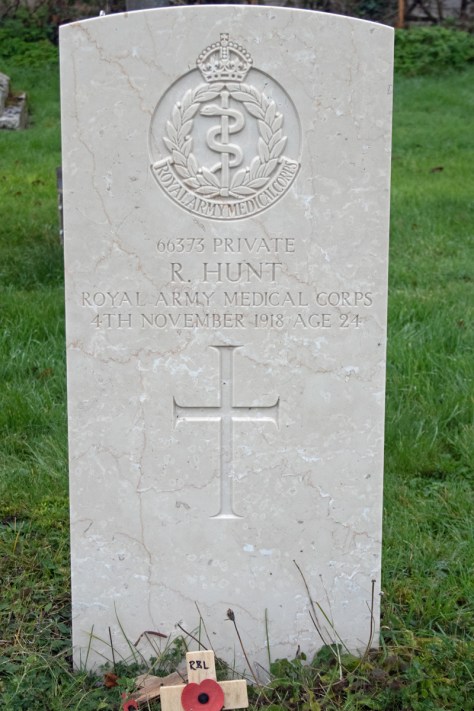
Robert Edward Nichols Hunt was born in Somerton, Somerset in 1894. One of five children to Charles and Rose Hunt, his father was a bootmaker.
By the 1911 census, however, things had taken a different turn; Charles and two of his sons were working for a brewer, Rose was working as a shop assistance in Boots, and the youngest of the family, Kate, was apprenticed to a dressmaker.
It was against this backdrop that war came, and, within a year, Robert had enlisted in the Royal Army Medical Corps. His sign-up documents confirm that he was short sighted, although this was corrected with glasses and he was deemed fit for active service.
Sent to the Western Front in October 1915, Private Hunt definitely found himself in the thick of the action.
In August 1916, he was supporting the fighting at High Wood on the Somme, when a gas shell exploded near him. He fell and, when he woke, he remembered little of what happened. Robert had inhaled a lot of gas, however, and was left coughing with difficulty breathing. He was transferred back to England by train and ship to recover, arriving back on the 2nd September.
There is no record of Robert having gone back to the front. The impact of the gas appears to have been severe and long-lasting. At the end of October 1918, he was admitted to the Becket House Auxiliary Hospital in St Albans with influenza and bronchial pneumonia. Sadly, this was to be a battle he would not recover from, and he passed away on 4th November 1918. He was 24 years old.
Robert Edward Nichols Hunt lies at rest in the cemetery of his home town, Somerton.
There are some times where no amount of research on a person will reveal their information.
William George Allen is one such person.
The only details I have been able to uncover for this man is his gravestone and the Army Register of Soldier’s Effects.
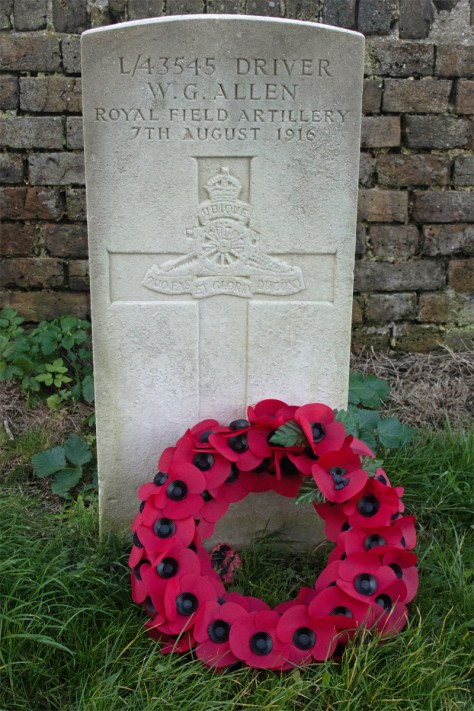
William Allen was a driver for the Royal Field Artillery. His troop – the 156th Camberwell Brigade – was raised in South London in early 1915, although I have no record of when Driver Allen enlisted.
At some point, the 156th Brigade were stationed at Port Victoria – the fort on the Isle of Grain in Kent.
It was during their time at the fort that William died. He passed on 7th August 1916 and there is no cause of death recorded, and he does not appear in any contemporary newspapers. This might suggest that his death was not out of the ordinary or unexpected.
Unusually for the Register of Soldier’s Effects, nobody is listed for the war gratuity payments to be made (this would normally be a next of kin – father, mother or spouse). In total a payment of £6 19s 2d was paid out, not an extravagant amount for that regiment.
So Driver Allen remains a mystery. A (presumably) young life lost too soon, and lost to time.
William George Allen lies at peace in the graveyard of St James’ Church in Grain, North Kent, metres from the fort in which he passed.
John Henry Armes was born in Cannock, Staffordshire in 1881. One of eight children to Richard and Mary Armes, his father was a colliery worker and labourer. After their mother’s untimely death in 1890, this was a trade into which his three boys – Richard Jr, John and Alfred – followed.
The 1901 census finds John living with his widowed father and working as a coal hewer. A year later, he married Caroline Caldwell and, by the outbreak of the war, the couple were living in Ilkeston, Derbyshire with their growing family of seven children.
Records of John’s enrolment are not evident, but it is likely to have been later in the war, rather than earlier, given that his trade was one of those protected from enlistment.
By 1915, Caroline had given birth to the couple’s seventh child and John had signed up to the King’s Royal Rifles, stationed at the fort in Grain, North Kent.
Rifleman Armes’ pension record shows that he was accidentally killed on active service, and the contemporary media pick up the story.
[He] had been on outpost duty. On coming off duty about half-past seven on Monday morning he placed his rifle in a rack in a hut, and went to breakfast. Another rifleman names John Bathams Olliff, picked up the rifle to unload it, but having trouble with the extractor he took the magazine of the rifle out, and then thinking all the cartridges were in the magazine he pressed the trigger to close the bolt of the rifle, and a shot went off. At that moment Rifleman Armes came round the door of the hut and received a bullet in the chest.
Exclaiming, “My God, Armes is here,” Olliff rushed to his assistance, and Armes said “I am done for. It was an accident.” Medical aid was telephoned for, but Armes died shortly after the doctor arrived.
Est Kent Gazette: Saturday 5th February 1916
An inquest was held, which found that the two Johns were great friends and had asked to serve together. The jury exonerated John Olliff from blame and recorded a verdict of accidental death.
John Henry Armes died at the age of 34, likely without seeing his youngest child. He lies at rest in St James’ Churchyard in the village of Grain in Kent, close to the barracks where he lost his life.
There are a couple of other protagonists in this story.
John’s widow, Caroline, married again later in 1916, to a George Chapman. She went on to live to the age of 77, outliving three of her children and both of her husbands.
John Battams Olliff, who had accidentally shot John, was born in London in 1880. The son of a butcher, he had emigrated to Canada in 1911. John returned to the UK to fight in the war, joining the King’s Royal Rifles in May 1915. Little information about his post-war survives, but it appears that he remained in England. There is no record of him marrying, but he died in 1938, at 58 years old.
When carrying out research on the Commonwealth War Graves, information remains tantalisingly elusive.
Sometimes just you can chance upon one document and the life of the person behind the name is laid out in front of you.
But in the majority of cases, the someone’s history has to be pieced together from a combination of sources.
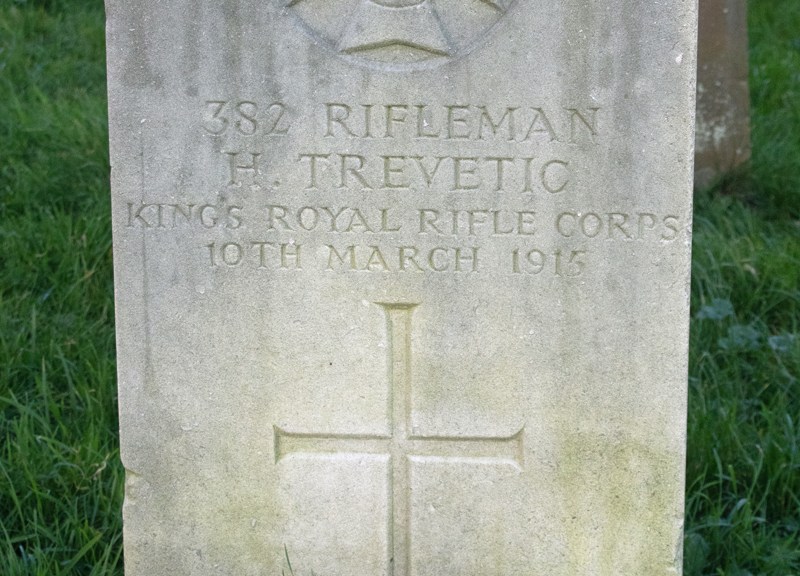
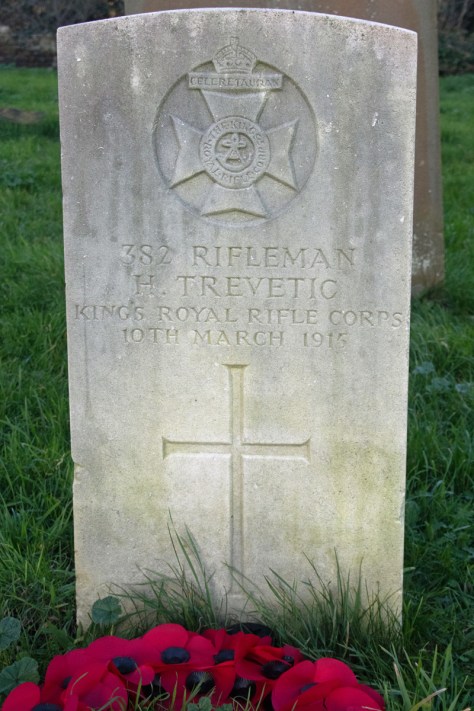
Henry Harry Trevitic was born in around 1879 in Burton-upon-Trent, Staffordshire.
There are no records of Trevetics in and around that area at that time, nor are there any permutations of his surname – Trevethick or Trevithick, for example.
The first evidence I have found of Harry is on his military service records. He enlisted in the King’s Royal Rifles in August 1897, listing himself as a ‘cycle fitter’. The document asks if the applicant has previously served in the armed forces; Harry’s reply is that he is in the militia – the 4th Worcestershire Regiment.
Rifleman Trevetic’s military career is extensive; his records show continual service in the King’s Royal Rifles from 1897 to his death in 1915. This included three years in South Africa, two in India and eight months as part of the British Expeditionary Force within weeks of the outbreak of World War One.
The 1901 census finds Rifleman Trevetic at a convalescent home in Hanbury, near Droitwich, along with eleven other soldiers. He is marked as a Visitor, rather than a Resident, so it can be assumed that the owner of the home, whose brother is party of the military party, has put them up for the night (or longer).
Harry next turns up in 1902 when, in December, he married Frances Boyes in Southampton. His military career continued, however, and moving to the 1911 census, and Rifleman Trevetic is barracked in Woolwich. He is listed as married, while Frances is also based in the town, in female quarters.
While the details of his early life are pretty scarce, those surrounding his passing are much more in depth. Because of the circumstances, an inquest into his passing was ordered into his death; this included four pretty in-depth witness statements.
In January 1914, Rifleman Trevetic was appointed as an assistant to Captain Adjutant Makins in Winchester. In August of that year he was shipped with Makins to France and remained his servant.
On 14th September, Captain Makins was badly injured, and Harry helped carry him to the church in the village of Soupir in France, which was acting as a dressing station.
In Makins’ own words “there were 300 wounded closely packed, occupying the whole of the floor space. The groans and the smell, night and day were most distressing. Fresh wounded were constantly being carried in and dead carried out. Shell fire was constant and the general conditions were such as would severely try a highly strung man. During all this time, [Rifleman Trevetic] was my only attendant.”
Makins was moved to various hospitals in France, always accompanied by Rifleman Trevetic and eventually invalided home. Given the seriousness of Captain Makins’ injury, he was permitted to bring Harry back home with him.
On 1st March 1915, Captain Makins was passed fit for general service, and rejoined his battalion, along with his servant. Conscious that he may be sent back to the Front at any point, he warned Harry to be prepared for France again.
Captain Makins’ testimony takes up the tragic story.
On March 9th, he came to me and asked if I would see the Doctor on his behalf privately. He told me that every since his time in the dressing station at Soupir, his nerves had been ajar, and that he could neither eat nor sleep. He asked whether I could get the Doctor to do something for him, as he feared if he went sick in the ordinary way, he would be passed unfit for the front, and be unable to accompany me there, which he was very keen on doing.
Later in the day he came to me and asked me to take no notice of what he had said in the morning, that as a matter of fact he had taken to drink, which was the true cause of his trouble, and that he was entirely giving it up and would be right within a week.
His whole manner was strange and he appeared under the impression that I had discharged him. This was the first intimation I had of any strangeness in his manner.
Being busy I did not pay the attention to it that perhaps I should, more especially as I knew him to be a thoroughly sober and reliable man.
The following day he called me as usual.
About 8:30 am I was called from the mess and asked to proceed to my room at once. On arrival, I found the door locked, and various Officers’ servants outside. The key was on the inside of the door but so turned that the body of Rifleman Trevetic could be seen through the keyhole lying on the floor.
I broke open the door and found Rifleman Trevetic shot through the heart, my revolver lying by his side. The revolver contained one empty shell, I cannot say where this was obtained. There were a few rounds of ammunition in the room, but the marks did not correspond nor am I able to trace any similar ammunition in the Fort.
Captain G Makins’ statement, Inquest from Rifleman Trevetic’s service records
Three other servicemen gave statements into the tragic events of that day, and all summed up Harry’s demeanour in the same way as Captain Makins.
Rifleman Trevetic has throughout his service to me, been a model servant, and had during my time in hospital not only been invaluable to me, but also to the hospitals themselves. He was very happily married, and constantly spoke affectionately of his wife and as far as I can tell, was in no financial difficulties.
Captain G Makins’ statement, Inquest from Rifleman Trevetic’s service records
The inquest found that his death was self-inflicted and “at the time he shot himself he was temporarily insane, and that his mental condition was clearly caused by what he saw and went through when on Active Service in France, and that there was no other contributory cause.”
Temporary insanity, shell shock, war neurosis, combat stress, cowardice; however it was badged Post Traumatic Stress Disorder is commonly recognised these days, but was frowned upon in the Great War.
Sadly, while appearing eager to accompany his superior, it seems that the thought of actually returning to the Western Front was so terrifying to Rifleman Trevetic, that he felt there was only one route out. He was 36 years old.
Harry Trevetic lies at rest in the quiet graveyard of St James’ Church on the Isle of Grain, metres from the fort where he ended his life.
Harry’s widow Frances lived on. Whilst there was no mention of her husband’s death in the newspapers of the time, she received a handsome war gratuity and a pension that reflected Harry’s long service. She went on to marry again in 1917, to Jack Finch, a Sergeant in Harry’s battalion.
Given the stigma around mental health in the early twentieth century, and, it is amazing that the documents have survived as part of the Harry’s military records. The inquest into his death was carried out within days of his passing, and I find the findings of the report forward thinking in the way that it was written.
Harry was obviously a man who experienced way more than his mind was able to cope with – the trauma of that dressing station must have been so much worse than he had seen before during his two decades’ military service. But the report is clear in that it apportions blame for his death on the fighting and bloodshed in France; this was clearly out of character for Harry, and it was his experiences in the field of battle that drove him to his death.
What is less clear is how much Frances was told of his death. While the inquest was decisive, suicide was as much of a stigma as shell shock at that time. Would the King’s Royal Rifles have be honest with her about how he died? Or, while they where internally open, would they have pulled ranks around their own and protected Frances from the truth and themselves from rebuke?
What I have discovered while researching the Commonwealth War Graves, is that, despite the general themes I find, the people behind the names always have an individual story to tell. Sometimes that story raises an eyebrow, or produces a gasp.
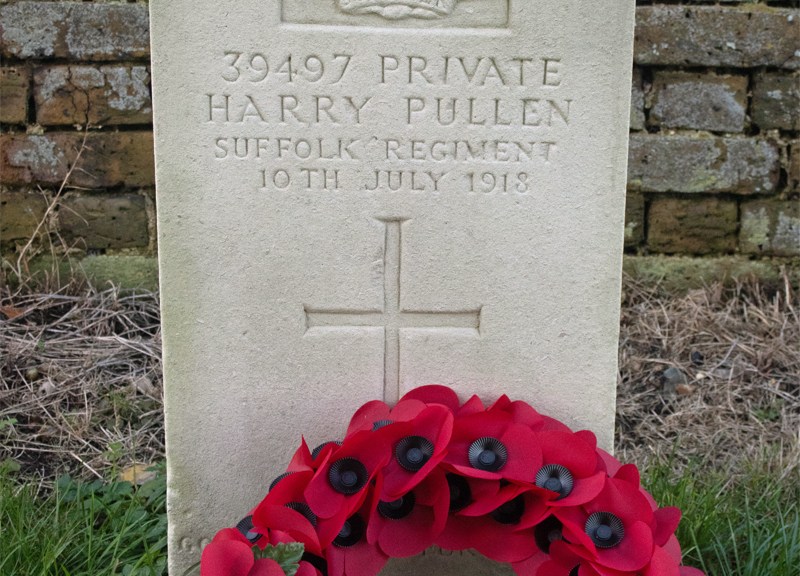
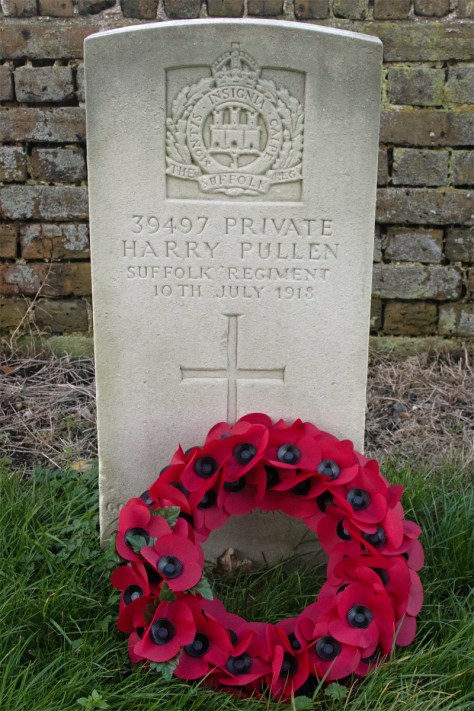
Such was the story of Private Harry Pullen.
What raised the eyebrow? Two words, written on the Army Records of Soldiers’ Effects.
Accidentally Drowned.
Harry Pullen was born in Shirehampton, Gloucestershire in 1886. His father, Robert Edward Pullen, was a carpenter; he and his wife Hannah Presulga Cissy Pullen had three other children, Gwendoline, Herbert and John.
By the time of the 1901 census, Robert is boarding in a house in Bristol with his three sons; Hannah and Gwendoline are not listed (nor do they appear on any other census records I have been able to locate).
Harry is listed as a Telegraph Boy, as is his brother Herbert, but he seemed to have wanted to take up a trade; by 1910 he had moved up to London.
In March of that year, Harry married Harriet Critchell, a spinster fifteen years his senior. On their marriage records for Christ Church, St Pancras, Harry lists himself as a tradesman. The census a year later confirms this – head of the household, he is an Agent for the Provident Clothing Supply Company. (Founded in Bradford, West Yorkshire, Provident’s mission was to help working-class families provide for themselves through the use of vouchers. These were exchanged for goods in local shops, and paid for in affordable instalments.)
Harry enlisted at some point after 1916. His regiment, the 1st (Reserve) Garrison Battalion of the Suffolk Regiment, was not formed until March of that year, and, after starting in Buckinghamshire, it moved to Tilbury in Essex and Gravesend in Kent. The battalion was finally settled in Grain, North Kent in 1918, and it was here that he served.
Here the trail goes frustratingly cold…
Private Pullen’s enlistment and service records are not available, so research is limited to the Army Register of Soldier’s Effects and the Pension Ledgers.
All we have about his death are those two words – Accidental Drowning. There are no contemporary news reports of his passing, which you might expect given the circumstances, so the circumstances surrounding his death are elusive.
Private Pullen died on 10th July 1918. He was 31 years old.
His records confirm that Harriet was entitled to a weekly pension of 15s for the duration of the war and twelves months after.
Harry Pullen is buried in the graveyard of St James’ Church in Grain, Kent, close to where he was stationed.
Charles Cornell was born in July 1885, the youngest of six children to Philip and Martha Cornell, from Ashdon in Essex. Philip was an agricultural labourer, and Charles and his older brother Daniel followed their father into the trade.
Charles was keen to further himself, however, and enlisted in the army. The 1911 census records him as a Private soldier at the Salamanca Barracks in Aldershot.
Private Cornell married Elizabeth Fanny Hoare in Strood, Kent, in October 1913. Beyond this there is little information on either Charles or Elizabeth.
Charles was assigned to the 3rd Battalion of the East Yorkshire Regiment and was promoted to Corporal. This reserve battalion was initially based in the town of Beverley, before moving to Hull and then nearby Withernsea. It seems unlikely, therefore, that Corporal Cornell saw active service on the Western Front.
His passing seems to have been sudden; his pension record shows that he had been admitted to the Military Hospital at Wharncliffe with nephritis (inflamed kidneys). He passed away on 27th January 1918, aged 32 years old.
Corporal Charles Cornell is buried in the graveyard of St Helen’s Church in Cliffe, Kent, the village his widow’s family were from. He is also commemorated in his own family’s village of Ashdon in Essex (where the memorial states he had attained the rank of Sergeant).
The majority of the the Commonwealth War Graves Commission headstones in the UK are made from Portland stone, although, in face, over 50 different natural stones have been used.
Corporal Cornell’s headstone is one of two in St Helen’s Churchyard that have been fashioned from dark grey slate.
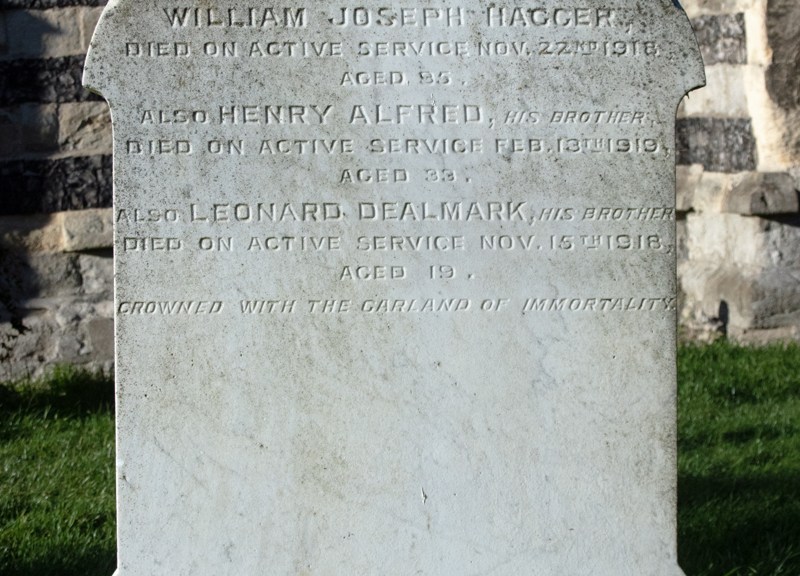
William Joseph Hagger was born in the spring of 1885, one of thirteen children to William Henry Hagger and his wife Emily Ann. The family lived on the Isle of Grain in Kent, where William Sr worked as a labourer in the local cement works.
William Jr was evidently keen to travel. On the 1901 census he is listed as a navyman on HMS Lion, a training vessel in Devonport, Plymouth.
His First World War records state that he officially joined the Royal Navy in 1906, travelling to West Africa as an Able Seaman. While there, he contracted a fever, and was invalided out of the service the following year.
William married Esther Elizabeth Reed in May 1909; by the 1911 census, she was living in Northfleet, Kent, working as a cartridge maker for the local arsenal. William himself is not recorded at the same property, and I have been unable to locate him at this point.
He next appears on the enlistment papers for the Royal Engineers. He joined up very early in the war – December 1914 – and after his training, Driver Hagger embarked for the Western Front in August 1915.
While serving, it seems that his previous affliction resurfaced, and William was dogged by colds and coughs. In the autumn of 1916, he was admitted to a field hospital with haemoptysis (coughing up blood), eventually returning to his unit three months later.
Driver Hagger’s health was fair until, in October 1917, his unit was gassed; he was sent back to England and hospitalised in Aldershot, and this time was discharged from the army six months later.
It seems that William did not recover from his illness and passed away on 22nd November 1918. He was 33 years old.
William Joseph Hagger lies at peace in a quiet corner of St Helen’s Churchyard, in Cliffe, North Kent.
William’s gravestone also acts as memorial to two of his brothers, Henry and Leonard.
Henry Alfred Hagger was born two years after William. He was also keen to make a name for himself, emigrating to California, and working as a streetcar conductor in Oakland. Initially declaring himself exempt from draft as he had a wife to support, he subsequently joined the British Columbia Regiment on 31st July 1917.
Henry was attached to the Forestry Depot of the Canadian Expeditionary Force, who were to be shipped to Europe to harvest trees for use on the Western Front. However, at the point of his medical – in September 1917 – he was discharged as unfit for active service due to his asthma.
Henry Hagger died on 13th February 1919, presumably of his lung condition. He is buried in Ross Bay Cemetery in British Columbia.
Leonard Dealimark Hagger was born in 1899. He enlisted as soon as he was able to, just short of his 18th birthday. Joining the York & Lancaster Regiment, he was posted in 1918.
His battalion saw some of the fiercest of the battles in the closing months of the war – Estaires, Messines, Bailleul, Kemmel Ridge, Scherpenberg, Selle, Valenciennes – and it is likely that Leonard was involved in some of these engagements.
Private Hagger was wounded in the closing weeks of the war, and passed away in a hospital in Liege, Belgium on 15th November 1918. He had just turned 19 years of age.
Private Leonard Hagger lies at peace in the Robermont Cemetery in Belgium.
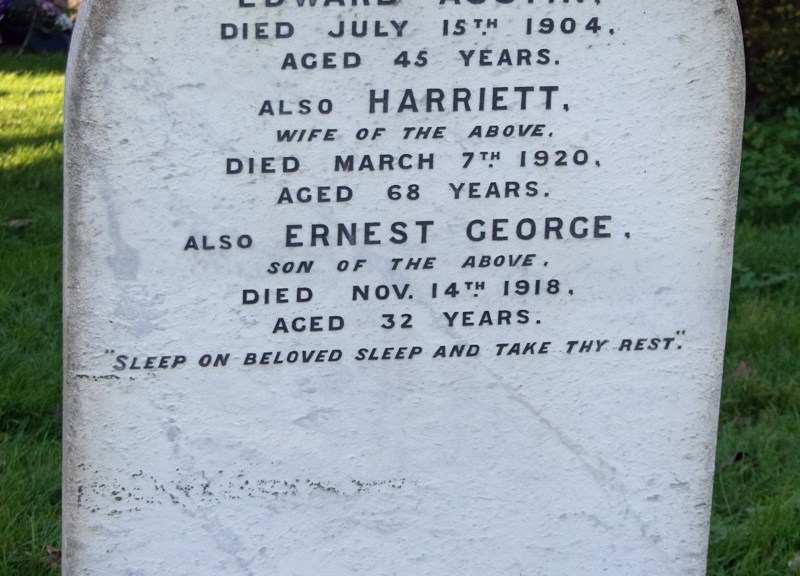
Ernest George Austin was born in early 1888, one of four children – all boys – to Edward Austin and his wife Harriett. The Austin family lived in the village of Cliffe, in the North Kent countryside, where Edward was a carpenter.
Ernest’s older brother Edward worked as a telegram messenger when he left school, and Ernest followed suit, becoming a postman by the time of the 1911 census. The four boys all lived with their now-widowed mother, their father having died seven years earlier.
Duty soon called, however, and Ernest enlisted in July 1916, joining the Army Service Corps. After training in England, he was shipped overseas that autumn.
Private Austin was discharged from the army just over a year later, and the medical report from that time sheds a lot more light onto this young man’s life:
Father [Edward] died of “consumption”.
Has had a chronic cough since a boy. Developed tubercle of lung in 1907. Went to Chile same year, where all symptoms disappeared. Put on weight and lost his cough completely. Returned to England and joined Army July 1916.
Has been in Mesopotamia three months. Cough has returned. Lost weight. Night sweats. Admitted to [military hospital] with sore throat; TB found present.
Admitted to this hospital 14th June 1917 with above symptoms. High temperature, evidence of infection.
In my opinion, the relighting of a latent infection is entirely attributable to active service in Mesopotamia.
Private Ernest Austin’s medical board record, 23rd Jun 1917
Ernest had been hospitalised in the Cumballa War Hospital, Bombay. He was sent home and ultimately discharged from active service on 8th October 1917.
Demobbed, Ernest married Antoinette Gurton at the start of 1918. The marriage was to be short-lived, however, as Ernest appears to have finally succumbed to his illness less than a year later.
Private Ernest Austin passed away on 14th November 1918. He was 31 years old. He lies at rest in the graveyard of St Helen’s Church in his home village of Cliffe, Kent.
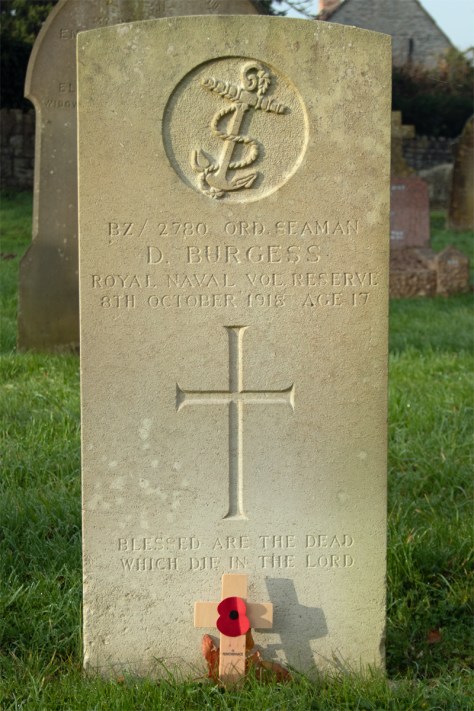
Donald Burgess was born in 1901 in the village of Queen Camel in Somerset. His father, Frank Luther Burgess was the local schoolmaster, and he and his wife Frances has four children, all sons.
By the time of the 1911 census, Donald and his three brothers – Claud, Wilfred and William – were all at school, and Frank was, by now, the village headmaster.
Donald seems to have volunteered as soon as his age allowed. He joined the Royal Naval Voluntary Reserve in September 1918, and was stationed at HMS Victory in Crystal Palace. He was training to become a wireless operator, but his time there seems to have been cut cruelly short.
Ordinary Seaman Burgess contracted pneumonia and was admitted to the 4th London General Hospital in nearby Camberwell. Sadly, he succumbed to the condition and passed away on 8th October 1918, after just a few weeks’ service. He was just 17 years of age.
Donald Burgess lies at rest in sight of his father’s school, in the graveyard of St Barnabas Church.
Edward Carver is one of those soldiers whose details have been lost in the mists of time.
From the information I have been able to gather, Edward was born in Kent in 1887, although I have been unable to track down his parents or any firm census records.
Edward married Violet Ethel Caroline Belsey in April 1918 and enlisted in the Royal West Kent (Queen’s Own) Regiment, although he later transferred to the Labour Corps. I have nothing to confirm, however, in which order these three events happened.
The Army Register of Soldier’s Effects records that Private Carver died at home – Chestnut Street in Sittingbourne – and confirms that this was on 20th November 1918, around six months after he and Violet married.
Nothing in contemporary media suggests that his passing was unusual, so it can only be assumed that something like pneumonia or influenza was the cause of his death. (It might also had had something to do with his transfer of regiments, although, again, I have nothing to confirm that this might be the case.)
Edward Carver lies at rest in the churchyard of St Mary the Virgin in Newington, Kent. He was 31 years old.
As an aside, Edward’s widow, Violet, married an Arthur Beaumont in December 1919, and the couple went on to have two children.












 Death and Service