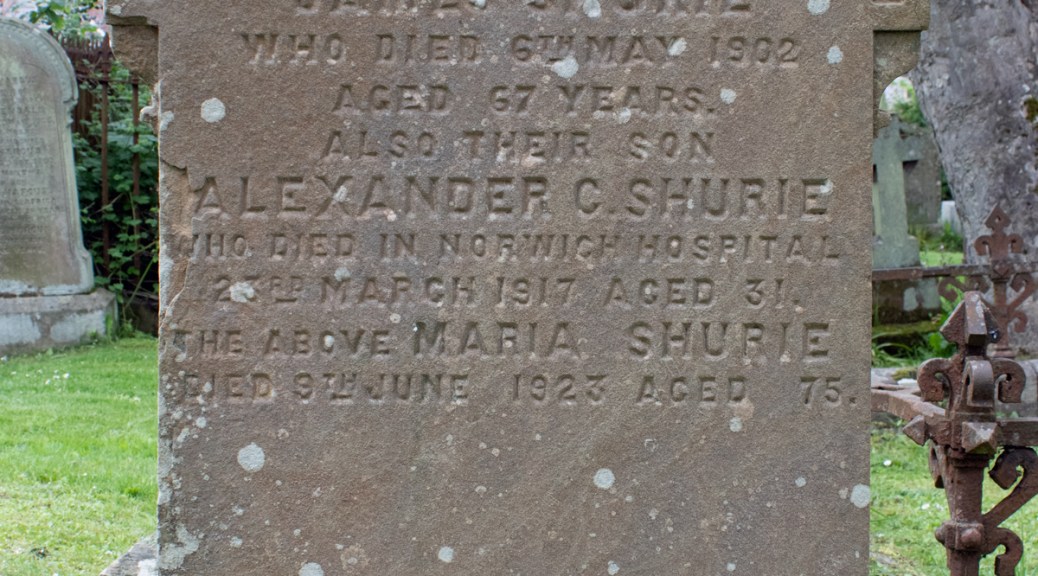
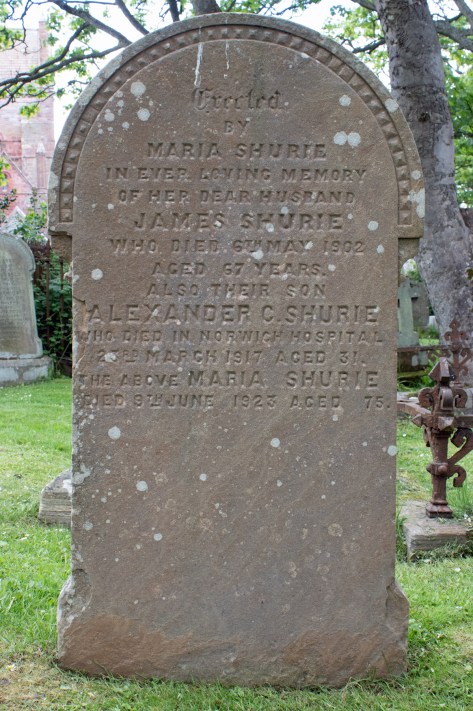
Alexander Cursiter Shurie was born in Orkney, in 1886. The youngest of seven children, his parents were farmers James and Maria Shurie. The family were born and raised in West Grenigoe, a small hamlet between Orphir and Scapa, on the Orkney mainland.
There is little information about Alexander’s young life. James died in 1902, and it is likely that his son helped with the running of the farm. When war broke out, he did not enlist immediate and, while his service records have been lost to time, it seems likely that he did not join up until the autumn of 1916.
Private Shurie’s unit – the 6th Battalion or the Seaforth HIghlanders – served on the Western Front during the conflict, but there is nothing to show that Alexander spent any time overseas himself. By March 1917, he had fallen ill, and was admitted to the Norwich War Hospital in Norfolk. His condition is unclear, but it would prove fatal: he passed away on 18th March 1917, at the age of 31.
The body of Alexander Cursiter Shurie was taken back to Orkney for burial. He was laid to rest in the family plot in the graveyard of St Magnus’ Cathedral, Kirkwall.
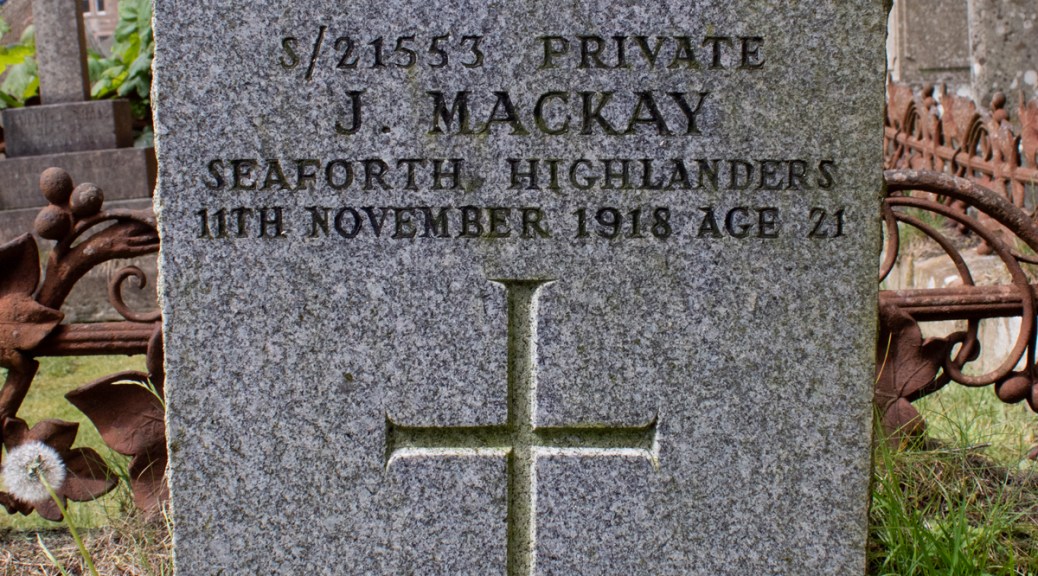
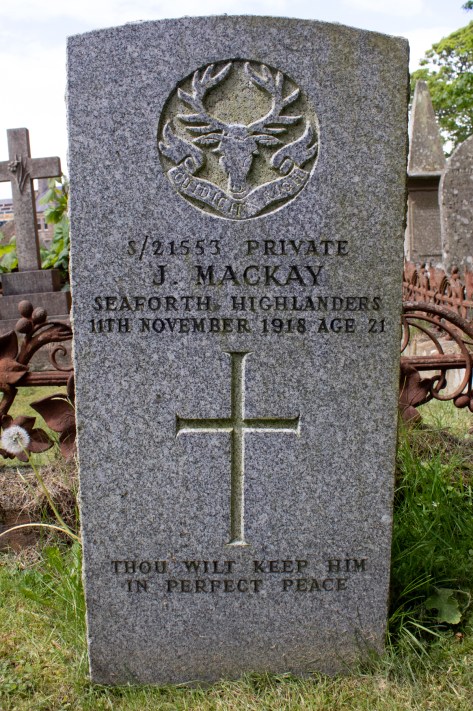
James – or Jim – Mackay was born in Kirkwall, Orkney, in 1897, and was the youngest of six children to John and Margaret Mackay. John was a stone mason, and the family lived in a small cottage at 14 Victoria Road, close to the town centre.
Little information survives about Jim’s life, and the family do not appear on the 1911 census. He would have been too young to enlist when war broke out, but at some point during the conflict, he enlisted in the army, joining the Seaforth Highlanders as a Private. His unit – the 3rd (Reserve) Battalion – was a depot unit, and was based at Cromarty, to the north of Inverness, for the duration.
In the closing weeks of the war, Jim fell ill, and was admitted to the military hospital in Cromarty, suffering from pneumonia. The condition would prove fatal, and he passed away on 11th November 1918, the day the Armistice was signed. He was just 21 years of age.
The body of James Mackay was taken back to Orkney for burial. He was laid to rest in the graveyard of St Magnus’ Cathedral, a short walk from where his family still lived.
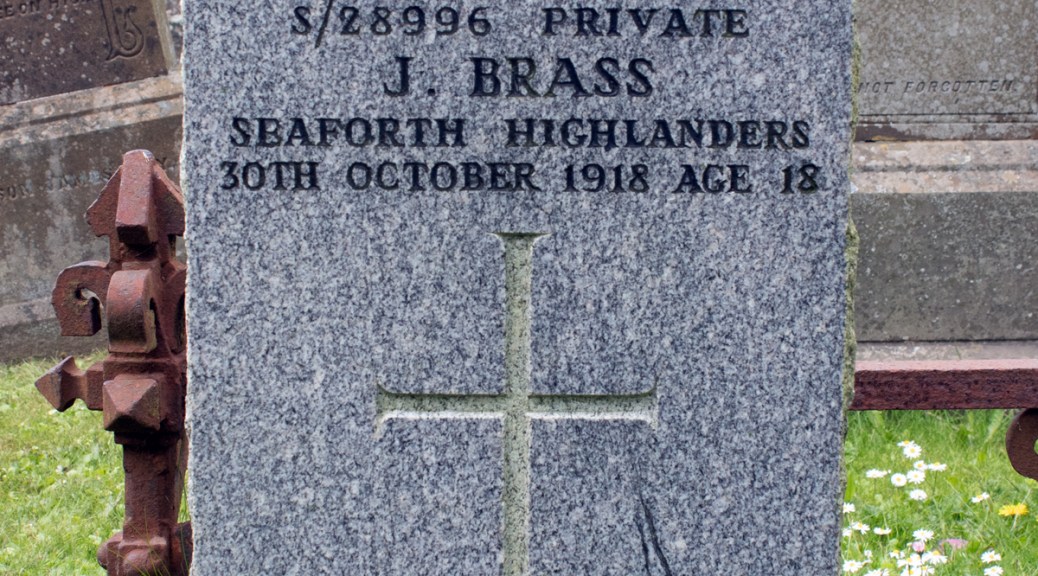
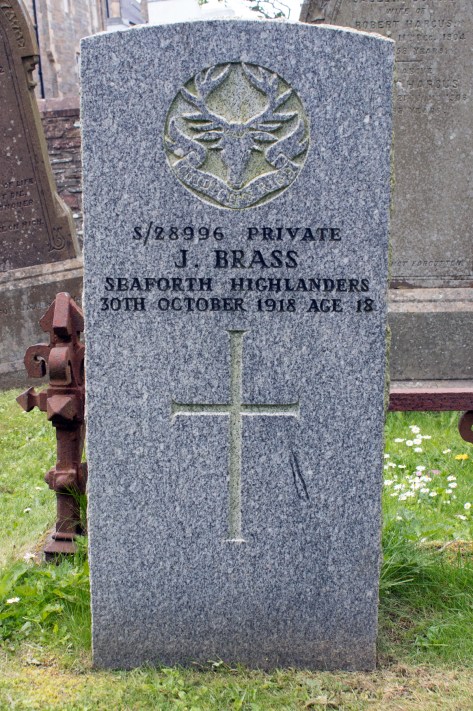
John Harcus Brass was born in Kirkwall on the Orkney mainland in May 1900. He was the oldest child to Thomas and Margaret Brass. Thomas was a grocer, and the family lived at 3 Union Street, to the south of the town centre.
There is little information about John’s early life. Better known as Jackie, he was too young to enlist when war broke out, but joined up as soon as he came of age. He was assigned to the Seaforth Highlanders and, as a Private, was attached to the 4th Battalion.
Jackie was sent south for training, and was billeted in Glencorse, to the south of Edinburgh. Sadly, Private Brass’ war was not to be a lengthy one. He was admitted to the 2nd Scottish General Hospital in Edinburgh, suffering from influenza. The condition was to get the better of him, and he passed away on 30th October 1918. He was just 18 years of age.
The body of John Harcus Brass was taken back to Orkney for burial. He was laid to rest in the graveyard of St Magnus’ Cathedral, in his home town of Kirkwall.
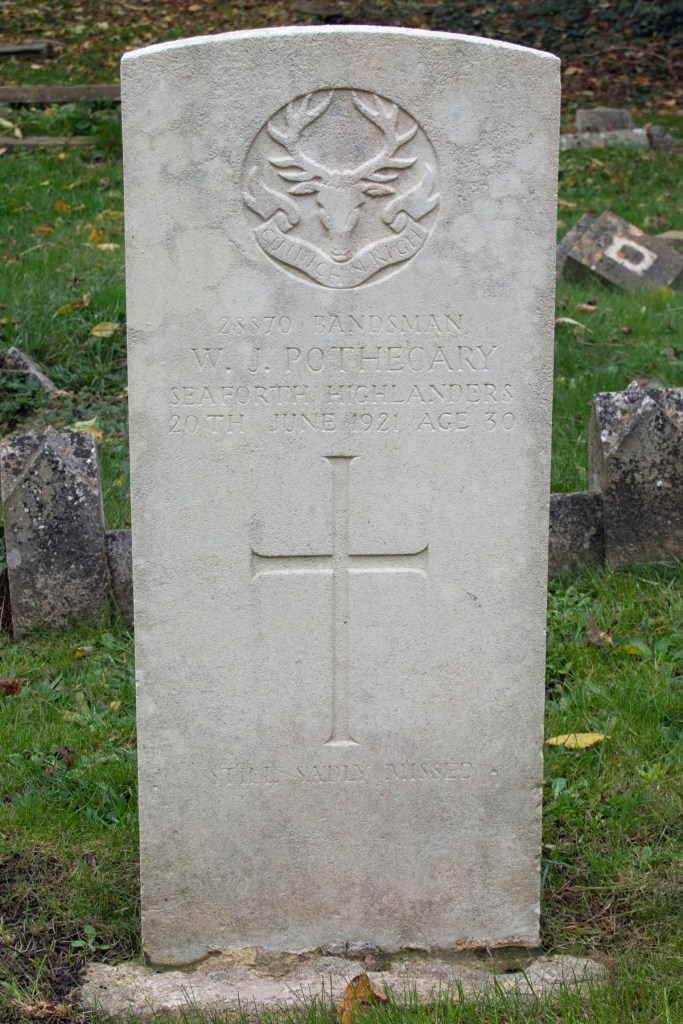
William James Pothecary was born in Frome, Somerset, on 24th April 1891, one of six children – and the only boy – to Francis and Annie Maria Pothecary. Francis was a groom, and the couple raised the family in Pilly Vale (now Willow Vale) which ran alongside the River Frome in the centre of the town.
Little further information on William’s early life is available, although it seems he was a keen musician, and took up the oboe at an early age. He joined the 2nd Seaforth Highlanders in 1909 as a Bandsman, and, from later reports, was a talented player.
When war broke out, William was sent to the front, but in 1915, while caught up in the Second Battle of Ypres, he was buried and seriously wounded by a bomb. He was sent to a convalescent home in Ireland, recovered reasonably well and returned to France, where he served until the end of the war.
Bandsman Pothecary was demobbed in July 1919 and returned to Somerset. The following year, he needed an operation following the recurrence of the issues he encountered following his injury, and all seemed to be going well for a long-term recovery.
William had a relapse in the summer of 1921, and was admitted to Bath Hospital. Sadly, however, he was not to recover this time, and he passed away on 20th June. He had just turned 30 years old.
William James Pothecary was laid to rest in the graveyard of Christ Church in his home town of Frome.
The Somerset Standard gave a glowing obituary for young William:
Death of an “Old Contemptible”
The was, through the fighting is over, still claims victims from the ranks of survivors. On Monday, Mr William James Pothecary, one of the “Old Contemptibles”, died in the Pensions Hospital at Bath from the effects of wounds which he received in 1915. He was the only son of Mr and Mrs FW Pothecary, of Bath Street, and very deep sympathy is felt with the parents and sisters in their great bereavement. Mt WJ Pothecary was an old Regular.
Nearly twelve years ago he joined the 2nd Seaforths. He was a talented player of the oboe, and it was his love of music which prompted him to become a bandsman in the 2nd Seaforths. He had previously been a bugle boy in the old Volunteers, and afterwards a member of the Territorial Band. And at the time of his death he was one of the most valued players in the Frome Town Military Band.
He went to France with his regiment in 1914. In 1915 he was seriously wounded and buried by a bomb. His condition was critical for a long time, but he slowly recovered and was sent to a convalescent camp in Ireland. He remained there for a considerable time, and when he was deemed medically fit he was sent to France a second time. He continued to serve in France until after the Armistice. He was discharged from the Army in July 1919.
Last year it was necessary for him to undergo a very serious operation in hospital. The operation was successful, and it was hoped there would be a permanent recovery. But on Thursday last there was a recurrence of an old trouble, and he was removed to Bath Hospital, where he died on Monday morning.
He was a talented and promising young fellow, and his death is deeply deplored by his many friends, and not least by his fellow members of the Frome Town Military Band.