Tag Archives: wound

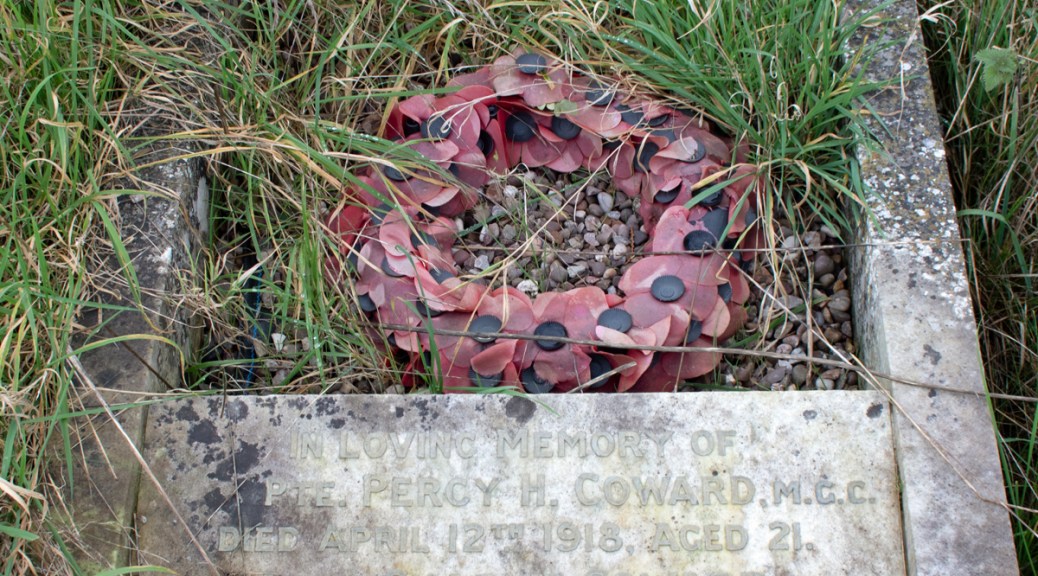
Private Percy Coward

Private Percy Coward

Percy Herbert Coward was born in the Wiltshire town of Westbury in the autumn of 1896. He was one of seven children – all boys – to Lily Coward and her weaver husband Charles. Not long after Percy was born, the family moved across the county border to Frome, Somerset, presumably for Charles’ work.

By the time of the 1911 census, the Coward family were living in a five-room end-of-terrace cottage on the outskirts of the town. Charles and Percy were both working as warpers – threading looms – in the cloth industry; two of his brothers were working for a printer in the town. Percy was proving himself an integral part of the community.

[Percy] was very highly esteemed by a large circle of acquaintances… He was a worker with the YMCA and Frome Brotherhood, a member of the band and in other directions showed himself a young man of much promise. He was employed successively at Messrs Houston’s [Woollen Mill] and at the Silk Factory.

Somerset Standard: Friday 26th April 1918

An active member of the town’s territorial force, when the Great War broke out he was mobilised. Initially attached to the Royal Army Medical Corps, he subsequently served with the Royal Army Service Corps and the North Staffordshire Regiment, before obtaining his final transfer to the 42nd Company of the Machine Gun Corps.

During his time in the army, Private Coward would have seen action in some of the fiercest battles of the war – at the Somme, Arras and Ypres. In the spring of 1918, his battalion was involved in the Battles of St Quentin and the Avre, and it was during this last skirmish that he was wounded.

Percy’s injuries were severe enough for him to be medically evacuated back to England and, once there, he was admitted to the Royal Woolwich Hospital in South London. His wounds were to prove too much for him, however, and he passed away at the hospital on 12th April 1918. He was just 21 years of age.

Percy Herbert Coward was brought back to Somerset for burial. He was laid to rest in the Dissenters’ Cemetery, Vallis Road, within walking distance of his family home.


Private Edward Rendell

Private Edward Rendell

Edward Rendell was born in the Dorset town of Corfe Castle in 1894. His parents were Edward and Sophie Rendell, and he had two siblings, William and Agnes.

Sadly, little information on Edward Jr’s early life is available. His father was a farmer – or at least an agricultural labourer – and this is the line of work his son went into.

When war broke out, Edward Jr was quick to play a part, enlisting within a fortnight of hostilities being declared. He joined the 1st Battalion of the Dorsetshire Regiment as a Private and, after initial training, was sent out to the Western Front by March 1915.

Private Rendell’s battalion was involved in the fighting at Ypres and, on 19th April 1915, he was injured, receiving a gun shot wound to his left arm. Initially treated in the field, he was later transferred to a hospital in Boulogne, before being evacuated back to England to recover.

Reunited with his regiment, Edward was then shipped out to Gallipoli, arriving there in September 1915. While he is likely to have been involved in the fighting in Turkey, he did end up in hospital, but was suffering from influenza.

A couple of weeks later, he is recorded as being admitted to a hospital in Malta, although whether this was also because of the lung condition is not clear. Either way, Private Rendell was back in England by mid-December 1915, remaining in the country for six months.

In March 1916, he again returned to the fray and was posted back to the Western Front. Private Rendell spent a couple of months in battle until, on 21st June 1916, he received a gunshot and shrapnel wound to his thigh. The injury was serious enough for him to be medically evacuated back to England, and he was admitted to the Voluntary Aid Detachment Hospital at Norton-sub-Hamdon in Somerset.

Sadly, while his treatment may have bought Private Rendell some time, it seems that his wounds were too severe; he passed away on 30th July 1916 at the age of just 22 years old.

By this time both of Edward’s parents were dead; his next of kin was his sister, Agnes. While she was still living in Dorset, Edward was laid to rest in St Mary’s Churchyard in Norton-sub-Hamdon.


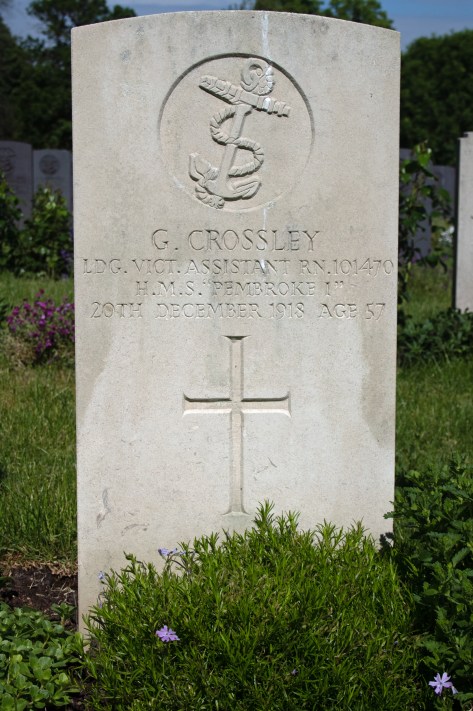
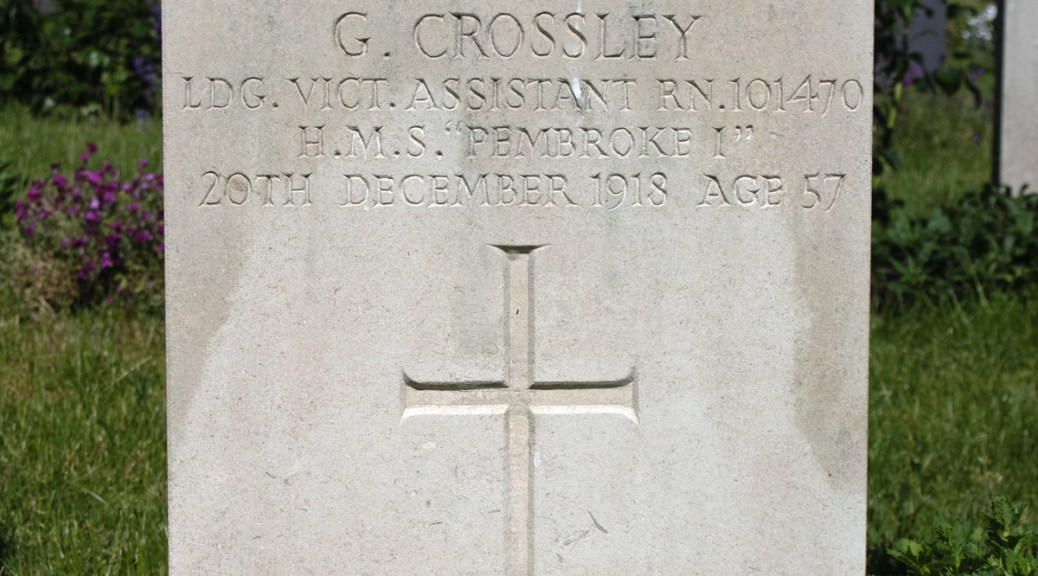
Leading Victualling Assistant George Crossley

Leading Victualling Assistant George Crossley

George Crossley was born on 30th December 1861 in the Stonehouse area of Plymouth, Devon. The oldest of five children, his parents were John and Charlotte. John died when George was only ten years old, leaving his widow to raise the family alone.

Left as the technical head of the family, George sought a reliable career and, in August 1877, aged just 15 years old he joined the merchant navy. After two years at the rank of Boy, he formally joined the crew, working as a Ship’s Steward’s Assistant.

Over the initial ten years of his service, George served on four ships, primarily the Royal Adelaide. In 1889, having seen the world, he signed up for a further decade. This new period of service saw him move up to Ship’s Steward, before working back in the assistant role.

In December 1899, George’s twenty years’ service came to an end. Charlotte, by this time, was in her mid-60s, and perhaps he felt it better to spend time ashore with her, rather than leaving her alone.

His experience did not count for nothing, however, and he found employment as a labourer in the Naval Dockyard in Chatham, Kent. And so another fourteen years passed, before war rose its ugly head.

George was called back into service at the start of the conflict, and resumed his role as a Ship’s Steward’s Assistant. Over the next few years, he served on a couple of ships, but the majority of his time was spent at the shore establishments in Portsmouth, Dover and Chatham. In 1917, George gained the rank of Leading Victualling Assistant, giving him some of the responsibility for the food stores at Chatham Dockyard.

Towards the end of 1918, George seems to have been in the east of the county, when he fractured and dislocated his left ankle. Little specific information is available, but it seems that he was admitted to the Royal Infirmary in Deal, but died of his wounds on 20th December. He was ten days short of his 57th birthday. An inquest later that month reached a verdict of accidental death.

Brought back to Gillingham, George Crossley was laid to rest in the Woodlands Cemetery in the town.