

Phillip George Clemett was born on 5th December 1891, one of eight children to Albert and Mary Jane Clemett. Albert was a carpenter from Devon, Mary Jane came from Somerset, but by the time Phillip was born, the family had moved to Fulham in Middlesex.
The 1911 census records the family as having moved back to Somerset. Mary Jane had been born in the village of Huntspill, and it was here that the Clemetts returned. Albert was now working as a farmer, so it is possible that they had moved to work on the family farm.
Labouring was not a job to satisfy Phillip, though, and he sought a career on the high seas. On 3rd February 1913, he enlisted in the Royal Navy as a Stoker 2nd Class. His service records show that he was 5ft 4ins (1.63m) tall, with brown hair, brown eyes and a fresh complexion.
Stoker Clemett’s was initially sent to HMS Vivid, the Royal Naval Dockyard in Plymouth, Devon. Here he received a few months’ training, before being given his first posting, on board the battleship HMS Indefatigable. He remained on board for the next fifteen months, gaining a promotion to Stoker 1st Class in the process.
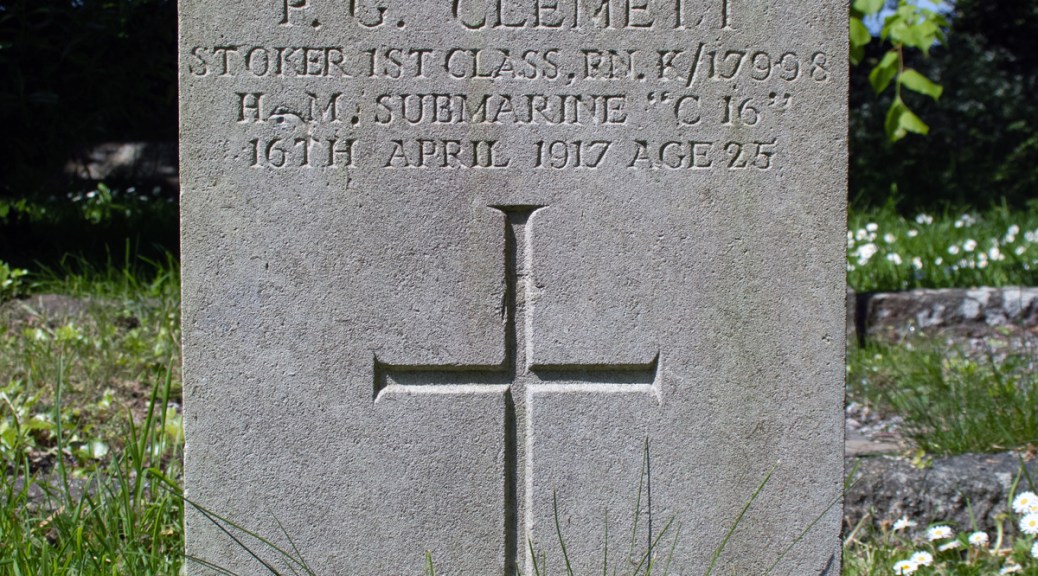
Over the next couple of years, Phillip served on a couple more vessels, but on 11th February 1917 he was assigned to the submarine HMS C16. Stoker Clemetts was on board for a couple of months, as she was patrolling off the Essex coast. On 16th April 1917, the C16 was accidentally rammed by the destroyer HMS Melampus. She sank to the bottom and a couple of attempts were made for the crew to escape, but they became trapped and all perished, including Stoker 1st Class Clemetts. He was 25 years of age.
Contemporary newspaper reports give little detail about the accident – stating simply that Phillip ‘perished at sea’ [Western Daily Press – Tuesday 01 May 1917] His service documents are equally cagy about the incident, confirming jus that he ‘lost his life on duty.’ The records, however, show that on each of his five annual reviews, his character was noted as ‘very good’, while his ability was ‘superior’.
When the submarine was salvaged, Phillip George Clemett’s body was brought back to Somerset for burial. He was laid to rest in the peaceful graveyard of St Peter’s Church in Huntspill.
 Death and Service