
AN AIR-RAID VICTIM
Killed in Barracks After Passing Through Many Battles
A Cambridge family which already had a splendid record suffered another loss by air raid on the Chatham-Sheerness district on Monday night in the death of Stoker Herbert Bavister. It will be remembered that a bomb fell on the naval barracks at Chatham, causing terrible casualties…
Stoker Bavister, the son of Mrs Bavister, of 68, New-street, was 28 years of age, and had been in the Navy over seven years. He had a grand record, having taken part in the Battle of Falkland Isles on December 8th, 1914, in the attack on the Dardanelles, both in the attack on the outer forts on February 19th and on the Chanak Forts on March 18th, 1915, and in the Battle of Jutland on March 31st-June 1st, 1916. He did not receive a scratch in any of these battles.
There are three brothers in the Army, one of whom – Pte. J Bavister, of the Rifle Brigade – was taken prisoner by the Germans during the retreat from Mons. The other two are Pte. W Bavister, of the Bedford Regiment, and Pte. A Bavister, of the Middlesex Regiment. Stoker Bavister was well known in Cambridge, and will be greatly missed by a wide circle of friends.
[Cambridge Daily News: Saturday 8th September 1917]
Herbert Lewis Bavister was born in Cambridge on 31st July 1889. The youngest of eight children, his parents were farm labourer William, and his wife, Ann. The 1891 census found the family living at the long-since-gone 8 Wellington Passage, to the east of the city centre.
By the time of the 1901 census, it seems that family were splitting. William was missing from the document and, given his age, and his passing a few years later, it may be that he had been admitted to a hospital or institution. Anne was living in a small cottage at 9 Albert Street, and was working as a charwoman. She was supported by three of her sons – Simon, Alfred and William – all of whom were employed as carters on a farm, while 11-year-old Herbert completed the household.
The 1911 census found a further moved for Ann and Herbert. The other children having flown the nest, it was just the two of them, living at 64 New Street, a one-up, one-down cottage on the outskirts of the city. Now 66 years of age, Ann was not working, and it was down to Herbert, employed as a fishmonger’s assistant, to bring in the money.
Supporting his widowed mother was clearly important to Herbert, and his shop salary was not enough to provide for her properly. He needed a regular pay packet, and the Royal Navy seemed to offer that security. On 30th May 1911 he enlisted, and was sent to HMS Pembroke, the Royal Naval Dockyard in Chatham, Kent, for his training. With the rank of Stoker 2nd Class, his papers show that he was 5ft 4ins (1.63m) tall, with brown hair, grey eyes and a fair complexion.
Following his induction, Stoker Bavister was given his first assignment, on board the battlecruiser HMS Inflexible. She would be his home for the next six years, and the newspaper article both outlines his time on board and his promotion to Stoker 1st Class, which came in June 1912.
The summer of 1917 found Herbert back on dry land in Chatham, his tenure aboard Inflexible at an end. HMS Pembroke was a particularly busy place at that point in the war and temporary accommodation was set up. Stoker Bavister found himself billeted at The Drill Hall, away from the main barracks.
On the night of 3rd September 1917, Chatham suddenly found itself in the firing line, as the German Air Force launched a bombing raid. Two of the bombs landed squarely on the Drill Hall, and Stoker Bavister was amongst the dozens killed. He was just 28 years old.
The body of Herbert Lewis Bavister was taken back to Cambridgeshire for burial. He was laid to rest in the city’s Mill Road Cemetery.
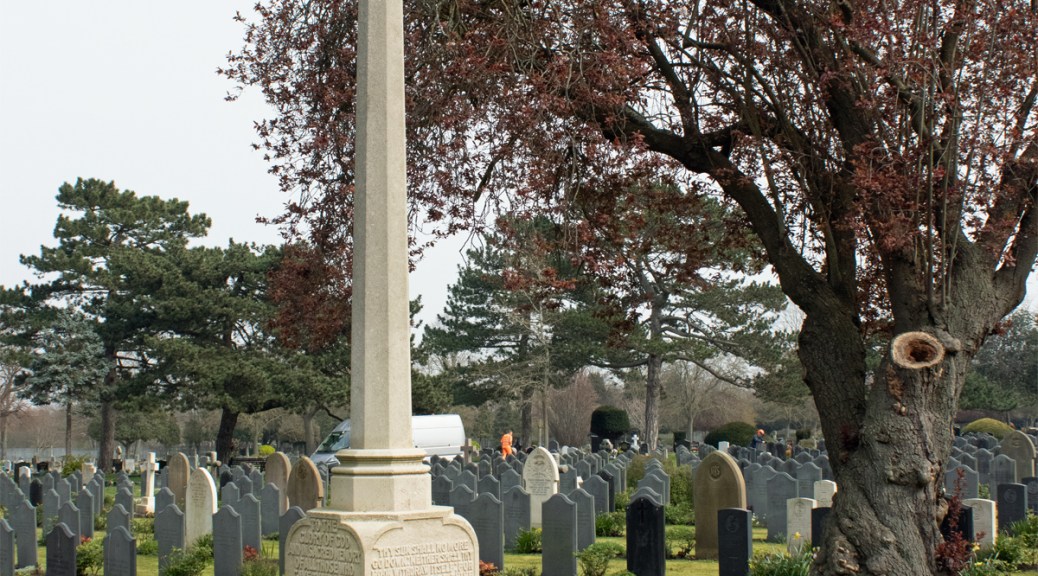
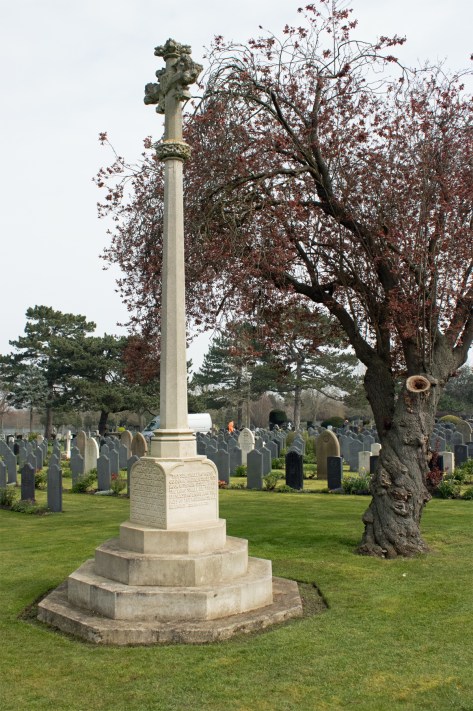
[Note: the photo above is of the memorial to the Chatham Air Raid victims, close to the mass grave for those whose bodies were not identified, in Woodlands Cemetery, Gillingham, Kent.]

