Category Archives: Cambridgeshire

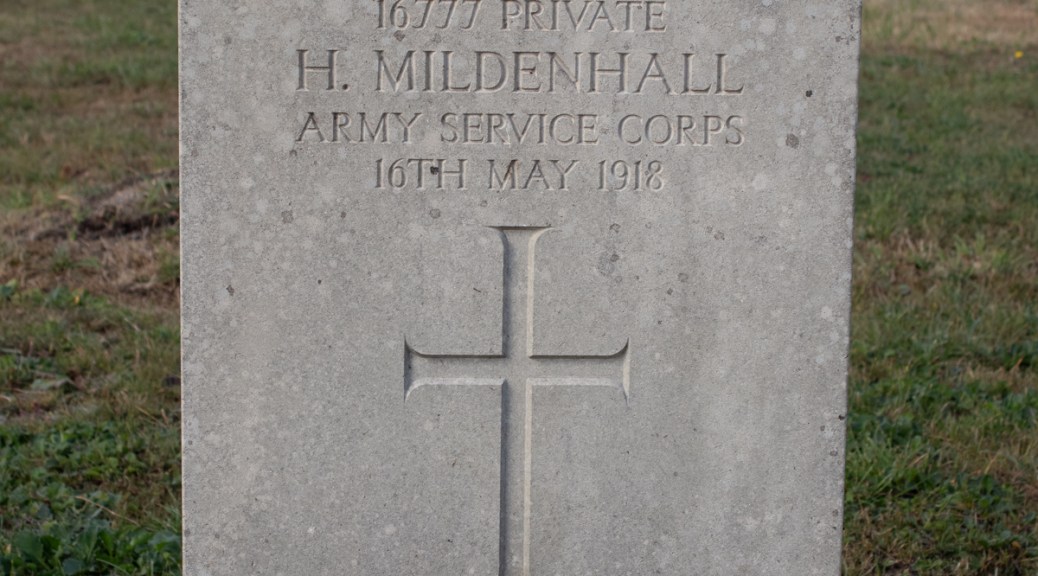
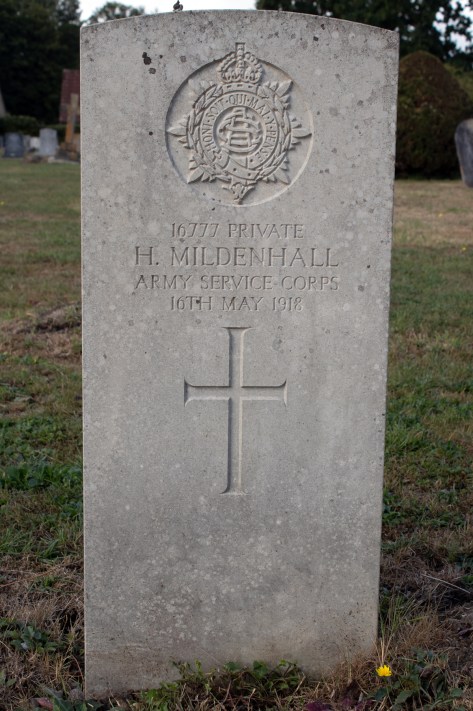
Private Harry Mildenhall

Private Harry Mildenhall

Harry Mildenhall was born in the autumn of 1873 in Eton, Buckinghamshire. The third of six children, his parents were Henry and Harriet Mildenhall. Henry was a groom, and the family lived on first on Mill Lane, before moving to Alma Road in nearby Boveney, by the time of the 1891 census.

The next census return, taken in the spring of 1901, recorded Harry as having left home. Initially apprenticed to house painter Glen Rowland, the document found him as boarding with his employer at 1 Thames View, Clewer, on the outskirts of Windsor, Berkshire.

It was not long before Harry would set out on his own. On 14th April 1906, he was living on Speedwell Street, Oxford. It was on that day that he married Annie Berridge in the parish church. Seven years her new husband’s junior, Annie was a labourer’s daughter, with a history of her own:

Annie Berridge (19), domestic servant, Peterborough, was charged with obtaining 4s. by false pretences from Martha Withers on Feb. 4th. The evidence showed that Berridge had been residing with Mrs Knighton of Wellington-street, who was known to Mrs Withers. On Monday week she visited the latter’s house at Oundle-road and stated that Mrs Knighton wanted to borrow 6s. In consequence Mrs Withers gave her 4s., but afterwards discovered that Mrs Knighton had never sent for the money. Accused pleaded guilty, electing to be dealt with summarily. The Bench gave defendant a chance to retrieve her character by dealing with her ad a first offender and binding her over to come up for judgment when called upon.

[Peterborough Standard: Saturday 16th February 1901]

But Annie was not done with the law just yet:

Annie Berridge (19), single soman, of no fixed abode, was charged with stealing from 11, City-road, a pair of shoes, value 4s. 6d., the property of Elizabeth Ryall, on the 24th. She was further charged with stealing from 7, Perseverance Cottages, Star-lane, money to the amount of 1s., the property of Ethel Norman, on the 18th. In the first care Elizabeth Ryall stated that accused asked for lodgings. She stayed one day and went out the following morning. As accused did not return witness looked round and missed a pair of shoes (produced), an old pair being left in their place. Detective-Sergeant Smith stated that he saw accused in Broadway on the 25th wearing the shoes missed by the previous witness. Accused, who cried bitterly, elected to be dealt with summarily, and pleaded guilty. The Chief Constable stated that a fortnight ago the accused was before the Bench and was then bound over to be of good behaviour. The Bench retired, and on their return into Court the Chairman stated that it appeared leniency was no good. That had been tried a fortnight previously, and a sentence of two months’ imprisonment would now be passed. The second charge was not proceeded with.

[Peterborough Standard: Saturday 2nd March 1901]

The 1902 census, taken just a month later, recorded Annie’s fate: she was imprisoned in Northampton Prison. Meeting Harry may have been what helped Annie back on the rails. After their wedding the couple took rooms at 6 Mill Street, Kidlington, Oxfordshire, and went on to have three children: Edward, Albert and Annie.

War came to Europe in the summer of 1915, and, despite his age, Harry would step up to play his part. He enlisted in the Army Service Corps on 16th September 1915, his papers confirming that he was of Church of England by faith, and was 5ft 5.5ins (1.66m) tall.

Private Mildenhall was sent to France within a fortnight of enlisting, although his exact role is unclear. He certainly remained overseas until April 1917, when he returned home for three months. He returned to the fray in July 1917, transferring to the Labour Corps.

Harry next returned to Britain in May 1918. By this point, however, he had fallen ill, and was admitted to Station Road Hospital in Gillingham, Dorset, suffering from bronchitis. Any treatment proved to be too little, too late: Private Mildenhall died from heart failure at 8:15pm on 16th May 1918, at the age of 44 years old.

The body of Harry Mildenhall was laid to rest in Gillingham Cemetery, not far from the hospital where he had breathed his last.


Of Annie there is no further record. The 1921 census records the three children boarding with separate families: Edward and Albert were living with the Bowd family at 35 Gracious Street, Whittlesey, Cambridgeshire. Annie, meanwhile, was living with Joseph and Harriett Wing, just around the corner from her brothers at 5 Whitmore Street. The census records note that the children’s father was dead, but their mother alive.
Private Percy Carpenter

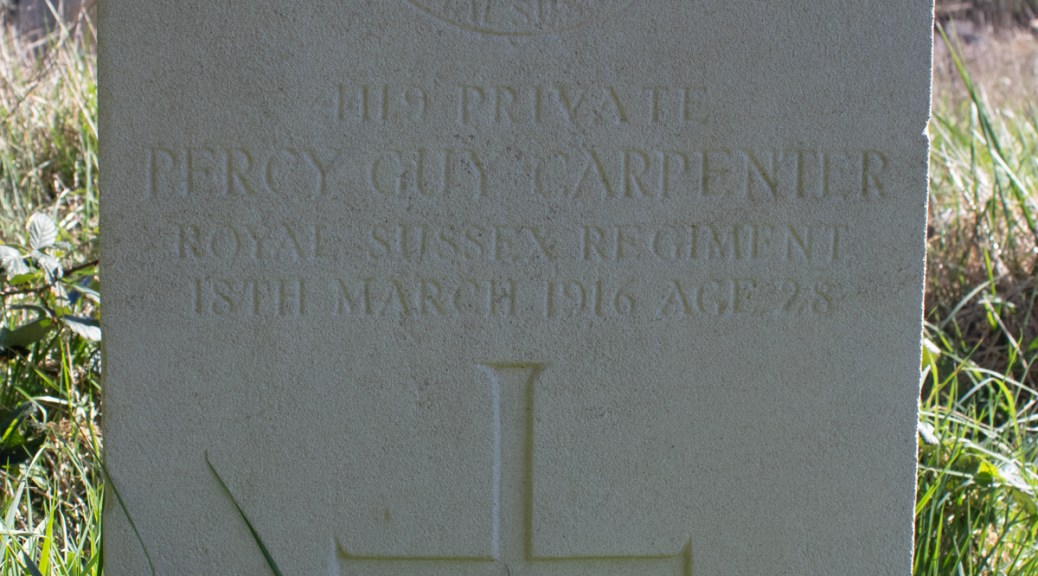
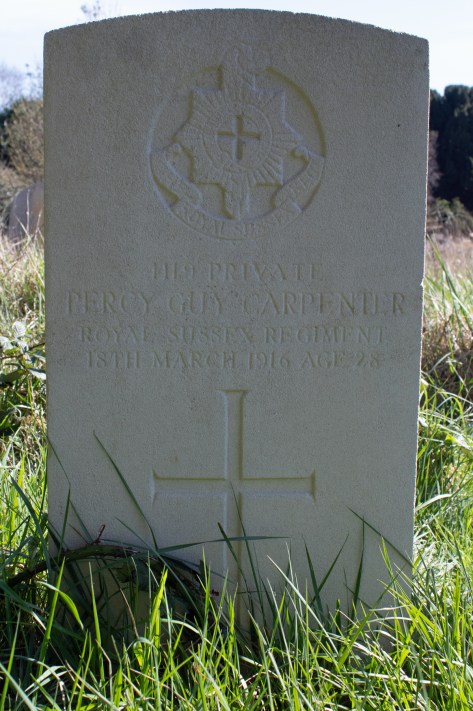
Private Percy Carpenter

Percy Guy Carpenter was born in Worthing, West Sussex, in the autumn of 1887. One of eight children, he was the middle of three sons to Alfred and Alice Carpenter. Alfred was a chief clerk at the town’s post office, and the 1891 census found the family living on Oxford Road, to the south of the central railway station.

By the time of the next census, taken in 1901, the family had moved to a small cottage at 93 Newland Road. Alfred had changed jobs, and was noted as being the chief clerk at the local gas works. This seemed not to have been a long-term position, however. The 1911 census recorded his occupation as post office clerk (out of employment).

The Carpenter family were still living at 93 Newland Road by this point, and, of the six children who remained at home, all of them were working. Percy was employed as a tailor’s porter, while his sibling’s jobs included chemist’s stock keeper, ironmonger’s clerk and bookbinder’s apprentice.

War came to Europe in the summer of 1914, and Percy would be called upon to serve his country. Little information about his time in the army remains, but it is clear that he enlisted in the Royal Sussex Regiment at some point early in 1915.

Attached to the 2nd/4th (Cinque Ports) Battalion, Private Carpenter found himself in France by the end of March. He remained overseas for a year, but, while there, he contracted pneumonia. Medically repatriated to Britain for treatment, Percy was admitted to the 1st Eastern General Hospital in Cambridge, but died from a combination of pneumonia and nephritis on 18th March 1916. He was 28 years of age.

The body of Percy Guy Carpenter was taken back to Sussex for burial. He was laid to rest in Broadwater Cemetery, not far from where his family still lived in Worthing.


Stoker 1st Class Herbert Bavister

Stoker 1st Class Herbert Bavister

AN AIR-RAID VICTIM

Killed in Barracks After Passing Through Many Battles

A Cambridge family which already had a splendid record suffered another loss by air raid on the Chatham-Sheerness district on Monday night in the death of Stoker Herbert Bavister. It will be remembered that a bomb fell on the naval barracks at Chatham, causing terrible casualties…

Stoker Bavister, the son of Mrs Bavister, of 68, New-street, was 28 years of age, and had been in the Navy over seven years. He had a grand record, having taken part in the Battle of Falkland Isles on December 8th, 1914, in the attack on the Dardanelles, both in the attack on the outer forts on February 19th and on the Chanak Forts on March 18th, 1915, and in the Battle of Jutland on March 31st-June 1st, 1916. He did not receive a scratch in any of these battles.

There are three brothers in the Army, on of whom – Pte. J Bavister, of the Rifle Brigare – was taken prisoner by the Germans during the retreat from Mons. The other two are Pte. W Bavister, of the Bedford Regiment, and Pte. A Bavister, of the Middlesex Regiment. Stoker Bavister was well known in Cambridge, and will be greatly missed by a wide circle of friends.

[Cambridge Daily News: Saturday 8th September 1917]

Herbert Lewis Bavister was born in Cambridge on 31st July 1889. The youngest of eight children, his parents were farm labourer William, and his wife, Ann. The 1891 census found the family living at the long-since-gone 8 Wellington Passage, to the east of the city centre.

By the time of the 1901 census, it seems that family were splitting. William was missing from the document and, given his age, and his passing a few years later, it may be that he had been admitted to a hospital or institution. Anne was living in a small cottage at 9 Albert Street, and was working as a charwoman. She was supported by three of her sons – Simon, Alfred and William – all of whom were employed as carters on a farm, while 11-year-old Herbert completed the household.

The 1911 census found a further moved for Ann and Herbert. The other children having flown the nest, it was just the two of them, living at 64 New Street, a one-up, one-down cottage on the outskirts of the city. Now 66 years of age, Ann was not working, and it was down to Herbert, employed as a fishmonger’s assistant, to bring in the money.

Supporting his widowed mother was clearly important to Herbert, and his shop salary was not enough to provide for her properly. He needed a regular pay packet, and the Royal Navy seemed to offer that security. On 30th May 1911 he enlisted, and was sent to HMS Pembroke, the Royal Naval Dockyard in Chatham, Kent, for his training. With the rank of Stoker 2nd Class, his papers show that he was 5ft 4ins (1.63m) tall, with brown hair, grey eyes and a fair complexion.

Following his induction, Stoker Bavister was given his first assignment, on board the battlecruiser HMS Inflexible. She would be his home for the next six years, and the newspaper article both outlines his time on board and his promotion to Stoker 1st Class, which came in June 1912.

The summer of 1917 found Herbert back on dry land in Chatham, his tenure aboard Inflexible at an end. HMS Pembroke was a particularly busy place at that point in the war and temporary accommodation was set up. Stoker Bavister found himself billeted at The Drill Hall, away from the main barracks.

On the night of 3rd September 1917, Chatham suddenly found itself in the firing line, as the German Air Force launched a bombing raid. Two of the bombs landed squarely on the Drill Hall, and Stoker Bavister was amongst the dozens killed. He was just 28 years old.

The body of Herbert Lewis Bavister was taken back to Cambridgeshire for burial. He was laid to rest in the city’s Mill Road Cemetery.


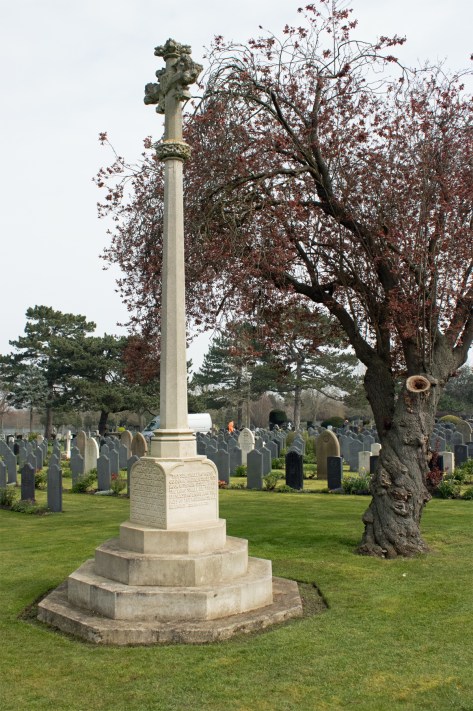
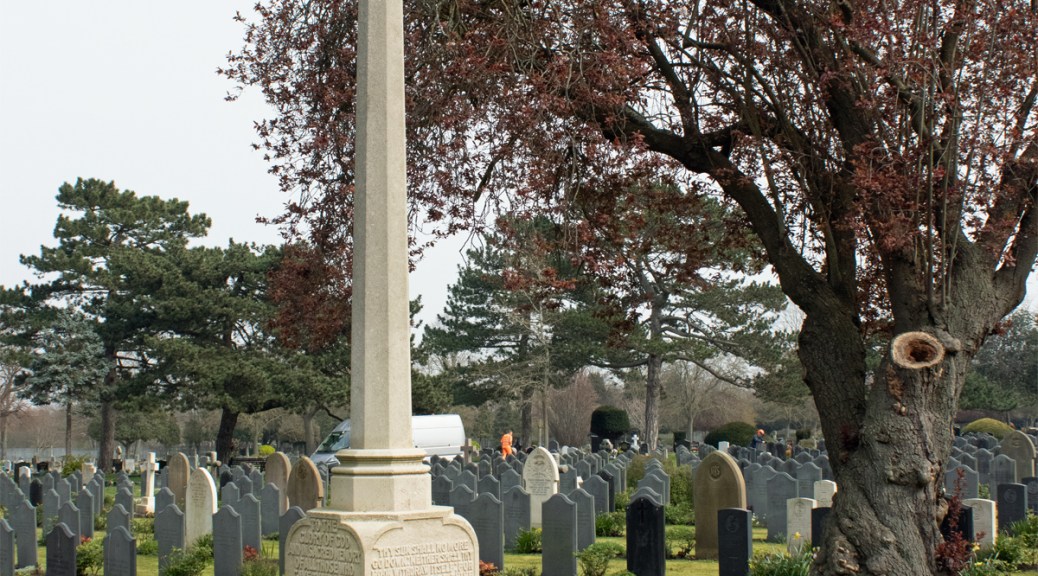
[Note: the photo above is of the memorial to the Chatham Air Raid victims, close to the mass grave for those whose bodies were not identified, in Woodlands Cemetery, Gillingham, Kent.]


Midshipman Gervase de Bless

Midshipman Gervase de Bless

Gervase Anthony David Herewyt de Bless was born on 20th October 1897 in Westminster, Middlesex. One of two children, he was the surviving son of barrister Alfred de Bless and his wife Maud, born Maud Cary-Elwes. Both were renowned families – Maud’s brother going on to become the Bishop of Northampton. The family do not appear in the 1901 census, but by 1911 Gervase’s parents were living at 156 St James’ Court, with French lady’s maid Henriette Forestier.

Alfred died not long after the census was taken. Gervase, meanwhile, was installed as a boarder at Downside College, Somerset. One of 168 students, he was taught by twelve schoolmasters and a handful of Roman Catholic priests from the local abbey.

An exceptionally clever boy of very active minds and many interests, during his time in the School he distinguished himself in all branches of study, winning the Gregorian Medal in 1912. He passed the Higher Certificate three times, twice gaining distinction in French and twice in Roman History. For three years he played in the Junior Cricket Eleven, which he captained in 1912. From 1908 to 1912 he sang in the choir as a treble, and he took a leading part with much success in “The Gondoliers,” and in “HMS Pinafore.” In 1914 he was Editor of The Raven, and he was on the committee of the Petre Library. In this year also he was awarded the Higher Certificate Latin Prose Prize given by St Gregory’s Society. On leaving Downside he spent two terms at Cambridge under the tuition of Mgr Barnes. Sensitive and somewhat retiring, and with health far from robust, he faced the situation created by the war with splendid courage, and obtained a cadetship in the Royal Navy. A skilful angler, fishing had ever been his favourite recreation, and on this pleasant pastime he wrote some charming verses which were afterwards collected in a little booklet.

[Baliol College War Memorial Book]

Gervase was given the rank of Midshipman in February 1916, and was assigned to the battleship HMS Revenge the following month. Before his posting he had suffered a bout of influenza, and had a relapse within days of boarding. He died from a combination of influenza and diabetes on 23rd March 1916, just two days after joining Revenge. He was just 18 years of age.

…rites of the Church… were administered to him by Dom Jerome Tunnicliffe, of St Mary’s, Liverpool, a monk of Downside.

[Baliol College War Memorial Book]

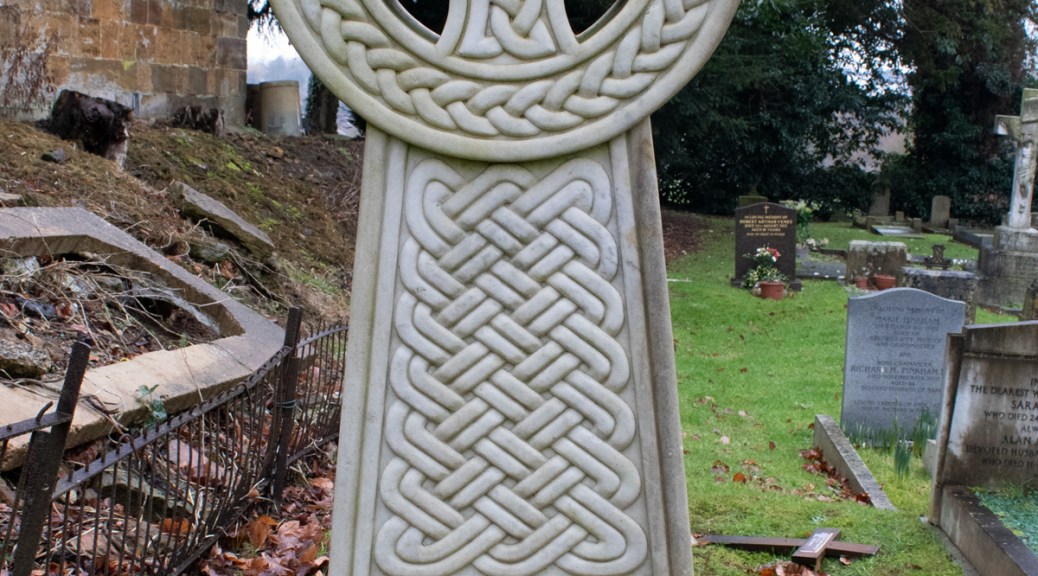
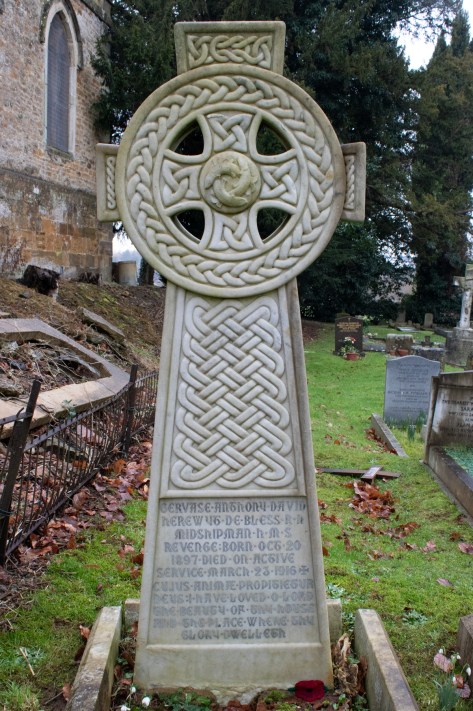
The body of Gervase Anthony David Herewyt de Bless was taken to Northamptonshire for burial. He was laid to rest in the ground of St Andrew’s Church, Great Billing, the last resting place of the Cary-Elwes family and de Bless families.


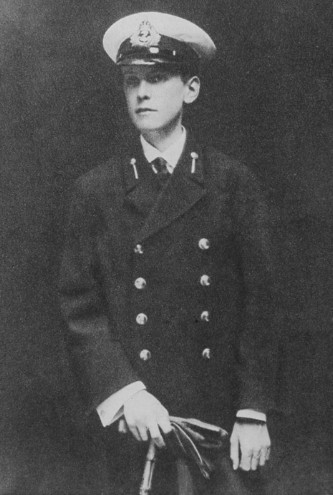
Midshipman Gervase de Bless
(from findagrave.com)

Second Lieutenant Edward Topley

Second Lieutenant Edward Topley

Edward Percival Augustus Topley was born on 6th November 1899 in Woolwich, Kent. He was the third of seven children to Percival and Sarah Topley. Percival was a grocer, and the 1901 census found the family living at 64 Eglinton Road, Plumstead.

Details about Edward’s early life are sketchy. There is a record of him learning to fly at the Cambridge School of Flying, and gaining his wings on 4th November 1917. “…he went through a course at the Royal Naval College, Greenwich. From there he was sent to Beaulieu Aerodrome, Hants…” [Kentish Independent: Friday 15th November 1918]

Edward rose to the rank of Second Lieutenant when the Royal Flying Corps and Royal Naval Air Service merged to become the Royal Air Force on 1st April 1918. Attached to the 29th Depot Training Station, he seems to have built up a fair amount of flying experience.

On 30th October 1918, Second Lieutenant Topley was flying his Sopwith Camel, when the engine stalled, and the aircraft crashed to the ground. Edward was killed instantly. He was a week shy of his nineteenth birthday.

The body of Edward Percival Augustus Topley – “a very promising young officer, and loved by all who knew him” [Kentish Independent: Friday 15th November 1918] – was taken to St Paul’s Church, East Boldre, not far from the base he had begun to call home, and laid to rest.


Second Lieutenant Edward Topley
(from britishnewspaperarchive.co.uk)

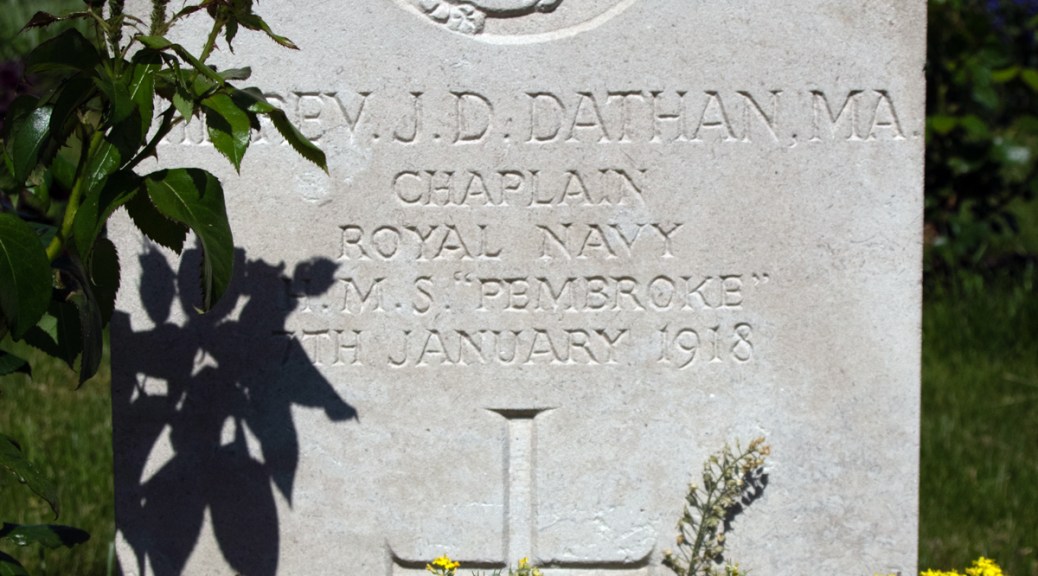
Reverend Joseph Dathan

Reverend Joseph Dathan

Much regret has been felt… at the death of Rev. JD Dathan MA, chaplain to the Royal Marines, at the age of 50 years. His death was due to pneumonia, caused by catching a chill while doing temporary duty… at the [Royal Naval Hospital, Chatham, Kent]. The eldest son of Captain JC Dathan RN, the deceased gentleman was educated at Christ’s Hospital and Cambridge, where he obtained the degree of MA. He entered the Royal Navy as a chaplain in 1896, and served on the China Station during the Boxer riots. For five years he was chaplain of Bermuda Dockyard and Hospital. He also served commissions in HMS Monmouth, Goliath and Russell. He was posted to the Royal Marine Barracks in July 1914, but on the outbreak of war he was appointed to HMS Formidable, and was transferred from the ship a week before she was lost. He was subsequently sent tot he Dardanelles for service in the Implacable at the first landing in April 1915. Later he joined the Italian Fleet, and was subsequently recalled to the Royal Marine Barracks. Three of the deceased officer’s brothers – Paymr.-in-Chief Ellis Dathan, Com. Hartley Dathan, and Eng.-Com. William Dathan – are serving in the Royal Navy.

[Naval & Military Record and Royal Dockyards Gazette: Wednesday 16th January 1918]

Joseph Duncan Dathan was born in 1866 in Halifax, Nova Scotia. The second of seven children, his parents were Joseph and Emma Dathan.

By the time of the 1891 census, the Dathan family had moved back to Britain. Joseph Sr and Emma were living in Portsea, Hampshire, while the younger Joseph was studying at Christ’s Hospital. The next return, taken in 1901, found him having taken up a role as curate at St John’s Church in Ipswich, Suffolk. He was, by this point, living on Foxhall Road on the western edge of the town.

On 25th February 1904, Joseph married Alicia Cane. The daughter of a vicar, she lived in Ipswich, and the couple married in the local parish church. By this point, Joseph was based in Portsmouth, Hampshire, and this is where the young couple set up home. Alicia gave birth to their first child, John, that November. The couple’s second son, Joseph, was born in 1906 and their third, daughter Alicia, was born in Bermuda while the family were stationed out there with Reverend Dathan’s work.

Joseph’s connection to the navy continued much as the newspaper reported. He died from pneumonia on 7th January 1918: he was 51 years of age.

Reverend Joseph Duncan Dathan was laid to rest in the naval section of Woodlands Cemetery in Gillingham, Kent, a place he would have known well, given its proximity to the Royal Naval Dockyard in Chatham, Kent, where he had been based.


Private Edward Vale

Private Edward Vale

Edward Charles Vale was born in the spring of 1890, one of ten children to William and Ellen. Born in Cambridgeshire, William was employed by the local railways, becoming a signalman by the time of the 1901 census. The family were raised in Great Shelford, before moving to the Ely area in the early 1900s.

By the time of the 1911 census, Edward was the oldest of three of his siblings to still be living at home. The Vales were living at 12 Granta Terrace, Stapleford, and Edward was employed as a domestic gardener.

When war broke out, Edward volunteered to serve his country. Full service details are lost to time, but he had enlisted in the Royal Fusiliers by the spring of 1915. By June of that year, Private Vale was fighting in the Balkans.

At some point during the conflict, Edward transferred to the Oxfordshire & Buckinghamshire Light Infantry. He remained in the Easter Mediterranean, but was badly wounded in the summer of 1917.

Medically evacuated to Britain, Private Vale was admitted to the Voluntary Aid Detachment hospital that had been set up at Knightshayes Court, Devon. While details are unclear, Edward’s injuries were to prove too severe. He passed away on 9th October 1917, at the age of 27 years old.

Edward Charles Vale was laid to rest in the peaceful graveyard of St Thomas’ Church in Chevithorne, not far from the hospital in which he had passed.


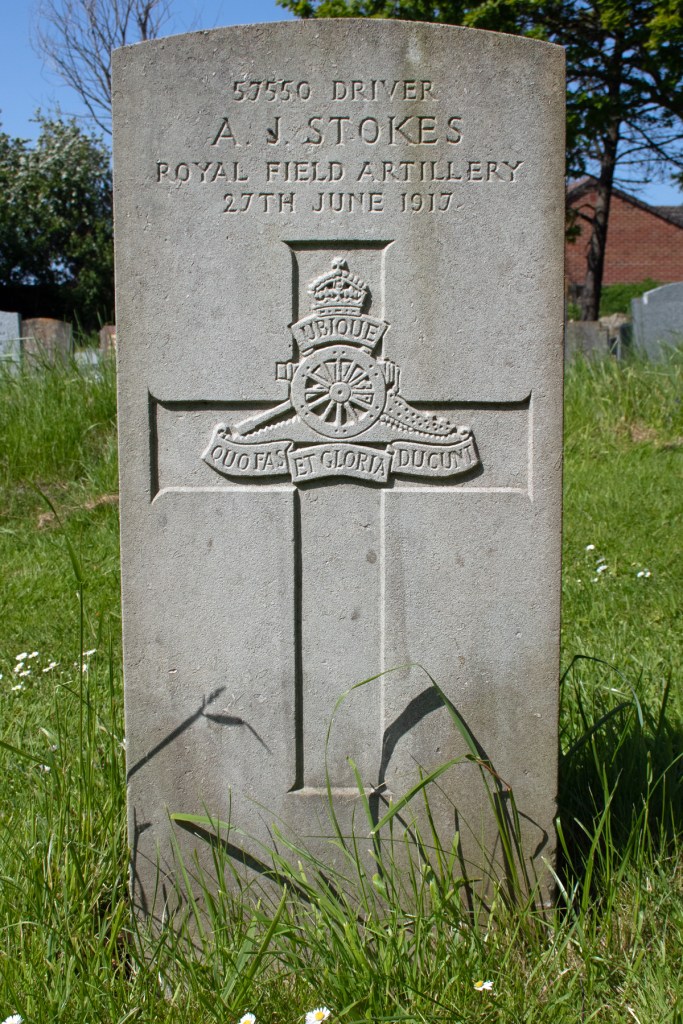
Driver Albert Stokes

Driver Albert Stokes

Albert John Stokes was born in the autumn of 1878, the fourth of seven children to John and Mary Ann Stokes. John was a cord winder from Puriton in Somerset, and it was in the village, in the house next to his parents, that he and Mary Ann raised their young family.

By the 1890s, John had turned his hand to boot making. When he finished his schooling, however, Albert found more manual work, and by the time he got married in 1903, he was working as a quarry labourer.

Albert’s wife was Minnie Nichols, a cooper’s daughter, who lived just up the road from the Stokes family. They married in Bridgwater Registry Office on Christmas Eve 1903. The newlyweds set up home in a small cottage in Puriton, and went on to have six children, although only four survived childhood.

When war came to Europe, Albert was one of the first to join up. He enlisted on 7th December 1914, and was assigned to the Royal Field Artillery as a Driver. His service records give an insight into the man he had become: he was 5ft 7ins (1.7m) tall, weighed in at 136lbs (61.7kg) and was of good physical development.

Driver Stokes spent the next eight months on home soil. He was sent to France on 21st July 1915, and was involved in the fighting at Loos. It was here, that he developed a persistent cough and, by October, he was back on home soil. That winter Albert contracted influenza, which then developed into haemoptysis.

While Driver Stokes did recover, he was admitted to the Voluntary Aid Detachment Hospital in Bishops Stortford in May 1916, having come down with influenza once more. He was transferred to the 1st Eastern General Hospital in Cambridge for a medical assessment, and this led to an eventual discharge from the army in August.

Albert returned to Somerset after leaving the Royal Field Artillery, although his trail does go cold. He was at home when he passed away on 27th June 1917, at the age of 39 years old. The cause of his passing is not recorded, but it is likely to have been as a result of a repeat of the conditions that had led to him leaving the military.

Albert John Stokes was laid to rest in the peaceful graveyard of St Michael’s Church in his home village of Puriton.


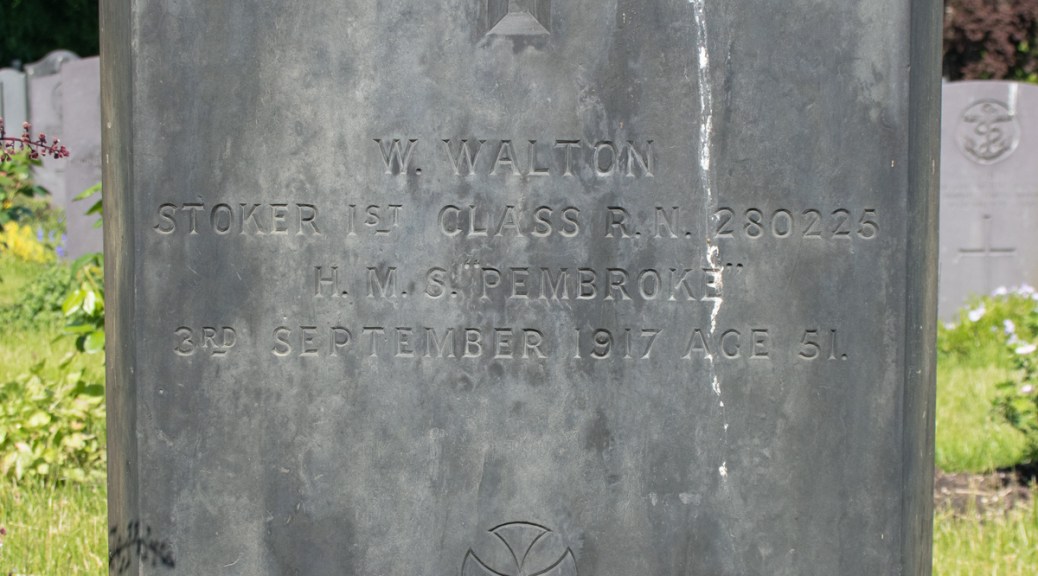
Stoker 1st Class William Walton

Stoker 1st Class William Walton

William Walton was born in St Neots, Cambridgeshire, early in 1868, the oldest child of William Moran and Hannah Walton. The couple married shortly after William’s birth and went on to have six further children. William Sr was a bricklayer’s labourer from Cambridgeshire, and until his mother’s death in 1903, William Jr used his father’s surname.

By the time of the 1881 census, William Sr had moved the family to London, where work was more plentiful. It was here that his eldest son met Annie Vigo; they married in Bethnal Green in August 1886 – using Hannah’s maiden name – and went on to have a son – also called William – the same year.

William was also working as a labourer by this point, but by the mid-1890s he and Annie had five children, and he needed a steadier income. In August 1895, he enlisted in the Royal Navy for a period of 12 years. His service record show that he stood 5ft 4ins (1.63m) tall, had brown hair, blue eyes and a fair complexion. He was also noted to have a scar on his head and an anchor tattoo on his left forearm.

Stoker 2nd Class Walton was initially based at HMS Victory, the training base in Portsmouth. By April 1896 he had been given his first off-shore assignment, HMS Fox. This was a cruiser, and he spent more than three years aboard, gaining a promotion to Stoker 1st Class in the process.

The summer of 1899 saw William back on land, as he was assigned to HMS Pembroke, the shore-based establishment at the Royal Naval Dockyard in Chatham. He remained here for the next three years, and returned to the dockyard in between assignments at sea.

In August 1907 Stoker Walton’s term of service with the navy came to an end, and he was placed on reserve. By this point he and Annie had had two more children, bringing the total to seven. The 1911 census found the family living in London, where William was still recorded as a stoker.

War was imminent, and, when hostilities broke out, William was recalled. This time, and probably because of his age, he was wholly based on land, spending nine months in Portsmouth, and the rest of the time in Chatham.

HMS Pembroke was a busy place and, in the summer of 1917, it had reached capacity. The Drill Hall was used as temporary accommodation, and this is where Stoker Walton found himself billeted.

On 3rd September, the German Air Force was trialling night raids on English locations to avoid suffering casualties in daylight; that night Chatham found itself in their flight path. The Drill Hall received a direct hit, and Stoker 1st Class Walton was killed, along with close to 100 others. He was 49 years old [the gravestone suggests a different age].

William Walton was laid to rest in the Woodlands Cemetery in Gillingham, within walking distance of the dockyard that had become his home. He was buried alongside the other victims of the Chatham Air Raid.


William’s younger brother Arthur Moran was also involved in the hostilities of the First World War. As a Bombardier in the Royal Garrison Artillery, he was caught up in the fighting on the Western Front, losing his life on 6th February 1917, seven months before his older brother. He was laid to rest in the Cité Bonjean Military Cemetery in Armentières, France.


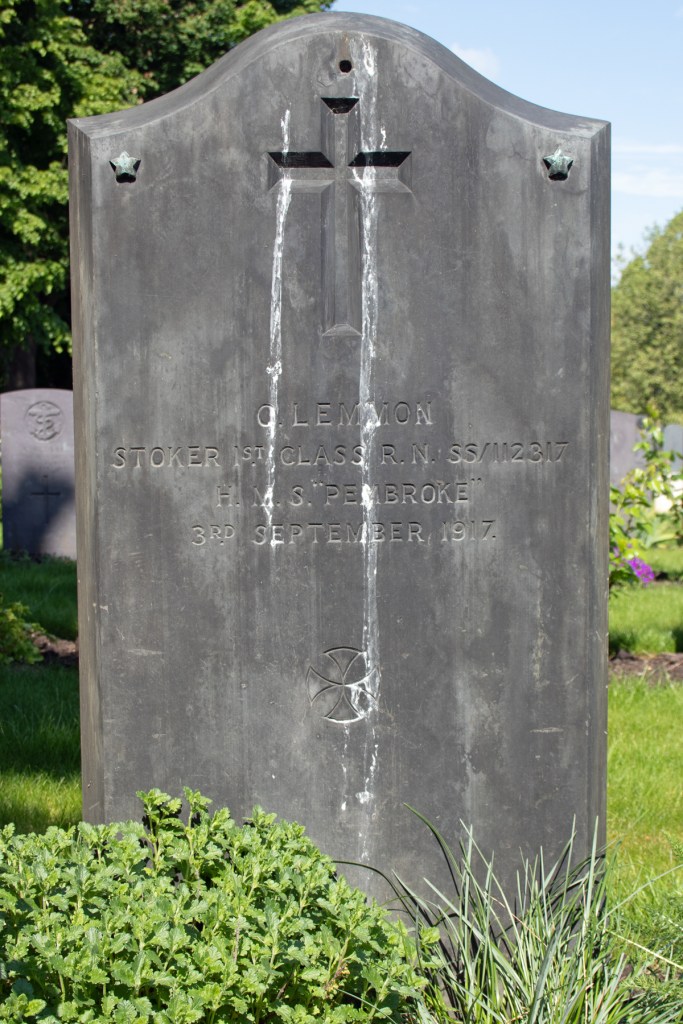
Stoker 1st Class Charles Lemmon

Stoker 1st Class Charles Lemmon

Charles Lemmon was born in Norwich, Norfolk on 12th July 1892. He was one of ten children and the son of bricklayer Henry Lemmon and his wife Sophia.

When Charles left school, he found work as an errand boy; by the time of the 1911 census, he had moved to Cambridge. He was living with John Buol, a Swiss confectioner and pastry chef who had set up a restaurant in the centre of the city, opposite King’s College.

The move from Norfolk to Cambridgeshire must has ignited a yearning for travel, however. Within a year, Charles had enlisted in the Royal Navy, and was taken on as a Stoker 2nd Class. His naval records show that he stood at 5ft 2ins (1.57m) tall, had brown hair, grey eyes and a fair complexion. It was also noted that he had a scar on his left leg.

Stoker Lemmon was set to see the world. After his initial training at HMS Pembroke – the Royal Naval Dockyard in Chatham, Kent – he was assigned to HMS Berwick, an armoured cruiser that sailed between England and the Americas.

The following year, Charles was reassigned to HMS Swiftsure, and received a promotion to Stoker 1st Class. He returned to HMS Pembroke in May 1916, and, after a couple of months on land, boarded HMS Titania, a submarine depot ship that had recently seen action in the Battle of Jutland.

Stoker Lemmon spent just under a year on the Titania, before again returning to Chatham in the spring of 1917. HMS Pembroke was a crowded place that summer, Charles was billeted in temporary accommodation in the dockyard’s Drill Hall.

On 3rd September, the German Air Force was trialling night raids on English locations; Chatham found itself in the line of fire. The Drill Hall received a direct hit, and Stoker 1st Class Lemmon was killed, along with close to 100 other servicemen resting there. He was just 25 years of age.

The servicemen who lost their lives in the Chatham Air Raid, including Charles Lemmon, were laid to rest in the Woodlands Cemetery in nearby Gillingham.