
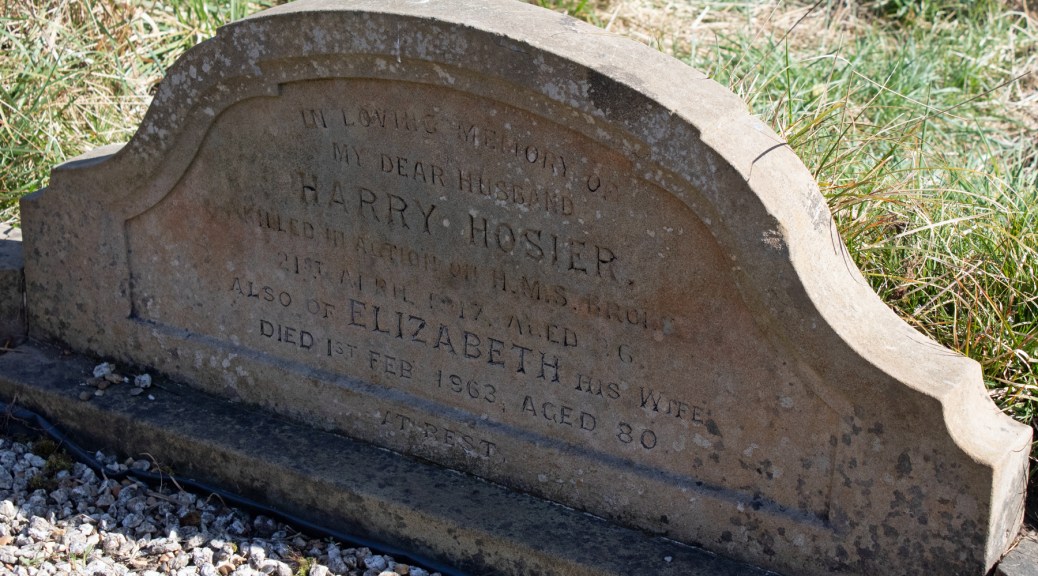
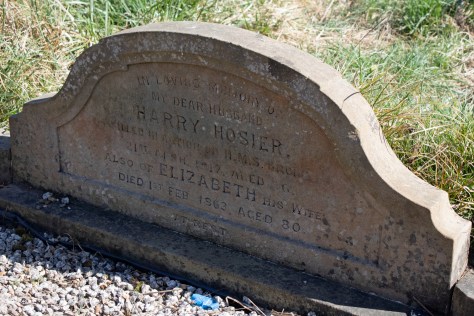
Henry – or Harry – Hosier was born on 22nd September 1880 at 2 Wenban Terrace, Worthing, West Sussex. The fourth of ten children, his parents were Charles and Elizabeth. Charles was a jack of all trades, working as a carman for the railway in 1881, and a gardener by 1891. That census recorded that the family had moved to 1 Ham Road, in East Worthing, and that Charles was the only person bringing money into the household.
When Harry completed his schooling, he found work as a coachman. On 3rd November 1900 he married Elizabeth Jenkins at Christ Church in Worthing town centre. Elizabeth was living in nearby Broadwater when the couple exchanged vows. Her father is unknown and the surname she went by was her mother Charlotte’s first husband’s name, although he died eighteen months before she was born. Charlotte married a second time, to a Stephen Lillywhite, and, for a while her daughter was listed with his surname. By the time she married Harry, however, Elizabeth had reverted to Jenkins.
Harry and Elizabeth initially moved in with Charlotte and Stephen. By the time of the 1911 census, however, they had set up their own home on Broadwater Street, to the north of Worthing town centre. The couple would go on to have seven children, although two would pass away in infancy.
Harry was working as a cab driver by this point but, when war broke out, he would be called upon to play his part. He enlisted on 26th June 1916, joining the Royal Navy as an Ordinary Seaman. His service papers show that he was 5ft 3.5ins (1.61m) tall, with dark brown hair, brown eyes and a dark complexion. His is also noted as having a number of tattoos on his arms.
Ordinary Seaman Hosier was initially sent to HMS Victory, the Royal Naval Dockyard in Portsmouth, Hampshire, for his training. In August 1916, however, he was assigned to the destroyer HMS Broke. Fresh from the Battle of Jutland, she was part of the 4th Destroyer Flotilla, charged with protecting the English Channel.
On the 20th and 21st April 1917, Broke took part in the Battle of Dover Strait against six German torpedo boats. In the confusion of the skirmish, Broke rammed the enemy ship SMS G42, and the two vessels became locked together. For a while the crews fought in hand-to-hand combat, before the British ship managed to break free. Soon afterwards the German boat sank. Badly damaged, HMS Broke had to be towed back to Dover: 21 of the crew – including Ordinary Seaman Hosier – were killed, and a further 36 were wounded. Harry was 36 years of age.
The body of Harry Hosier was taken back to Sussex for burial, his funeral at Broadwater Cemetery, making the local newspapers:
A fallen hero of the naval fight off Dover last week was buried in Worthing yesterday with full service honours. Worthing people welcomed the opportunity to show honour to a townsman who had laid down his life in one of the most brilliant naval exploits of the war, and the occasion was unique in that the funeral was the first to take place locally during the war of a naval man killed in action. Seaman Harry Hosier was serving on the destroyer leader “Broke,” so valiantly commanded by Commander Edward Evans, CB, when he met his end. He died the death of a Briton after nobly doing his duty. The coffin was conveyed from Dover to Worthing for the funeral at the request of the deceased’s relatives. Scenes of the most impressive character were witnessed, the route of the procession being thronged from one end to the other, and several thousand people assembled at the cemetery…
The Red. EJ Elliott (Rector) officiated, and from the pulpit gave a stirring address. He said “In the course of the 700 years’ history of this church, I don’t suppose there has ever been a service quite like the present one – the funeral of a Broadwater man killed in action. Forty or more Broadwater men have already made the supreme sacrifice, and we are glad this afternoon to be able in a special way to honour these noble men. In all probability Henry Hosier will be the last in this war who will be called upon to die whose funeral will take place at home. In doing honour to whim whose mortal remains are with us this afternoon – the remains of a gallant bluejacket belonging to HMS Broke – we do honour to our two score other parishioners who at the call of duty, joined up, and are now sleeping their last sleep.
“They heard their Motherland calling to them for the help of their sons and at once, with enthusiasm and alacrity, they responded. They loved their loves as we do, but they loved something more – they had a deeper love for their country and for the safety of their homes and hearth. They died, let us remember, for us, in order that we at home might be spared the agony and the martyrdom of the Belgians and the Serbians. They died in order that we might remain safe and comfortable in the home land and not be called upon the endure the nameless agony and also the atrocities perpetrated by the Huns. We leave the soul of Henry Hosier and of our 40 other Broadwater heroes in God’s hands…”
[Sussex Daily News: Friday 27th April 1917]
Two of Harry’s siblings – Christopher and Ernest – had added to the tally of Broadwater’s forty.
Ernest Hosier was born in 1895, and was the ninth of Charles and Elizabeth’s children. He found work as an errand boy when he left school, but managed to associate himself with the wrong group of friends.
Ernest Hosier, 14, errand boy, on bail, and Frederick Clark, 21, rag and bone collector, were indicted for offences against Fanny Newman and Alice Smith, girls between 13 and 16 years of age, at Worthing, between December 1st, 1909, and March 11th, 1910.
Clark pleaded guilty and Hosier not guilty. The latter gave an absolute denial to the charge, and suggested that the girls had associated him with the charge in revenge because he would have nothing to do with them…
After hearing the evidence, the jury found Hosier not guilty, and his Lordship said he was discharged without any imputation whatever upon his character. Clark was sentenced to six months’ hard labour, his Lordship remarking that girls of the character of those in this case were a terror and a real temptation to men.
[Hastings and Bexhill Independent: Thursday 30th June 1910]
Soon after the court hearing, Ernest joined the Royal Navy, the 1911 census recording him as a boarder at the Training Establishment in Shotly, near Ipswich, Suffolk. After serving on a number of vessels, he came of age, and formally enlisted as an Ordinary Seaman on 16th October 1912. Within a year he had been promoted to Able Seaman and in the summer of 1914, he was assigned to the battlecruiser HMS Invincible.
Able Seaman Hosier was on board during the Battle of Heligoland Bight in August 1914, and the Battle of the Falklands that November. In May 1916 Invincible was involved in the Battle of Jutland, and Ernest was one of the 1,000 crew who were killed when she was was hit by a number of German salvoes and sank. Able Seaman Hosier was 21 years of age, and is commemorated on Portsmouth Naval Memorial.
Christopher Hosier was born in 1887, and was working as a cellarman when war broke out. He enlisted in the Royal Sussex Regiment, and was assigned to the 7th Battalion.
In the autumn of 1917, Private Hosier’s unit was caught up on the Western Front, as Arras and Cambrai. It was here, on 20th November 1917, that he was killed, although his body was not recovered. He was 29 years of age, and is commemorated on the Cambrai Memorial.

