Category Archives: Australian Infantry

Private Richard Ryan

Private Richard Ryan

Richard Charles Gladstone Ryan was born in Talia, South Australia, on 31st March 1895. The son of Richard and Margaret Ryan, he was the older of two chidren.

There is little information available about Richard Jr’s early life. When he finished his schooling, he found work as a farm hand, and this was the trade he was following when war broke out. In his spare time, he was a member of the Elliston Rifle Club, and, on receiving the call to serve his King and Empire, he stepped up to play his part.

Private Ryan’s service papers show that he enlisted in the Australian Imperial Force on 13th March 1916. The document shows that he was 5ft 4.75 (1.64m) tall, and weighed 143lbs (64.9kg). A Roman Catholic, Richard had auburn hair, brown eyes and a medium complexion.

Richard ‘s unit – the 50th Battalion of the Australian Infantry – left Adelaide on 21st September 1916. The ship he was on, the A73 Commonwealth, would take nearly two months to reach Britain, and he disembarked in Plymouth, Devon, on 14th November. From there, he was marched to the ANZAC base in Codford, Wiltshire.

Soon after arriving, Private Ryan became unwell. He had contracted pneumonia, and was admitted to the No. 3 New Zealand General Hospital in Codford on 13th December 1916. His condition quickly worsened, and he passed away just three days later. He was 21 years of age.

The body of Richard Charles Gladstone Ryan was laid to rest in the newly extended graveyard of St Mary’s Church in Codford.


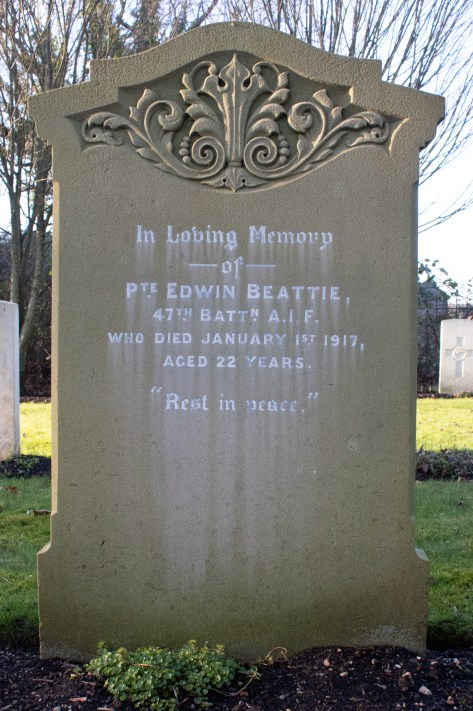
Private Edwin Beattie

Private Edwin Beattie

Edwin Beattie was born on 14th March 1894, in the town of Coomera, Queensland, Australia. He was the youngest of three children to John and Mary Beattie.

There is little information available about Edwin’s early life, but when he completed his schooling, he took up farm work. When war broke out, he was keen to play his part, and enlisted in the Australian Imperial Force on 28th March 1916.

Private Beattie’s service records show that he was 5ft 9.5ins (1.65m) tall, and weighed 136lbs (61.7kg). A Methodist, he was recorded as having brown hair, blue eyes and a medium complexion. He also had a birthmark on the small of his back, and scars on both knees.

Edwin was assigned to the 44th Battalion of the Australian Infantry. His After training, his unit boarded the SS Seang Choon in Brisbane, and set off on the ten month voyage to Britain, arriving in Devonport, Devon, on the 9th December 1916.

During the voyage, Private Beattie had fallen ill, and, on disembarking, he was taken to the local hospital for treatment. By 23rd December, he was moved to the Military Hospital connected to the ANZAC camp in Codford, Wiltshire. His condition – pneumonia – worsened over the coming days, and Edwin would eventually succumb. As a new year began, he breathed his last, passing away on 1st January 1917, at the age of just 22 years of age.

Thousand of miles from home, Edwin Beattie was laid to rest in the newly extended graveyard of St Mary’s Church, Codford.


Private Edwin Beattie
(from findagrave.com)

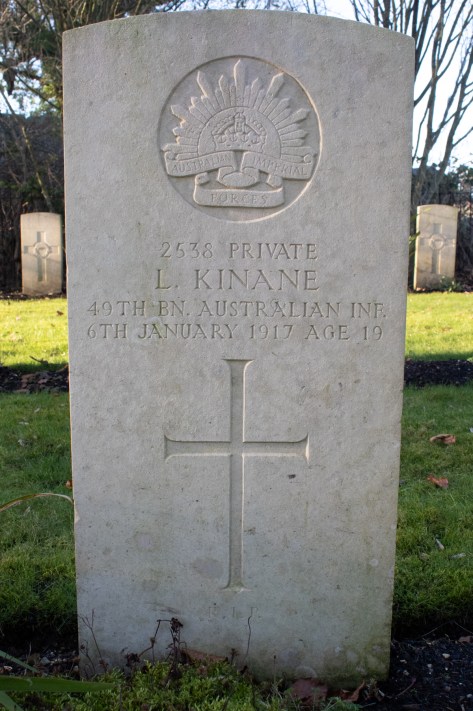
Private Lawrence Kinane

Private Lawrence Kinane

Lawrence Kinane was born in Tipperary, Ireland, in 1896. One of eight children, his parents were Daniel and Catherine Kinane. Daniel was a farmer and, when Catherine died when Lawrence was just 10 years old, he was left to raise the support the family on his own.

At this point, the family’s trail goes cold, and it later picked up in an unexpected way. Daniel and some of the children seem to have emigrated to the United States, and he died in Brooklyn in March 1914. Lawrence, meanwhile, seems to have gone further, seeking a new life in Australia. A cousin, Mary Mulcahey, was living with her husband in Warwick, Queensland, and, by the time war broke out, he had moved to Brisbane.

Lawrence was working as a labourer when, on 10th June 1916, he enlisted in the Australian Imperial Force. His service papers show that he was 5ft 11ins (1.8m) tall and weighed 147lbs (66.7kg). A Roman Catholic, he had dark brown hair, grey eyes and a medium complexion. Under Distinctive Marks, he was recorded as having a large patch of scars on his left side, about 7ins (18cm) above his buttock.

Private Kinane’s unit – the 49th Battalion of the Australian Infantry – set sail from Brisbane on the 19th September 1916. His ship – the SS Seang Choon – would take ten weeks to reach its destination – Devonport, Devon, and Lawrence finally arrived at the ANZAC base in Codford, Wiltshire in mid-December.

The lengthy sea voyage had taken its toll on a lot of the soldiers being transported, and Private Kinane was not to be immune. Within weeks of arriving, he came down with pneumonia, and was admitted to the No. 3 New Zealand General Hospital in nearby Sutton Veny on 31st December. Lawrence’s condition worsened, and he finally succumbed to it on 6th January 1917. He was just 20 years of age.

Thousands of miles from Australia, and with no family close by, the body of Lawrence Kinane was instead laid to rest in the graveyard of St Mary’s Church in Codford, not far from the base that had been his home for just a few short weeks.


Private Lawrence Kinane
(from findagrave.com)

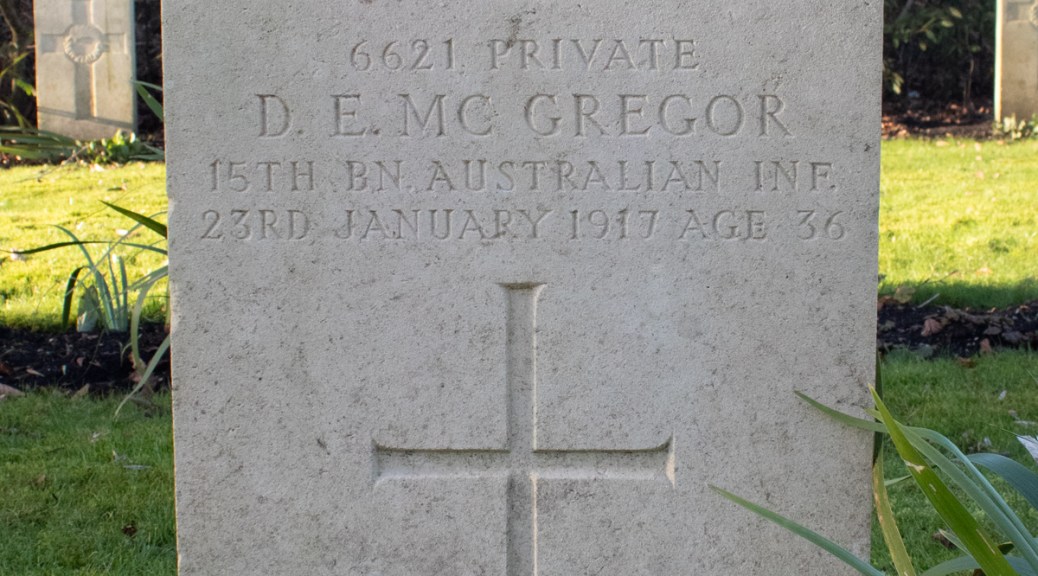
Driver David McGregor

Driver David McGregor

David Edward McGregor was born in Bega, New South Wales, Australia, in the summer of 1880. One of fourteen children, his parents were John and Isabella McGregor.

There is little information about David’s early life, but when he completed his schooling, he found work in a dairy, eventually becoming employed as a cheesemaker.

When war broke out, David stepped up to serve his King and Empire, enlisting in the Australian Imperial Force as a Driver on 7th July 1916. His service records show that he was 5ft 10.5ins (1.79m) tall and weighed in at 168lbs (76.2kg). A Presbyterian, he was noted as having black hair, brown eyes and a medium complexion.

Driver McGregor’s unit – the 15th Battalion of the Australian Infantry – set sail from Brisbane on the SS Boonah on 21st October 1916. Their journey would take ten weeks, arriving in Devonport, Devon, on 10th January 1917. From here David was marched in to the ANZAC camp at Codford, Wiltshire.

The lengthy sea voyage had taken its toll on a lot of the troops, and David was not to be immune. He came down with pneumonia and, after initially being treated in the camp hospital, he was admitted to the military hospital in Codford in a moribund condition. Driver Brooks’ move was to prove too little, too late, and he passed away on 23rd January 1917, just a day after being admitted. He was 36 years of age.

David Edward McGregor was laid to rest in the ANZAC extension to St Mary’s Churchyard in Codford, Wiltshire, not far from the base he had so briefly called home.


Private Harold Brooks

Private Harold Brooks

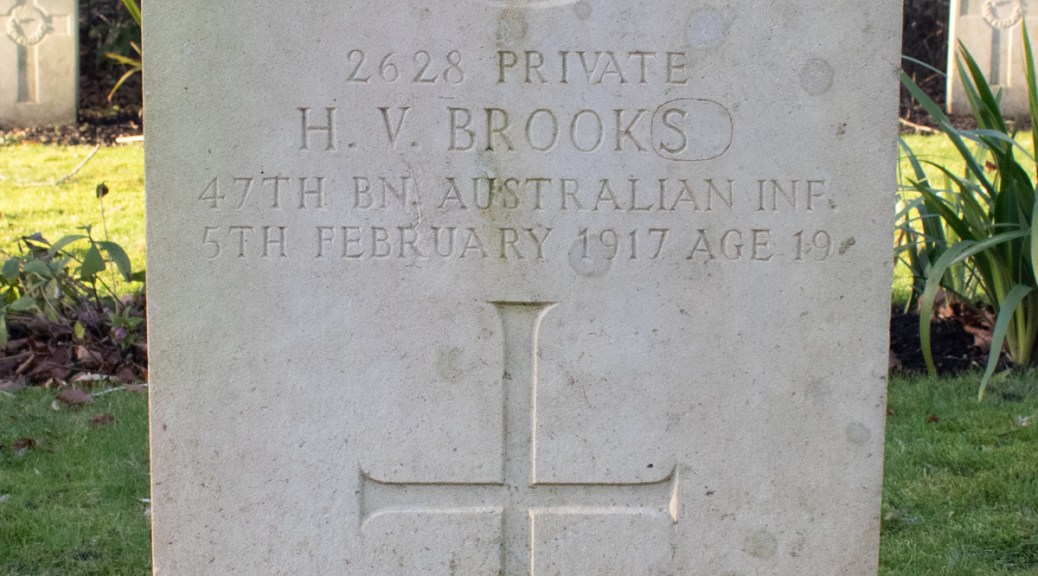
Harold Vincent Brooks was born in Ipswich, Queensland, Australia, in the spring of 1898. One of ten children, his parents were William and Mary Brooks.

Little information is available about Harold’s early life, but when he completed his schooling, he found work as a labourer. When war broke out, he was initially turned down for military service because of poor eyesight, but as the conflict rolled on, he tried to enlist again and was accepted into the Australian Imperial Force.

Private Brooks’ service records show that he was 5ft 4.5ins (1.63m) tall, and weighed 136lbs (61.7kg). A Roman Catholic, he had brown hair, hazel eyes and a medium complexion.

Assigned to the 47th Battalion of the Australian Infantry, Harold left his home country from Brisbane on the 27th October 1916. The ship his unit was sailing on – the Marathon – took just over ten weeks to reach Britain, eventually docking in Devonport, Devon. From there Private Brooks was marched to the ANZAC camp in Codford, Wiltshire.

Harold’s time in Britain was not to be a lengthy one. He contracted pneumonia, and was admitted to the nearby Sutton Veny Military Hospital on 24th January. Private Brooks’ condition worsened, and he passed away on 5th February 1917. He was just 19 years of age.

Thousands of miles from home, the body of Harold Vincent Brooks was buried in the newly extended St Mary’s Churchyard, Codford.


Private Alfred Parkinson

Private Alfred Parkinson

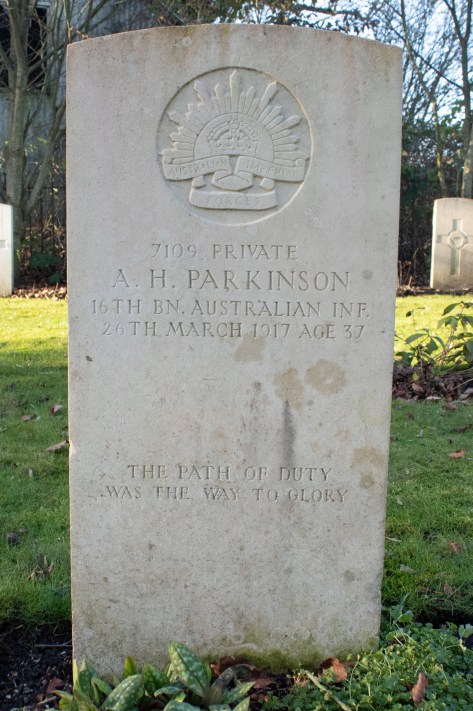
Alfred Henry Parkinson was born in Reedy Creek, South Australia, on 20th October 1880. One of nine children, his parents were William and Isabella Parkinson.

There is little concrete information about Alfred’s early life, but when he finished his schooling he found work in the mines. When war broke out, however, he stepped up to play his part, joining the Australian Imperial Force on 2nd November 1916.

Private Parkinson’s service records show that he was 5ft 9ins (1.65m) tall, and weighed in at 10st 4lbs (65.3kg). He was noted as having brown hair brown eyes and a fair complexion. After a month’s training, he left Australia on board the SS Berrima, bound for Europe.

Alfred’s unit – the 16th Battalion of the Australian Infantry – arrived in Devonport, Devon, on 16th February 1917. Within a matter of days he arrived at the ANZAC camp at Sutton Veny, Wiltshire.

Illness amongst the Australian troops was rife by the time they arrived in Britain, and Private Parkinson was not to be immune. He was admitted to the Military Hospital connected to the camp on 20th March, suffering from bronchial pneumonia. The condition worsened, and he died just six days later. Alfred was 36 years of age.

Thousands of miles from home, the body of Alfred Henry Parkinson was laid to rest in the newly extended graveyard of St Mary’s Church, Codford, not far form the base in which he had breathed his last.


Private Frank Buck

Private Frank Buck

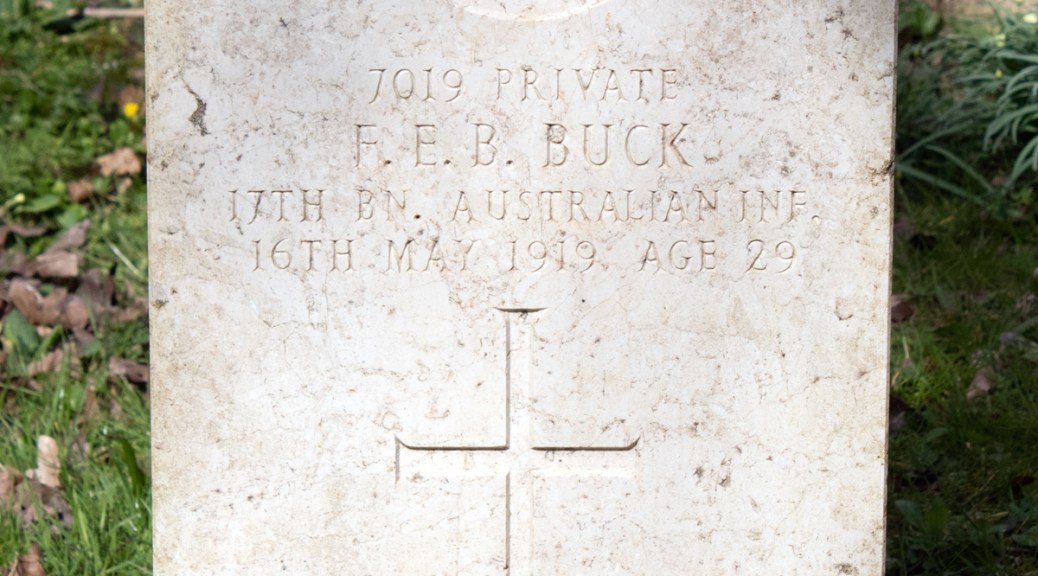
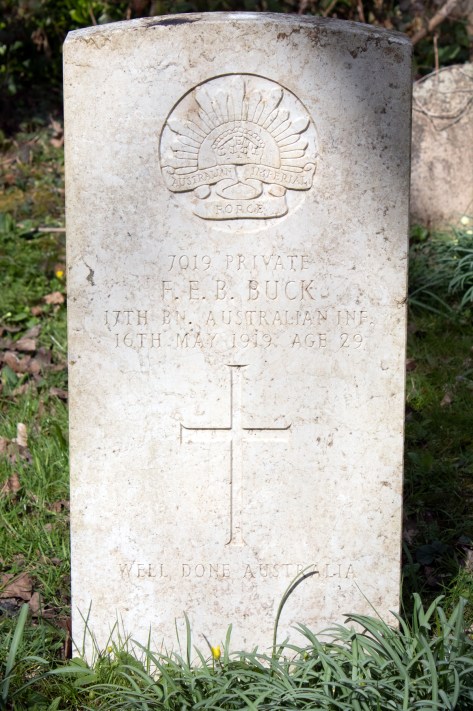
Frank Ernest Brydgnes Buck was born in Islington, Middlesex, early in 1889, his mother’s name was Rosina, but his father’s details have been lost to time, the 1901 census confirming that she was a widow. The document notes that Frank was the youngest of four children, and the family had taken rooms in a three-storey house on Yerbury Road.

By the summer of 1917, Frank had emigrated to Australia. Settling in the town of Inverell, New South Wales, he took employment as a clerk. However, when war came to Europe, he was called on to play his part, and enlisted in the Australian Imperial Force on 16th July 1917.

Private Buck’s service records confirm that he was 5ft 11.5ins (1.82m) tall and weighed 11st 4lbs (71.7kg). He was recorded as having dark hair, blue eyes and a dark complexion. He had a burn scar on his right forearm, and a third nipple on the right side of his chest.

Frank’s unit departed from Sydney on 31st October 1917, and he spent the next two months on board the SS Euripides. During that time he was promoted to Acting Corporal and, when he disembarked in Devonport, Devon, on 26th December, he marched to the ANZAC camp in Fovant, Wiltshire.

Assigned to the 5th Training Battalion, Frank seems to have taken this unexpected return to Britain as a free ticket home: on 6th February 1918 he went AWOL, and only surrendered back to his unit on 9th April. Help in detention for a day, he forfeited 63 days’ pay, and was demoted to the rank of Private for his actions.

On 13th May, Private Buck was dispatched to France. He was assigned to the 17th Battalion of the Australian Infantry, but his time overseas was not to be a lengthy one. In July he was admitted to the 5th Australian Field Ambulance with gastritis: he was then transferred to the 5th Casualty Clearing Station, then the 3rd General Hospital in Le Treport. Medically evacuated to Britain for treatment, he ended up in Reading War Hospital for ongoing treatment.

Placed on furlough on 16th September, Private Buck went AWOL again on just two weeks later. Arrested on 26th November 1918, he was hauled before a judge at Highgate Police Court: his crimes amounted to being absent without leave, but also stealing three blank cheques and forgery. Pleading guilty, he was sent to Wormwood Scrubs for nine months.

Frank would not end up serving his time, however. He was admitted to the infirmary with a perforated duodenal ulcer, and died from exhaustion on 16th May 1919. He was 29 years of age.

Frank Ernest Brydgnes Buck was laid to rest in Highgate Cemetery.


Private Harry Holder

Private Harry Holder

Harry Holder was born in the village of Ludgvan, Cornwall, in the summer of 1885. The oldest of fourteen children, his parents were Harry and Grace Holder. Harry Sr was a market gardener, and his oldest son was to follow in his footsteps.

By the time of the 1911 census, the Holders had moved to Cheltenham, Gloucestershire. Settling in a seven-room house in Leckhampton Road, the household of eleven people had six wages coming in, split between market gardening for the men and floristry for the women.

The following year, Harry Sr took his family on the long journey to Australia for a new life. They found work on a farm near Perth, and Harry Jr was employed as an agricultural labourer when war broke out. When the call came, he stepped up to play his part and his service records suggest that he had spent four years in the territorial army back in Britain. Harry had been turned down for service because of the state of his teeth just a month before trying to enlist again. The second time, however, he was successful, and he joined the Australian Imperial Force on 13th September 1916.

Private Holder’s medical report confirmed the man he had become. At 31 years of age, he was 5ft 10.5ins (1.79m) tall, and weighed 140lbs (63.5kg). A Roman Catholic, he had brown hair, blue eyes and a fresh complexion.

Assigned to the 16th Battalion of the Australian Infantry, Private Holder’s unit departed from Fremantle on 21st January 1917, travelling no board the ship Miltiades. Just under two months later, on 27th March, Harry arrived back in Britain, docking at Devonport, Devon, before moving with his battalion to a camp on the outskirts of Codford, Wiltshire.

A significant proportion of the ANZAC troops became unwell within weeks of arriving at the camp, and Harry was not to avoid illness. On 27th April he was admitted to the barracks’ hospital with cerebrospinal meningitis, but the treatment was to prove too little, too late. Private Holder died on 28th April 1917: he was 31 years of age.

Harry Holder was laid to rest in a new extension to St Mary’s Churchyard in Codford, close to the base where he had breathed his last.


Private Harry Holder
(from findagrave.com)

Private Thomas Bickley

Private Thomas Bickley

Thomas George Bickley was born in Fremantle, Australia, in 1881, and was the second of six children to Absolom and Mary Bickley. May had been married and widowed twice before wedding Thomas’ father, and so he had eight half-siblings as well.

Thomas’ early life is a challenge to piece together, but his service records from the First World War fill in some of the detail. He confirms that he had served in the 1st Imperial Light Horse for eleven months, and that he fought in South Africa – presumably as part of the Boer War of 1899-1902.

At the time of enlisting on 13th September 1916, he was working as a carpenter, and had completed a five-year apprenticeship. He married Rose Buck in 1907, but they did not have any children.

Private Bickley was assigned to the 16th Battalion of the Australian Infantry, and his medical report confirms the man he had become. He was 5ft 10ins (1.77m) tall and weighed 170lbs (77.1kg). At 34 years of age, he had light brown hair, blue eyes and a fresh complexion.

Thomas’ unit left Fremantle on the Argyllshire. The troop ship arrived in Devonport, Devon, two months later, and his battalion was sent to their base near Codford in Wiltshire. The journey impacted a lot of soldiers, and Thomas was not to be immune from this.

On 12th February Private Bickley was sent to the camp hospital as he was suffering from bronchitis. The severity of his condition meant he was immediately transferred to an army hospital in nearby Sutton Veny, but it was to prove too late. Thomas died from the lung condition on 23rd February 1917: he was 35 years of age.

Thomas George Bickley was laid to rest in the ANZAC extension to St Mary’s Churchyard, Codford, not far from the based that had so briefly been his home.


Private Thomas Gorman

Private Thomas Gorman

Thomas Michael Gorman was born on 6th April 1887 and was the seventh of ten children. Both of his parents – Patrick and Mary Gorman – were Irish, and had followed Patrick’s work around the world as an army Quartermaster Serjeant. By the time Thomas came along, the family had settled in Australia, and he was born in Brisbane.

There is little information about Thomas’ early life. When he completed his schooling, his father took him on as an apprentice and, by the time war broke out, he was working as a mechanic.

Thomas enlisted in the Australian Imperial Force in March 1916. His service records show that he was 5ft 8ins (1.72m) tall, and weighed 138lbs (62.6kg). A Roman Catholic, he was recorded as having dark hair, light blue eyes and a fair complexion. It was also noted that he had two scars – one relating to his appendix, and another to a hernia operation.

Private Gorman’s unit – the 15th Battalion of the Australian Infantry – set sail for Europe on 8th August 1916. After just over two months on board the Itonus, they arrived in Plymouth, Devon, from where they were sent to Codford, Wiltshire, which is where several of the ANZAC battalions were based.

Thomas’ service was a mixed one, and his record is not without blemish. In October 1916, he was confined to barracks for seven days for going absent without leave. The following month, the same thing happened, and he we detained for a further seven days.

In December 1916, Private Gorman was admitted to a military hospital in Fovant, near Salisbury, suffering from jaundice. By February 1917 he was back in Codford, and was held in detention for two weeks, for going absent without leave, being drunk in the lines and for urinating in the lines.

Thomas’ jaundice had returned, and he was admitted to the camp hospital again. This time, however, he luck was to run out. He passed away on 14th March 1917, at the age of 29 years old.

Thomas Michael Gorman was laid to rest in the graveyard extension to St Mary’s Church in Codford, Wiltshire.