
Category Archives: Reserve Cavalry Regiment

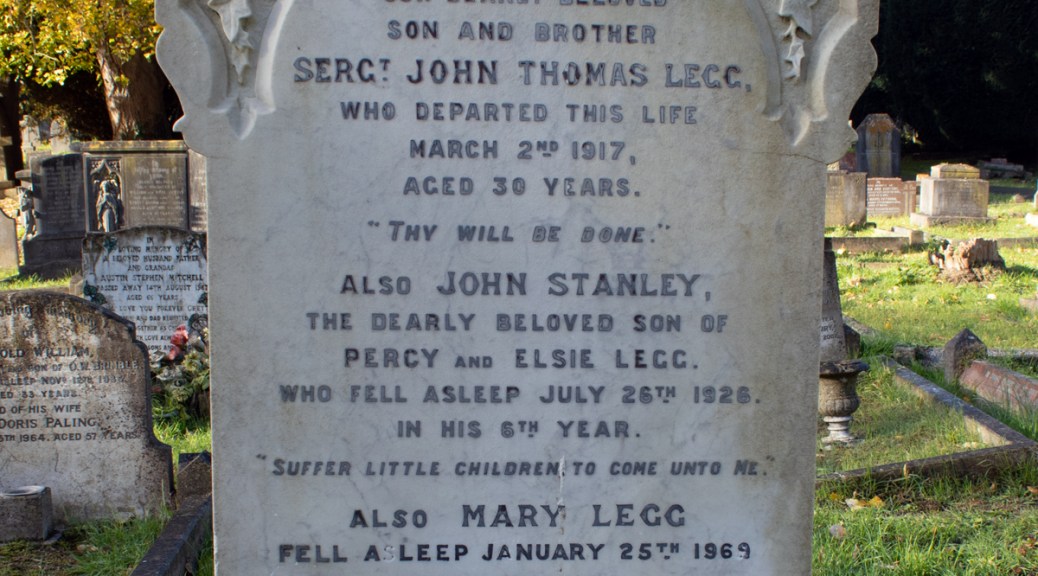
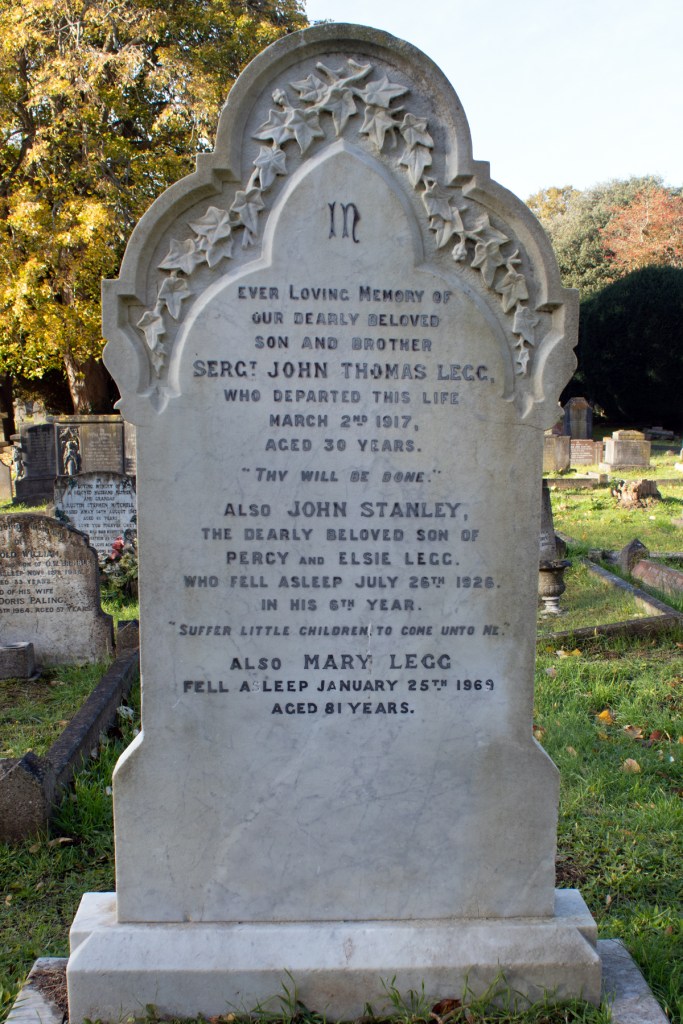
Lance Sergeant John Legg

Lance Sergeant John Legg

John Thomas Legg was born in the summer of 1885, the oldest of five children to Benjamin and Sarah Legg. Benjamin was a carpenter from Dorset, and it was in Bridport that John was born. Within a year or so, however, the young family moved north to Weston-super-Mare, Somerset, and this is where they settled.

When he completed his schooling, John found a job as a clerk. By the time of the 1911 census, he was working as a political assistant/clerk, and five of the six members of the Legg household were gainfully employed. Benjamin was still working as a carpenter, while John’s two sisters were dressmakers, and his younger brother Percy was a tailor’s assistant.

In the summer of 1914, war came to Europe, and John was one of the first to step up and serve his King and Country. He initially enlisted in the North Somerset Yeomanry, and was assigned to the 1st/1st Battalion. Private Legg’s unit was quickly sent to France, and fought at the Battle of Nonne Bosschen that November.

John’s service records are sparse, and so it is not possible to confirm exactly when and how he served. He moved from the North Somerset Yeomanry to the 6th Battalion of the Reserve Cavalry Regiment: his promotion to Corporal and then Lance Sergeant suggests that this move enabled him to share his skills with incoming recruits. It is unclear whether he was based in Somerset by this point, but it is certainly where he ended up by the start of 1917.

The remains of Sergeant JT Legg, North Somerset Yeomanry, were buried at Weston-super-Mare Cemetery on Wednesday. The first portion of the service was held at St Saviour’s Church, which the sergeant formerly attended, and the interior of which bears many evidences of his skill as an amateur wood-carver… Sergeant Legg was formerly chief clerk in the offices of the Well Division Conservative Association.

Bath Chronicle and Weekly Gazette: Saturday 10th March 1917

John Thomas Legg passed away on 2nd March 1917: he was 31 years of age. He was laid to rest in the sweeping grounds of Milton Road Cemetery, Weston-super-Mare, a short walk from where his family still lived.


Serjeant Major Ernest Simmons

Serjeant Major Ernest Simmons

Ernest Simmons was born in Priddy, Somerset, in 1869, the oldest child to Henry and Ellen Simmons. Henry was a mason who, by the time of the 1881 census, was employing ten men and a boy. Three doors down lived another Simmons family, Daniel and Elizabeth, and it is likely that Ernest’s father was somehow related to them.

Ernest sought a bigger and better life away from the Somerset countryside, and enlisted in the army, joining the Army Veterinary Corps. “[He] served for 28 years… 10 of which were spent in India and 5 in South Africa.” [Wells Journal: Friday 23rd August 1918]

His service did him well, and he progressed through the ranks. The 1911 census recorded him back in the UK, renting a room in a terraced house in Preston, near Brighton. He was still serving in the army, however, and was listed as being a Farrier Sergeant Major in the 4th Battalion of the Dragoon Guards.

When war was declared, Ernest was quick to return to the fray, arriving in France on 16th August 1914. He served his battalion well, and was mentioned in dispatches for his action in the retreat from Mons the following month.

Farrier Sergeant Major Simmons returned to Britain, and transferred across to the 6th Reserve Regiment of Cavalry. This new regiment, formed in 1917, trained men for a number of regiments, including the 3rd, 4th, 6th and 7th Battalions of the Dragoon Guards. Ernest’s previous experience with horses, including his time in the Army Veterinary Corps, likely stood him in good stead for the role.

It was while he was at the camp in Tidworth, on Salisbury Plain, Wiltshire, that Ernest met with an accident. “[He] was thrown through his horse tripping over some wire. He was found in an unconscious state and died the same day.” [Wells Journal: Friday 23rd August 1918] Farrier Sergeant Major Simmons died on 26th July 1918: he was 49 years of age.

Ernest Simmons’ body was brought back to Somerset for burial. He was laid to rest in the peaceful graveyard of St Lawrence’s Church in his home village of Priddy.


Private George Dove

Private George Dove

George Dove was born in Wincanton, Somerset, on 4th December 1883. One of five children, his parents were farm labourer George Dove and his wife, Jane.

George Jr did not follow his father into farm work: the 1901 census found him boarding with a family in Radstock, working in one of the coal mines in the area. Ten years later, he was living back with his family, employed as a groom.

His work with horses stood him in good stead when war was declared. George enlisted early on, and was assigned to the 19th (Queen Alexandra’s Own Royal) Hussars as a Private. By October 1914, he was in France, returning to England with his squadron the following spring.

At some point during the conflict, Private Dove transferred to the Reserve Regiment of Cavalry. He was posted to the 5th Regiment, which trained men for the Northumberland Hussars and Yorkshire Dragoons, amongst others.

Further details of George’s life are scarce; at some point, he married a woman called Emily, although records of the couple’s wedding no longer exist. The only thing that can be confirmed is that George was admitted to the Bermondsey Military Hospital in Surrey, where he passed away on 24th October 1918. He was 34 years old.

The body of George Dove was brought back to Somerset for burial. He lies at rest in the cemetery in his home town, Wincanton.


Private John Saunders

Private John Saunders

John Henry Saunders was born at the end of 1899, in the West Sussex village of East Preston. One of five children, his parents were agricultural labourer John and his wife Louisa. John Sr sadly passed away in 1904, when his son was just 4 years old.

Louisa went on to marry again in 1909, to a man named Charman. While no marriage records remain, it seems that he might have been a widower. The 1911 census finds Louisa living in Worthing with her four surviving children (her eldest, Lilian, having passed away earlier in the year), a stepson of 16 and new babe-in-arms.

With the outbreak of war in 1914, John looked to do his part. Sadly, his military records are not available, but what is clear is that he joined the Cavalry Regiment at some point after September 1917. He was assigned to the 3rd Reserve Regiment, which trained men for the Dragoon Guards, and Northamptonshire, Surrey and Sussex Yeomanry units.

Sadly, Private Saunders’ time in the armed forces was limited. He was admitted to the Military Isolation Hospital in Aldershot and, while it is not clear what the admission was for, it seems likely that he was moved from the main hospital because of a contagious condition like tuberculosis or pneumonia.

John Henry Saunders’ time in hospital was brief. He passed away on 16th March 1918, aged just 18 years of age. His body was brought back to Worthing, and he was buried in the Broadwater Cemetery to the north of the town.