Category Archives: Royal Warwickshire Regiment

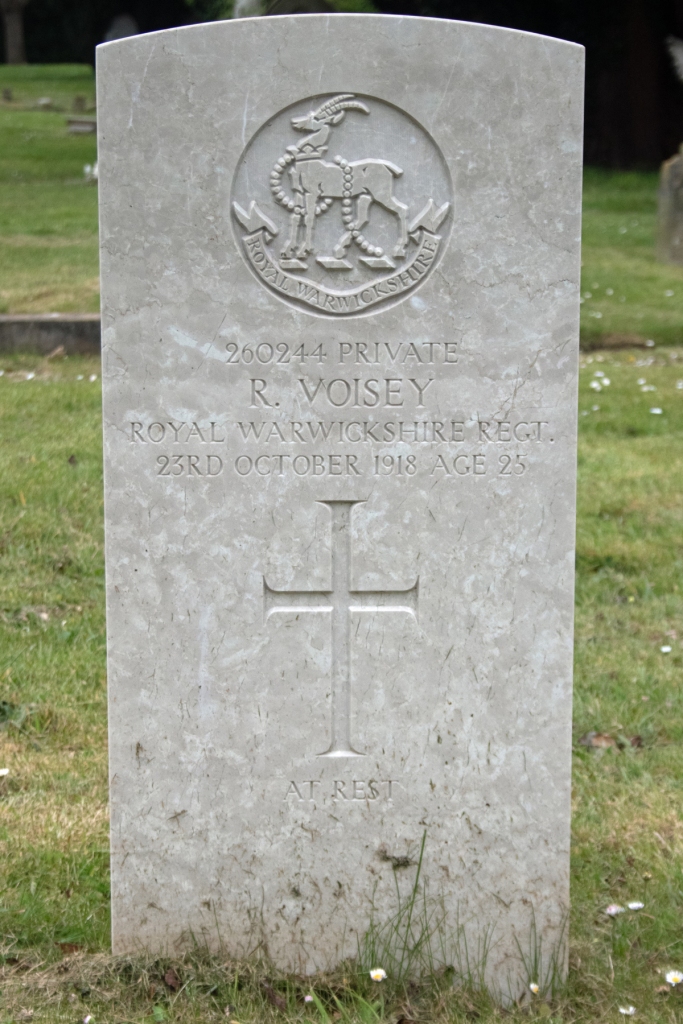
Private Robert Voisey

Private Robert Voisey

Robert Voisey was born towards the end of 1891, one of six children to Richard and Sophia. Richard was a tailor and, while both he and Sophia had been born in Cullompton, Devon, by the time Robert was born, they had moved to the Somerset town of Taunton.

When he left school, Robert followed his father’s trade and, by the time of the 1911 census, he was living with his parents and two of his sisters in a terraced house not far from the town’s station.

With the outbreak of the Great War, Robert was keen to do his bit. While full details of his military service are not available, it seems that he initially enlisted in the Somerset Light Infantry, but was subsequently transferred to the Royal Warwickshire Regiment. Joining the 6th Battalion as a Private, he saw action on the Western Front, and was wounded in April 1918.

Evacuated to England for treatment, Private Voisey was admitted to the 5th Northern General Hospital in Leicester. He seemed to be recovering well from his injuries, but then contracted influenza.

Sadly, this developed into pneumonia and Private Voisey subsequently died on 23rd October 1918, at the tender age of 25 years old.

Robert Voisey’s body was brought back to Somerset and he was laid to rest in the St James’ Cemetery in the town.


Robert’s funeral was written up in the local newspaper, and the report sheds more of a light on the Edwardian attitude towards some medical and mental health conditions than it does on the actual service.

The very fact of [Robert] ever having been a soldier, considering the great disability he was afflicted with through an incurable impediment in his speech, testifies abundantly to his high and noble interpretation of duty and patriotism.

Had he insisted he could at any time have evaded military service, but so eager was he to serve his country that it was not until he had actually been four times rejected as “physically unfit for military service” was he eventually accepted.

To the writer o this brief notice, who was his friend and fellow shop-mate for a long while, but who was at the time doing duty at Castle Green Recruiting Office, he often time used to express his indignation at not being accepted, and on the last occasion he spoke to the writer, it was to emphatically declare himself “as fit to be a soldier as anyone who had yet left Taunton.”

He dreaded the thought of being considered a shirker, and his opinion of many who have, even up till now, successfully evaded service, though far more physically fit than he was, was contemptuous to the bitterest extreme.

He was a true Britisher, a faithful friend and shop-mate, and a courageous soldier of whom no fitter epitaph could be written than “he gave himself in defence of home, country and liberty.”

Taunton Courier and Western Advertiser: Wednesday 6th November 1918

Private Roberts Hallett

Private Roberts Hallett

Private Roberts Pretoria Hallett was born in the summer of 1900, to Frank – a shepherd from Charlton Adam in Somerset – and Emily, who came from the neighbouring village of Charlton Mackrell. Roberts (the correct spelling) was the youngest of eleven children.

Roberts was just twelve when his father died, and, when war came, he enlisted in Taunton, along with his brothers, Francis and William.

Private Hallett was assigned to the 5th Battalion Royal Warwickshire Regiment. While his records don’t identify exactly when he saw battle, by the last year of the war the battalion would have been involved in the fighting in northern Italy.

What we can say for certain is that he was shipped home at some point towards the end of the war. He was admitted to the No. 1 Northern General Hospital in Newcastle-upon-Tyne in October 1918. Private Hallett’s records show that he died “of disease” on 16th October.

Roberts Pretoria Hallett lies at rest in the churchyard of St Mary’s in his home village of Charlton Mackrell, Somerset.


The Great War was not kind to Emily Hallett: having lost her husband in 1912, her son William died while fighting in India in 1916 and that is where he was buried. Her other son Francis died in the Third Battle of Ypres in June 1917 and lies at rest in Belgium.

Roberts Hallett, therefore, is the only one of the three brothers to be buried local to her.

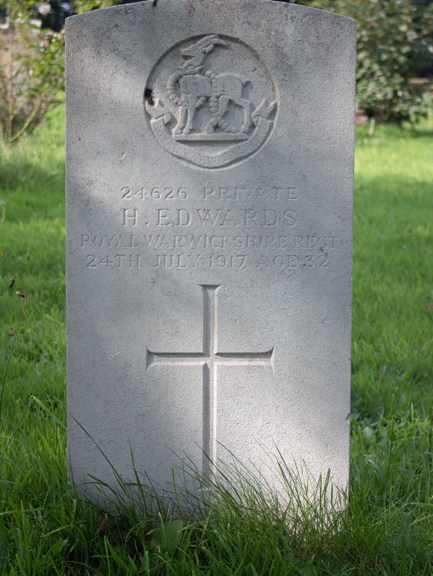
Private Harry Edwards

Private Harry Edwards

Henry Charles Edwards was born in 1883, the eldest of four children for Joseph and Elizabeth.

Joseph was an agricultural labourer, and Henry (or Harry) followed his father in the farming life, continuing in the role after Joseph died, and up until at least the 1911 census.

I was unable to find much regarding Harry’s military service. He signed up the Royal Warwickshire Regiment, and subsequently transferred to the Somerset Light Infantry.

He died from tetanus on 24th July 1917, aged 34. His pension records give his mother, Elizabeth, as his beneficiary.

Private Henry Edwards lies at rest in the churchyard of Lydeard St Lawrence, Somerset.

Private Cecil Paine

Private Cecil John Paine

Cecil John Paine was born in Sherborne, Dorset, in May 1899, the son of John and Emily Paine. He was the fifth of seven children, and the second son.

Cecil’s military records are sparse, but the local newspaper provides more information. According to the Western Gazette, Cecil joined up on reaching his 18th year, and had only been in service for three weeks, when he succumbed to pneumonia at Chiseldon Camp in Wiltshire on 6th June 1917.

Private Cecil Paine lies at rest in Sherborne Cemetery.


As an aside, Chiseldon Camp was initially set up to train new soldiers. In 1915, part of it was developed into a hospital for wounded soldiers before, in 1916, it began to treat soldiers coming back from the front who had contracted VD. Interesting times that Private Paine probably knew little about.


Cecil’s eldest brother, Frederick William Paine also served in the Great War. He had enlisted in the navy in 1903, initially for 12 years, but continued on and was finally discharged in 1919.

Private Nelson Pitman

Private Nelson Pitman

Nelson Victor Pitman was born in April 1890, the fourth of eight children to George Pitman and Amy Roles Pitman (née Treasure). George was a butcher’s assistant, and the family lived in their home town of Sherborne in Dorset.

As with a number of the other servicemen I have been researching, Nelson’s military records are sparse, probably lost to time. He is not listed as living with his parents on the 1911 census and, in fact, is nowhere to be found.

On 2nd January 1915, Nelson marries Alice Moores at the parish church (Sherborne Abbey). His profession is listed as soldier, so we know that, but this point in the war, he had enlisted.

While there are no records of Private Pitman’s service, his battalion, the 1st Royal Warwickshire Regiment was involved in a number of the key battles of the war, including the second Ypres, Arras and Passchendaele. The battalion was also involved in the Christmas Truce, so there is a slight chance that Nelson played football with his German counterparts in one of the defining moments of the Great War.

Private Pitman survived the war to end all wars, but was discharged on 22nd February 1919 with a disability. He was suffering from bronchitis, and steadily went downhill.

Private Nelson Pitman passed away eighteen months later, on 21st November 1920. He was 31 years old.

He lies at rest in Sherborne Cemetery.