Category Archives: Corporal

Private Henry Boyce

Private Henry Boyce

Henry Leslie Boyce was born on 14th June 1872 in the parish of St Michael, in Barbados, then the British West Indies. His parents were Samuel and Mary Boyce.

Further details of his early life are scant, but Henry appears to have moved to England at some point in the early 1890s. The 1911 census shows him living in Ilford, Essex, and working as an iron and metal merchant. His wife Rosanna, a dressmaker, was born in Wincanton, Somerset, and they married in 1896. The young couple had two children; sadly they both died young.

Henry was quick to do his duty when war broke out, joining up in September 1914. He enlisted in the British West Indies Regiment, and after training on the home front, served in France from April 1917. While there, he was promoted to Acting Corporal, but contracted bronchial pneumonia and was sent back to England to recuperate after only five months.

A medical report from November 1917 states that Acting Corporal Boyce remained unfit for military service, and he was discharged from the army at the end of that year. The same report showed him as a former commercial traveller, living in Forest Gate. It marks him as having a very good military character – “Judging from his records, he is a steady, sober, well-conducted man“.

While no information after that point is available for him, it seems that he succumbed to the disease less than a year later.

Henry Leslie Boyce died on 24th October 1918. He was 46 years old.

He lies at rest in the graveyard of St Leonard’s Church in Butleigh, Somerset; presumably close to his widow’s family.


There is some discrepancy over Henry’s rank. He was discharged with the rank of Acting Corporal, although his headstone cites his previous rank of Private.

Trooper William Dawbin

Trooper William Dawbin

William Joseph Dawbin was born on 23rd April 1888, in Yeovil, Somerset. He was the oldest of three children to William and Julianna Dawbin, a farming family.

In 1897, when William Jr was 9 years old, the family emigrated to New Zealand, settling in the town of Feilding, 100miles (150km) north of Wellington.

William enlisted in 1905, joining the Wellington Mounted Rifles for a five-year term of service, and being promoted to the rank of Corporal. He re-enlisted on 14th August 1914, and the troop departed New Zealand for Europe a month later.

Trooper Dawbin arrived in Alexandria, Egypt on 3rd December, from where they travelled to Cairo for training. Initially planning on becoming involved in the defence of the Suez Canal, on 14th April 1915, William and his battalion landed in Gallipoli, to support the invasion there.

History knows that the fighting in this battle was some of the fiercest of the Great War. History also tells us that this campaign resulted in huge losses for the Anzac troops, including the Wellington Mounted Rifles. Sadly, Trooper Dawbin was not to escape injury.

On 27th May 1915, he received a gunshot wound to the back, fracturing his spine. He was evacuated by hospital ship back to Egypt, and, suffering from paralysis, was shipped back to England ten days later.

Trooper Dawbin was admitted to the Netley Hospital in Southampton, but his wounds appeared too severe; he died there on 22nd August 1915. He was 27 years old.

William Joseph Dawbin lies at peace in the quiet churchyard of St Andrew’s, in the village of Compton Dundon, Somerset, not far from extended family in Butleigh.


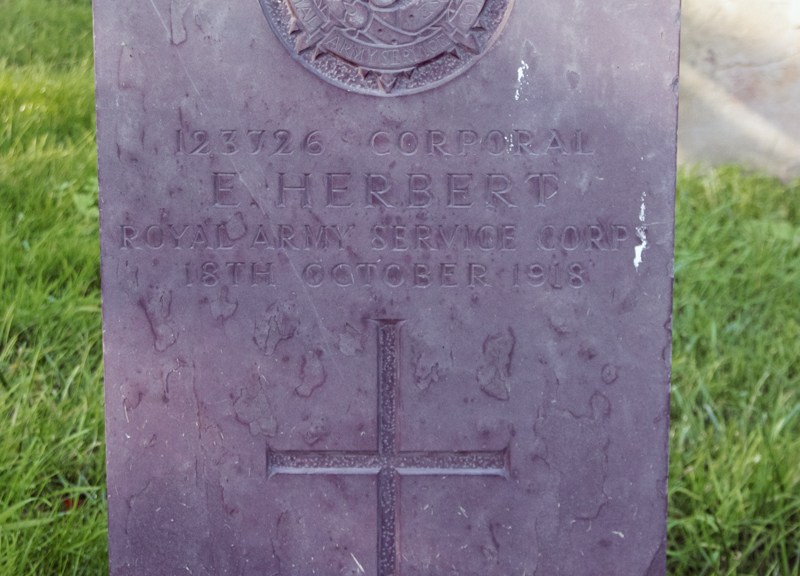
Corporal Edwin Herbert

Corporal Edwin Herbert

Edwin Herbert was born in 1864, the third of three children to Moses and Melina Herbert of Hove in East Sussex. Moses worked in the cement industry as a labourer, a job that had taken him from his home in Kent to Sussex, and which, by the 1871 census, would return him to his home county.

Edwin married Amelia Charlotte Titus in 1885 and the couple’s first child – a daughter, Nelly – was born a year later.

By the 1891 census, Edwin was also labouring in the North Kent cement industry, something he continued to do for at least the next twenty years, as confirmed in the following two censuses.

The Herberts’ second child, Amelia, was born in 1901, the year after Edwin’s mother passed away. The family were, by then, living in Cuxton, just to the south of Rochester. The cement industry was one of the large employers in the Medway valley, and it is not surprising that the family lived in and around that area for so long.

In 1910, Edwin’s father also died, at the age of 69. After the death of Melina, Moses had moved in with his daughter – Edwin’s older sister – in Rochester, and the family were also still labouring in the cement and brickmaking industry.

Edwin’s military records are sketchy. Piecing the evidence together, he enlisted in the Royal Army Service Corps.

It is likely that he did so on a voluntary basis. The cement industry was not protected by exemption. Kitchener’s initial conscription in March 1916 excluded married men. When this was extended in May 1916, there was still a maximum age limit of 41 (Edwin was 52 year old by this point).

By whichever means he had enlisted, Edwin served as a Corporal (there is nothing to confirm whether he was promoted from Private, or if he went straight into service at that rank). He was discharged on 30th July 1918, and it is likely that this was on a medical basis.

Corporal Herbert’s pension documents record that he passed away on 30th October 1918, as a result of carcinoma of the liver and exhaustion. He was 54 years old.

Edwin Herbert lies at peace in the quiet churchyard of St Helen’s in Cliffe, Kent.


The majority of the the Commonwealth War Graves Commission headstones in the UK are made from Portland stone, although, in face, over 50 different natural stones have been used.

Corporal Cornell’s headstone is one of two in St Helen’s Churchyard that have been fashioned from dark grey slate.


Corporal Charles Cornell

Corporal Charles Cornell

Charles Cornell was born in July 1885, the youngest of six children to Philip and Martha Cornell, from Ashdon in Essex. Philip was an agricultural labourer, and Charles and his older brother Daniel followed their father into the trade.

Charles was keen to further himself, however, and enlisted in the army. The 1911 census records him as a Private soldier at the Salamanca Barracks in Aldershot.

Private Cornell married Elizabeth Fanny Hoare in Strood, Kent, in October 1913. Beyond this there is little information on either Charles or Elizabeth.

Charles was assigned to the 3rd Battalion of the East Yorkshire Regiment and was promoted to Corporal. This reserve battalion was initially based in the town of Beverley, before moving to Hull and then nearby Withernsea. It seems unlikely, therefore, that Corporal Cornell saw active service on the Western Front.

His passing seems to have been sudden; his pension record shows that he had been admitted to the Military Hospital at Wharncliffe with nephritis (inflamed kidneys). He passed away on 27th January 1918, aged 32 years old.

Corporal Charles Cornell is buried in the graveyard of St Helen’s Church in Cliffe, Kent, the village his widow’s family were from. He is also commemorated in his own family’s village of Ashdon in Essex (where the memorial states he had attained the rank of Sergeant).


The majority of the the Commonwealth War Graves Commission headstones in the UK are made from Portland stone, although, in face, over 50 different natural stones have been used.

Corporal Cornell’s headstone is one of two in St Helen’s Churchyard that have been fashioned from dark grey slate.


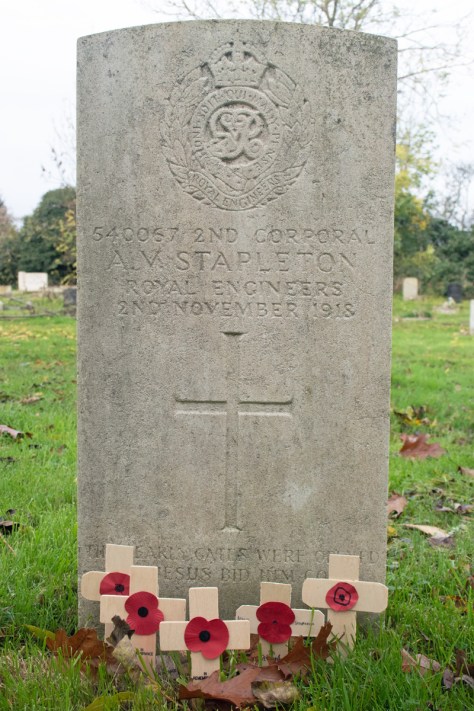
Lance Corporal Albert Stapleton

Lance Corporal Albert Stapleton

Albert Victor Stapleton was born in East London in 1893. One of five children to James and Mary Anne Stapleton, he lost his father when he was only eight years old. Mary Anne married again, and where her first husband has been a glass blower, her second, Edward, was a cooper/barrel-maker, and the family moved to Rainham in Kent.

Albert joined the armed forced early, enlisting in the Royal Engineers in December 1910 for a period of four years. When war was declared, this was extended for a further four years.

In 1915, Private Albert married Daisy, and they lived in the Rainham area. Over the next couple of years, he was promoted, joining the London Electrical Engineers and becoming Lance Corporal.

On 24th October 1918, just a couple of weeks before the end of the war, Albert was admitted to hospital in South London with influenza; while there, he developed pneumonia in the right lung. Lance Corporal Stapleton died on 2nd November 1918. He was 25 years old.

Lance Corporal Albert Victor Stapleton lies at rest in the churchyard of St Mary the Virgin in the quiet village of Upchurch in Kent.


Tragically, just weeks after Albert’s death, Daisy gave birth to a son. Albert William Stapleton would never know his father.

Corporal Louis Townsend

Corporal Louis Henry Townsend

Louis Henry Townsend, also known as Henry, was born in the spring of 1881 in Leytonstone, Essex.

Much of Louis’ life remains elusive, he first appears on the census in 1911, and from this we know that he married Florence Annie Ridley (known as Annie) in December 1906. The couple had three children, Thomas, Florence and George.

Louis’ marriage record suggests his father’s name was Thomas Clark, although he also remains a bit of a mystery.

Again, Louis’ military service appears lost to time. He enlisted in the Lincolnshire Regiment, and fought on the Western Front.

The Western Chronicle (26th March 1915) confirms that Corporal Townsend was brought to the Greenhill Voluntary Aid Detachment Hospital in Sherborne, suffering from “a shot through the brain, and from the first was in an extremely precarious condition”.

Louis passed away from his wounds on 20th March 1915, aged 34. He lies at rest in Sherborne Cemetery.