Category Archives: Private

Corporal Sidney Hornby

This image has an empty alt attribute; its file name is photo-01-11-2020-12-01-50-e1605266325697.jpg

Sidney Horace Hornby was born to John and Emily in March 1880. John was a tailor’s assistant from Paddington, and the family – Sidney was the eldest of six siblings – initially lived in the Greenwich.

Sidney enlisted in the army in 1898. He joined the East Kent Regiment for a short service of seven years and was sent to South Africa. In March 1900 he was wounded at the Battle of Driefontein. His service, though, saw him promoted through the ranks from Private to Sergeant.

Something must have happened during his enlistment, however, as on 2nd September 1901 Sergeant Hornby’s military record marks him as having deserted.

Sidney’s records pick him up again on 24th April 1908, when he is put on court martial. Found guilty of desertion, he is reduced to the ranks and sentenced to three years’ penal servitude (later reduced to two years’ hard labour).

His attitude seems to continue, however, as within a matter of months he was discharged due to misconduct and denied any pension for his previous service.

Sidney’s family had moved from Greenwich to Kent at some point before the 1901 census, and his father died three years later. By the 1911 census, he had moved back in with his mother, and worked as a labourer to help look after them.

The Great War called, however, and it seems that Sidney’s previous misdemeanours did not excluding him from fighting again. He joined the Royal West Kent Regiment although his full service for the 1914-18 campaign are not accessible. Again, his service seems to have been good, as he was elevated to the rank of Sergeant for a second time.

Hints of Sergeant Hornby’s rebellious nature remain, however, as he was court marshalled again in February 1916. He was convicted of drunkenness, and reduced to the rank of Corporal.

That was the summer of the Battle of the Somme, and by the autumn Hornby was one of the many who fell during that time. He died on 4th October 1916 and was 36 years old.

Corporal Sidney Hornby is commemorated on the Thiepval Memorial.


Sidney Horace Hornby was my 1st cousin, four times removed.
Private Thomas Daines

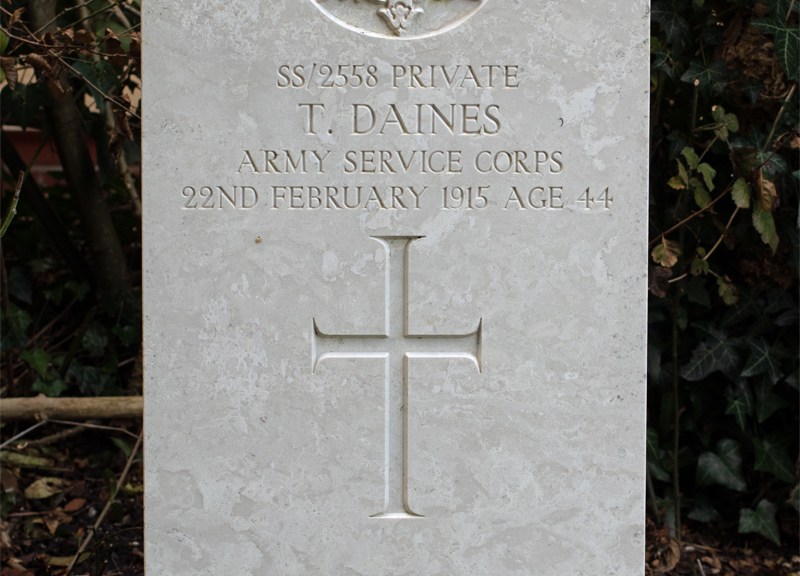
Private Thomas Daines

Born in 1871, Thomas Daines was one of fourteen children. His parents, Charles and Sarah, worked on a farm a few miles from Halstead in Essex.

After leaving school, Thomas followed in his father’s footsteps and, by the time of the 1891 census was also listed as an agricultural labourer. He married Kate Rawlinson in the spring of 1893, and they had two children – Matilda and Lewis – before relocating to South East London in around 1898.

The reason for the move was, more than like, job opportunities, and Thomas was soon working at the Royal Arsenal in Woolwich.

Settling into their new city life, Thomas and Kate had five further children: Annie, Thomas, Alfred, Charles and Beatrice. Thomas continued as a labourer, before enlisting in the army within three months of war being declared in October 1914.

Sadly, Private Daines’ service was not to be a long one. Having suffered a bout of influenza, Thomas was admitted to a Red Cross Hospital in Sherborne, Dorset. He died of pneumonia on 22nd February 2015.

Private Thomas Daines lies at peace in the Sherborne Cemetery.


As a sad aside to Thomas and Kate’s story, their eldest son, Lewis, enlisted in the 16th Battalion of the Lancashire Fusiliers. He fought on the Western Front, and was killed in action in Pozières on 26th March 1918.

The Great War had claimed both father and son.

Private Edward Lewsley

Private Edward Lewsley

Edward (Teddy) Lewsley was born in 1894, the ninth of twelve children to James and Charlotte Lewsley from London.

James had worked with horses, and become a cab driver at the turn of the century; Edward started as a general labourer on finishing school.

Edward’s military history is a little vague. From his gravestone, we know that he joined the Duke of Cornwall’s Light Infantry and was in the 1st Battalion. The battalion fought at the Battles of Mons, Marne and Messines.

In the spring of 1915, Edward’s battalion fought in the Second Battle of Ypres and, given the timing, it seems likely that he was involved.

Whether he was on the Western Front or stationed in the UK, Private Lewsley was admitted to the Red Cross Hospital in Sherborne, where he passed away on 30th May 1915. He was buried in the town’s cemetery.


One of Edward’s brothers also enlisted in the Light Infantry.

Daniel Lewsley first joined the East Surrey Regiment in 1909 and continued through to 1928. This included a stint as part of the British Expeditionary Force in France.

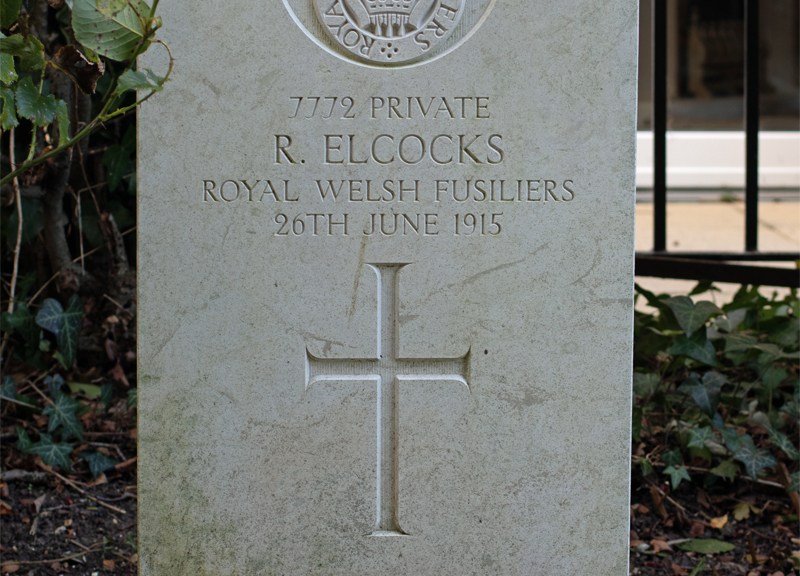
Private Richard Elcocks

Private Richard Elcocks

Richard William Elcocks was born in Wellington, Shropshire, the second son of foundryman Thomas Elcocks and his wife Emma. Born in June 1883, he was one of nine children.

After initially becoming a printer’s apprentice, he enlisted in the Royal Welsh Fusiliers in May 1903. After his initial training and service, Private Elcocks was transferred to the Army Reserve in 1911.

In January 1914, Richard married Charlotte Shenton. Charlotte was a widow ten years his senior, and had two children, Albert and Fred.

When war broke out, Private Elcocks was again called up and shipped to France as part of the British Expeditionary Force. His records confirm that he received a gunshot wound to the left arm on 31st October 1914; the injury was enough for him to be shipped back to the UK for treatment.

He was treated in the Yeatman Hospital in Sherborne, Dorset, and appears to have been there for some time. His records state that he died on 26th June 1915 from an ‘intestical [intestinal?] obstruction following gun shot wound of left humerous’. He was 32 years of age.

Private Richard Elcocks lies at rest in Sherborne cemetery.

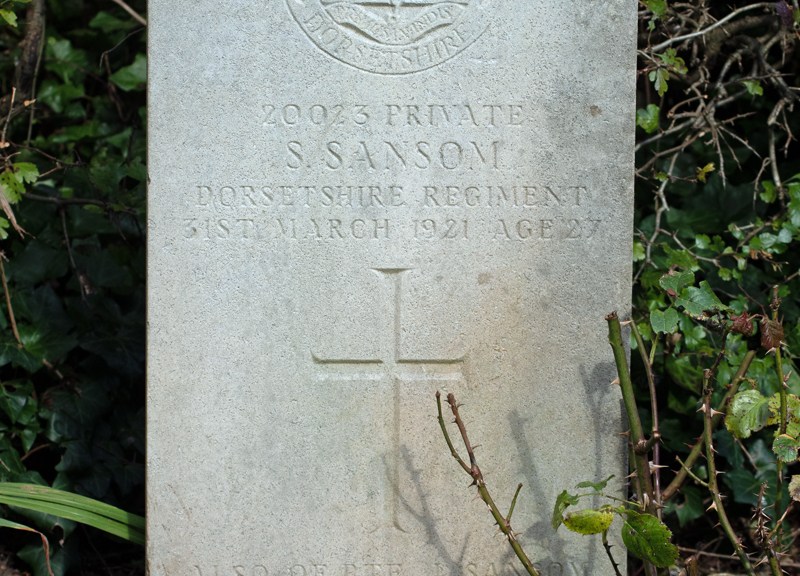
Private Stanley Sansom

Some of the research on the Commonwealth War Graves has been fairly straightforward – information has been readily available on sites like Ancestry, or the death has been unusual or sudden enough for it to have made contemporary newspapers.

Other times, the search goes on for a while and only the tiniest of leads manages to turn up some information.

Private Stanley Sansom falls firmly into the second category.


Private Stanley Sansom

In a corner of Sherborne Cemetery stands a gravestone. It is dedicated to 20023 Private S Sansom of the Dorsetshire Regiment. He died on 31st March 1921, aged 27 years.

Searching just on a surname doesn’t turn up a great deal, even for one as seemingly uncommon as Sansom.

My default first sites for this research are the Commonwealth War Graves Commission and Find A Grave. Both sites, however, list the soldier’s name as Sanson, even though the stone clearly says Sansom.

The FAG site provides no other information, although the CWGC page does name the soldier’s father, Thomas Sanson of Sherborne. Again, an Ancestry search does not bring anyone by that name in Dorset.

My next option is usually the British Newspaper Archive; no Sansons are recorded, but the surname Sansom does turn up just after the date on the stone:

Mrs Sansom desires to thank all friends who have expressed sympathy with her in the sad bereavement she has sustained by the death of her husband.

Western Gazette: Friday 22nd April 1921

Nothing conclusive, but it did suggest that Sansom may be the correct spelling.

Back on Ancestry, Thomas Sansom doesn’t turn up anything, but a random check on the surname and specific date of death did show a few family trees for a Stanley Sansom, born in 1892. Again nothing conclusive here, particularly as none of the trees include any military records or spouses, but there was enough information to collate an overview of his life.


Stanley Sansom was born in September 1892 in Sherborne. He was one of six children to Thomas Sansom, a glove cutter, and his wife Jane.

The cloth business was a large employed in the Dorset town, and after leaving school, Stanley became an apprentice tailor.

There don’t appear to be any records of Private Sansom’s military service. However, he enlisted in the Dorsetshire Regiment, and his Service Number identifies that he served in the 1st/4th Battalion.

According to the Dorsetshire Regiment records, this battalion sailed for India on 9th October 1914, so Private Sansom must have enlisted at the outbreak of hostilities.

After a year’s training, his battalion moved to the Eastern Front, where soldiers saw action against the Turks in what is now Iraq. From what records there are, it can only be assumed that Private Sansom survived the war pretty much unscathed and returned to England in 1918 to be demobbed.

There is no record of Stanley marrying, so whether the Western Gazette’s article relates to him, or to another Sherborne Sansom is unclear.

All that can be confirmed is that Private Stanley Sansom died on 31st March 1921, aged 27.

He lies at rest in the cemetery of his home town in Dorset.


As I was writing this post, I happened to notice an additional inscription at the bottom of Stanley’s gravestone:

Also of Private J Sansom, Dorsetshire Regiment. Died at Basra June 1916

Stanley had a younger brother, Jack, who also enlisted in the 1st/4th Battalion. The brothers were shipped to India and Mesopotamia together; while Stanley came home, Jack died in battle and is buried in Basra War Cemetery. He was just 20 years old.

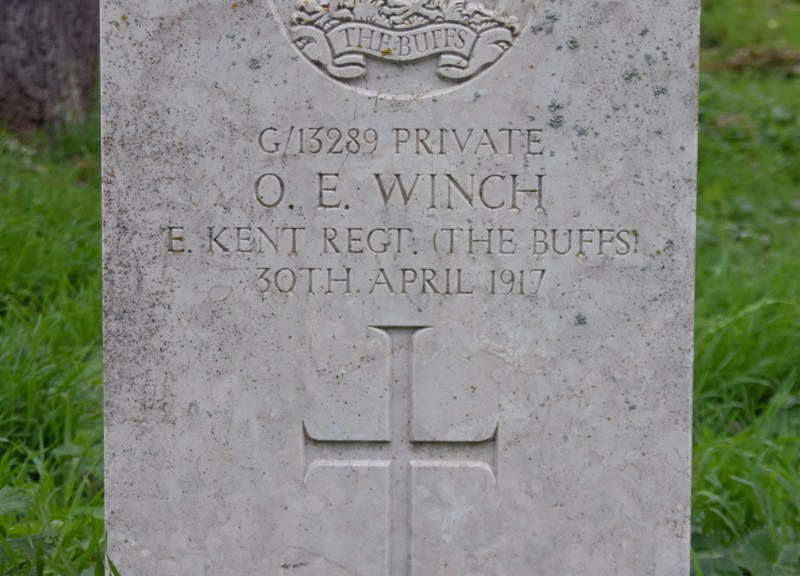
Private Osbourne Winch

Private Osbourne Winch

Osbourne Ethelbert Winch was born in Kent in 1888, one of three sons to Ernest and Ann Winch. Being the eldest, he inherited his unusual combination of names from his grandfathers – Osbourne on his mother’s side and Ethelbert on his father’s.

Osbourne had moved out of the family home by the time of the 1911 census, and, when war broke out, was quick to enlist. His records show that he was a tall man – standing at 5ft 10ins (1.78m) and he was declared fit for territorial service.

Private Winch joined the 45th Provisional Battalion, before moving to the Royal East Kent Mounted Rifles (also known as the Buffs) in 1916. Soon to be posted to the Front Line, Osbourne married Elsie Taylor in March that year, and he was posted in April.

Along with the move to the Buffs, Private Winch received promotions, first to Lance Corporal and then to Corporal. He again transferred to the Base Depot at Etaples in December 1916 and, for some reason, he reverted to being Private. His records confirm this was “under Para 12.VV.W.L.9/Geb No 5080 (AGI)”, although I have not been able to established what this means. There is no mention of disciplinary behaviour in his records, so whether this was because of the transfer to the depot, I cannot say.

Either way, he was transferred to the Front again on 13th December 1916, and remained on the Cavalry rate of pay.

Private Winch remained at the Front for a number of months. On 19th April 1917, possibly while involved in the Nivelle Offensive, he received gunshot wounds to the head and right hip. He was moved to a hospital in Béthune in northern France, where his hip was operated on.

Osbourne was transferred back to the UK on the Hospital Ship Cambria for medical treatment. His medical report from the UK hospital makes for grim reading:

Private states that he lay out for 2 days before being brought in. Gun shot wound head and right hip 19.4.17. Op on hip at Béthune – bad cough on admissions and moist sound in chest. Large septic wound over right hip exposing iliac crest and much comminution of ilium [breakage of the hip bone]. Acute pneumonia developed and patient grew steadily worse.

Medical Report: E Hamilton-Browne, Military Hospital, Endell Street, London WC

Private Osbourne Winch died at 4pm on 30th April 1917. He was 28 years old. He lies at peace in the graveyard of St Bartholomew’s Church in his home village of Bobbing in Kent.

Private Henry Thurley

Private Henry Thurley

Henry Edward Thurley was born in 1895, the tenth of twelve children to George and Charlotte Thurley. George was a brickmaker from Enfield, Middlesex, and the family moved around to follow his work.

Born in Sheerness, Kent, by the 1901 census, Henry was living with his family in Shoeburyness, Essex. Ten years later, the family had relocated back in Kent, and Henry had joined his father in the brickmaking business, while also working as a waterman – working on boats in the nearby Medway estuary.

When the Great War came, Henry was quick to enlist. He joined the East Kent Regiment – also known as “The Buffs” – in August 1915. After his initial training, Private Thurley was sent to France as part of the British Expeditionary Force.

Private Thurley was wounded on 6th March 1916, receiving gunshot wounds to his right foot, head and eyes. He was sent home to recover, but within a couple of months, he was back on the front line, serving for King and country again.

Henry was wounded again on 16th January 1917; this time is was his right eye that was affected, and he was shipped back to the UK and admitted to Merryflats War Hospital in Glasgow. His wounds appeared more serious this time, and he succumbed to them at 3:50pm on 1st February 1917. He was just 21 years old.

Private Henry Thurley was buried in the churchyard of St Mary the Virgin in his home village of Upchurch in Kent.

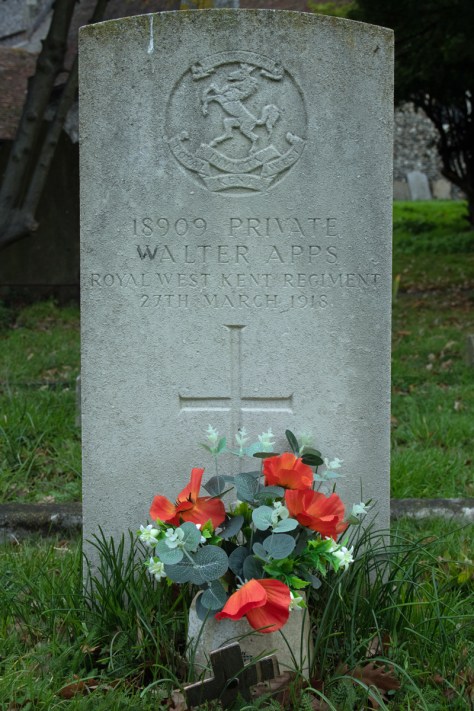
Private Walter Apps

Private Walter Apps

Walter Apps was born in 1896 in Kent. He was one of thirteen children to Richard Apps, a shepherd, and his wife Emeline. By the age of 14 he was listed as working on the farm the family lived on; his older brother Bertie was also helping out.

In February 1916 Walter was called up; his enlistment papers show he worked as a horseman, and that he joined the Royal East Kent Regiment (also known as the Buffs because of the colour of their tunic).

Private Apps was posted to the Western Front as part of the British Expeditionary Force in October 1916, and was soon transferred to the Royal West Kent Regiment.

He saw active service, and was wounded on 17th July 1917, receiving a gun shot wound to the face, which resulted in him losing the sight in his left eye.

Private Apps was repatriated on 8th August 1917, and remained there. He was discharged from the army as being no longer medically fit to serve at the beginning of the following March, but sadly passed away on 27th March 1918. He was just 22 years old.

Walter Apps lies at rest in the graveyard of St Bartholomew’s Church in Bobbing, Kent.

Private Frederick Smith

Private Frederick Smith

Frederick Smith was one of twelve children to George and Ann Smith of Rainham in Kent. Sadly, the couple lost their first four children early on, but at least seven of Frederick’s siblings survived beyond childhood.

His father was a labourer, and Frederick’s two surviving older brothers followed him into this profession.

A lot of Frederick’s service records are missing, but I have been able to ascertain that he enlisted in early 1915, joining the 8th Battalion, Queen’s Own (Royal West Kent Regiment). He trained at Fort Darland in Chatham before being shipped overseas.

The battalion was involved in the Battle of Loos later that year, but it was the fighting at Wulverghem in Western Flanders that changed Private Smith’s life. The German army launched a gas attack on the Allied lines on 30th April 1916; in the second attack on 17th June, Frederick was injured by the gas, and was shipped back to home soil.

The East Kent Gazette takes up the story:

He was brought to Camberwell Hospital, where he was for seven weeks. Enteric fever developed, and young Smith died on Thursday in last week [14th September].

East Kent Gazette: Saturday 23rd September 1916.

Frederick was just 19 years old.

Private Frederick Smith lies at rest in the graveyard of St Margaret’s Church in Rainham, Kent.