
Category Archives: Shoeing Smith

Shoeing Smith Samuel Treeby

Shoeing Smith Samuel Treeby

Samuel Treeby was born in December 1865 in Taunton, Somerset. The third of seven children, his parents were cordwainer Thomas Treeby and his wife, Anna (or Hannah).

When he finished his schooling, Samuel found work as a blacksmith at a collar factory in Taunton. His trade stood him in good stead away from the forge: he volunteered for the Royal Horse Artillery, becoming adept at shoeing the animals.

In 1906, Samuel married Sarah Parker. She was from Enmore, between Bridgwater and Taunton, although the couple married in Cardiff, Glamorgan. The couple settled back in Enmore, where Samuel continued his smithing trade.

War came to Europe in 1914 and, although he was 49 years old, Samuel stepped up to play his part. He was attached to the Royal Army Service Corps and given a rank that echoed his civilian profession, that of Shoeing Smith. His service records show that he was of average height – 5ft 6ins (1.68m) tall – but that he was illiterate: he signed his declaration with a cross.

Samuel spent several months on home soil, before being sent out to France in March 1916. He spent six months overseas, before being shipped back to Britain, suffering from rheumatism. Shoeing Smith Treeby was admitted to the East Leeds War Hospital before being discharged to the regiment’s Remount Depot in Woolwich, Kent.

Samuel returned home to Somerset, but his poor health still dogged him during the winter of 1916/17. He contracted bronchitis, and died of the condition on 27th February 1917, while still based in London. He was 51 years of age.

Samuel’s body was taken back to Somerset for burial. He was laid to rest in the peaceful graveyard of St Michael’s Church in Enmore, not far from where his widow still lived.
Gunner William Merritt

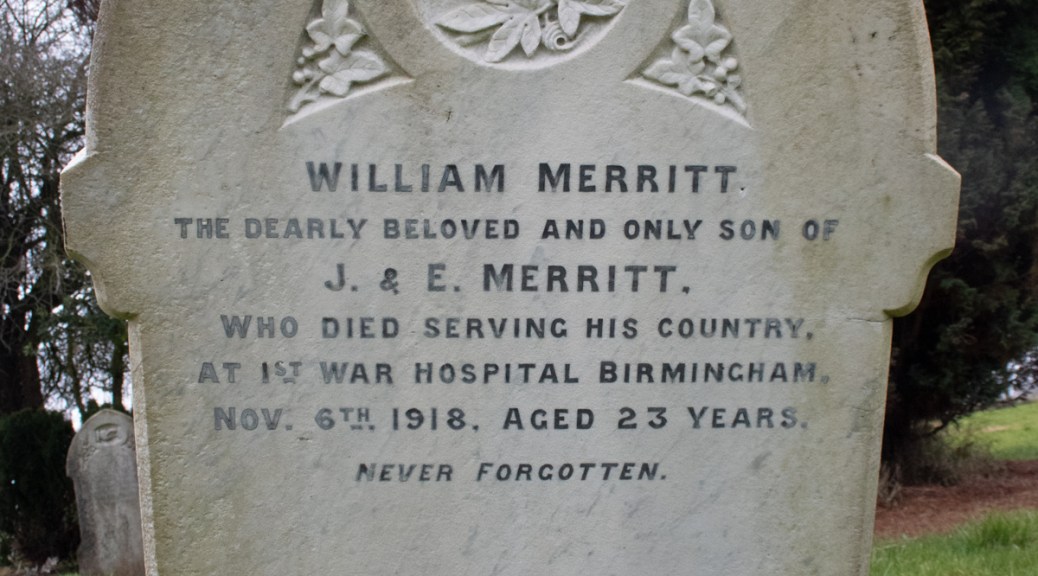
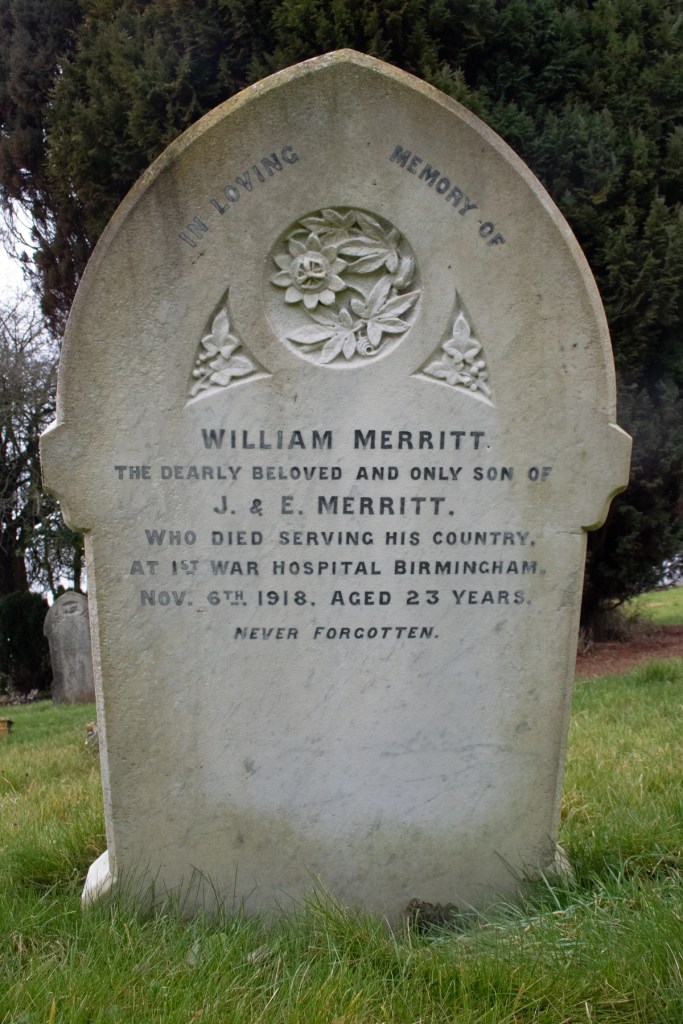
Gunner William Merritt

William Merritt was born in the summer of 1895 in Chippenham, Wiltshire. He was the youngest of three children to John and Elizabeth Merritt. John was a blacksmith, and he moved the family to Milborne Port, Somerset, when William was just a boy.

William found work as a shoesmith when he left school, but was one of the first to enlist when war broke out in 1914. He had his medical examination on 17th November, which confirmed that he was 5ft 5ins (1.65m) tall, had good vision and was of good physical development.

Initially assigned to the Dorset Yeomanry, Private Merritt’s trade soon found him taking on the role of Shoeing Smith for the battalion. He was obviously good at what he did, because by May 1915, he had been promoted to the rank of Corporal Shoeing Smith.

William had not enlisted in the army to make and mend shoes, however, and, in March 1916, he transferred to the Royal Garrison Artillery, back with the rank of Gunner. Rather than being sent to the Western Front, however, he found himself billeted at a camp in the West Midlands.

Little further information about Gunner Merritt’s service is available for the next couple of years. The next record for him comes on 5th November 1918, confirming his admission to the Birmingham War Hospital, as he was suffering from influenza and pneumonia. Sadly, his admittance to hospital was to prove too late: he passed away from heart failure the following day. Gunner Merritt was just 23 years of age.

William Merritt’s body was brought back to Somerset for burial. He was laid to rest in the cemetery of the town in which he had plied his trade before the war, Milborne Port.


William’s sparse personal effects were also returned to his parents. The records note that these included: “pair [of] boots, 6 postcards, razor, comb, toothbrush, shaving soap and brush, letter, pair of socks, bell.”

Another bureaucratic error is highlighted in a letter sent from the hospital in which William passed to his regiment’s records office notes that “I have to inform you that the body was forwarded to his Wife for burial…” William was unmarried, and his body was actually returned to his mother, Elizabeth.


Shoeing Smith George Stone

Shoeing Smith George Henry Stone

George Henry Stone was born in 1872, son of Milverton’s blacksmith James Stone and his wife Mary Ann. He followed in his father’s footsteps and, by the time he married Mary Florence Paul in 1894, he was also working in the forge in Milverton.

George and Mary had eight children – seven girls and one boy; by the time he signed up in 1915, he listed himself as a blacksmith.

His military records show that he was medically certified as Category B2 (suitable to serve in France, and able to walk 5 miles, see and hear sufficiently for ordinary purposes). He was assigned to the Remount Depot in Swaythling, Southhampton, which was built specifically to supply horses and mules for war service. (In the years it was operating, Swaythling processed some 400,000 animals, as well as channelling 25,000 servicemen to the Front.)

While serving George contracted pneumonia. He was treated in Netley Military Hospital, but passed away on 19th November 1918, aged 47.

Shoeing Smith George Henry Stone lies at peace in a quiet corner of St Michael & All Angel’s churchyard in his home village of Milverton.