Tag Archives: accident

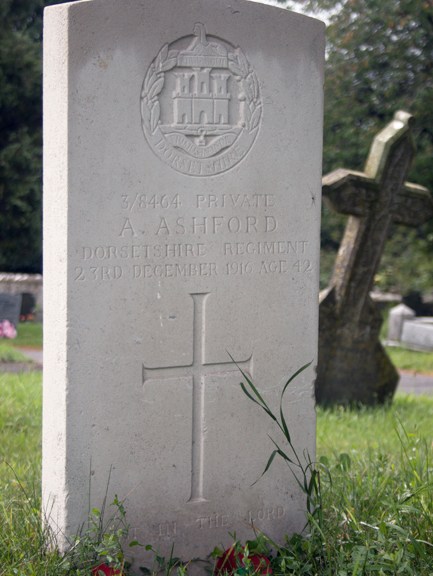
Private Arthur Ashford

Private Ashford

Arthur James Ashford was born in the Dorset village of Okeford Fitzpaine, to John and Tryphina Ashford. His father died when Arthur was only seven years old, leaving Tryphina to raise him and his three siblings.

Arthur had had a military career before the start of the Great War. He had enlisted into the Dorsetshire Regiment in 1891 and, while I have not been able to locate his records from that time, the regiment had been stationed in Ireland in the 1890s.

In 1899 he married Amy Upshall, at which point he was employed as a labourer. The couple had six children, though sadly, two of them – Arthur George and Elsie May – died in childhood.

He enlisted within months of the First World War beginning, returning to the Dorsetshire Regiment he had previously served on 30th September 1914. (It is interesting that on his enlistment papers he said that he had previously served for 12 years, although the dates don’t fully tally up.) This time, however, Private Ashford served on the Home Front, in Dorchester and Portland.

On the evening of 22nd December 1916, Arthur fell down a gulley in Portland. He was taken to the Verne Military Hospital in the town, but died of his injuries – a fractured skull – in the early hours of the following day.

Private Arthur Ashford was buried in his home village of Evercreech on Thursday 28th December 1916.

Second Lieutenant Sidney Pragnell

Second Lieutenant Sidney Pragnell

Sidney Ralph Pragnell was the eldest of two children of Edward and Ellen Pragnell. Edward grew up in Sherborne, before moving to London to work as a chef; he found employment as a cook in an officer’s mess, which took him and his wife first to Ireland – where Sidney was born – and then to the barracks at Aldershot.

By the time of the 1911 census, Edward had brought his family back to Dorset, and was running the Half Moon Hotel, opposite the Abbey in Sherborne. Sidney, aged 12, was still at school.

When war broke out, Sidney was eager to play his part, even though he was underage. An article in the local newspaper highlights his keenness and how he progressed.

…he was keen to serve his country and joined every local organisation his age would allow him to. He was an early member of the Sherborne VTC and Red Cross Detachment, and was actually the youngest member of the Volunteers to wear the uniform. Whilst still under age, he enlisted in the Royal Naval Division at the Crystal Palace and after a period of training was drafted as a qualified naval gunner to a merchant steamer carrying His Majesty’s mails and in this capacity went practically round the world. In February he joined the RNAS and after some air training in England went to France to an air station, where he passed all the tests with honours and gained the ‘wings’ of the qualified pilot. Lieutenant Pragnell then decided to go in for scouting and came back to England for advanced training in the special flying necessary for this qualification and it was whilst engaged in this that he met with the accident which resulted in his death.

Western Chronicle: Friday 16th August 1918.

The esteem in which Second Lieutenant Pragnell was held continues in the article, which quotes the condolence letter sent to his parents by his commander, Major Kelly.

It is with deep regret that I have to write you of the death of your son, Second-Lieutenant SR Pragnell. Your boy was one of the keenest young officers I have ever had under my command and was extremely popular with us all and his place will be extremely hard to fill.

The service can ill afford to lose officers of the type of which Lieutenant Pragnell was an excellent example and it seems such a pity this promising career was cut short when he had practically finished his training. May I convey the heartfelt sympathy of all officers and men in my command to you in this your hour of sorrow.

Western Chronical: Friday 16th August 1918.

What I find most interesting about this article is that the letter from Major Kelly detail how Edward and Ellen’s son died, and this this too is quoted by the newspaper.

Your son had been sent up to practice formation flying and was flying around the aerodrome at about 500 feet with his engine throttled down waiting for his instruction to ‘take off’. Whiles waiting your boy tried to turn when his machine had little forward speed. This caused him to ‘stall’ and spin and from this low altitude he had no chance to recover control and his machine fell to earth just on the edge of the aerodrome and was completely wrecked. A doctor was there within a minute, but your boy had been killed instantaneously.

Western Chronicle: Friday 16th August 1918.

Further research shows that the aerodrome Second Lieutenant Pragnell was training at was RAF Freiston in Lincolnshire, which had been designated Number 4 Fighting School with the specific task of training pilots for fighting scout squadrons. He had been flying a Sopwith Camel when he died.

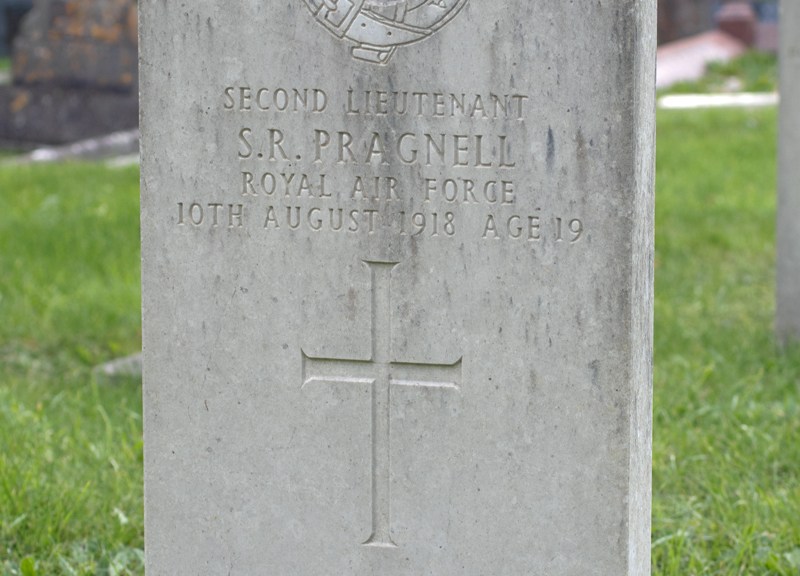
Second Lieutenant Sidney Ralph Pragnell lies at rest in the cemetery of his Dorset home, Sherborne.