William Gulliford was born on 8th November 1877 in the village of Thurloxton, just to the north of Taunton, Somerset. William’s father – also called William – was an agricultural labourer who, with his wife Charlotte, had nine children in total.
William Jr found work as a labourer for a brewery and, by 1899, had moved to Staffordshire, met and married a local woman called Elsie Sutton. The couple settled down in Burton-on-Trent, and went on to have a daughter, also called Elsie.
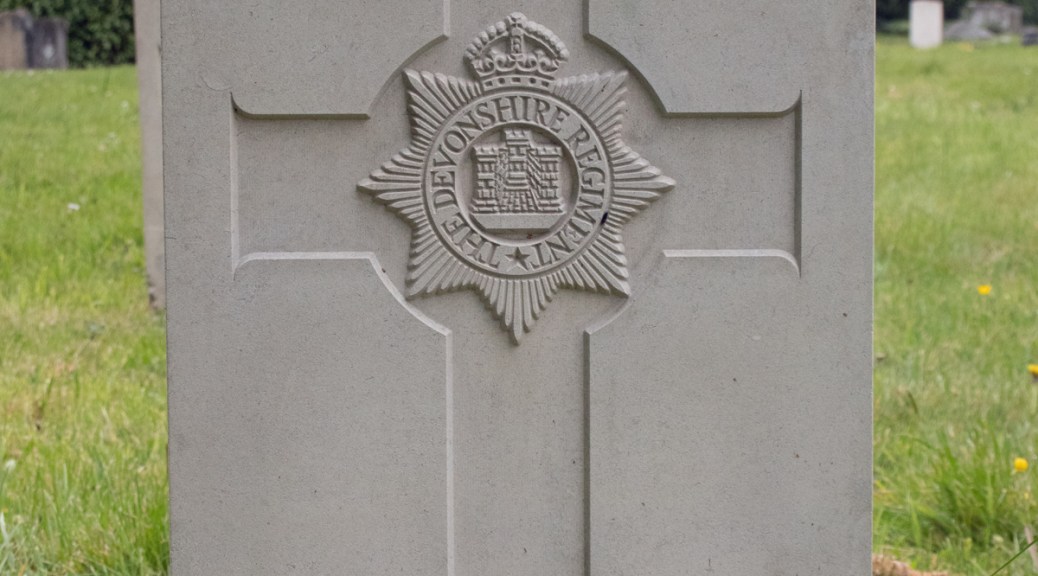
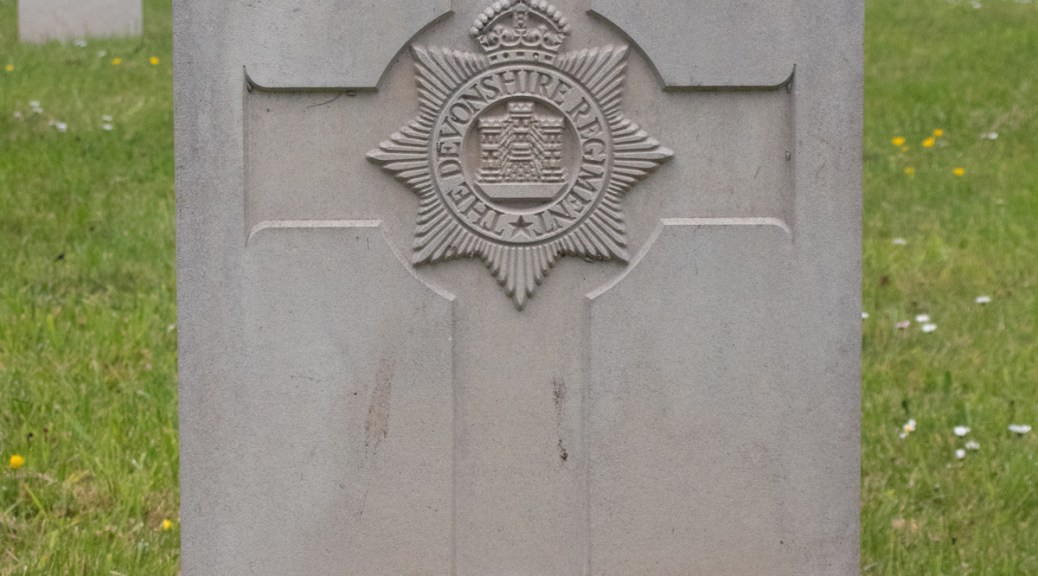
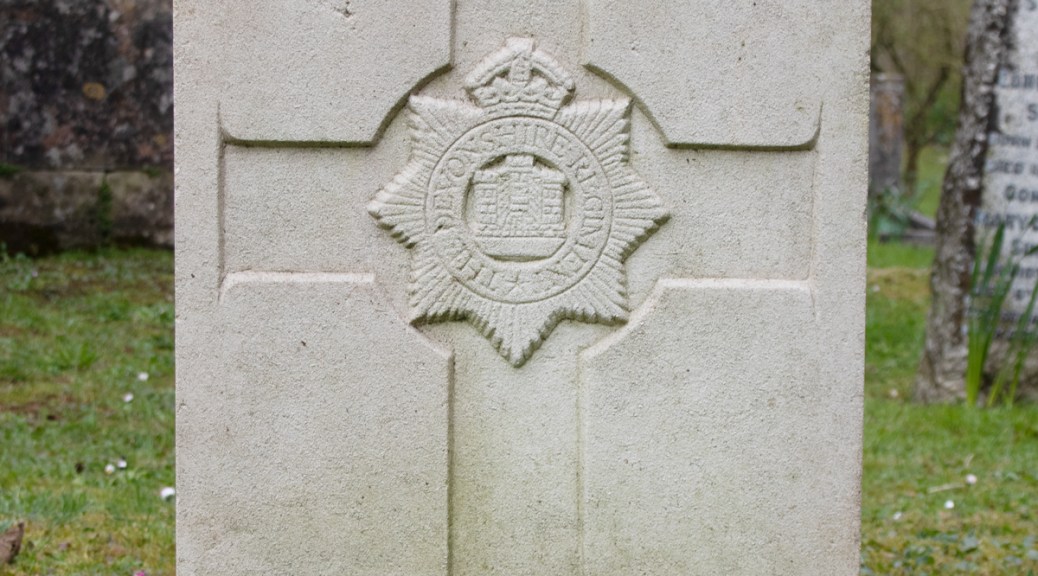
War was coming, however, and, in August 1916, William enlisted. Initially assigned as a Private in the 14th Devonshire Regiment, he was soon moved to the Labour Corps, and within a couple of months was on the Western Front as part of the British Expeditionary Force.
In November 1917, Private Gulliford was shipped back to England, suffering from ill health. He was admitted to the Military Hospital in Taunton with heart failure, and sadly passed away from this a month later. He had just turned 40 years old.
William Gulliford lies at rest in St Mary’s Cemetery in Taunton, Somerset.
Thomas Henry Winter was born in 1887, one of six children to James and Mary. James was a farmer, and the family lived in Milverton, in the Somerset countryside to the west of Taunton.
James died in 1900, and Thomas found his way into farm work as well. He met and married a local woman called Ada Thynne in February 1909, and the couple went on to have five children: Beatrice, James, Charles, Frank and Thomas.
There is little confirmed information about Thomas’ military career. When he joined up, he enlisted in the 13th Battalion of the Devonshire Regiment, although, as his service records no longer exist, it is not possible to identify when this was.
Private Winter later transferred to the Labour Corps – again there are no records to confirm the dates – and this is the division in which he remained.
Illness was to dog Thomas, however; in early 1918, he contracted enteric fever (known nowadays as typhoid), and was hospitalised. Sadly, he succumbed to the disease, and passed away on 14th February 1918. He was 30 years of age.
Thomas Henry Winter lies at rest in St Mary’s Cemetery in Taunton, Somerset.
An additional tragic turn to Thomas’ story is that Ada was pregnant when he passed away. His youngest son, whom Ada named after him, would never know his father.
Henry John Venn was born in September 1900, the youngest of three children to Charles and Mary Venn. Charles was a gardener, and the family lived in the small Somerset village of Shipham.
Sadly, there is little information available about Henry’s life, although when war broke out, he enlisted as a Private in the Devonshire Regiment. There is no documentation to confirm exactly when he enrolled, although, given his age when the conflict began, it it unlikely to have been before 1918.
Indeed, later records show that his parents were refused a war gratuity. This was only usually the case where a soldier had completed less than six months’ service. It is likely, therefore, that Private Venn did not join up before he turned 18 years old in September 1918.
Henry joined the 53rd Training Reserve Battalion; they were based at the Rollestone Camp near Stonehenge, Wiltshire. It is here that he likely became unwell, as he was subsequently admitted to the Military Hospital on Salisbury Plain. He was suffering from influenza and pneumonia, and this is what he succumbed to. Private Venn passed away on 10th November 1918 – the day before the Armistice that ended the conflict. He was just 18 years old.
Henry John Venn lies at rest in the graveyard of St Leonard’s Church in his home village of Shipham in Somerset.
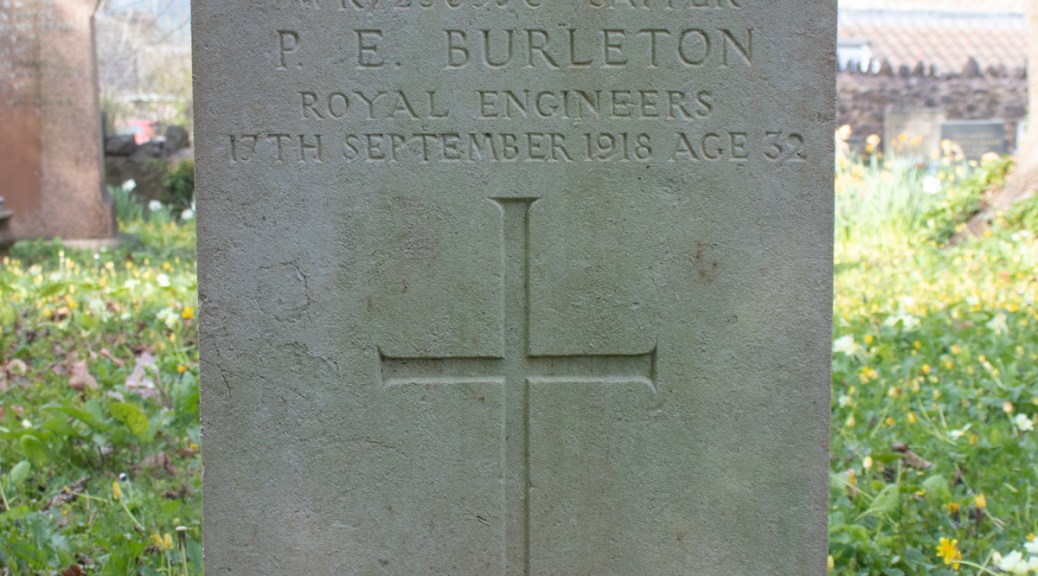
Percy Edward Burleton was born on 24th July 1885, the youngest of seven children to George and Lucy Burleton. George was a quarryman, and the family lived in the village of Draycott, near Wells in Somerset.
Percy’s older brother Lewis worked for the railways, and this is a trade that his younger sibling followed. By the time of the 1911 census he was living with his brother in Glastonbury and worked as a carman, delivering goods to and from the local station.
In February 1914, Percy appeared as a witness in an inquest about the death of a colleague, George Gillett. George had gone missing one night after the two had met for a drink in a local pub. The alert was raised when George’s coat was found hanging on a branch on the banks of the River Brue, to the south of the town; the waters were dredged and George’s body found.
At the inquest, Percy confirmed that the two men had had a drink in a local pub, and that George had seemed a little strange, but not the worse for drink. He reported that the deceased man had been quieter than usual at the railway stables for a week or so. George had left the pub at 10:55 that evening, and that was the last time that Percy had seen him.
Part of a carman’s duty was to collect money for the goods they had delivered; this was then paid to the station clerk on a daily basis. In the week leading up to his death, the stationmaster had been advised of some financial discrepancies, and on the day he drowned, he had been spoken to and advised the matter would be reported to the police if the missing amount was not paid back.
The place where George’s coat was found was not on his way home from the pub, and he would have had to have gone out of his way to get there. When considering their findings, the jury returned a verdict of suicide during temporary insanity, citing that the financial situation George had apparently gotten himself into.
When war broke out, Percy seemed to have been keen to get involved. Initially joining the Devonshire Regiment in September 1914, his experience with his job saw him transferred to the Railway Operating Division of the Royal Engineers.
Shipped to France on 22nd September 1915, his service saw him awarded the Victory and British Medals and the 1915 Star. Sapper Burleton was moved to the Eastern Front and served in the Balkans for three years. According to the Central Somerset Gazette, which reported his passing, he contracted ‘a chill’ on the boat back to England and was admitted to Frensham Hill Hospital in Surrey.
Sadly, the chill seems to have been more severe than the report suggested, and Sapper Burleton passed away on 17th September 1918. He was 32 years old.
Percy Edward Burleton lies at rest in the graveyard of St Peter’s Church in his home village of Draycott, Somerset.
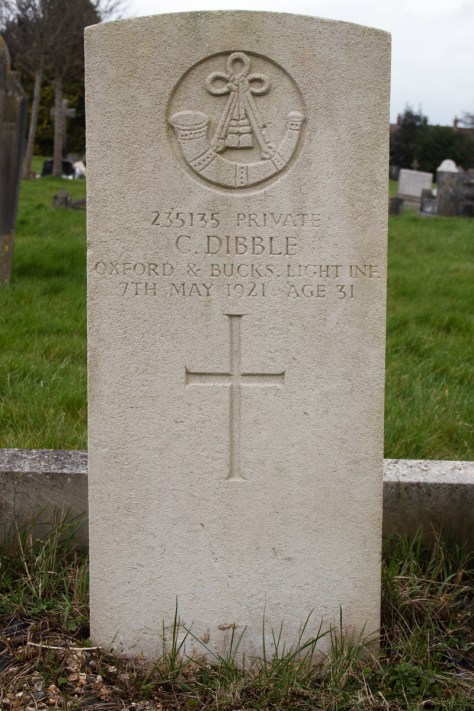
Charles Lang Dibble was born in 1890, one of nine children to Evan and Eliza Dibble from Bridgwater in Somerset. Evan was a labourer in a brickyard, and clay must have been run through the family’s veins, as Charles found employment as a kiln hand in a local tile maker when he left school.
By the 1911 census, Charles was boarding with William Rainey and his family in Bridgwater; whether there was a connection before he moved in or not, I don’t know, but the following year he married one of William’s daughters, Constance. The young couple wed on Christmas Day 1912 and went on to have one child, Charles, who was born in 1915.
Full details of Charles’ military service are not available. However, when he enlisted, he initially joined the Somerset Light Infantry, before transferring to the Devonshire Regiment and finally the Oxfordshire and Buckinghamshire Light Infantry. During his service, he was awarded the Victory and British Medals, but there is little further information about Private Dibble.
Charles survived the war, but his pension records confirm that he passed away on 7th May 1921; the cause of death was noted as exhaustion and sarcoma of the rectum. He was 31 years old.
Charles Lang Dibble lies at rest in St John’s Cemetery in his home town of Bridgwater.
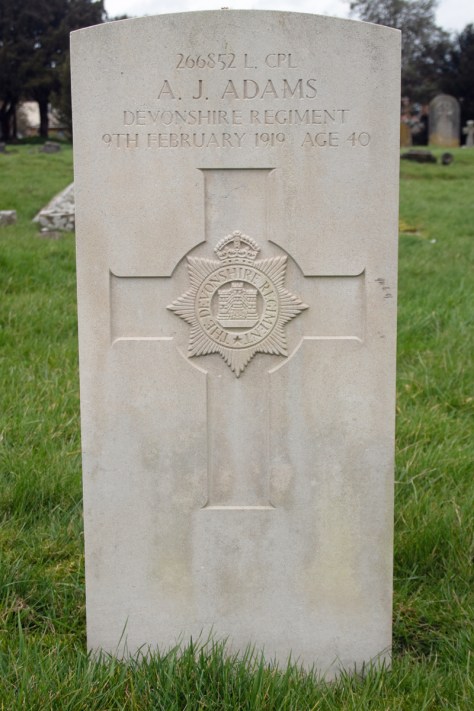
Albert James Adams was born in Somerset in September 1878, the fifth of ten children to Robert and Mary. Robert was a mason, who sadly passed away when Albert was only 11 years old. Mary lived on as the head of the household, and by the 1901 census, she had four of her five sons living with her, three of them also stone masons.
Albert had taken a different route in life, and found work as a postman. He married Annie King, a young woman from Taunton, in 1910, and they set up home in the village of Selworthy near Minehead. Albert was the village postman, and the young couple lived there with their sons – Albert and Robert – and Mary.
When war came, Albert enlisted, joining the 6th Battalion of the Devonshire Regiment. While his military records are scattered, his battalion served in India and Mesopotamia; during their three years in the Middle East, the 6th Battalion lost twice as many men to illness – influenza, pneumonia, malaria – as to enemy action.
Lance Corporal Adams was not immune to sickness; while I have been unable to unearth exact dates for his military service, his cause of death is recorded as malaria and pneumonia. He passed away on 9th February 1919, at the age of 40 years old.
Albert James Adams lies at rest in St John’s Cemetery in Bridgwater, Somerset.
Frederick Hobbs was born in December 1886, the fourth of ten children to William and Martha Hobbs, from Bridgwater in Somerset. William was a mason, and all of his children seemed to be good with their hands. Frederick went on to become a plumber’s apprentice, while his siblings worked as a mason, a dressmaker and a carpenter.
The 1911 census found him living in Polden Street, Bridgwater with his mother and youngest sibling, Florrie. William, however, was living round the corner in Bath Road, with three of his other children, Clara, Tom and George. Both of Frederick’s parents are listed as married, which adds to the confusion of them being in separate houses.
Frederick enlisted with weeks of was being declared; he joined the 10th (Service) Battalion of the Devonshire Regiment and, after a year on home soil, his troop was shipped to France. This wasn’t the end of the Private Hobbs’ journey, however as, within a couple of months, he journeyed on as part of the Mediterranean Expeditionary Force, finally arriving in Salonica, Greece, in November 1915.
Private Hobbs has only been serving for a month when he was admitted to the Hospital Ship Asturias in Alexandria, with lacerations to his cheeks and eyelids. The initial report seemed to suggest the wounds were as a result of gunshot, although a more detailed report later confirmed that the injuries were caused by barbed wire.
While in hospital, Frederick’s urine was found to include a high level of sugar. He also confirmed having lost a lot of weight in recent months, but could not confirm when this had begun. He was diagnosed with diabetes, and was evacuated back to England for treatment for both his injuries and his illness.
The damage to his left eye healed, but he was left with significant ptosis, or drooping of the eyelid. When it came to his diabetes, specialists back in England determined that, while it could not be put down to Private Hobbs’ service, it had definitely been aggravated by it. He was deemed no longer fit for military service and furloughed in June 1916, with a follow-up report confirming this three months later.
Sadly, whether Frederick’s life returned to normal is not recorded. It seems likely, however, that the diabetes got the better of him, and he passed away on 25th November 1916, aged just 29 years old.
Frederick Hobbs lies at rest in St John’s Cemetery in his home town of Bridgwater, Somerset.
Frederick’s younger brother Herbert Hobbs also fought in the Great War. He enrolled in the Royal Marines Light Infantry and fought on the Western Front. Caught up in the Battle of Gavrelle Windmill, he was one of 335 Royal Marines to be killed in that skirmish. He lies buried at the Arras Memorial in Northern France.
Wilfred Allen Gillson was born in 1888, the fourth of nine children – and one of eight boys – to George and Emma Gillson. George was a coachbuilder from Cornwall; Emma, whose maiden name was Allen, came from Derbyshire. The family were living in Torquay by the time Wilfred was born.
In 1895, George had moved the family to Bridgwater in Somerset, presumably as railway works had dried up in the coastal Devon town. By this time his oldest son, also called George, was working as a compositor, keying text for a printer. Wilfred was still at school, but his other two older siblings – William and Albert – were both working with their father, working on railway coaches.
Wilfred was also to follow in his father’s employment, and the 1911 census found him living in Bristol, boarding with the Cridland family, earning his keep a a carriage painter.
He joined up within weeks of war breaking out, enlisting in the Worcestershire Regiment on 20th September 1914. Private Gillson readily proved his worth, and was promoted to Lance Corporal after three months, and Corporal within a year of enlisting.
Corporal Gillson’s promotion coincided with his shipment abroad, and he served on the Western Front for eight months. Returning to England in March 1916, he subsequently transferred to the Devonshire Regiment, before being moved to the 4th Reserve Battalion in the spring of 1917.
Things were not right for Wilfred; he was reprimanded for neglecting his post on the night of the 26th May that year, before being medically discharged with neurasthenia in August.
The root of the matter is detailed in his discharge report; he was hospitalised at Neuve Chapelle in February 1916, suffering from shellshock, and it seems that he never really fully recovered.
Sadly, at this point Wilfred’s trail goes cold. He passed away on 10th November 1918, aged 30 years old.
Wilfred Allen Gillson lies at rest in St John’s Cemetery in Bridgwater, Somerset.
There are a couple of additional notes to Wilfred’s life.
During the war, Wilfred’s youngest brother, Thomas, fought with the Oxfordshire & Buckinghamshire Light Infantry. He was involved in the fighting in France, but died from wounds on 10th June 1918. He was just 18 years old, and is buried at Aire-sur-la-Lys, not far from Boulogne.
Given that Wilfred was one of eight brothers, all of whom would have been of fighting age during the war, it is lucky – although still a tragedy – that only he and Thomas died as a result of the conflict.
Sadly, Wilfred’s mother, Emma, passed away in the autumn of 1914, at 57 years of age. It might be a blessing, however, that she was not alive to see two of her sons suffer so.
Bernard Dyke was born in 1897, the oldest of three children to Albert and Edith Dyke from Bridgwater, Somerset. Albert worked for a brewery, and the young family lived in a house on the main road west out of the town.
Bernard received a scholarship to attend Dr Morgan’s School, a grammar school in the town, and he was a pupil there from autumn 1910 to spring 1913. He left at the age of 16, and became a merchant’s clerk.
War was on the horizon, however, and Bernard joined up. Full details of his military service are not available, but he enlisted in the Devonshire Regiment. Private Dyke spent some time at the Tregantle Fort, near Plymouth, and it was here that he was caught up in an accident.
It has transpired than a rather remarkable shooting fatality occurred at Tregantle rifle ranges, near Plymouth, on Friday, when Private Bernard Dyke, aged about 24, of the Devon Regiment, received a gunshot would in the left side, and almost immediately expired.
The soldier was acting as an observer for a Lewis gun section when he received the fatal injury, the section being at the time out of action awaiting the appearance of a moving target. On the deceased’s left hand side was a musketry party of nine carrying out an exercise, and when he received his injury only one or two rounds had been discharged by this party.
When the first shot or so had been fired deceased suddenly shouted “Oh! Oh!” and dropped. An officer and NCOs ran to assist him, but found that life was extinct. A military doctor was soon on the spot, and found the bullet had entered the deceased’s left side below the ribs and made its exit at the top of his right arm.
As the musketry party was 80 degrees to the right of the firing party it is strange that a shot could have been fired so wide, but the explanation may be found to be in a ricochet or a soldier’s erratic action.
Western Morning News: Monday 21st January 1918.
Private Bernard Dyke died on 18th January 1918, aged just 20 years old. He lies at rest in the Wembdon Road Cemetery in his home town of Bridgwater, minutes’ walk from his family home.
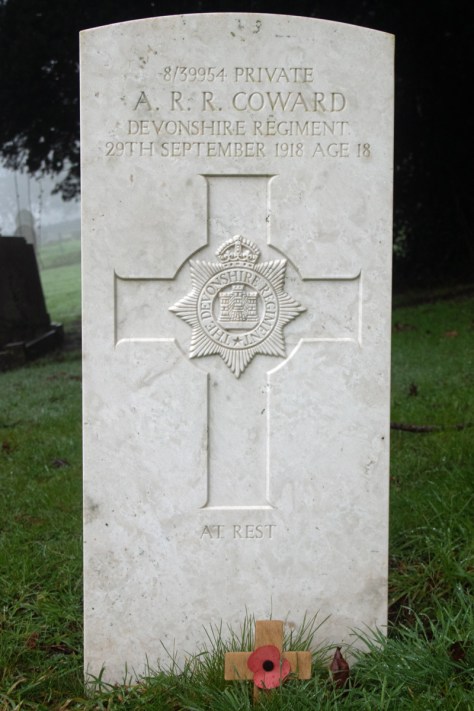
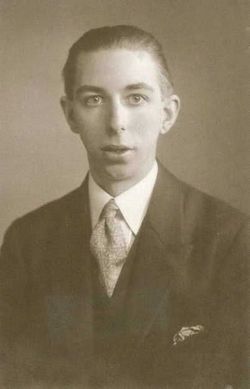
Albert Reginald Robert Coward was born on 26th August 1900, the middle of three children – all boys – for James and Florence Coward. James was a labourer and drayman for the railways, and the family lived in Shepton Mallet, Somerset.
Little remains of Albert’s military service records. His older brother Arthur was a Corporal in the Somerset Light Infantry. He died in France in April 1918, which may have been a contributing factor to his sibling’s decision to do his duty.
Albert enlisted in the 53rd Battalion of the Devonshire Regiment and, given his age, I would presume that this was as soon as he was able to – sometime in 1918.
Whether Private Albert Coward saw any military action is not known. He is listed as having passed away at a military hospital on 29th September 1918, although, as I have been unable to find a cause of death, it is likely to have been an illness, rather than an injury. Albert was aged just 18 years old.
Albert Reginald Robert Coward lies at rest in the cemetery of his home town.
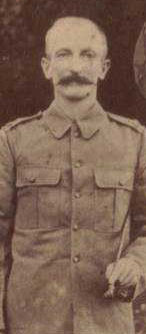
Albert Reginald Robert Coward (courtesy of findagrave.com)
Corporal Arthur William James Coward is commemorated on the Arras memorial in France. He was 23 years old when he died.









 Death and Service