Tag Archives: gas

Private Ernest Lewis

Private Ernest Lewis

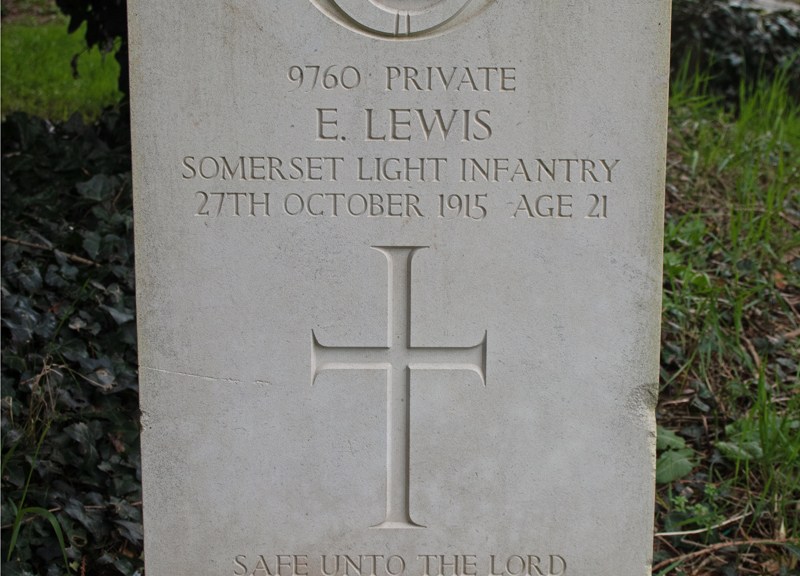
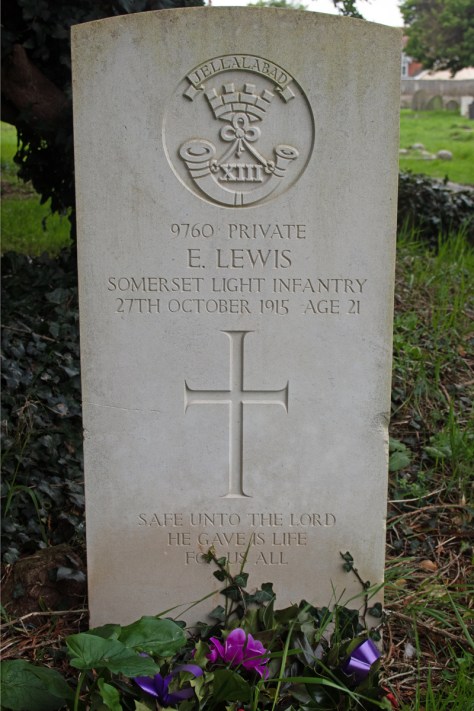
Ernest George Lewis was born in Bridgwater, Somerset, in the spring of 1895, one of fourteen children to labourer Frederick and his wife Harriett Rose. Two of his older brothers went to work for the local brickworks, but Ernest hauled coal to earn a living once he left school.

When war broke out, he was eager to do his part; he enlisted in the Somerset Light Infantry early on, serving as a Private in the 1st Battalion. His troop was to see some of the fiercest fighting in the conflict, including the Battles of Le Cateau, the Marne, the Aisne, Messines within the first six months.

Private Lewis’ troop was also involved in the Second Battle of Ypres in the spring of 1915, but it was later that year that his fate became sealed. At some point he was caught up in a German gas attack; he was evacuated home, but there is no confirmation whether he was hospitalised as a result (although it seems likely).

The gas was to damage his lungs to the extent that he would not recover. There are conflicting reports as to the cause of Private Lewis’ passing, with one source identifying the gas in France, while another put it down to pneumonia and typhoid. (It seems probable that the attack ultimately resulted in Ernest catching pneumonia, although this is not clear.)

Either way, Private Lewis passed away at home on 27th October 1915. He was just 20 years old.

Ernest had eleven brothers, four of whom would have been old enough to be enlisted to fight. Ernest was the only one of the family to perish.

Ernest George Lewis lies at peace in the Wembdon Road Cemetery in his home town of Bridgwater.


Private Robert Hunt

Private Robert Hunt

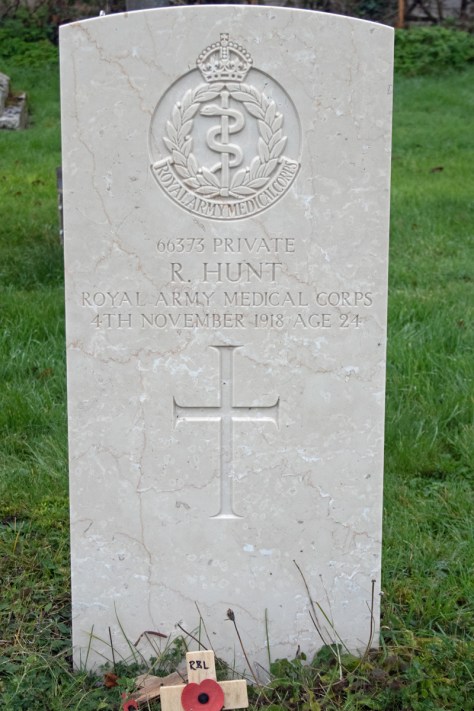
Robert Edward Nichols Hunt was born in Somerton, Somerset in 1894. One of five children to Charles and Rose Hunt, his father was a bootmaker.

By the 1911 census, however, things had taken a different turn; Charles and two of his sons were working for a brewer, Rose was working as a shop assistance in Boots, and the youngest of the family, Kate, was apprenticed to a dressmaker.

It was against this backdrop that war came, and, within a year, Robert had enlisted in the Royal Army Medical Corps. His sign-up documents confirm that he was short sighted, although this was corrected with glasses and he was deemed fit for active service.

Sent to the Western Front in October 1915, Private Hunt definitely found himself in the thick of the action.

In August 1916, he was supporting the fighting at High Wood on the Somme, when a gas shell exploded near him. He fell and, when he woke, he remembered little of what happened. Robert had inhaled a lot of gas, however, and was left coughing with difficulty breathing. He was transferred back to England by train and ship to recover, arriving back on the 2nd September.

There is no record of Robert having gone back to the front. The impact of the gas appears to have been severe and long-lasting. At the end of October 1918, he was admitted to the Becket House Auxiliary Hospital in St Albans with influenza and bronchial pneumonia. Sadly, this was to be a battle he would not recover from, and he passed away on 4th November 1918. He was 24 years old.

Robert Edward Nichols Hunt lies at rest in the cemetery of his home town, Somerton.


Private Quinton Wyatt

Private Quinton Wyatt

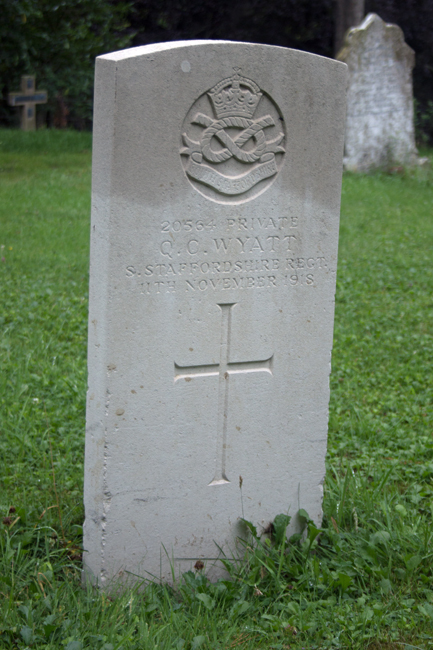
Quinton Charles Wyatt was born in the Gloucestershire town of Northleach in 1893 to William and Elizabeth. His mother died when he was a toddler, leaving William to look after Quinton and his older sister Agnes.

By the time war was declared, Quinton was working as a farm labourer and waggoner in the Gloucestershire village of Hampnett.

Quinton enlisted in the 8th Battalion of the South Staffordshire Regiment on 22nd November 1915. Appointed Lance Corporal just two months later, he was posted to France in March 1916.

Neglect of duty in June meant that Lance Corporal Wyatt was demoted to Private four months later. His battalion was caught up in a German gas attack in the autumn of 1917, and he was injured; ultimately, he was medically discharged from the Army on Boxing Day 1917.

Quinton Charles Wyatt finally succumbed to his injuries on 11th November 1918 – Armistice Day. He was 25 years old.

He is buried in St Mary’s churchyard in the village of Charlton Mackrell in Somerset.

Private Frederick Smith

Private Frederick Smith

Frederick Smith was one of twelve children to George and Ann Smith of Rainham in Kent. Sadly, the couple lost their first four children early on, but at least seven of Frederick’s siblings survived beyond childhood.

His father was a labourer, and Frederick’s two surviving older brothers followed him into this profession.

A lot of Frederick’s service records are missing, but I have been able to ascertain that he enlisted in early 1915, joining the 8th Battalion, Queen’s Own (Royal West Kent Regiment). He trained at Fort Darland in Chatham before being shipped overseas.

The battalion was involved in the Battle of Loos later that year, but it was the fighting at Wulverghem in Western Flanders that changed Private Smith’s life. The German army launched a gas attack on the Allied lines on 30th April 1916; in the second attack on 17th June, Frederick was injured by the gas, and was shipped back to home soil.

The East Kent Gazette takes up the story:

He was brought to Camberwell Hospital, where he was for seven weeks. Enteric fever developed, and young Smith died on Thursday in last week [14th September].

East Kent Gazette: Saturday 23rd September 1916.

Frederick was just 19 years old.

Private Frederick Smith lies at rest in the graveyard of St Margaret’s Church in Rainham, Kent.