Tag Archives: Royal Army Medical Corps

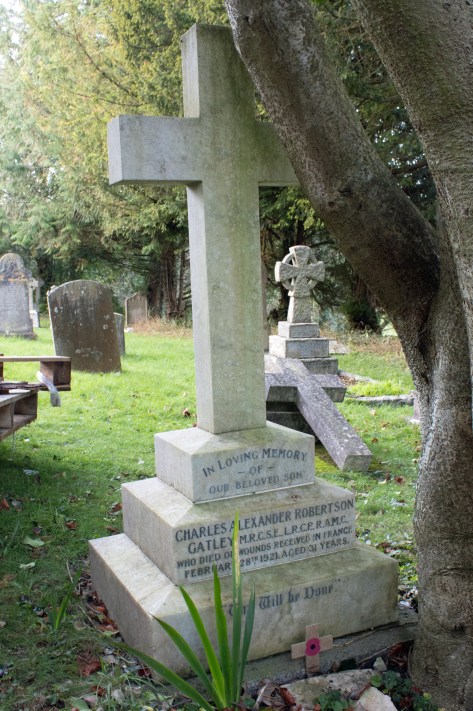
Captain Charles Gatley

Captain Charles Gatley

A gloom was cast over Bratton and the neighbouring villages when it became known on February 28th, that Dr Gatley had passed away, after an illness of about a fortnight. Although he had only lived at Bratton since 1919, he had endeared himself to everyone with whom he came into contact.

Dr Gatley had become partner with Dr Trevor Shorland, of Westbury, in September 1919, and after working for six months with him in Westbury, went to live at Mill Vale House, Bratton. He was the only son of Dr HR Gatley and Mrs Gatley, of Kingston-on-Thames, and received his education at Marlborough College and Guy’s Hospital, London, where he was house surgeon for some time. On the outbreak of war he went as house surgeon to Mrs Hal Walker’s (not Lady Wavertree) hospital, in Regent’s Park, and a year later went to France, and was attached to the East Kents.

It was while at Cherisy in 1917, that he was very severely wounded, and the effects of the wound he received brought about his death at the early age of 31.

Dr Gatley was medical officer for the Bratton district and the Westbury Board of Guardians, and he was also a member of the Pensions Board for Wiltshire.

[Wiltshire News: Friday 11th March 1921]

Charles Alexander Robertson Gatley was born in the spring of 1889 in Norbiton, Surrey. The youngest of three children, his parents were general practitioner Henry Gatley, and his wife, Isabella.

The family moved around the area with Henry’s work and status: in 1891 they were recorded as living in a villa on Kingston Hill; by 1901 they had moved to Adelaide Road, Surbiton; and the 1911 census recorded the family residing at 12 Surbiton Road, Kingston. Interestingly, Henry is not recorded as being at home for the latter two documents and, in fact, does not appear on the census records again until 1921, when he is the Assistant Medical Officer for the Warneforld Mental Hospital in Oxfordshire.

Charles, meanwhile, was continuing his education and, according to the 1911 census, was a medical student. He and Isabella were sharing their Kingston home with his older newlywed sister and brother-in-law, Marion (or May) and Russell Fawcus. The family were supported by two servants, Edith and Sarah.

The Wiltshire News outlined Charles’ studies and career: wounded in France, he was invalided out of the Royal Army Medical Corps, and moved to the county to set up his practice. He died on 28th February 1921, at the age of 31, and was laid to rest in the village’s St James’ Churchyard.


Tragically by this point, Henry and Isabella had outlived all three of their children. Their eldest, daughter Jane, had died in 1900, aged just 16 years old. Marion – May – passed away in 1918, at the age of 30.
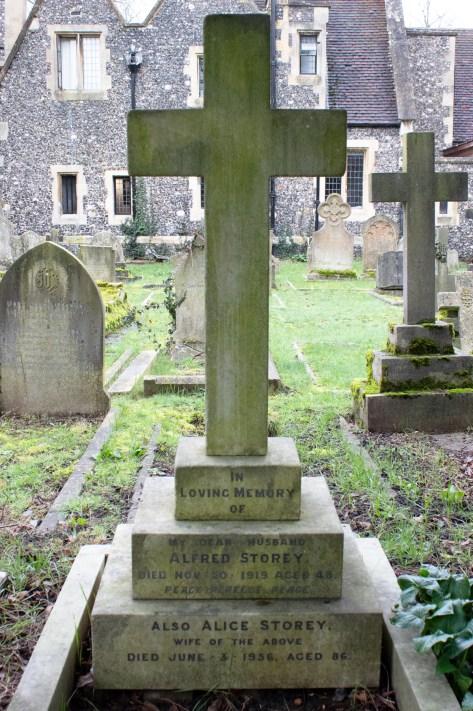
Corporal Alfred Storey

Corporal Alfred Storey

Alfred Story was born in the summer of 1876 in Poplar, Middlesex. The youngest of three children, his parents were Benjamin and Margaret. Benjamin was an engine fitter from North Shields, Tyne and Wear, but he and Margaret had moved to London by the time their eldest was born in 1863.

Margaret died in the 1880s, and, when Alfred left school, he found work as a draper’s assistant. He did not carry out this trade for long, however, and took up a career in the Royal Army Medical Corps. His First World War service papers suggest that he remained in the army for twelve years, gaining the Kedive’s Star for service in the Sudan in 1898, and the Queen’s Medal with five clasps and the King’s Medal with two clasps for his time in South Africa.

By the time of the 1911 census Alfred was living at 1 Belle Vue, Eton, Berkshire, and that he was a house porter at Eton College. He was recorded as having married Alice in 1905 (although a later document suggests they did not exchange vows until 26th October 1916), and the couple were living there with their daughter, May, who was three years old. While no formal marriage certificate is available, it would seem that Alice was a widow when they got together: also living at 1 Belle Vue were her children, William Mallaband (who was 15) and Violet Mallaband (13).

The next record for Alfred is his service papers for the First World War. He enlisted on 26th February 1917, and was assigned back to his former regiment as a Private. His medical confirms that he was 5ft 8ins (1.72m), and that he weighed 160lbs (72.6kg). He was recorded as having brown hair, blue eyes and a fresh complexion.

Private Storey carried out his duties on home soil, and was attached to 18th Company. He survived the conflict, and rose to the rank of Corporal, then Acting Sergeant. When he was stood down on 16th February 1919, we readily volunteered to extend his service for a further twelve months. On 20th November that year, he collapsed and died from a cerebral haemorrhage. He was 39 years of age.

The body of Alfred Storey was taken back to Berkshire for burial. He was laid to rest in the peaceful graveyard of St John’s Church, Eton. He was reunited with Alice when she died in 1956: husband and wife buried together after 37 years.


Private Frank Belthle

Private Frank Belthle

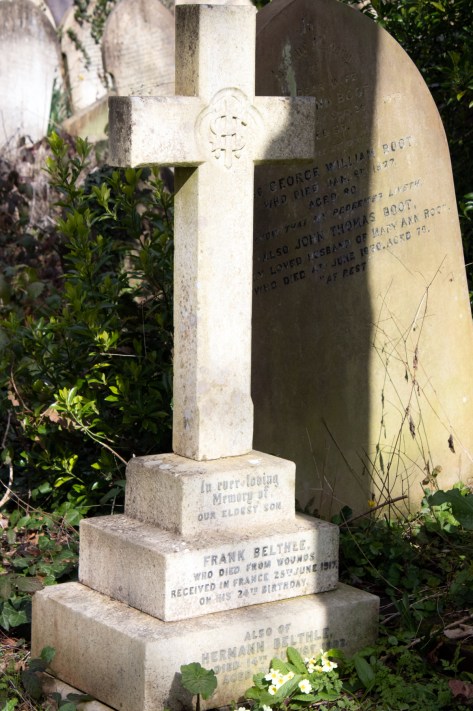
Frank Hermann Belthle was born in Dartford, Kent, on 25th June 1893. The oldest of four children, his parents were German-born Frederick Emil Hermann Belthle and his wife Elizabeth, who came from Surrey.

Frederick – who was better known as Hermann – was a manufacturer compressed tablets and pills. By the time of the 1901 census, he had moved his family to Aldrington, Sussex, were the set up home at 58 Westbourne Street. They had the house to themselves, unlike their neighbours, with two or three families sharing each property.

Hermann took the family to where work required him, and between 1903 – when Frank’s youngest sibling was born – and 1911, they relocated to London. Now seventeen years old, Frank was assisting his father in the business, and that business was obviously paying dividend: the Belthles’ new home was the 8-roomed house at 106 Barnsbury Road, Islington. Again, they occupied the whole building, while others in the street renting just a couple of rooms.

The outbreak of war must have had an impact on German national Hermann and his family. Frank looks to have stepped up to play his part, however, joining the Royal Army Medical Corps, possibly because of the medical training he had picked up through the family business.

There is little documentation about Private Belthle service, although he was awarded the Military Medal. By the summer of 1917, his unit – the 14th Field Ambulance – was supporting troops at Arras. While here, on 9th May, he was badly wounded, and medically evacuated to Britain for treatment. His injuries were to prove too severe, however, and, on 25th June 1917, he passed away: it was his 24th birthday.

Frank Belthle was laid to rest in the majestic Highgate Cemetery.


After the war, Hermann continued with his business. Things were more difficult for the family, however and, while they had moved to the prestigious Lonsdale Square, Islington, they were one of six families taking rooms in the large Georgian terrace.

Hermann passed away in the autumn of 1932, at the age of 70: he was laid to rest alongside his son in Highgate Cemetery.


Private Alfred Darch

Private Alfred Darch

Alfred James Darch was born early in 1884, the second of seven children to James and Emily Darch. James was a postman and labourer from Somerset, but the family were brought up in Devon village of Clayhidon.

By the time of the 1901 census, the family had moved over the border to Wellington. Alfred had completed his schooling, and was working as a showmaker’s assistant. He committed himself to the role, and by 1911 was a shoemaker in his own right. By this point he was one of two of the Darch children to still be living with his parents: the family were settled at 22 Eight Acres Lane in Wellington.

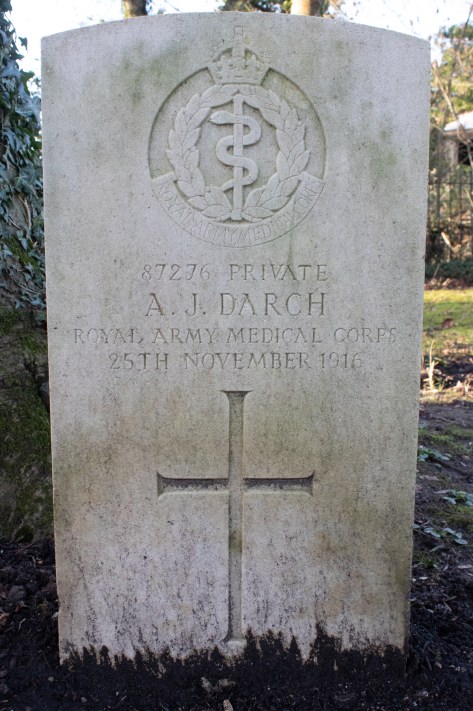
When war broke out, Alfred stepped up to play his part. On 19th October 1916 he enlisted, joining the Army Medical Corps. His service records show that he was 5ft 4ins (1.63m) tall. They also suggested that his right leg was slightly shorter than his left, following an old dislocation. Private Darch had also had an operation for appendicitis five years previously.

Alfred was sent to Codford, Wiltshire, where the No. 3 New Zealand General Hospital was located. His time there was to be tragically short, however. On 17th November he was admitted himself, suffering with some breathing complications. The medical report noted that he was “vaccinated a fortnight ago. Bad, sore, inflamed arm. Reported sick eight days later with general malaise, slightly sore throat, slight headache – some cough. He had one anti-typhoid inoculation 2 or 3 days before vaccination… Has had no [previous] chest trouble… Face flushed. Temp 104.8. Pulse 100. Tongue white in centre, red at sides. Breath extremely foul. Voice hoarse. Breathing quiet. Not distressed.”

Over the nest week, Private Darch’s health deteriorated. Pleurisy was suggested, but when he passed away, at 5:45am on 24th November 1916, the diagnosis was pneumonia. He was 32 years of age.

Alfred James Darch was laid to rest in the extension to St Marys Church, Codford, not far from the base to which he had been sent just weeks before.


Captain Robert Graves

Captain Robert Graves

Robert Kennedy Grogan Graves was born on 1st January 1878. An announcement in the local newspaper confirmed that “at Baronne Court, County Tipperary, the wife of Lieutenant-Colonel W. Grogan Graves, 82nd Regiment, of a son (prematurely).” Robert was the older of two children, while his parents were William Graves, a Justice of the Peace in Ireland, and his wife, Georgianna Graves.

William died in 1890, and Georgianna moved the family to London. The 1891 census found her residing at the Golden Hotel in St Martin in the Fields, while her two boys, Robert and his younger brother, Geoffrey, were boarding students at Francis Napier’s classics school on Shooter’s Hill Road in Kidbrooke, Kent.

Robert found his calling through education. He studied medicine, and by January 1896 he was a student at St George’s Hospital in Tooting, Surrey.

By 1906 Robert had set himself up in an infirmary on Southgate Street in Gloucester, Gloucestershire. That same year, he married Kathleen Schofield: the couple went on to have two children, Robert Jr in 1912, and Bernard the following year.

Graves, Robt. Kennedy Grogan, Scison Lodge, Clevedon, Somerset (Tel. 11 Y Clevedon) – MRCS, LRCP London 1904; (St Geo.); Hon, Med, Off. Clevedon Cott. Hosp.; Med. Off Mutual Insur. N.Y. & Clevedon Hydro. Estab.; late Sen. Ho. Surg. & Asst. Ho. Surg., & Surg. Gloucester Co. Infirm., & Asst. Med. Regist. & Obst. Clerk St Geo. Hosp.

[The Medical Directory, 1910]

Robert had set himself up well during his life. The 1911 census found him and Kathleen – who was better known by her middle name, Gladys – living in their 17-room house on Linden Road in Clevedon. They afforded themselves three servants, including a housemaid, a cook and a motor driver. By the outbreak of war, Robert has an entry in the town’s Kelly’s Directory, and seemed to be a focal member of the community, joining the local Grand Lodge in September 1908.

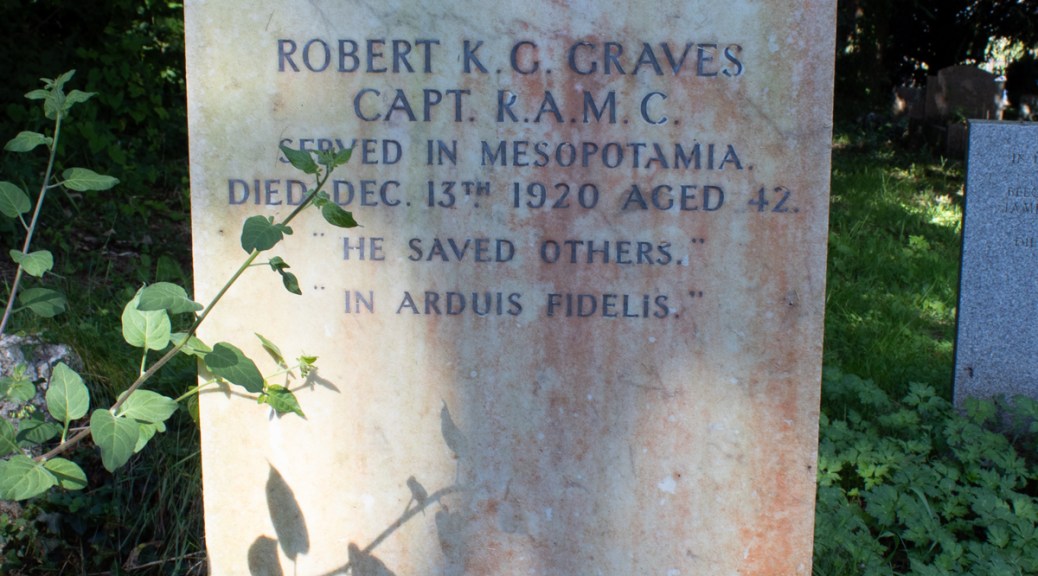
Robert’s time in the army, is hard to piece together. He joined the Royal Army Medical Corps as a Captain, and appears to have been connected to the air force. His headstone suggests that he served in Mesopotamia, but when and exactly where, however, is lost to time.

After the war, Robert returned to Britain. Leaving the Somerset coast, however, he and Kathleen appear to have set themselves up in Dorset. He died, through causes not detailed, on 12th December 1920, at 42 years of age. His entry on the probate register states:

GRAVES Robert Kennedy Grogan of 1 Charnwood Chambers Seabourne-road West Southbourne Hampshire died 12 December 1920 at The Grange Buckfastleigh Devonshire…

It is unclear whether Charnwood Chambers was his working address, with The Grange being the family’s official home, or if Buckfastleigh served as a place of convalescence.

Robert Kennedy Grogan Graves left an estate totalling £370 14s 7d (approximately £21,100 today) to Kathleen. He was buried in the graveyard of Holy Trinity church, Buckfastleigh.


Private Albert Chapple

Private Albert Chapple

Albert Chapple was born early in 1895, and was the son of Elizabeth Chapple. She was just 16 years of age when he was born, and her parents, John and Sarah, unofficially adopted him as their own. John was a church sexton from the village of Knowstone, Devon, and this is where the Chapple family were raised.

Elizabeth married William Dart, a fishmonger from Dawlish, in 1909, and by the time of the census two years later, they had set up home in Beach Street, close to the town’s railway station.

Albert, meanwhile, was still living with his grandparents back in Knowstone. John, now 66 years of age, was employed as an agricultural labourer, while his grandson was working as a cattle boy on the same farm.

When war broke out, Albert was called upon to play his part. Sadly, full details of his military service have been lost, but it is clear that he had enlisted by June 1916. He enlisted in the Royal Army Medical Corps as a Private, with his entry in the British Army of Soldiers’ Effects suggesting that his unit was attached to the 2nd/1st Wessex Field Artillery.

Private Chapple’s pension record confirms that he had been admitted to the 2nd Western General Hospital in Exeter, Devon. He passed away on 10th December 1916, following an operation, although the document gives no clue as to why he had needed surgery. He was just 21 years of age.

Albert Chapple’s body was taken back to Knowstone for burial. He was laid to rest in the graveyard of St Peter’s Hospital in the village.


The next census return, taken in 1921, found Elizabeth and William still plying their trade in fish in Dawlish. By this point, they had had a son, Edmund, who was five years old. Elizabeth’s sister, Rosie, was living with them, and assisting in the business.


Captain William Mence

Captain William Mence

William Charles Mence was born in Blackheath, Kent in the spring of 1877. He was the oldest of five children to William Cookes Mence and his wife, Susanna.

William Sr was a chemist-turned-dentist, and by the time of the 1881 census, the family had moved to prestigious lodgings on the corner of Claremont and Victoria Roads in Kingston-upon-Thames, Surrey. William had set up practice in the building, and employed two servants to assist him with the practice, and two more to help Susanna with the family.

Dentistry would keep William Sr occupied for at least the next thirty years, a move to nearby Surbiton in the late 1890s being the only change tot he business.

William Jr, meanwhile, was making his own way in the medical world. The 1901 census recorded the 24-year-old Mr Mence visiting a possible mentor, physician and surgeon Charles Gallie, in Camberwell. William was also noted as being a physician and surgeon, and this was to become the career in which he forged his way.

On 9th August 1906, William married Dorothy Mytton in the Saint Aelhaiarn’s Church in Guilsfield, Powys, Wales. Dorothy was the daughter of a retired army captain, Devereaux Mytton. She had been born in Guilsfield and, at the time of the 1901 census, was living with her family and ten servants at Garth Hall, close to the village.

The young couple’s marriage certificate also sheds some light on William’s career. It confirms that he was working as a medical practitioner, and was living in the village of Perranzabuloe in Cornwall.

William and Dorothy went on to have five children, and named them to reflect their combined family histories. Daughter Evaline Dorothy Cookes Mytton Mence was born first, in 1907, followed by sons John Herbert Myttone Cookes Mence, Devereaux Mervyn Mytton Cookes Mence and Godfrey Powis Mytton Cookes Mence. Their fifth child, daughter Myfanwy Susan Mence, was born in 1914.

When war broke out in Europe, William was drawn to play his part. While full details about his service are not available, his public standing meant that he took a commission as Captain in the Royal Army Medical Corps. His Medal Roll Index Card confirms that he was awarded the 1914-1915 star, so he joined early in the conflict. It also outlines that he served in Mesopotamia from 4th February 1916, in France in 1917 and in Salonika from 1917 to 1919.

Ill health seemed to have dogged him in later years, and by the summer of 1919, Captain Mence had returned to British shores, and to Devon, where his practice had moved to shortly before the conflict.

Dr William Charles Mence, of Axminster, who died in Axminster Cottage Hospital on Friday night, recently returned from active service… He was a medical officer under Axminster Board of Guardians…

Western Morning News: Monday 28th July 1919

William Charles Mence died on 25th July 1919 as a result of an ongoing illness: he was 42 years of age. He was laid to rest in Axminster Cemetery, not far from the family home.


Private John Turner

Private John Turner

John Francis Turner was born on 24th March 1899 in the St Ouen region of the Channel Island of Jersey. He was the only surviving child of Francis and Eugenie Turner, his older brother, Francis Jr, having passed away before John was born.

Francis was a farm labourer, but when John finished his schooling, he found work as a carpenter. When war broke out across Europe, he was conscripted to play his part and, on 31st March 1917, he enlisted in the army.

Private Turner was noted as being 5ft 5ins (1.65m) tall and weighing 115lbs (52kg). His medical records show that his vision was defective, but not so bad as to exclude him from service, but he was also found to have flat feet.

John was assigned to the Royal Army Medical Corps, and was sent to Blackpool, Lancashire, where he was attached to the local depot. He spent the next two years in the army, although his time was not without incident.

In December 1917, he was confined to barracks for five days for overstaying his pass by more than eight hours. This seems to have been Private Turner’s only misdemeanour, however, and there is nothing to suggest anything other than good service.

John’s time in the army does not seem to have been limited to home soil, and, in the spring of 1919, he was attached to one of the Russian convoys ferrying aid and supplies overseas. On his return, however, he fell ill, and on 2nd February, he was admitted to hospital in Edinburgh, suffering from pleurisy.

Private Turner was to remain in hospital for the next few months. He slowly recovered, but then contracted meningitis, and, with his body already weakened by illness, this was to prove his undoing. He passed away on 23rd June 1919, aged just 20 years of age.

John Francis Turner’s body was taken back to Jersey for burial. He was laid to rest in the peaceful churchyard of St Ouen’s.


Private Herbert Griffith

Private Herbert Griffith

Herbert Griffith was born in the summer of 1883 in the Somerset village of Crowcombe. One of eight children, his parents were coachman James Griffith and his wife, Selina.

Herbert’s early life is a challenge to piece together. The 1901 census recorded him as living at Weacombe House, West Quantoxhead, where he was employed as a footman.

On 16th December 1909, Herbert married Selina May Davies. Also born in Crowcombe, she was the daughter of a tailor. The couple’s marriage certificate confirms the wedding was conducted at the village church. The couple went on to have two children, Dorothy in 1912, and Geoffrey four years later.

Herbert, at this point, was living in Farnborough, Warwickshire, where he was employed as a valet. (While no document remains to confirm this, it seems possible that this was actually Farnborough Hall, home to generations of the Holbech family.)

When war broke out, Herbert seemed keen to serve his country. He enlisted in the Royal Army Medical Corps, although his full service records no longer remain, so it is not possible to confirm whether he served on home soil or overseas.

The next record relating to Private Griffith is that of his passing. He died in Southampton, Hampshire, on 22nd February 1916, as a result of a combination of bronchitis, asthma and cardiac failure. He was 32 years of age, and would never get to meet his son, who was born two weeks later.

The body of Herbert Griffith was taken back to Somerset for burial. He was laid to rest in the peaceful surroundings of the Church of the Holy Ghost in his home village, Crowcombe.


Captain James Pettinger

Captain James Pettinger

The death of Capt. James Wilson Pettinger has taken place in a military hospital at Aldershot. Captain Pettinger came to Kingsbridge [Devon] in 1903, entering into partnership with Dr D de Courcy Harston… He made a wide circle of friends, and was appreciated for his professional skill. Previously to coming to Kingsbridge, he was house surgeon at St George’s Hospital, London. In July 1915, Dr Pettinger volunteered for service in the Royal Army Medical Corps, being appointed Lieutenant to the Plymouth Military Hospital. He quickly gained promotion to captain, and was appointed to a hospital ship, and served in the Mediterranean for several months. He contracted blood poisoning in the arm, and was sent to Netley Hospital [Hampshire]. On recovery he was placed in charge of an infections hospital for several months at Salisbury. He was later ordered to France, and being taken ill was transferred to an Aldershot hospital, where he died from pneumonia. He leaves a widow and one son. Dr Pettinger was 43 years of age.

Western Times: Tuesday 16th October 1917

James Wilson Pettinger was born in the spring of 1874 in Moss Side, Lancashire. The youngest of four children, his parents were doctor and surgeon George Pettinger and his wife, Sarah.

James may have been a sickly child: the 1901 census recorded him as being a patient in community hospital in North Meols, near Southport, Lancashire. The oldest of only three patients, the facility was overseen by caretaker John Carr and his matron wife, Susan.

Having gone on to study at Cambridge University, James was carving a career for himself. By the time of the next census he was living in Shaftesbury, Dorset, he was recorded as being a medical practitioner, living on his own in a house near the centre of town.

As the Western Times was to report, James moved to Devon in 1903. On 8th January, he married Clara Risdon, a nursing sister seven years his senior. She came from the Somerset village of Old Cleeve, and the couple married in her local parish church. The couple set up home in Ewart House in Kingsbridge, and went on to have a son, Geoffrey, who was born that November.

James’ career continues to flourish. The 1910 medical directory noted that he was the Honourable Medical Officer for Kingsbridge & District Cottage Hospital, and noted that he had previously worked as an Honourable Physician, Honourable Surgeon, Ophthalmologist, Aural, Obstetric and Dental Assistant and Assistant Surgical Registrar at St George’s Hospital in London.

Little information relating to James’ time in the armed forces is available, and so it falls to his obituary in the Western Times to fill in the gaps. It would seem that Clara and Geoffrey moved to Minehead, Somerset, while James was serving overseas. The town was not far from where she had been born, and family connections may have helped with her husband’s absence.

When James Wilson Pettinger died, on 6th October 1917, his body was brought to Minehead for burial. He was laid to rest in the town’s sweeping cemetery, and was joined there by Clara when she passed away in 1945: a husband and wife reunited.