Arthur Ernest Taylor was born at the end of 1892, the middle of three children to James and Sarah. James was a baker, and the family lived in Bruton, a small town in the west of Somerset.
Only one of James’ three sons followed him into the baking business; this was his youngest, Reginald. The oldest of the three brothers, Oatley, found employment in Wales as a miner. Arthur, on the other hand, stayed in Bruton, but found work as a cycle repairer when he left school.
In December 1913, Arthur married Gertrude James, the daughter of a local carpenter; the young couple went on to have a son, Gerald, the following year.
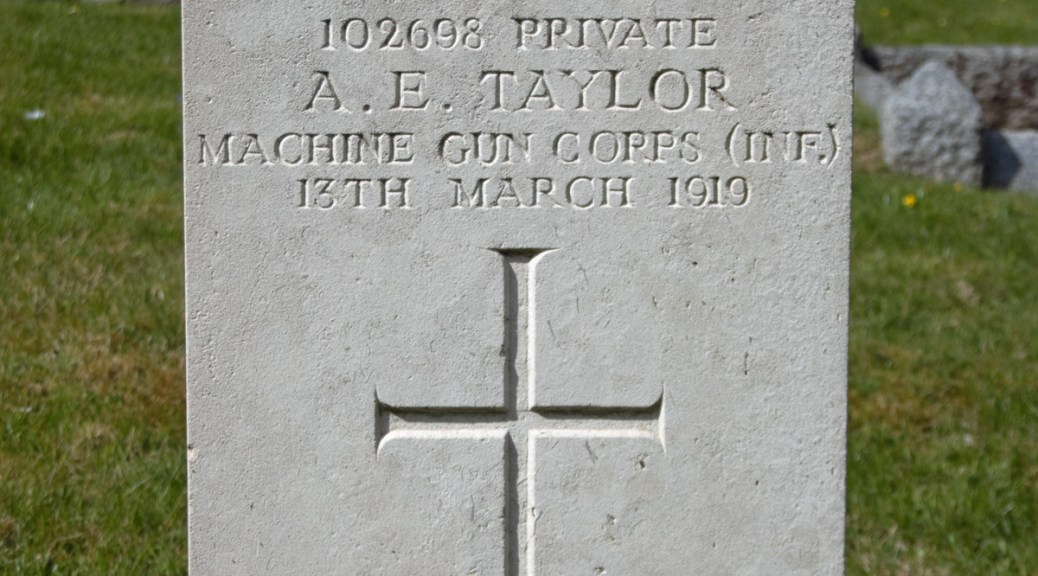
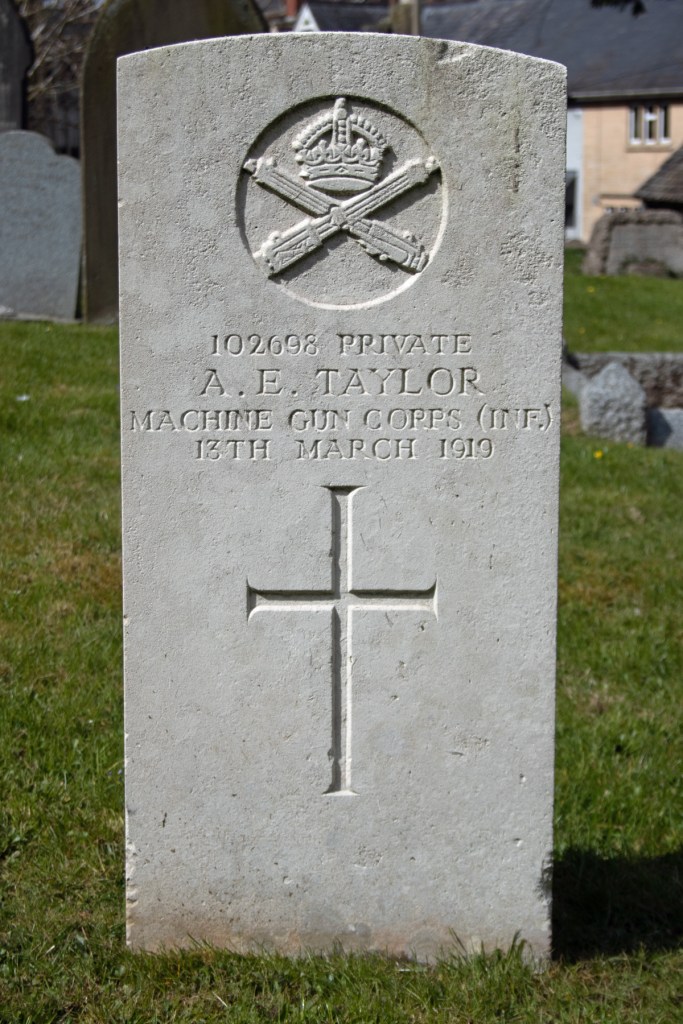
Sadly, little information about of Arthur’s military career survives. He enlisted in the Machine Gun Corps, although there is nothing to confirm exactly when he enrolled.
The next time Private Taylor appears in the records is a notice in the Western Gazette on 28th March 1919. The newspaper reports that he passed away in the Military Hospital in Grantham, Lincolnshire. Further documentation shows that he passed away on 13th March 1919, at the age of 27 years old. Sadly, there is no confirmation of the cause of his passing.
Arthur Ernest Taylor was brought back to Somerset, and his body lies at rest in the graveyard of St Mary’s Church in his home town of Bruton.
Francis William George Packer was born in Bristol on 28th July 1884. The eldest of three children, he was the son of a grocer, Francis Packer Sr, and his wife, Eliza.
When Francis left school, he followed his father into the grocery business and married Kate Taverner on 1st September 1907. They had one child, a daughter called Dora, in 1909 and, by the time of the census two years later, Francis had moved his young family to Bath.
By the time he was called up, in December 1915, Francis had moved the family again, this time to the sleepy village of Blagdon, in the Somerset Mendips. He formally enlisted in the Machine Gun Corps of the Somerset Light Infantry in July 1916, and was sent to the front in January the following year.
Private Packer’s battalion fought at Arras, and it was here that he was injured. On 1st May 1917, he received a gunshot wound to his right thigh, which fractured his femur. He was initially treated on site, before being shipped back to England, where he was admitted to King George’s Hospital in London.
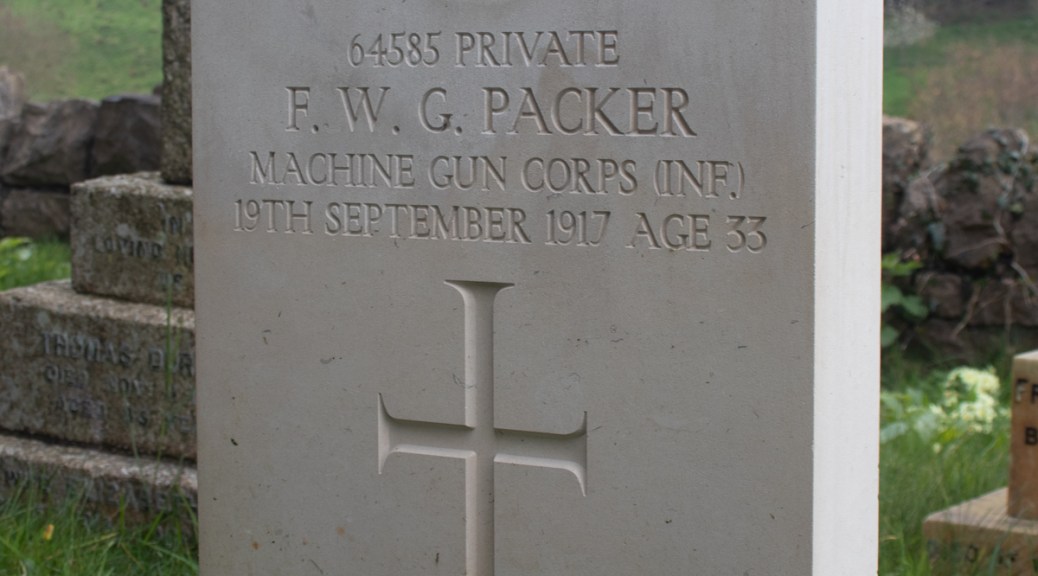
Sadly, it seems there were complications with his treatment, and Private Packer died from his wounds four months later, on 19th September 1917. He was 33 years old.
Francis William George Packer was brought back to his family in Blagdon, and lies at rest in the churchyard of St Andrew’s there.
The local paper reported on Francis’ funeral, but what struck me is that there seems a glaring omission in the list of those who attended. It was obvious that he wanted a strictly private funeral, but:
The mourners were Mr FE Packer (father), Mr S Emery (brother-in-law), Mr SG Packer (uncle), Mr W Taverner (uncle), Mrs ES Packer (mother), Mrs E Emery (wife’s sister), Amy Parker and Nellie Parker [his sisters-in-law], A Packer (aunt), Dolly Parker, Dolly Flower, Mr J Jones (uncle), Mr CJ Redwood, Mr J Nelson and Mr AH Bleacove.
Western Daily Press: Wednesday 26th September 1917
There is nothing in the report to suggest that Francis’ widow attended the funeral.
Francis’ younger brother, Albert Packer, also fought and died in the First World War. Find his story here.
Walter John Millard was born in the summer of 1887, the youngest of nine children to Robert and Elizabeth. Robert was a farmer, and brought his family up in the village of Wedmore, Somerset. Walter followed in his father’s footsteps, and by the time of the 1911 census, was listed as a farm labourer in Wedmore, working for a William Millard, who presumably was a cousin of the family.
In March 1915, Walter married Jessy Masters, daughter of a grocer in nearby Wells. The couple set up home in the neighbouring village of Wookey, but would later make their home in Westbury-sub-Mendip.
In December 1915, aged 28, Walter was called up, and assigned to the Reserve Machine Gun Corps. He was not formally mobilised for almost three years when, in October 1918, he was shipped to Rugeley, Staffordshire, for training.
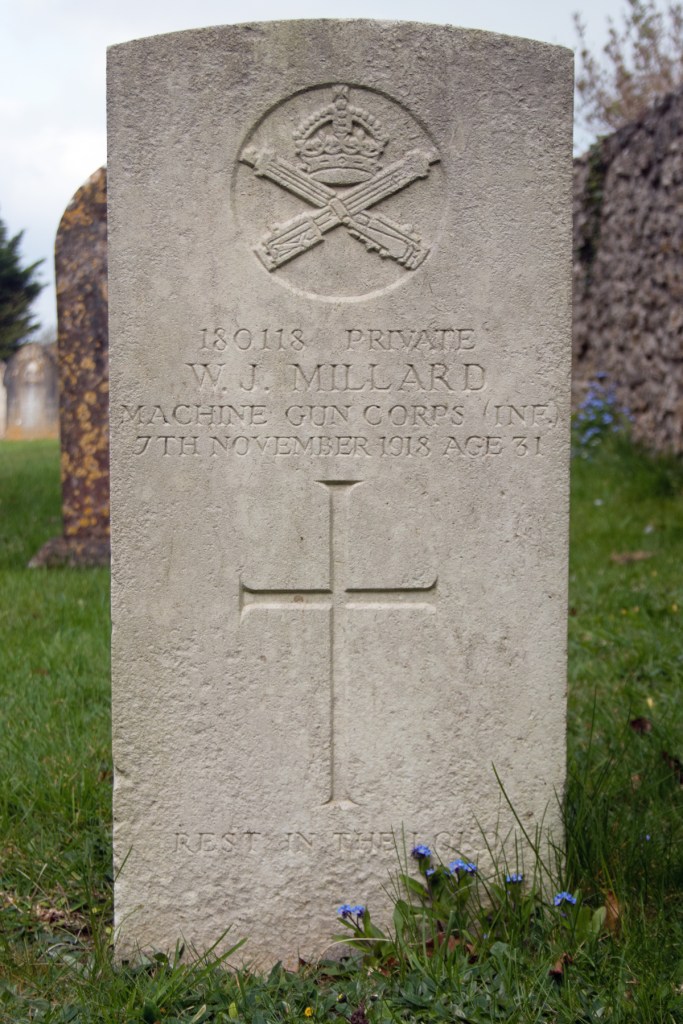
During this time, Private Millard was taken ill, and was admitted to the Military Hospital at Cannock Chase within weeks with influenza. His health deteriorated and, on 7th November 1918, he died from pneumonia. He was 31 years of age.
Had it not been for the quirk of fate of having been mobilised a month before the war ended, tragically, this would likely not be a story that needed to be told.
Walter John Millard was brought back to Somerset, and lies at rest in the graveyard of St Lawrence Church in Westbury-sub-Mendip.
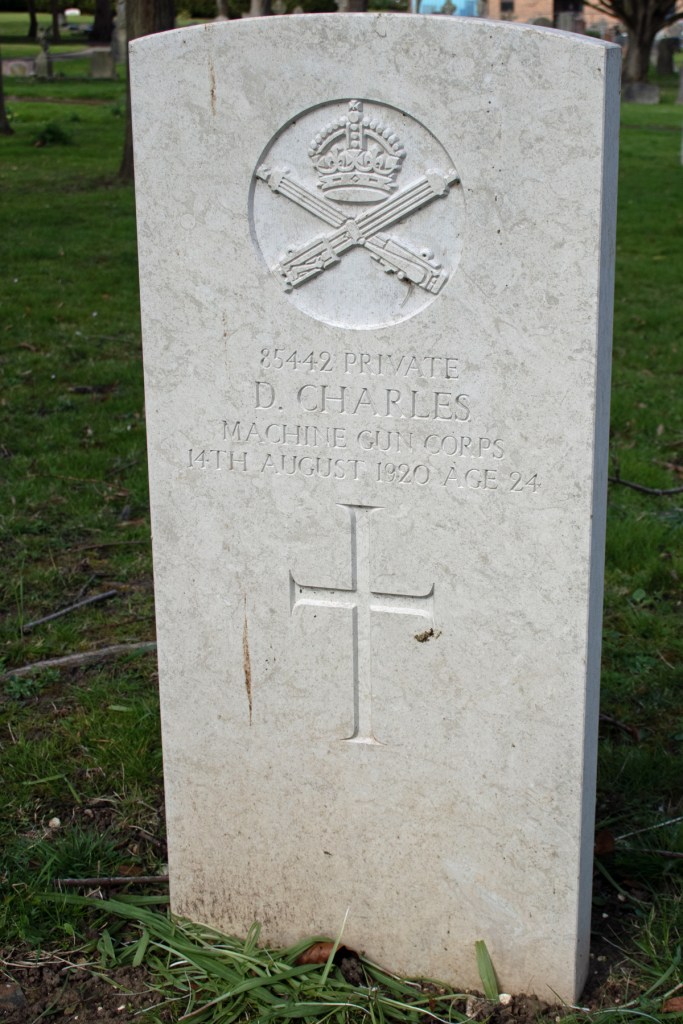
David Charles was born towards the end of 1893 and was one of eight children. His parents – David Sr and Elizabeth Charles – both came from Wales, and moved their young family to Kent in 1891. David Sr worked at a torpedo factory, and the move may have been determined by employment at the Naval Dockyard in Chatham, Kent.
When he left school, David Jr found work at an ironmonger’s, but storm clouds were forming over Europe, and he was soon called up on to do his duty for King and country.
David Jr enlisted in July 1915, joining the 23rd Reserve Battalion. He transferred to the Machine Gun Corps in February 1917 and was posted to the Western Front a month later.
Private Charles was wounded in action on 7th October 1917, although the injury did not prevent him from returning to duty after three weeks’ rest. He was readmitted to hospital on 23rd November, eventually being transferred home on a hospital ship before Christmas.
On 11th January 1918, Private Charles was transferred to No. 5 Battalion in Grantham, where he was promoted to Acting Lance Corporal within a couple of months. Sickness dogged him, however, and he was eventually discharged from military service for medical reasons on 7th August 1920.
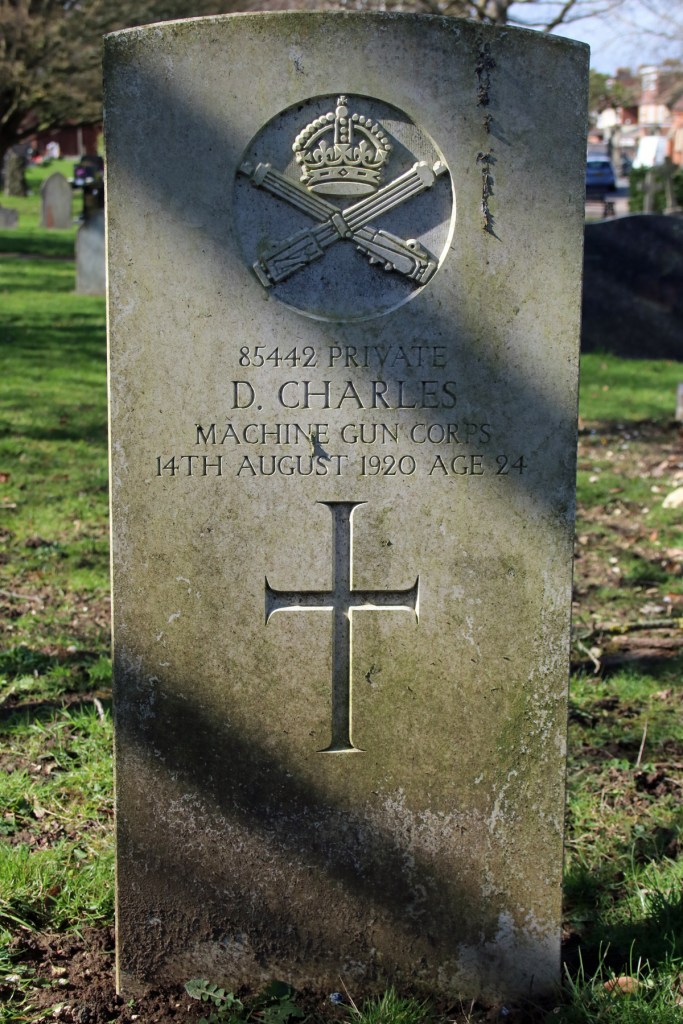
By this time, David had been admitted to Fort Pitt Hospital in Chatham with endocarditis – enlarged heart – and this is where he sadly passed away from the condition just a week after being discharged from the army. He died on 14th August 1920, at the age of 27 years old.
David Charles lies at rest in the Woodlands Cemetery in Gillingham, Kant.
David seems not to have been originally commemorated by the Commonwealth War Graves Commission. I can find no record of why this might have been the case, but this was eventually rectified 10th February 2016, and his name was immediately added to the United Kingdom Book of Remembrance.
The United Kingdom Book of Remembrance commemorates United Kingdom casualties of the two World Wars who were not formerly recorded by the Commonwealth War Graves Commission. The men and women remembered on it are recent additions to the list of war dead and are presently commemorated solely by their database record and register entry.
The register is maintained at the Commonwealth War Graves Commission’s Head Office, Maidenhead, and the names remain recorded there until such time as The Commission has investigated the grave location details.
David’s grave was identified and a headstone now placed in its rightful position.
Ernest Edward Hector was born in 1875, one of six children – all boys – to Thomas and Mary Hector. Thomas was a farm labourer, and this was a trade Ernest and his brothers all followed their father in.
Ernest was keen for a better life, however, and enlisted in the Somerset Light Infantry in May 1896, aged 21. After initial training and service in England, Private Hector was off to the East Indies, arriving there just after Christmas 1897.
Six years abroad followed, after which Ernest returned to England to serve another four years. He completed the 12 years of his military career in May 1908.
By this point, Ernest had married Eliza Humphries, a young lady seven years his junior, who came from his home village of North Wootton in Somerset. The couple went on to have six children and, by the time of the 1911 census, Ernest had settled his family in West Pennard, near Glastonbury, and was working as a farm labourer.
Ernest’s service during the Great War remains tantalisingly hidden. Given that he was 39 when hostilities broke out, it is unlikely that he was called up again straight away; his gravestone confirms that he was assigned to the Machine Gun Corps (Infantry), but research on his service number provides little other detail.
There is nothing in the media of the time reporting on his death or funeral either, so no concrete cause of death can be confirmed. All that is known is that Private Hector died on 9th May 1920, aged 45 years old.
Ernest Edward Hector is buried in the graveyard of St Peter’s Church in North Wootton.
Hubert Wilfred Labdon was born in the spring of 1896, to Alfred and Elizabeth Labdon, bakers in Ashcott, Somerset. One of five children, with two older brothers and two older sisters, he lost is mother at a very early age; Elizabeth died in 1901.
Hubert had left home by the time he was fifteen, but had not gone far – the 1911 census found him learning a trade from Edgar and Betsy Vining, farmers in the village.
When war came, Hubert enlisted – he joined up in February 1916, aged 19 years and five months. Private Labdon was initially assigned to the Somerset Light Infantry, but he must have quickly shown aptitude, because he was soon transferred to the Machine Gun Corps. After initial training, he found himself on a ship to France, arriving in Camiers, to the south of Boulonge, on 25th September 1916.
Private Labdon’s military records survive and are quite detailed – after an early mishap, where he was docked two days’ pay for losing part of his kit ‘by neglect’, he also spent time in hospital in June 1917.
By August of that year, he was based permanently at Camiers, where he was acting as a stretcher bearer. This was a role he continued to execute until he was demobbed at the end of the war.
His records show Hubert was granted two periods of leave; it was on the second of these, in November 1918, that he married Eva May Acreman. She was two years his senior, a farmer’s daughter from Ashcott as well, although the couple married in Ealing, London.
By mid-December, Private Labden was back in France, and here he stayed until February 1919, when his unit was finally demobilised. On returning to England, the young couple moved back to Ashcott, to be close to his family.
Sadly, Hubert seems to have succumbed to illness as many of his returning colleagues did. The local newspaper gave details of his passing:
The deceased, who was only 23, was recently married. He had served his country during the late war, part time as stretcher bearer. He had suffered from trench fever, which considerably injured his constitution and left him with a weak heart, which, no doubt, was the cause of death.
He had left his home for a short walk, and having been away rather longer than usual [a] search was made for him, and he was found sitting in an unconscious state. He died in a short time after reaching his home.
Deceased was of a very quiet and inoffensive disposition, and was much respected.
Central Somerset Gazette: Friday 2nd January 1920
While the end result was the same, Private Labdon’s military records adds the cause of death as ‘heart failure following influenza and acute diarrhoea’.
Hubert Wilfred Labdon lies at peace in the graveyard of All Saints’ Church, in his home village of Ashcott in Somerset.
Eva remained in Somerset after her husband’s death. In 1930, she married William Langford, a baker, and the couple went on to have a daughter.
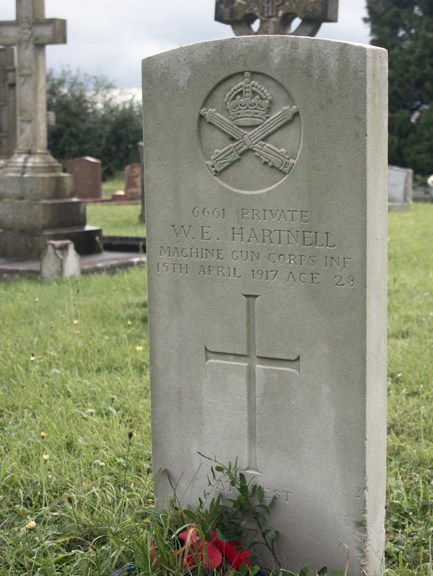
Walter Ernest Hartnell was born in 1888 to William and Jane Hartnell in Charlton Musgrove, on the outskirts of Wincanton in Somerset.
One of eight children, it appears he could have been a bit of a tearaway in his youth; in October 1905, the Shepton Mallet Journal reports on a “Hobbledehoy Nuisance” in Evercreech, when a Walter Hartnell was caught with nine of his friends causing a disturbance close to the church.
They were shouting, racing after each other up and down the road, using obscene language, and smoking cigarettes. This continued till 7.15, about half an hour.
Shepton Mallet Journal – Friday 20th October 1905
Hartnell was fined 5/- and 2/6 costs, or would face ten days in prison.
Things looked up for Walter and, by the time his call to enlist came, he was working on the railways. He joined the Somerset Light Infantry and the Machine Gun Corps (MGC), while his brother Fred fought in the Royal Artillery.
The MGC was a particularly brutal part of the armed forces. Of the 170,500 officers and men who served in the corps, 62,049 became casualties, including 12,498 killed, earning it the nickname ‘the Suicide Club’.
Details of Private Hartnell’s death are sketchy; his company saw action at Ypres and Arras. However, records suggest that he died in Colchester; the Military Hospital there was used to dealing with troops straight from the Front. It is likely that he was injured at Ypres and shipped back home to recuperate, but died of his injuries.
This is all conjecture on my part, of course, but either way, Private Walter Hartnell lies at peace in a quiet cemetery at Evercreech in Somerset.
Arthur Palmer was born in Bicester in 1889 to groomsman George Palmer and his wife Annie. Arthur was the eldest of five children, five boys and one girl.
By 1911, the family had moved to Dorset, where George continued to work as a groom. His son, Arthur, had also gone into domestic service, and was a footman. Presumably this was under the same employ as his father, although the records do not confirm this.
This is where the trail for Arthur Palmer dries up.
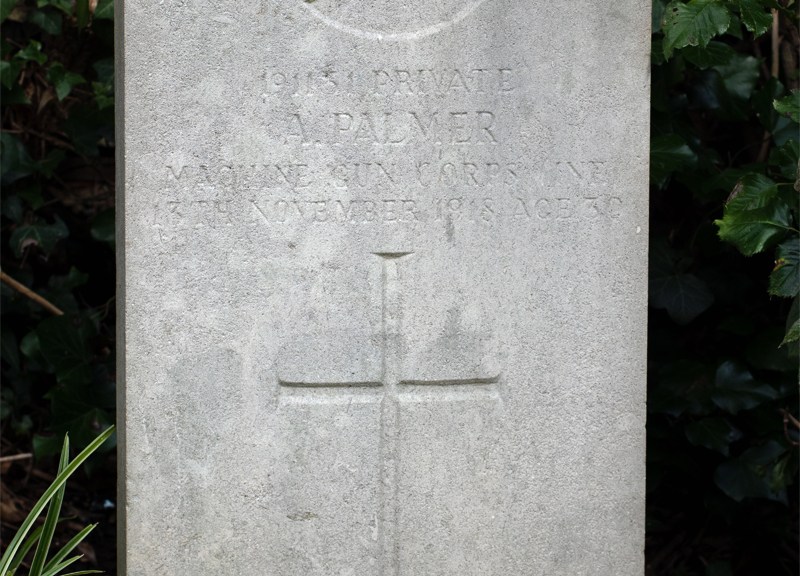
From his gravestone, we know he served in the Machine Gun Corps (MGC). The Register of Soldiers’ Effects confirms he was in the 3rd Company; this was formed in January 1916, so Private Palmer can only have enlisted after that date.
Online research only brings up MGC military service records for an Arthur George Palmer, who lived in Kettering. However, this Private survived the war, so could not be the one buried in Dorset. There is nothing in contemporary newspapers to suggest that there was anything untoward or unusual about his passing.
All I can say for certain is that Private Arthur Palmer died at the Cannock Chase Military Hospital on 13th November 1918.
He lies at rest in Sherborne Cemetery, Dorset. He was 30 years old.








 Death and Service