
Tag Archives: mania

Private William King

Private William King

William Samuel King was born in the summer of 1880, and was one of four children to Richard and Elizabeth King. Richard was a railway worker from Totnes, Devon, and this is where the family were born and raised.

When he left school, William found work as a house painter, and this is a job he continued to do through to the outbreak of the Great War. On 8th June 1908 he married Minnie Edmunds: the couple went on to have a son, Leslie, who was born in 1912. William and Minnie had, by this point, moved to Swansea, West Glamorgan, presumably as work was more plentiful here than in their Devon home. His work as a decorator seems to have been recognised, and he was admitted to the National Association Partnership, Swansea South.

On 1st December 1915, William enlisted and his service records show that he was 5ft 2ins (1.57m) tall. While it is clear that he spent his time on home soil, his service seems a bit disjointed.

Private King wasn’t formally mobilised until September 1916, when he was assigned to the 2nd/2nd Battalion of the Monmouthshire Regiment. In December he was transferred to the Royal West Kent Regiment before returned to his original battalion in February 1917. A month later, he moved to the Bedfordshire Regiment, before moving to the Middlesex Regiment a few weeks later. This also seems to have been a temporary move as, three weeks later, he was assigned to the 337th Works Company of the Labour Corps (although this was still part of the Middlesex Regiment).

The potential reason behind Private King’s haphazard service seemed to become a little clearer when, in September 1917, he was referred to Fort Pitt Hospital in Rochester, Kent. He was noted as being “very talkative, noisy [and] in a state of mental disease… he has… exalted and grandiose ideas and is difficult to restrain.” His mental health was obviously suffering, and he was discharged from military service in December 1917.

William returned home, although it was not to be for long. He passed away on 13th April 1918, at the age of 37 years old. While no cause of death is evident, it seems likely to have been connected to his ‘mania’, which had been exacerbated by his army service.

William Samuel King was laid to rest in Totnes Cemetery, not far from his parental home.
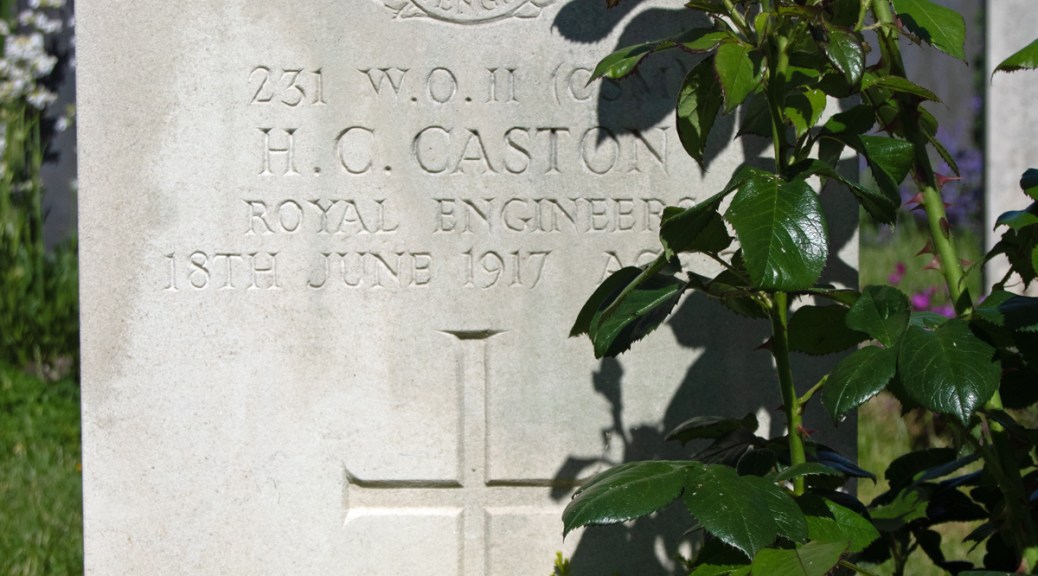

Company Sergeant Major Hugh Caston

Company Sergeant Major Hugh Caston

Hugh Charles Caston was born in Chelsea in the summer of 1881, the oldest of three children to Emily and Hugh Caston. Hugh Sr died in the late 1880, leaving Emily to raise the family on her own. She moved the family to Gillingham, Kent, to be near her family. She found work as a seamstress and took in boarders.

As the effective head of the family, Hugh obviously felt he had to earn a wage. On 1st August 1896, he enlisted in the Royal Engineers as a Bugler.

Hugh’s medical report shows he stood at 5ft 4.5ins (1.63m) tall and weighed 97lbs (44kg). He had a medium complexion, with brown eyes and brown hair. The report also gave his distinctive marks as being a scar on his forehead, a brown patch on his left buttock and that his eyebrows meet.

Initially too young for full active service, Hugh formally joined up on 1st June 1897. He spent more than five years on home soil, rising through the ranks from Sapper to Lance Corporal to 2nd Corporal. In May 1902, he was posted to Malta, returning home nearly two years later. Hugh’s promotions continued over the next decade, and, by the time war broke out, he had reached the rank of Company Sergeant Major.

By this point, Hugh had married, wedding Rochester woman Mary May Coast in September 1907. The couple went on to have two children, Hubert, who sadly died young, and Joan.

War came to Europe, and things took a turn for Company Sergeant Major Caston. He was admitted to Netley Hospital near Portsmouth, with mania:

Patient’s very restless, often gets ‘excited’ is thwarted in any way. Has a delusion that he is to be promoted to Major and that he possesses great wealth. He continually asks that his motor may be sent round to take him out, also that his tailor be sent for to rig him out. Stated this morning that he wished all the other patients be supplied with Egyptian cigarettes.

Medical Report on Hugh Caston, 20th January 1915

The medical officer went on to state that he did not consider that military service had in any contributed to the mania; he was dismissed from the army on medical grounds on 2nd February 1915, after nearly 20 years’ service.

Sadly, at this point Hugh’s trail goes cold. There is no documentation relating to his time after being discharged from the army and, tragically, after his death Mary was not granted a war pension, as he had served for less that six months during the First World War.

Hugh Charles Caston died on 18th June 1917, at the age of 36 years old. While the cause of his passing is lost to time, he was laid to rest in the Woodlands Cemetery in Gillingham, Kent.