

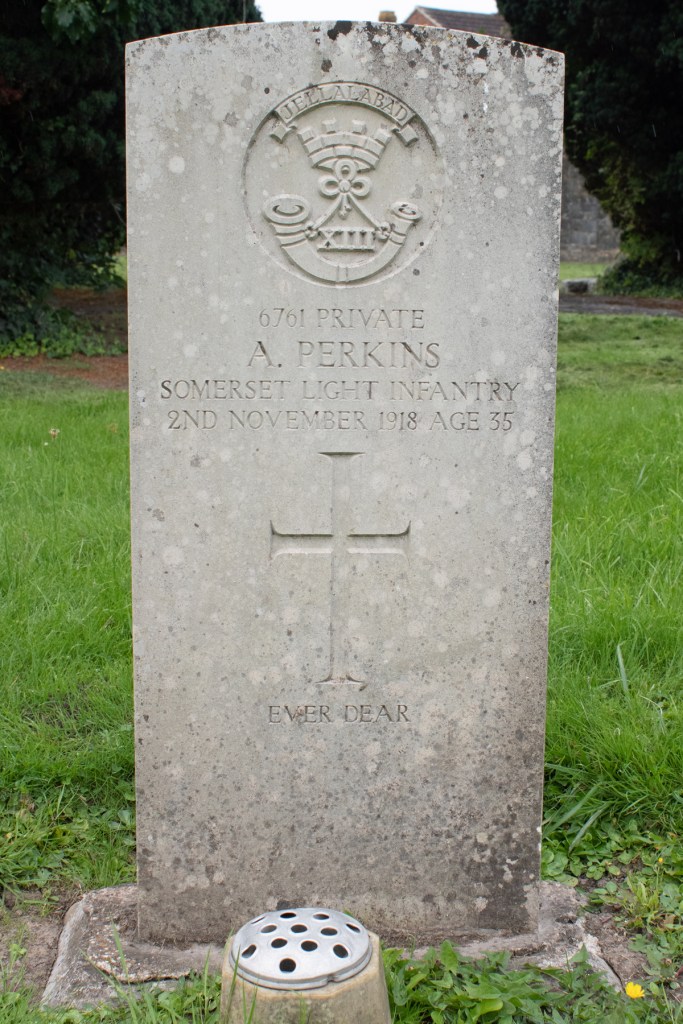
Arthur Perkins was born on 22nd April 1883, the seventh of eight children to James and Jane Perkins. James was a farm labourer who subsequently found work on the railways. The family were all born in Huntspill, Somerset, moving the few miles north to Highbridge when James’ work changed.
Arthur initially took on labouring work, but sought a more reliable career. On 26th February 1903, he enlisted in the army, joining the Somerset Light Infantry, for whom he had previously been a volunteer. His service records show that he was 5ft 7ins (1.7m) tall and weighed 122lbs (55.3kg). He had brown hair, hazel eyes and a fresh complexion, and his medical records note that he had a scar above his right eye.
Private Perkins was initially attached to the 2nd Battalion, remaining on home soil until September 1904. At this point, Arthur was moved to the 1st Battalion and, as a result, was sent to a unit in Quetta, India. He remained overseas for more than eighteen months, and, during his army career had a number of spells in hospital. He was admitted for bronchial catarrh in March 1904, a swollen stomach in December, a blistered foot in January 1905, syphilis in April and dyspepsia in September.
Arthur returned to Britain in May 1906, and at this point was stood down to reserve status. He returned to Somerset and, by the time of the 1911 census, was living with his older brother Harry and his family.
The Perkinses shared a small cottage in Benedict Street (at the time known as Station Road), Glastonbury. Arthur and Harry both laboured in a timber yard, while one of the yard’s engineers, William Webb, boarded with the family to bring an extra income in.
By the time war broke out in 1914, Arthur had moved back to Highbridge. He had taken up employment as a butcher, but this came to an end when he was mobilised on 5th August. Attached to the 1st Battalion of the Somersets again, Private Perkins was sent to France with his unit within weeks of the conflict being declared.
On the 18th September, Arthur was caught up in the Battle of the Aisne. He was wounded in the arm, and subsequently knocked unconscious by a shell burst nearby. From that point on, Private Perkins was dogged by a persistent tremor, which resulted in him being medically evacuated to Britain, and ultimately discharged from active service. “He had a functional tremor of the whole body. He he typically neurasthenic and depressed and convinced he will never be any better. No treatment is of the slightest avail.” [Medical discharge papers for Private Arthur Perkins: 26th June 1915]
Following Arthur’s discharge from the army, his trail goes cold. It is likely that he returned to Highbridge, although it is also likely that he spent periods of time – or longer – hospitalised because of his condition. He married a woman called Florence, although details of her are also scarce.
Arthur Perkins died through causes unknown on 2nd November 1918: he was 35 years of age. He was laid to rest in the cemetery of his home town, Highbridge.



 Death and Service