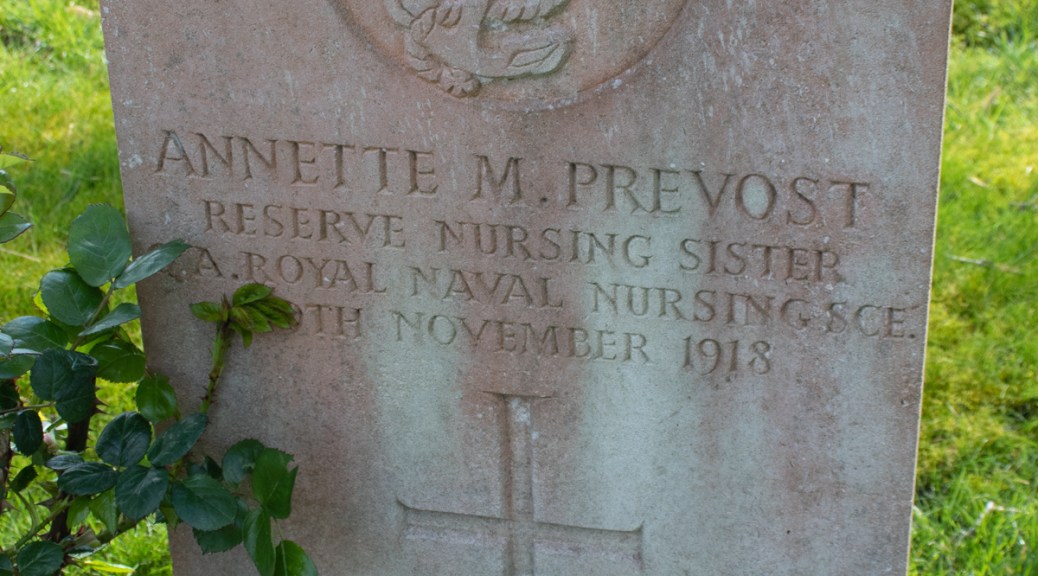
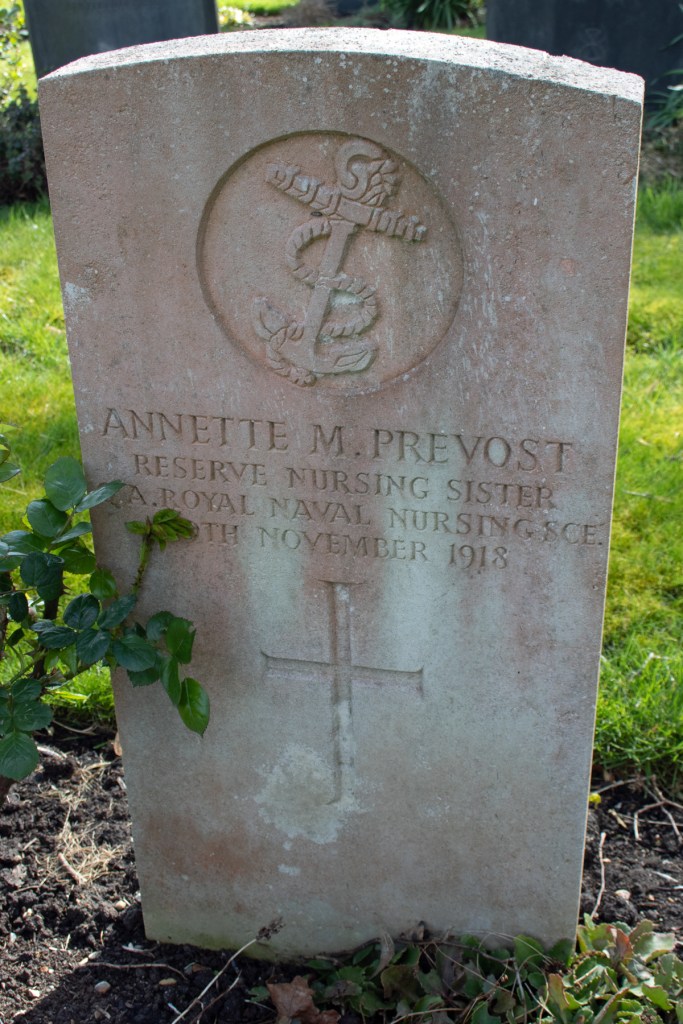
Annette Maud Prevost was born on 27th August 1892 in Bombay, India. Her parents were Cumbria-born Francis Prevost and his wife, Maud, who came from Somerset, and she was their only child.
It is unclear why the Provosts were in India, although Annette’s paternal grandfather was a Major in the army and her maternal grandfather was a clerk in holy orders (as per Maud’s baptism record). It is likely, therefore that her grandparents’ work took her parents overseas, which is how Francis and Maud ended up meeting.
Full details of Annette’s life are not readily available. She does not feature on any surviving census records, but it appears that the family returned to England in the early 1910s.
War was on the horizon, of course, and the tragedy of Edwardian culture is that women’s roles in the conflict were under-documented. What is clear, however, is that Annette wanted to play her part and she enlisted in the Queen Alexandra’s Royal Naval Nursing Service as a Nursing Sister, and was based at Chatham, in Kent.
During the conflict, she would have treated servicemen from the nearby Royal Naval Dockyard, as well as from the Royal Engineers Barracks. As the conflict progressed towards its end, an increasing number of cases would have been for pneumonia and tuberculosis, and, in the autumn of 1918, Annette contracted influenza. She developed sepsis, and died of heart failure on 19th November, a week after the Armistice was declared. She was just 26 years of age.
Annette Maud Prevost was laid to rest in the Woodlands Cemetery, Gillingham, not far from the Naval Hospital in which she served and died.
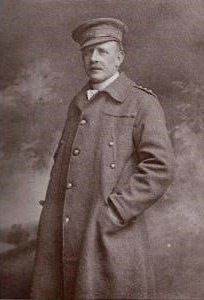
Hugh Cyril Arthur Brooking was born on 15th September 1870 and was one of six children (although he also had three further half-siblings through his father’s first marriage). His father, Arthur Brooking, was the vicar of the Hertfordshire village of Bovingdon, and it was in the vicarage that he and his wife Marian raised their family (with the help of seven servants).
Hugh led a life befitting of a reverend’s son; he was educated at St Mark’s School in Windsor, Lancing College and Down College, both in Sussex. He continued his studies at the Mining College in London (now part of Imperial College London), and went out to South Africa to further that work.
The local newspaper reporting on his funeral takes up the story:
When the Boer War broke out he joined the Imperial Light Horse, and was engaged in the battles of Elandslaagte, Wagon Hill and others, was in Ladysmith during the siege, and the relief of Mafeking. He was several times mentioned in despatches, and obtained the Queen’s medal and six clasps, and the King’s medal with two clasps. He then joined the South African Constabulary, under General Baden Powell.
He had previously held a commission in the North Somerset Yeomanry, and after leaving it for a short time he re-joined a soon as the [First World War] was declared, and was in France with his regiment when it made its famous stand against the Prussian Guards. All his superior officers were killed or wounded, and he was temporarily in command of the regiment.
He received the ribbon of the 1914 Star of Mons, but did not live to get the star. He served with the regiment 20 years. He was latterly attached to the Labour Corps at West Ham.
Captain Brooking came to Frome with his parents as a boy. In his youth he was a thorough sportsman, well known in the hunting field, genial and kindly, ready with a pleasant word, and courteous to all, he won friendly appreciation from all classes of townsfolk.
He had seen a great deal of fighting, though from exposure and other causes his health suffered, and he was employed on home service.
He was in command of the 371st Labour Company, and second in command of his battalion, when he met with the slight accident which led to his death. He grazed his knuckles, causing bleeding, but of so slight a character that no notice was taken of it. A few hours later he again struck his hand, and fresh paint appears to have affected the wound, and blood poisoning supervened.
Somerset Standard: Friday 7th June 1918
In his personal life, Hugh had met and married Florence Day, a farmer’s daughter seventeen years his junior from Somerset. The wedding was in the autumn of 1912, and they would go on to have two children, Granville and Hugh Jr. The boys would both go on to lead distinguished lives, Granville in the armed forces and Hugh as a ‘King’s Messenger’ in South America.
Following Captain Brooking’s injury, he was admitted to the Military Hospital in Purfleet but the treatment he received there was to do no good. Three months after the accident, on 31st May 1918, he passed away; he was 47 years of age.
Hugh Cyril Arthur Brooking’s body was taken back to Frome; he was laid to rest in the graveyard of St John the Baptist Church in the town.
William Hann was born towards the end of 1871, the son of Harry Hann, who was a stonemason, and his wife Susan. Born in Stoke-under-Ham (now Stoke-sub-Hamdon), he was one of nine children, although sadly five of his siblings passed away at a young age.
Sadly, little of William’s early life remains documented. A newspaper article that reported on his passing, however, confirms that he served in the Royal Field Artillery, and was based in India for four years, before being shipped to South Africa to fight in the Boer War.
Back in Somerset in the early 1900s, he married a woman called Ellen, and the couple went on to have four children – Hilda, Herbert, Kate and Louisa.
At the outbreak of the [First World War], though under no obligation, [Gunner Hann] responded to the call of duty and was among the first to volunteer from Stoke. He was attached to the Indian Expeditionary Force and sent to France, and it is interesting to know that he saw some of the native soldiers whom he had bet while serving in India many years ago.
After serving in France for some time, he was transferred to Mesopotamia, and it was there that his health became impaired, which made him an easy victim of the disease which caused his death.
Western Chronicle: Friday 1st June 1917
Gunner Hann had contracted cellulitis in his right arm, which turned septic. He returned home on sick leave on 22nd May 1917, but died at home from blood poisoning just two days later. He was 48 years of age.
William Hann was laid to rest in the graveyard of St Mary’s Church, in his home village of Stoke-sub-Hamdon.
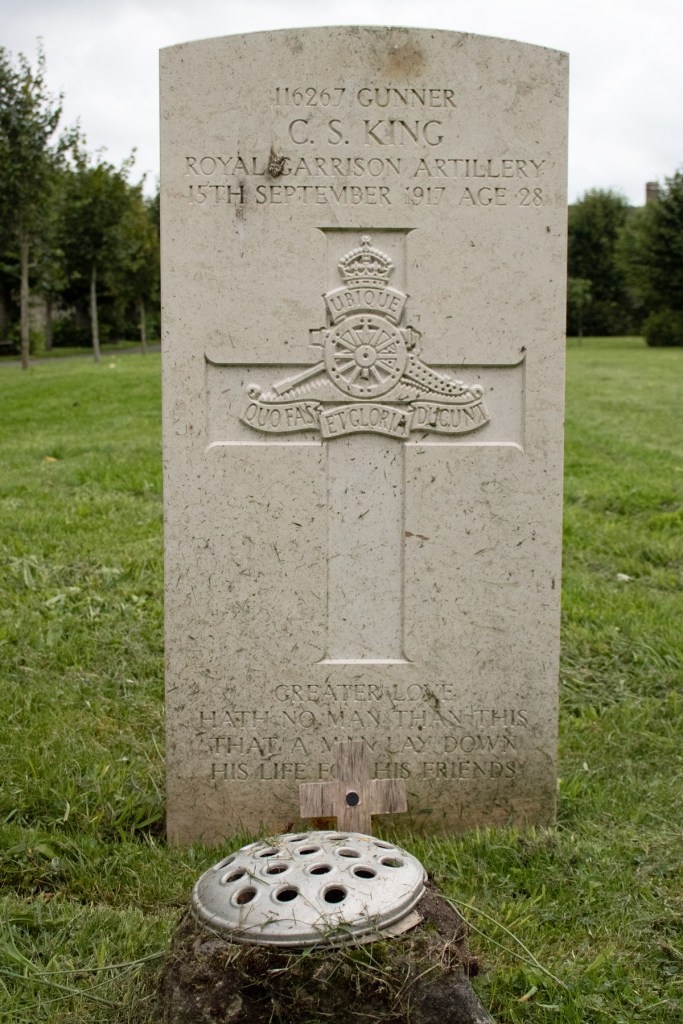
Charlie Stephen King was born in Dorset on 18th October 1888, one of six children to Stephen and Virtue King. Stephen was a painter, glazier and paperhanger from Gillingham, and this is where he and Virtue raised their children.
When Charlie left school, he also went on to become a painter, but specifically for the railways, but whether this was on the rolling stock or stations, is not certain.
In October 1909, Charlie married Bessie Imber, a postman’s daughter from Shaftesbury. The couple set up home in Gillingham, before moving back to Bessie’s home town; they went on to have three children.
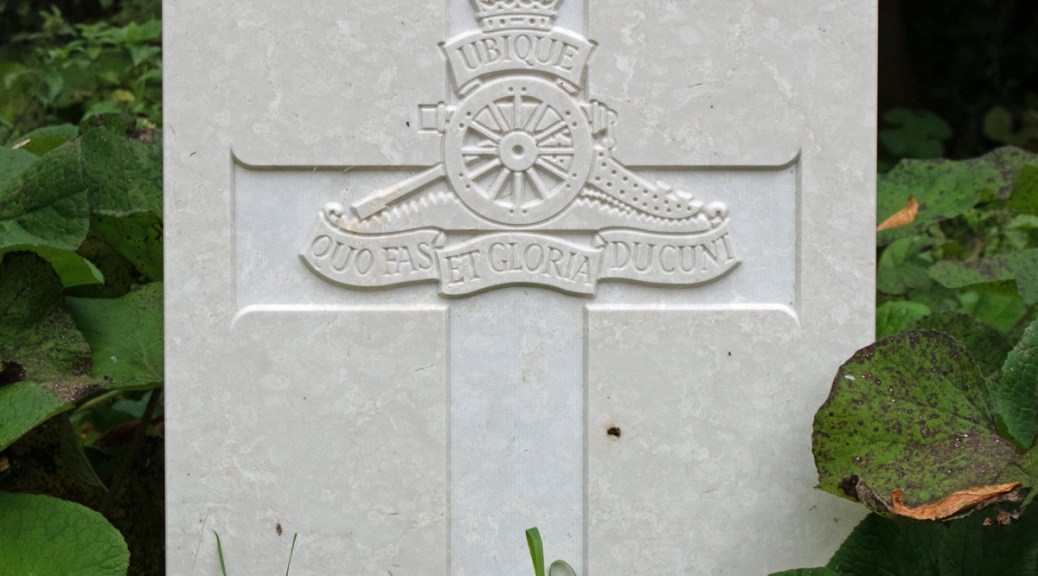
War was coming, though, and Charlie enlisted in December 1915. He was not formally called up until August 1916, and was assigned a Gunner in the Royal Garrison Artillery. After initial training, he was sent to the Western Front in March 1917.
Exact details of Gunner King’s service are not available. He was certainly involved in fighting during the summer of that year, and, in September, was wounded. Evacuated back to England with a gunshot wound to his left ankle and shell shock, he was admitted to the War Hospital in Sunderland. Sadly, septicaemia set in, and he passed away on 15th September 1917, at the age of just 28 years old.
Charlie Stephen King’s body was brought back to Dorset, where he was laid to rest in the Holy Trinity Churchyard in Shaftesbury.





 Death and Service