Tag Archives: Somerset Light Infantry

Captain Bertram Perkins

Captain Bertram Perkins

Bertram Falls Perkins was born in December 1872, the third of four children to Alfred and Mary Perkins. Alfred was a Colonel in the army and has met his wife while serving in Madras, India. He had retired by the time Alfred was born, and had brought his family back to England, where he set up as a Country Magistrate, living in the village of Wookey in Somerset.

Bertram was set for good things – by the time of the 1881 census, the family were living in Eastcott House, with a footman, cook, two ladies’ maids, two house maid and a governess to look after them.

Bertram’s military records are a little scant, but can be pieced together from his funeral notice.

The late Captain Bertram Perkins… joined the 1st Vol. Batt. of the Somerset Light Infantry as 2nd Lieutenant in February 1892, and, in November 1894, was transferred to his father’s regiment, the 3rd Batt. Welsh Regt. as Lieutenant… In October 1896 he went to South Africa and joined the Natal Mounted Police, in which he saw much active service… at the relief of Ladysmith and Dundee. Being stricken down with a very severe attack of enteric fever, he had to resign… and return home. As soon as he recovered his health he again retuned to South Africa as a Captain in the 3rd Battalion Welsh Regiment, where he saw much service…

Whilst at Vryburg, he was appointed Provost Marshal, and in recognition of his tact and energy in filling a very difficult position, was presented by the inhabitants of the district with a gold watch and an illuminated address. He was in possession of the Queen’s Medal with four clasps and the King’s Medal with two clasps. On his return home he took to farming… He retired from the Service in 1905, but on the outbreak of the present war was appointed as Captain to the 12th Battalion of the Sherwood Foresters. Unfortunately, his health, which had never been quite restored, broke down, and he was invalided out of the Regiment.

Wells Journal: Friday 16th June 1916

During the Great War, Captain Perkins’ regiment has been the 12th (Service) Battalion for the Nottinghamshire and Derbyshire Regiment. His unit been shipped out to France in August 1915, but it is likely that he saw little, if any, time on the Western Front. After being invalided out, he succumbed to his ongoing illness on 14th June 1916, aged 43.

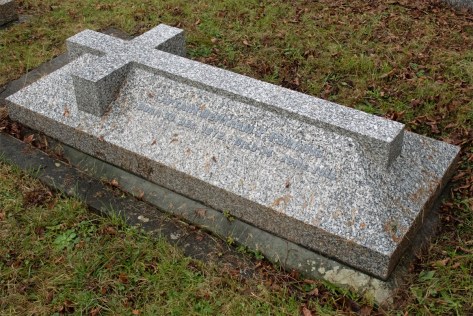
Bertram Falls Perkins lies at rest in the graveyard of St Matthew’s Church, in his home village of Wookey, near Wells in Somerset.


Private Martin Kiddle

Private Martin Kiddle

Martin Kiddle was born in 1871, the oldest of four children to Joseph and Annie Kiddle. Joseph was a butcher in the Somerset town of Street, and the family lived above the shop on the High Street.

When Joseph died in 1886, Martin took on the role of shopman, before taking over the business entirely.

In 1895, aged 24, Martin married Eleanor Freeman, four years his senior from the nearby town of Ilminster. The young couple had five children and, by the time of the 1901 census, they were running the business as a family, employing an assistant in the shop and a domestic servant.

It is evident that Martin left the butchery business behind him, though. Ten years later, on the 1911 census, he is listed as a Stock Room Manager in a local rug factory.

Martin joined up when war broke out, initially serving in the Somerset Light Infantry, before transferring across to the Royal Defence Corps.

While there is no date for his transfer, it is likely to have been at some point in 1915. Private Kiddle’s wife, Eleanor, passed away in May of that year, so it is reasonable to assume that he requested a transfer to support her before her death, or to support his children afterwards.

Sadly, however, Martin was also to succumb to illness. His pension ledger shows that he passed away on 5th March 1917, dying from carcinoma of the liver. He was 46 years old.

Martin Kiddle lies at rest in the graveyard of Holy Trinity Church in his home town of Street. The gravestone gives dedications to his father, Joseph, and his brother, John, who had died as just over a year old.


Guardianship of Martin and Eleanor’s five, now orphaned, children – Eleanor, Martin, John, Rachel and George – passed to Martin’s mother, Annie.


Private Gilbert Drew

Private Gilbert Drew

Gilbert Victor Drew was born in Dinder, Somerset in 1898, the youngest of the eight children of James and Theresa Drew, a groom/coachman and laundress respectively.

Gilbert initially enlisted in the West Somerset Yeomanry on 11th December 1915, serving on the Home Front.

Private Drew then transferred to the 1st Battalion of the Somerset Light Infantry and was shipped overseas as part of the British Expeditionary Force on 1st August 1916.

He first reported to a medic in mid-November 1916; his records pick up the story from there:

First noticed he was passing a larger quantity of water than usual and was also feeling very thirsty.

2nd December 1916, caught influenza and was sent to England. Thirst has been great and urine very large in quantity since November. General condition good. Passes from 14 to 17 pints of urine each 24 hours – large quantity of sugar contained. No evidence of other disease. No improvement since admission.

Result of AS[?] Prolonged strain – especially during Somme offensive.

Medical Records

Private Drew was discharged from the army on 3rd February 1917 as “no longer physically fit for war service” due to diabetes.

Gilbert Victor Drew died on 1st July 1917; he was just 19 years of age. He was buried in the graveyard of the Church of St Michael in his home village of Dinder, Somerset.

He was one of six villagers to fall during the Great War.

Private Harry Edwards

Private Harry Edwards

Henry Charles Edwards was born in 1883, the eldest of four children for Joseph and Elizabeth.

Joseph was an agricultural labourer, and Henry (or Harry) followed his father in the farming life, continuing in the role after Joseph died, and up until at least the 1911 census.

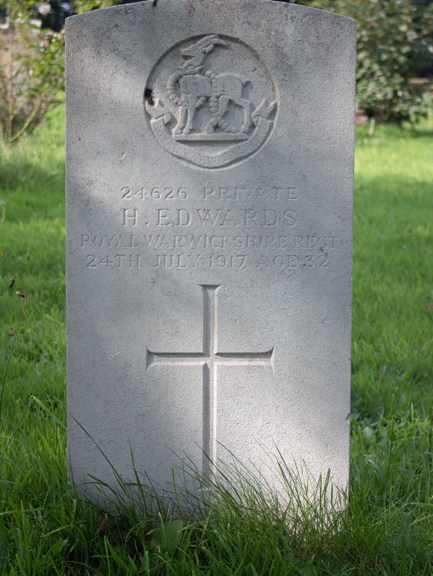
I was unable to find much regarding Harry’s military service. He signed up the Royal Warwickshire Regiment, and subsequently transferred to the Somerset Light Infantry.

He died from tetanus on 24th July 1917, aged 34. His pension records give his mother, Elizabeth, as his beneficiary.

Private Henry Edwards lies at rest in the churchyard of Lydeard St Lawrence, Somerset.

Serjeant Richard Prout

Sergeant Richard Edwin Prout

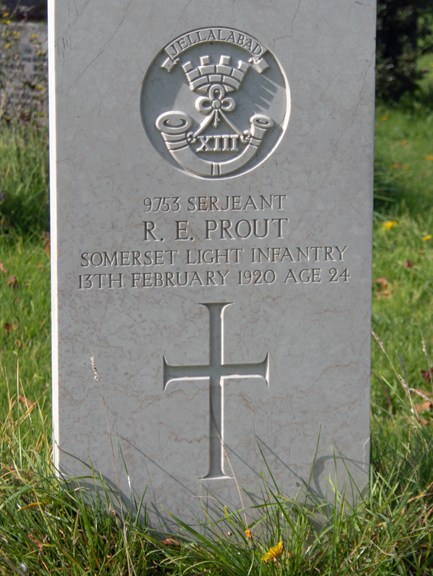
Richard Edwin Prout was born in 1896, the second son of Frederick and Anna (Hannah) Prout. When his father died in 1908, his mother remarried and by the 1911 census, Richard and his family had moved to Lydeard St Lawrence, where he was a baker’s boy.

He enlisted in June 1914, joining the Somerset Light Infantry and served throughout the war, receiving the Mons Star, Victory Medal and General Service Medals.

After the war, he continued in the army, and was assigned to Taunton Barracks.

His passing was unusual enough for it to be reported on in the local newspaper.

Sergt. Prout, it was stated at the Barracks yesterday, had been on leave for some days prior to his departure for Ireland, and had been spending his furlough at Crowcombe, where his parents live. On the evening of his death, he left home, after taking a hearty meal, to catch the 7.25 train to Taunton. He had to walk a mile to Crowcombe station, most of the way uphill. Early the following morning his dead body was discovered lying face downwards by the roadside, about 50 yards from the station. The body was removed to his home, and Dr. Frossard, of Bishop’s Lydeard, was called in to make a post-mortem examination. The doctor has reported that death was due to asphyxia brought on by over exertion on a full stomach, and syncope, following pressure on the neck by the tightness of the collar of his outside jacket, the doctor adding that he had great difficulty in unfastening the collar.

Western Daily Press – Friday 20th February 1920

A genuine case of someone going before their time. Having visited Lydeard St Lawrence, I recognise the hill he would have had to have climbed to reach the station, and it’s steep enough in a car, let alone walking up it.

Sergeant Prout, the newspaper reported, was generally esteemed by his fellow company, and at his funeral he received full military honours.

Richard Edwin Prout lies peacefully in the churchyard of Lydeard St Lawrence.

Private William Rawle

Private William Henry Rawle

William Henry Rawle was born in 1890, the eldest child of George Rawle, a sailor, and Louisa, his wife.

At the time of the 1911 census, William was working as a carter on a farm not far from Porlock in Somerset.

He enlisted in August 1914, joining the Somerset Light Infantry and serving as part of the Expeditionary Force. After a couple of postings, Private Rawle was transferred to the Pioneer Depot in March 1916.

Six months later William was medically discharged as unfit for continued service. His notes highlight his distinguishing marks as 3 marks on his left arm, birth mark under his right nipple and gunshot wound to the left eye (which I am guessing is what led to his discharge).

William died on 11th June 1921, aged 27 years old. I have been unable to find anything specific relating to his death and it is likely, therefore, that no misadventure was involved.

Private William Henry Rawle lies at peace in the churchyard of Lydeard St Lawrence, alongside his brothers Stephen and Ernest.


George and Louisa’s other son – Edward – also served, enlisting in the Somerset Light Infantry and fighting in the Balkans. Private Edward Rawle survived the war, returning home in March 1919.

It should be noted that, by June 1921, George and Louisa had lost three of her four sons to the Great War. Their daughter, Norah, had also passed away in 1918.

The 1921 census found Louisa living in East Town, in the parish of Tolland, not far from Lydeard St Lawrence. Edward was living with her, as were her three-year-old granddaughter, Lorna, and her eighteen-month-old grandson Beatty. It is unclear whose children they were. George, at this point, was helping his younger brother out on the family farm in Williton.


Private George Symons

Private George Symons

George Symons was born in 1895 to Charles and Rosa Symons. He was the third of five sons.

Charles worked as a carter on a farm, and his son became a cowman as soon as he could leave school.

Military records for George Symons are pretty sparse. From his gravestone we know he had joined the Somerset Light Infantry by the end of 1917. Assigned to the 4th Battalion, Private Symons’ unit served in India and the Middle East throughout the war, and it was while he was overseas that he was caught up on the fighting.

In the confusion of battle, George was initially recorded as ‘presumed dead’. Subsequently identified as badly injured, he was medically repatriated to Britain for treatment. Admitted to hospital, his wounds were to prove too severe: Private Symons passed away on 23rd June 1918: he was 23 years old.

George Symons’ body was taken back to Somerset for burial. He lies at rest in the churchyard of St Michael and All Angels in Milverton.