Tag Archives: Somerset

Private George Symons

Private George Symons

George Symons was born in 1895 to Charles and Rosa Symons. He was the third of five sons.

Charles worked as a carter on a farm, and his son became a cowman as soon as he could leave school.

Military records for George Symons are pretty sparse. From his gravestone we know he had joined the Somerset Light Infantry by the end of 1917. Assigned to the 4th Battalion, Private Symons’ unit served in India and the Middle East throughout the war, and it was while he was overseas that he was caught up on the fighting.

In the confusion of battle, George was initially recorded as ‘presumed dead’. Subsequently identified as badly injured, he was medically repatriated to Britain for treatment. Admitted to hospital, his wounds were to prove too severe: Private Symons passed away on 23rd June 1918: he was 23 years old.

George Symons’ body was taken back to Somerset for burial. He lies at rest in the churchyard of St Michael and All Angels in Milverton.


Shoeing Smith George Stone

Shoeing Smith George Henry Stone

George Henry Stone was born in 1872, son of Milverton’s blacksmith James Stone and his wife Mary Ann. He followed in his father’s footsteps and, by the time he married Mary Florence Paul in 1894, he was also working in the forge in Milverton.

George and Mary had eight children – seven girls and one boy; by the time he signed up in 1915, he listed himself as a blacksmith.

His military records show that he was medically certified as Category B2 (suitable to serve in France, and able to walk 5 miles, see and hear sufficiently for ordinary purposes). He was assigned to the Remount Depot in Swaythling, Southhampton, which was built specifically to supply horses and mules for war service. (In the years it was operating, Swaythling processed some 400,000 animals, as well as channelling 25,000 servicemen to the Front.)

While serving George contracted pneumonia. He was treated in Netley Military Hospital, but passed away on 19th November 1918, aged 47.

Shoeing Smith George Henry Stone lies at peace in a quiet corner of St Michael & All Angel’s churchyard in his home village of Milverton.

Gunner Samuel Hayes

This image has an empty alt attribute; its file name is img_4069s.jpg
Gunner Samuel James Hayes

Samuel James Hayes was born in the Somerset village of Milverton in May 1879. He was the eldest son of James and Harriet.

James was an agricultural labourer, but Samuel wanted more than this; he enlisted in the Royal Marine Artillery in February 1897, three months before his 18th birthday.

The 1901 census finds Gunner Hayes in the Eastney Barracks in Portsmouth, while ten years later, he was on board the HMS Swiftsure in the Mediterranean.

In May 1912, he married Annie Thorne, also from Milverton, in his home village. Two years later, just before Christmas 1914, their first – and only – child, Lionel, was born.

I have struggles to find anything specific relating to Gunner Hayes’ wartime service. He certainly continued to serve, and by the time of his death had clocked up more than twenty years’ service in the Royal Marine Artillery.

Samuel passed away on 6th July 1919, at the age of 38. One record I have located suggests that he died in a military hospital in Malta, but whether he passed there or in the UK, he was buried back in Somerset.

Gunner Samuel James Hayes lies at rest in St Michael & All Angel’s churchyard in Milverton.

Private Charles Stodgell

Private Charles William Stodgell

Charles William Stodgell was born in Somerset in 1878, the eldest son of Samuel and Mary Stodgell. His father was an agricultural labourer, while his mother was a glover. Charles followed into farm work, becoming a carter by time of the 1901 census.

Charles married Mabel Duke in 1898 and the young couple had two daughters – Ida and Florence – in the following few years.

When war came, Charles was called up. He enlisted in June 1916, joining the Devonshire Regiment before being transferred to the Agricultural Company. His record shows that he stood at 5ft 6ins (1.67m) and weighed 10st 2lbs (64kg) and his build, health and experience is probably why he ended up in service where he did.

Private Stodgell was demobbed at the end of the war, and returned home on furlough (a word not just linked to everything 2020 has thrown at us!). Sadly, before he was fully demobbed, he contracted influenza, and died on 2nd February 1919.

Charles William Stodgell lies at rest in his home village of North Curry, in the churchyard of St Peter & St Paul.

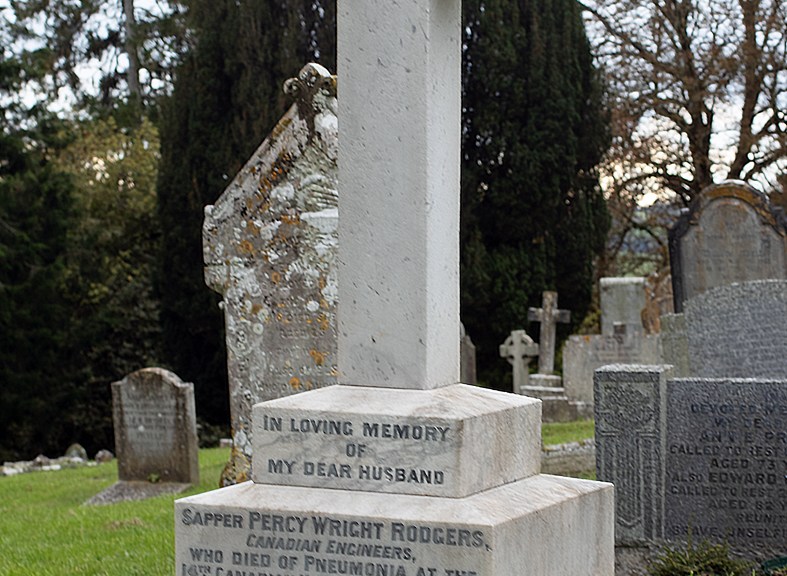
Sapper Percy Rodgers

Sapper Percy Rodgers

Percy Wright Rodgers was born in June 1888 in Pilton, Somerset. He was the fifth of eleven children to Levi and Elizabeth Rodgers.

In the 1901 census Levi was listed as a butcher and publican; ten years later, he listed himself as a butcher, slaughter man and shopkeeper.

Percy followed in his father’s footsteps – by the time of the 1911 census, he was boarding with a family in Swanage, Dorset, and worked as a butcher’s assistant.

1913 was a busy year for Percy. He married Frances Bower, they had their first child, Percy Augustus, and he emigrated to the United States (Frances and Percy Jr followed a year later).

In the 1915 New York census, Percy and his family are listed in in the town of Cortland, around 200 miles north of New York City. Percy describes himself as a meat cutter – following in his father’s footsteps – and he and his wife now have a second child, Vera, who was born in the States.

Sapper Rodgers joined the Canadian Engineers in May 1918; he was shipped abroad, back to Europe, but his service appeared short-lived. He contracted pneumonia, and was admitted to the Canadian Hospital in Eastbourne, East Sussex. He passed away on 5th November 1918, at 30 years of age.

Sapper Percy Wright Rodgers lies at rest in the churchyard of St John the Baptist in his home village of Pilton. His grave is topped with a cross dedicated by his widow, Frances.