Tag Archives: Royal Marines

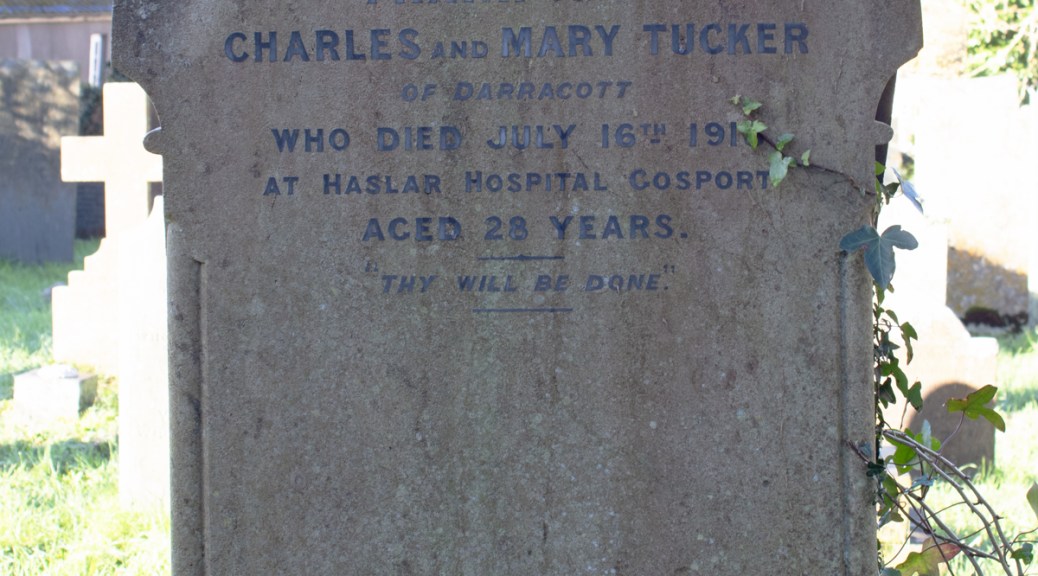
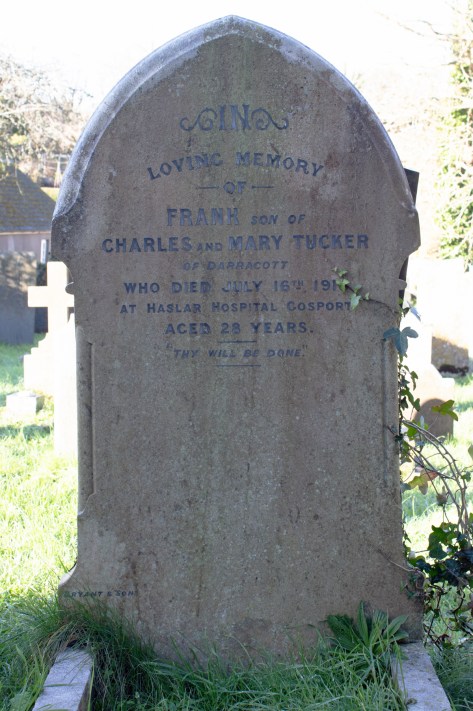
Private Frank Tucker

Private Frank Tucker

Frank Tucker was born in the Devon village of Georgeham on 7th June 1890. The youngest of seven children, his parents were farmers Charles and Mary Tucker.

When Frank completed his schooling, he joined his older siblings helping on the farm. The 1911 census recorded all but one of the Tucker household doing agricultural work, Frank’s older sister Hannah being the exception, as she was working as an elementary school teacher.

War broke out in the summer of 1914, and Frank would be called upon to play his part. He did not enlist until 21st June 1918, however, when he joined the Royal Marine Artillery as a Private. His service papers note that he was 5ft 10ins (1.77m) tall, with fair hair, blue eyes and a fair complexion.

Private Tucker was sent to the Royal Marine depot in Eastney, Hampshire, for this training, but his time there was not to be a lengthy one.

It is with regret that we have to record the death from pneumonia, of Pte. Frank Tucker (RMA) son of Mr and Mrs C Tucker, or Darracott, which occurred at Haslar Hospital, Gosport, on Tuesday in last week after a brief illness. Deceased, aged 28, had been serving with the colours just a month, and his death came as a sad blow to his many friends and relatives resident in Braunton and district.

[North Devon Journal: Thursday 25th July 1918]

The body of Frank Tucker was taken back to Devon for burial. He was laid to rest in the graveyard of St George’s Church in his home village.
Private Albert Thorne

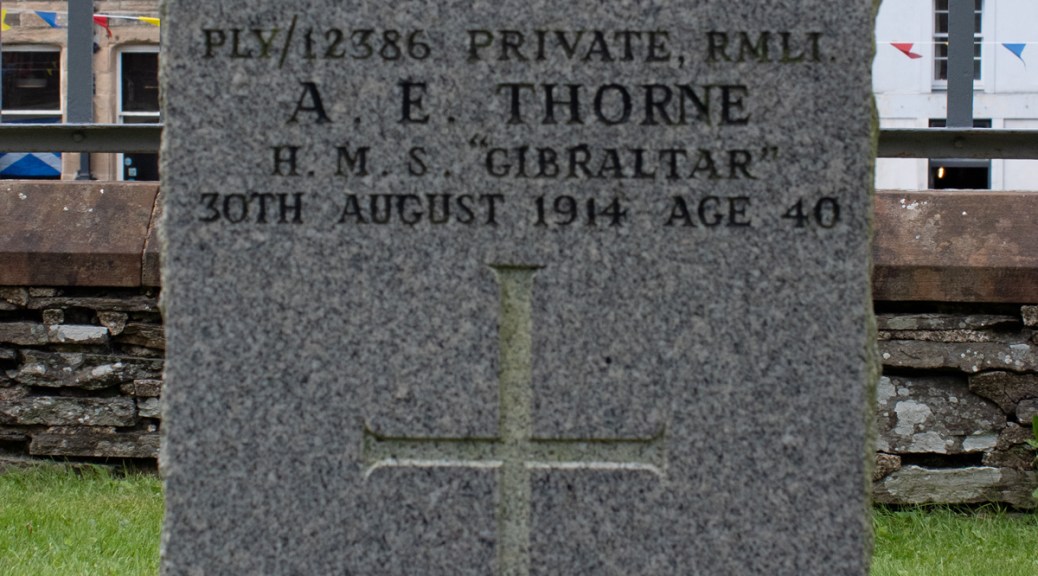
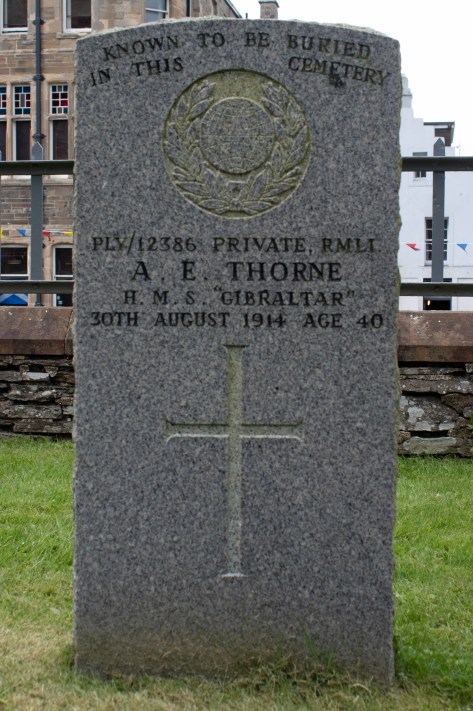
Private Albert Thorne

Albert Edward Thorne was born on 30th April 1874. The fourth of eight children, his parents were George and Rosanna Thorne. George was born in Nether Compton, Dorset, and this is where the family were raised. He worked as a stone mason, the 1884 census confirming he employed six men and two boys.

When Albert completed his schooling, he found work as a domestic gardener. This was not something he wanted to do long-term, however, and, on 30th May 1892, he enlisted in the Royal Marine Light Infantry. His service records show that he was 5ft 6ins (1.68m) tall, with dark brown hair and blue eyes. He was also noted as having a mole on the right of this abdomen and a scar on the right of his waist.

Private Thorne was sent to the Royal Marine depot in Walmer, Kent, for his training, and he remained there until the end of November. He transferred to Plymouth, Devon, and, over the next three years, split his time between there and Devonport.

On 26th December 1895, Albert married Rhoda Mills, the daughter of a local labourer, in Plymouth Register Office. The couple would have three children: Albert Jr, Arthur and Vera.

Private Thorne was a career marine, and remained in the service, based between Plymouth and Portsmouth, Hampshire, until the spring of 1914. Having completed 22 years, he was stood down to reserve status, although this was not to be for long, as storm clouds were brewing over Europe.

In August 1914, Albert was mobilised once more, and was assigned to the cruiser HMS Gibraltar. A depot ship, she would support other ships in and around the Orkney and Shetland Isles. The voyage north seems to have taken its toll, however, and Private Thorne was evacuated to the hospital ship Rohilla, suffering from appendicitis, which resulted in peritonitis. The conditions would prove fatal, and he passed away on 30th August 1914, at the age of 40 years old.

The Rohilla docked at Kirkwall on the Orkney mainland. Hundreds of miles from home, is seems that Rhoda may not have been able to afford to bring her husband’s body back to Devon. Instead, the body of Albert Edward Thorne was laid to rest in the graveyard of St Magnus’ Cathedral, Kirkwall.


Rhoda remained in Plymouth, in the rooms at 64 Durnford Street that she knew as home. The 1921 census found her living there with eldest son Albert – now a construction manager at the Royal Naval Dockyard in Devonport – and daughter Vera. The family had a boarder, Irish-born merchant seaman William Arnold, whose sister, Margaret Fitzgerald, was also visiting.


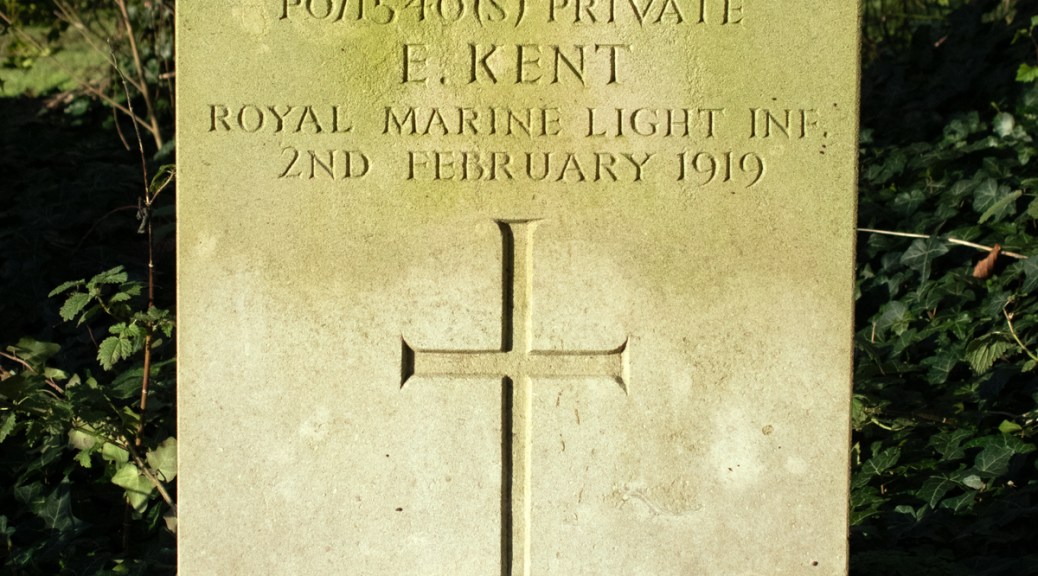
Private Edward Kent

Private Edward Kent

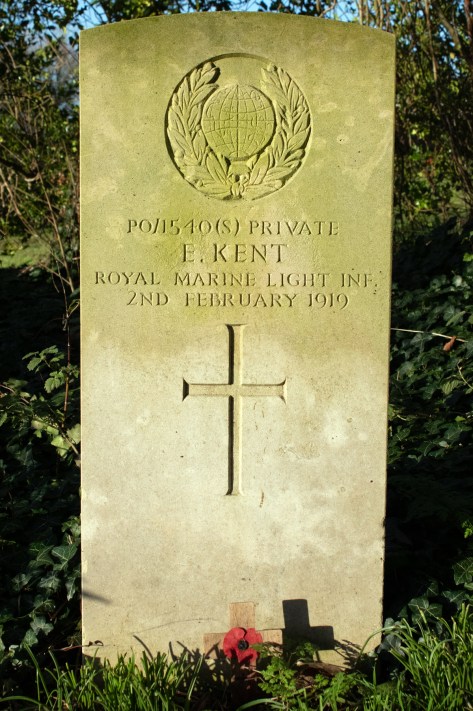
Edward Kent was born in the Berkshire village of Little Coxwell on 8th December 1887. One of fourteen children, his parents were John and Agness Kent. John was a mason’s labourer, and by the time of the 1901 census, the family had relocated to Fisherton de la Mare in Wiltshire.

Edward found work as a general labourer when he completed his schooling, but when war broke out, he was called upon to serve his country. Conscripted in the spring of 1916, he enlisted in the Royal Marine Light Infantry as a Private. His service papers show that he was 5ft 6.5ins (1.69m) tall, with brown hair, brown eyes and a fresh complexion. He was also noted as having a scar on the back of his neck.

Private Kent was sent to Deal, Kent, for his training, but by September 1916, he had moved to Portsmouth, Hampshire. Change was afoot, however, and in November Edward was assigned to the 3rd Battalion and sent to the Aegean, where he would remain for the rest of the conflict.

Edward returned to Portsmouth in January 1919, and was admitted to the Haslar Hospital, suffering from pneumonia. The condition would prove fatal, however, and he passed away on 2nd February 1919: he was 31 years of age.

The body of Edward Kent was taken back to Wiltshire for burial. He was laid to rest in the graveyard of St Nicholas’ Church, Fisherton de la Mere.


Private John Stenson

Private John Stenson

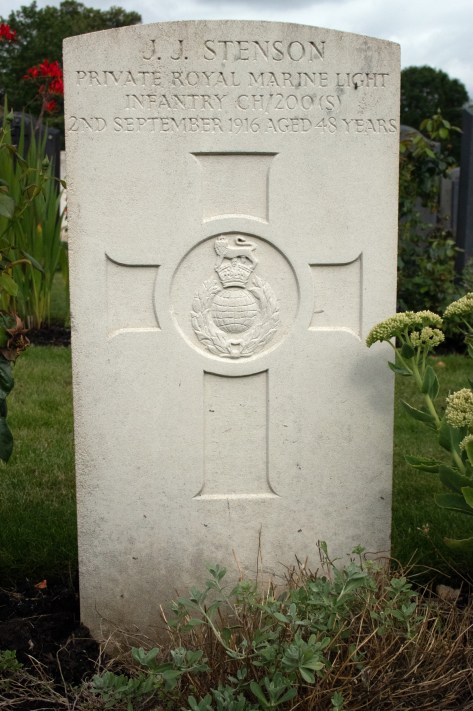
John Joseph Stenson was born in the Derbyshire village of Crich on 27th October 1869. He was the younger of two children to Jane and Joseph Stenson. Jane had been married and widowed before, and John had a number of half-siblings in his extended family.

Tracing John’s early life is a bit of a challenge, and he is missing from a number of census records. By 1901, he was working as a blacksmith in Nottingham, and living at 94 Park Street, to the west of the town centre. He was married to Rose Moon, and they had exchanged vows in 1896.

By 1911, the couple had moved to the Bulwell area of Nottingham, and were living at 23 Padley Street. John was still working as a blacksmith, Rose as a dressmaker, and their adopted son, 18-year-old John Daley, was also living with them, and was employed as a hosiery washer.

When war broke out, and despite his age, John stepped up to play his part. He enlisted on 5th September 1914, joining the Sherwood Foresters as a Private. His service records show that he was just under 5ft 8ins (1,72m) tall, with brown hair and grey eyes.

Private Stenson did not stay with the army for long and after just ten days he was transferred to the Royal Marine Light Infantry. His time was split between two bases, the Royal Naval Dockyard in Chatham, Kent, and the equivalent in Portsmouth, Hampshire. He did see time overseas, with a later report confirming that he had fought at Gallipoli.

ACCIDENTAL DEATH OF A SLEEP WALKER

At an inquest at Chatham on Tuesday on Pte. John Joseph Stenson… belonging to Bulwell, Nottingham, whose body was found in an area beneath the barrack rooms, it was stated that he walked in his sleep. A verdict of “Accidental Death” was returned.

[Kentish Gazette: Saturday 9th September 1916]

Other reports suggested that Private Stenson had started sleep walking in recent weeks. The coroner reported that he was killed “either by falling our of his bedroom window or over the passage-way railings…” [Hull Daily Mail: Wednesday 6th September 1916]

John Joseph Stenson was 46 years of age when he died on 2nd September 1916. His body was laid to rest in the naval section of Woodlands Cemetery, Gillingham, Kent, not far from the dockyard at which he had been based.


Private Frederick Pagett

Private Frederick Pagett

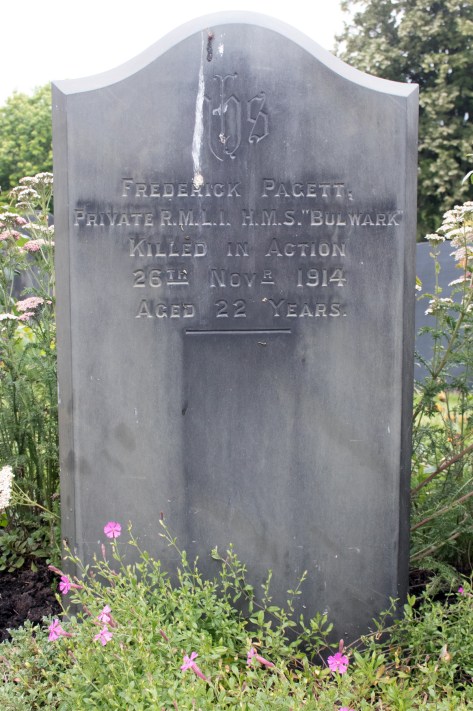
Frederick Pagett was born in the Worcestershire village of Hanley Castle on 27th July 1892. The seventh of eight children, he was the youngest son to Samuel and Ann Pagett.

Samuel was a policeman, but when he completed his schooling, Frederick found work as a miner. This seemed not to suit him, however, and, on 20th December 1910, he enlisted in the Royal Marine Light Infantry.

Private Pagett’s service records show that he was 5ft 4.5ins tall, and that he had brown hair, blue eyes and a fresh complexion. He had two small scars on his upper lip, and was noted as being able to swim.

Frederick was sent to Deal in Kent for his training. Over the next couple of years, he learnt his trade, and would serve in the Hampshire towns of Gosport and Portsmouth. His papers noted a very good character.

On 12th June 1912, Private Pagett was assigned to the battleship HMS Bulwark. He would remain part of her crew for the next couple of years.

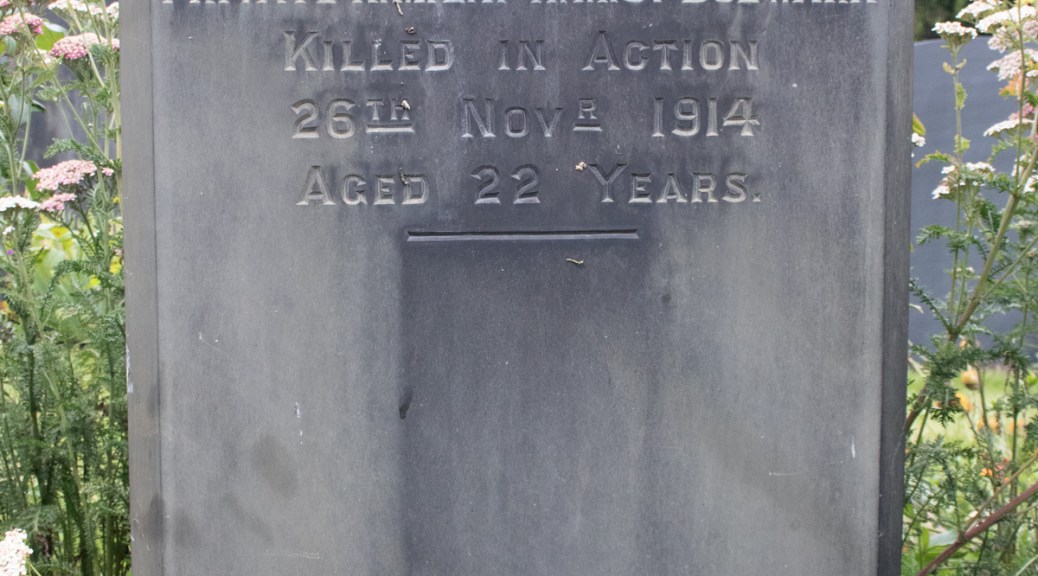
On the 26th November 1914, when Bulwark was moored close to Sheerness, Kent, an explosion ripped through the ship, sinking it and killing more than 740 people. Frederick was on board at the time, and was amongst those to be killed: he just was 22 years of age.

The body of Frederick Pagett was laid to rest in a marked grave in the naval section of Woodlands Cemetery, Gillingham, Kent.


Sergeant Edwin Ward

Sergeant Edwin Ward

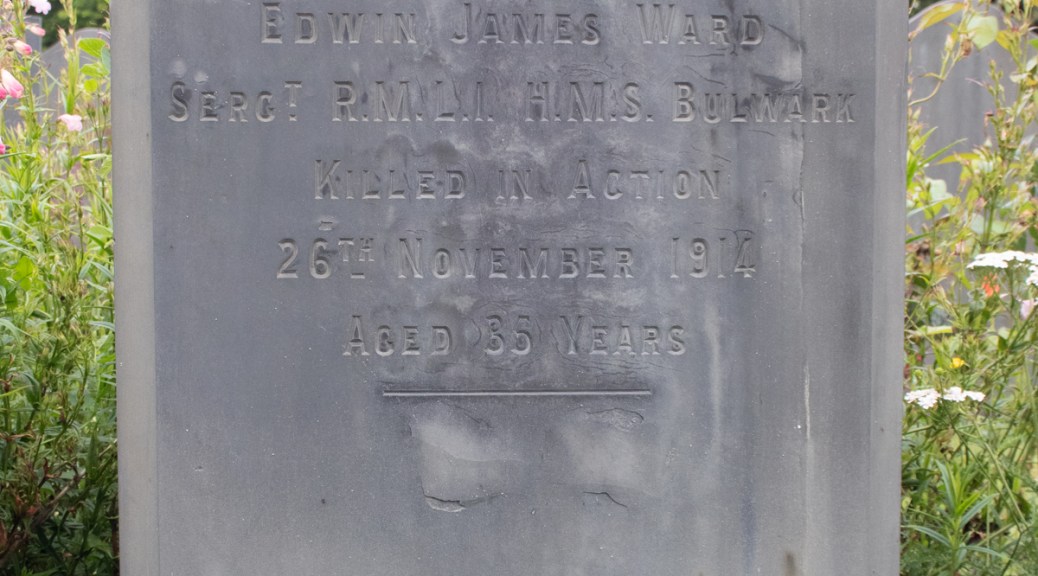
Edwin James Ward was born at the start on 3rd December 1879 in London. The oldest of four children, his parents were William and Emma Ward. William, who was a printer, had also been born in London, and the family lived initially in rooms on Trafalgar Street, Walworth, then Hardaker Street in Shoreditch.

There are tantalising gaps in Edwin’s life, and it is a challenge to piece together what happened to him after the 1891 census. He disappears from the records for nearly two decades, and is it likely that he had enlisted in the Royal Marine Light Infantry, and spent time overseas.

On 21st August 1908, Edwin married a woman called Kate. There is no further information available about her, although the couple went on to have a daughter, Kitty, who was born in Portsmouth on 13th November 1911.

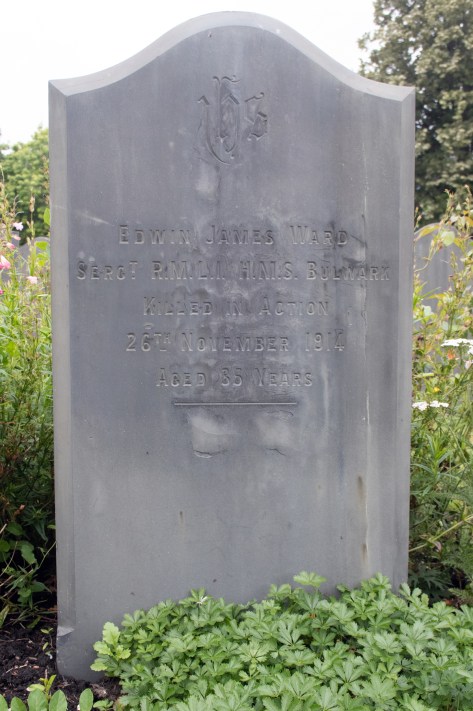
Edwin’s trail goes cold again at this point. He appears to have risen through the ranks with the Royal Marines and, by the summer of 1914, was a Sergeant. He was assigned to the battleship HMS Bulwark, and was on board on the 26th November 1914, when she was moored close to Sheerness, Kent. That morning, an explosion ripped through the ship, sinking it and killing more than 740 people. Sergeant Ward was amongst them: he was 34 years of age.

The body of Edwin James Ward was laid to rest in a marked grave in the naval section of Woodlands Cemetery, Gillingham, Kent.


Private Arthur Harrison

Private Arthur Harrison

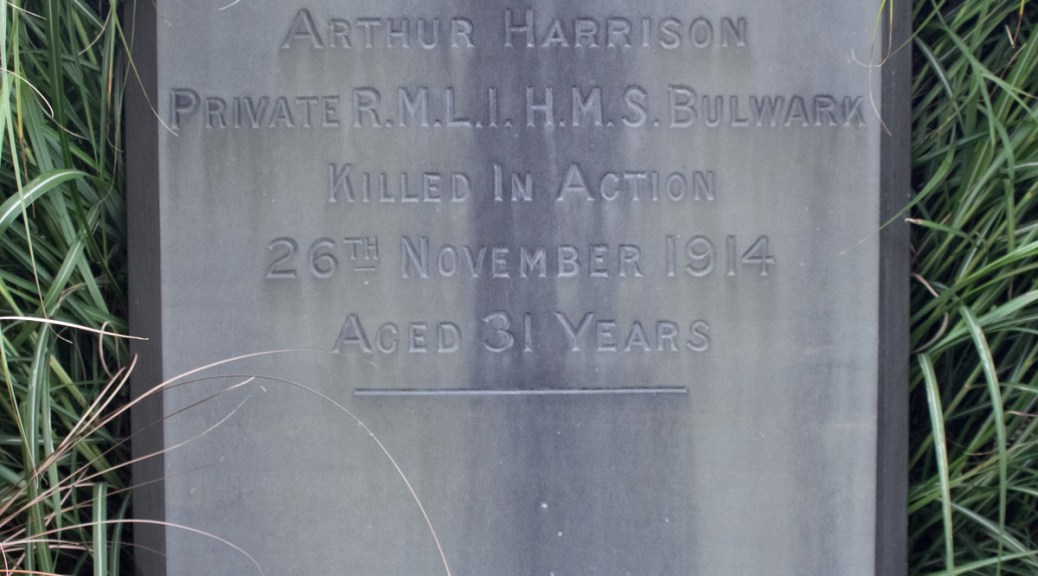
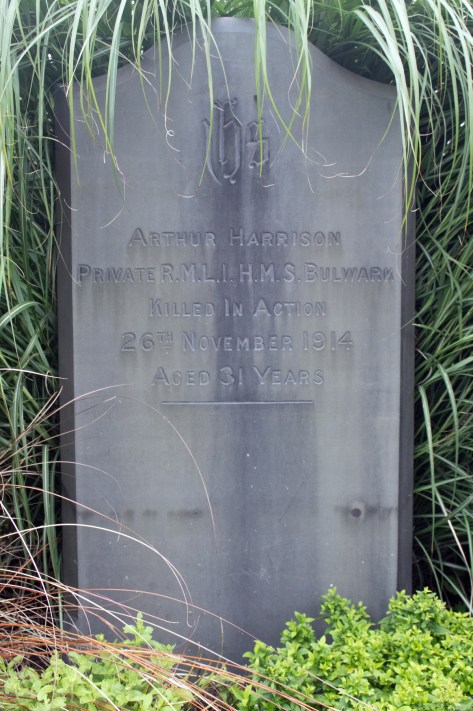
In the naval section of Woodlands Cemetery, Gillingham, Kent, is the grave of Arthur Harrison. A Private in Royal Marine Light Infantry, his headstone suggests that he was born in around 1883. The inscription also confirms that he was killed in the explosion that sank the battleship HMS Bulwark on 26th November 1914.

Beyond these sparse facts, little else is known. No surviving service records remain to illuminate Arthur’s military career, and his name is too common to be reliably traced through census returns or other contemporary documents.

As a result, Arthur Harrison’s life has largely slipped from the historical record. His story is destined to remain fragmented—lost to time, save for this quiet grave and the brief inscription that marks his passing.


Captain Guye Lushington

Captain Guye Lushington

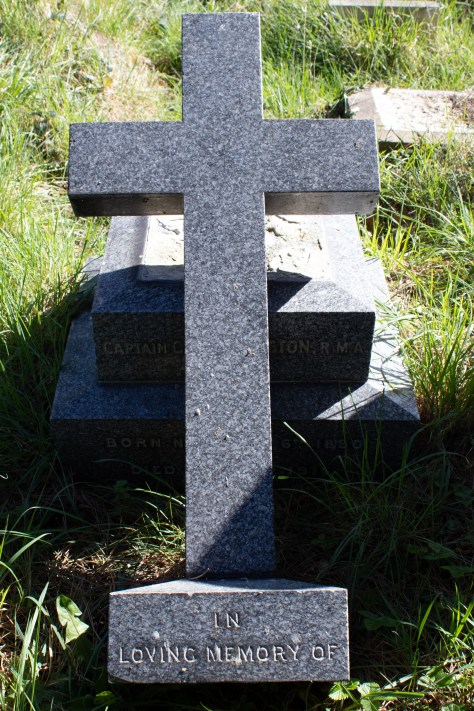
Guye Wellesley Lushington was born in India on 6th November 1880. The oldest of four children, his parents were James and Bessie Lushington. James was a worked in the Bombay Uncovenanted Civil Service and, while it’s not possible to track his location through census records, by the time of the 1891 census, Bessie had returned to Britain with the children. The document found them living at 31 Clarendon Street in Bedford, Bedfordshire.

Guye’s background stood him in good stead when it came to building a career. His chosen profession was the army and, by January 1898 he had landed a commission in the Royal Marine Artillery. Lieutenant Lushington continued to do well and, on 13th March 1908, he received a promotion to Captain.

Full details of Guye’s military service have been lost to time, but by the time war broke out, he was attached to the dreadnought battleship HMS Bellerophon. The stress of the Great War was to take its toll, however, and he was diagnosed with neurasthenia. In 1916, he was admitted to the King Edward Convalescent Home at Osborne House, on the Isle of Wight. Captain Lushington’s condition, however, was to worsen.

The Isle of Wight Coroner yesterday held an inquest respecting the death of Captain George [sic] Wellesley Lushington, 35, of the Royal Marine Artillery, sone of Mr James Law Lushington, of Briar Bank, Grove-road, Worthing [West Sussex], who was found dead… on Tuesday, having apparently thrown himself over an iron staircase fire escape into the courtyard.

Colonel Douglas Wardrop, house governor and medical superintendent, said the deceased arrived at Osborne House from Haslar on the 5th inst… He was rather depressed and worried about his loss of will power. He had been four years on the “Bellerophon” and on active service with the Grand Fleet. There was nothing in the deceased’s manner to suggest suicide. He slept on the top floor of the south wing. At two o’clock on Tuesday morning, the night nurse reported that the deceased had not slept in his room. Search was made, and the deceased was found lying in the courtyard between the kitchen and the south wing. He must have jumped from the fire escape – which was an iron staircase with platforms outside each landing – onto the flag stones below, a distance of 45 feet. His skull was smashed to pieces. There was a railing 3 feet 6 inches high round the staircase, and deceased could not have accidentally fallen over.

Two letters were found in deceased’s room, one addressed to his father and the other to his sister. His father identified the writing. The letter to the deceased’s father was as follows:

“Osborne House, Sunday.

“My dear pater, Since I broke down a month ago, I feel I shall never pick up again. I am afraid this will rather surprise you, but I cannot stand the tension any longer. I am always wondering what is going to happen to me. Give my love to Daisy. If one has to die, it is better quickly than slowly. With lots of love – GUYE”

Nursing sister Arkins, who had charge of the deceased, said he was quiet, bur showed no suicidal tendency.

Lieutenant George Stewart Manisty, of the Indian Army Reserve, attached to the 7th Bengal Lancers, said he played bridge with the deceased up till 10:30 on Monday night, and for three nights running. Deceased seemed quite friendly and in good spirits.

A verdict of “Suicide while of unsound mind” was returned.

The Coroner said that was the third suicide within a week on the Isle of Wight, either directly or indirectly due to the war.

[Sussex Daily News: Thursday 11th May 1916]

Captain Lushington’s full state of mind on the night he took his life will never be know. The family had suffered three early deaths in a matter of years: Guye’s oldest sister, Violet, had died in 1899, at the age of 18; his brother Hubert had died in 1905 at the age of 19; his mother Bessie passed away in 1911 at the age of 58. Guye had taken his life on 8th May 1916, aged 35 years old.

The body of Guy Wellesley Lushington was taken to Worthing, West Sussex, for burial. He was laid to rest in the town’s Broadwater Cemetery.


Sergeant Herbert Marriott

Sergeant Herbert Marriott

Herbert Ernest Marriott was born on 15th November 1881 in the Hampshire village of Alverstoke (now part of Gosport). The younger of two children, his parents were George and Sarah Marriott. George was a navy pensioner, who died a matter of months after his youngest son was born, leaving Sarah to raise their two children alone.

The 1891 census found Sarah living at Prince Alfred Cottage in Alverstoke, with her two sons – Herbert, aged 9, and Joseph, aged 22 – and grandson, one-year-old Charles. She was employed as a launderess, while Joseph was employed as a bricklayer’s labourer.

Herbert was keen to build a career for himself and, on 20th July 1897, he enlisted in the Royal Marine Light Infantry. His service record shows that he was 5ft 7.5ins (1.71m) tall, with dark brown hair, brown eyes and a fresh complexion. He was also recorded as having a small scar on his left shoulder.

Private Marriott was sent just along the coast to Portsmouth for his training: this would become his land base in between voyages. He evidently showed some musical talent as, just two months after enlisting, he was given the rank of Bugler. Over the years the career he had sought grew, and his abilities grew with it.

Between 1897 and 1914, Herbert would serve on nine vessels in total. In February 1900 he became a Private once more, but by the end of the following year he had been promoted to Corporal. He continued to rise through the ranks, becoming Lance Sergeant in January 1905 and full Sergeant in the summer of 1907.

In the spring of 1901, Herbert married navy pensioner’s daughter Annie Hill. The newlyweds would set up home at 140 Queen’s Road, Gosport, and have six children between 1904 and 1914.

Back at sea and, by the time war was declared, Sergeant Marriott had been assigned to the battleship HMS Bulwark for two years. Part of the Channel Fleet, she was charged with patrolling and protecting the water off the south coast of England.

On 16th November, Bulwark was moored in the River Medway, near Sheerness, Kent, and being restocked with ammunition. A number of cordite charges had been stored incorrectly and overheated. These detonated the nearby shells and the resulting chain reaction of explosions ripped apart the battleship, sinking it and killing more than 740 crewmen, including Sergeant Marriott. He had turned 33 years of age just the day before.

The bodies recovered were laid to rest in the naval section of Woodlands Cemetery, Gillingham, Kent. As his had been identified, Herbert Ernest Marriott was buried in a marked grave.


Private Thomas Neale

Private Thomas Neale

Thomas Neale was born in the Botley, Oxfordshire, on 3rd June 1876. One of eight children, his parents were George and Mary Neale. George was an agricultural labourer and the family would settle in Cumnor, just over the Berkshire border.

Thomas was keen to make a life for himself and, on 29th December 1898, he enlisted as a Private in the Royal Marine Light Infantry. HIs service papers show that he had been employed as a general labour and the point he signed up, and give an indication into the man he was becoming. He was noted as being 5ft 7ins (1.7m) tall, with grey eyes, brown hair and a fresh complexion. He was also recorded as having a small scar on his right knee.

Private Neale was initially sent to the Royal Marines barracks in Deal, Kent, for his training. Over the next sixteen years, he would serve on eight ships, each time returning to what would become his home base, the Royal Naval Dockyard in Portsmouth, Hampshire, in between voyages. While never outstanding, his annual reviews reported his good or very good character, and very good ability.

When war broke out in the summer of 1914, Private Neale was serving on board the battleship HMS Bulwark. Part of the Channel Fleet, her role was to patrol and protect the English Channel and south coast.

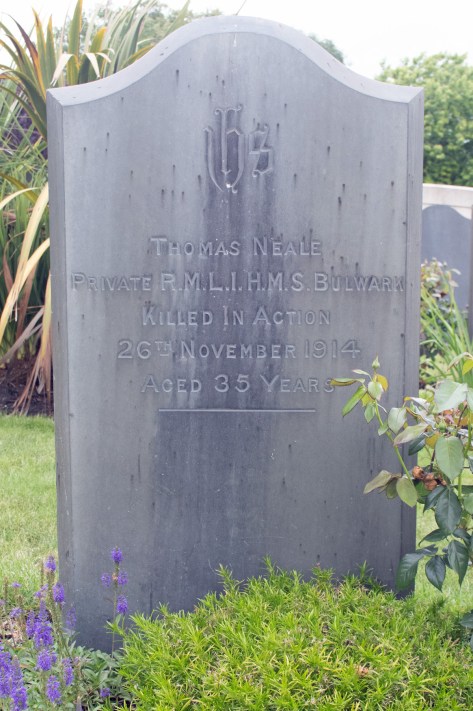
On 26th November she was moored up in the lower reaches of the River Medway, not far from Sheerness, being re-stocked with ammunition. That morning, a number of cordite charges overheated, detonating the shells stored nearby. The resulting explosion ripped through the battleship, and more than 740 crew were killed. Thomas was amongst those whose bodies were recovered and identified: he was 38 years of age.

The bodies that were recovered from the tragedy were taken to the Woodlands Cemetery in nearby Gillingham and laid to rest. Thomas Neale was buried alongside his colleagues in a marked grave, while those whose remains had not been identified were laid to rest in a mass grave nearby.


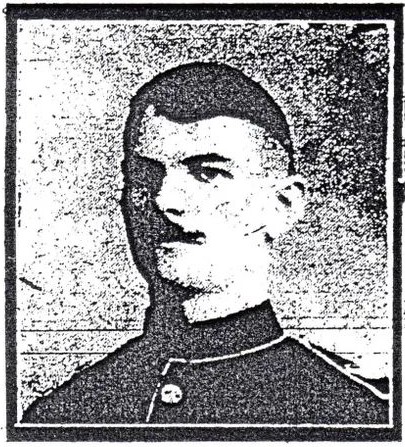
Private Thomas Neale
(from findagrave.com)