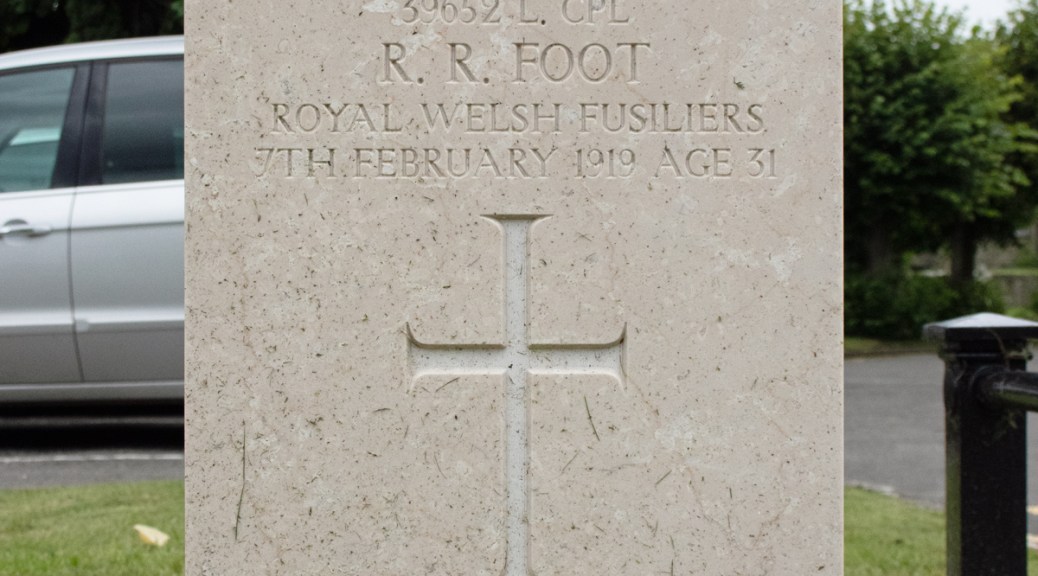
Reginald Robert Foot was born at the beginning of 1888 in Shaftesbury, Dorset, the oldest of three children to Robert and Annie Foot. Robert was a tailor from the town, who brought up his young family in the comfort of well-known surroundings.
When he left school, Reginald found work as a carpenter and joiner. He was a keen, if over-eager, sportsman, and played for Shaftesbury FC. In May 1906, he was reported for ‘cheeky’ behaviour towards the referee in one match.
In the lead up to the Great War, he also spent some of his his spare time in the Territorial Army and, when war broke out, he was keen to continue doing his bit. He joined the Royal Welch Fusiliers as a Private in December 1915 and, by the time he was shipped out to France in January 1917, he had been promoted to the rank of Lance Corporal.
After a year on the Western Front, Reginald returned to the United Kingdom and, once the Armistice had been declared, his unit was shipped to Ireland. He fell ill while he was out there, and, in January 1919 was admitted to a military hospital in Ireland.
Sadly, the lung conditions he had contracted – influenza and pneumonia – were to get the better of him, and he passed away on 7th February 1919. Lance Corporal Foot was 31 years old.
The body of Reginald Robert Foot was brought back to Dorset; he lies at rest in the Holy Trinity Churchyard in the town of his birth, Shaftesbury.
The early life of Charles Willcox is a bit of a mystery. From fragments of information, we can determine that he was born in 1893 and had a brother called Edmund and a sister called Beatrice. His mother was a Mrs S Willcox, who, by the early 1920s was living in Johannesburg, South Africa.
Piecing together the tiny pieces of information online, it seems likely, therefore, that his parents were Frank and Sarah Willcox. Frank was a cabinet maker and upholsterer, he and Sarah were from Bridgwater in Somerset, and they had eleven children.
By 1895, Frank had moved the family from Somerset to Cardiff; Charles was the last of the siblings to be born in England. The family did eventually move to South Africa – alongside Sarah, both Beatrice and Edmund lived and died there in their later years.
Back to Charles and, once the Great War started, he was quick to enlist. He joined the Somerset Light Infantry in August 1914, and had a narrow escape in October of that year. The Bridgwater Mercury reported that he was in the trenches and had had a near miss when his backpack was hit by a shell.
Corporal Willcox was wounded at Ypres in November, when a piece of shrapnel hit him in the shoulder, went through the lung and had to be cut out of the centre of his back. He was expected to make a full recovery within a year. Charles was also awarded the Distinguished Conduct Medal for his actions in the battle.
In September 1915, Sergeant Willcox received another award; the Russian Cross & Order of St George; the BridgwaterMercury noted that Charles was the first man from the town to be awarded both this and the DCM. The town’s mayor also subsequently presented him with a gold watch and chain on behalf of the town.
Promotion continued for Charles, and, by 1917, he had been elevated to Company Sergeant Major. He was heavily involved in recruitment for the Somerset Light Infantry, and it is likely that, standing at a strapping 6ft 4ins (1.93m) tall and weighing in at 17st (107kg), he would have been the perfect advert for the battalion.
When the war came to a close, things quietened down for him. A keen sportsman – he played rugby for Somerset – he had been a gym instructor in the army, and had taken up boxing around 1912. He entered a novices’ boxing competition in Southampton in December 1919, and found himself up against Seaman Merrilees, from the HMS Hearty.
In the fight, Charles received a body blow and a blow to the jaw, he fell to the floor, landed awkwardly and was knocked out. Attended to by doctors in the sports club, he was sent to Charing Cross Hospital when he did not regain consciousness after a couple of hours.
At the hospital, bruising was reported to Charles’ eye and cheek, but no skull fracture was found. They operated on him, two pieces of bone were removed, and a large clot on the left-hand side of his brain discovered. Sadly, the operation did no good, and Charles died that afternoon, the 4th December 1919. He was just 26 years old.
His death was recorded as concussion and a cerebral haemorrhage, attributed to the fall he had had in the ring. An inquest was held, although one report suggests a verdict of accidental death, while another states excusable homicide by misadventure.
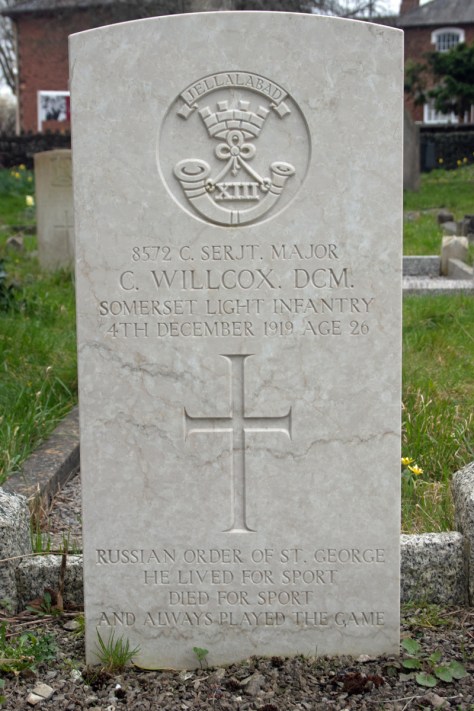
Charles Willcox lies at rest in the Wembdon Road Cemetery in his home town of Bridgwater in Somerset. His gravestone remembers that he lived for sport, died for sport and always played the game.
Serjeant Major Charles Willcox (from wembdonroadcemetery.com)
Walter James ‘Rattler’ Roman was born in July 1880, one of six children to George and Betsy Roman. George was a labourer in a brickyard, and the family lived in Bridgwater in Somerset.
Walter’s passion was rugby football, and he made the Bridgwater & Albion first team at the age of 15. Two years later had reached county level, and was playing for Somerset.
Walter enlisted in the army in around 1897, joining the Somerset Light Infantry. He spent several years abroad, serving as a Private in India and South Africa and fighting at Cawnpore and in the Second Boer War.
When Walter’s service ended, he returned to England, and continued his rugby career. He was a regular for the Bridgwater and Somerset teams, gaining the nickname ‘Rattler’, before being signed up by Rochdale Hornets in 1910.
Walter married Henriette Washer in Bridgwater in April 1911, and the couple had two children, Edna – born in 1912 – and Leonard – who was born a year later.
Continuing with rugby union, Walter was called to county level, where he joined Lancashire for a number of games. Walter also played for England, receiving a cap in the international match against Wales in February 1914, and he toured Australia and New Zealand the same year.
War broke out, and Private Roman was re-enlisted, one of twenty-five Hornets players to enlist. He served on the Western Front with the 1st Battalion of the Somerset Light Infantry and was caught up in the engagements at Ypres and Armentieres. Fighting at in the Battle of the Somme, he went over the top at Beaumont-Hamel at the start or fighting, on 1st July 1916 – his 36th birthday.
In that initial charge, he was shot several times, in both arms, a leg and the torso. Initially treated at a local field hospital, he was evacuated to England and admitted to the Voluntary Aid Hospital in Cheltenham. His condition initially improved, and he wrote letters to Henrietta, who was living back in Rochdale.
Sadly, Walter’s contracted sepsis and his health deteriorated; Henrietta was called to the hospital in Cheltenham on 27th July 1916. It is likely that she didn’t make it in time, as Walter passed away at 1pm the following day. He was just 36 years old.
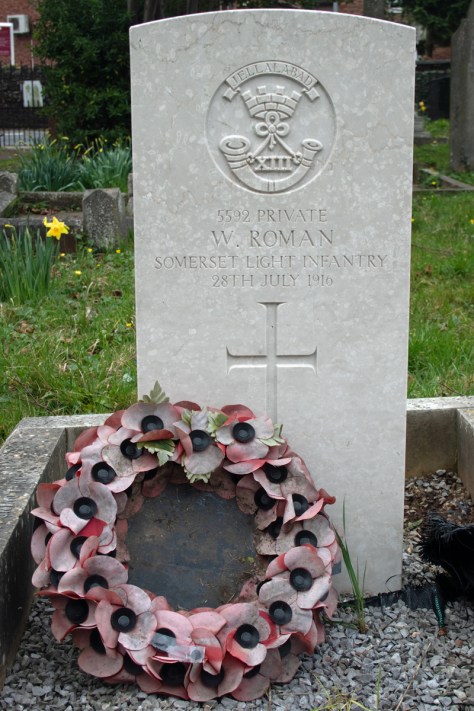
Walter James Roman lies at rest in the Wembdon Road Cemetery in his home town of Bridgwater, Somerset, one of may sporting heroes to perish in the First World War.
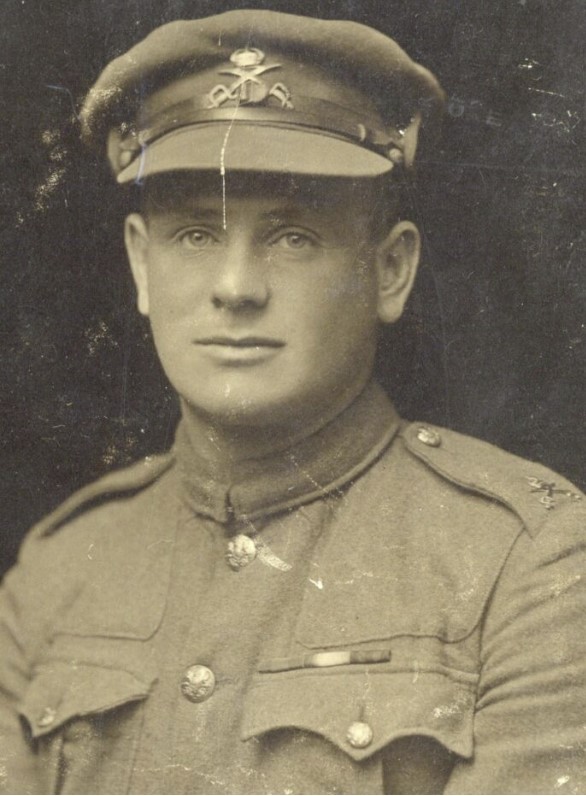
Walter Roman (courtesy of findagrave.com)
Walter was one of 25 Rochdale Hornets players to enlist when war broke out. Of those men, five did not return: Private Walter Roman; Sergeant John Twigg; Private Archie Field; Private Tom West and Private CJ Burton.





 Death and Service