
The funeral took place at All Saints’ Cemetery, Jesmond Road, Newcastle, on Saturday, of Senior Sick Berth Reserve Attendant George Gilbert, of Portland Road, Newcastle, who was killed in the air raid on the South-East Coast on Monday last. The deceased, who was 53 years of age, was, prior to the outbreak of war, employed as a machine-man at Elswick Works, and was an active member of the St John Ambulance Brigade. When hostilities began he volunteered for service as a sick berth attendant in the Naval Division.
[Newcastle Journal: Monday 10th September 1917]
George Gilbert was born in 19th March 1866 in Birmingham, Warwickshire. One of five children, he was the oldest son to George and Mary Gilbert. George Sr was an engine fitter and, according to the 1881 census, the family lived at 42 Devonshire Street, to the north west of the city centre.
The next census, taken in 1891, found a change of circumstances for George Jr. Having moved to Leicester, he had found work as a boot finisher. He had also found love, and, in 1889, had married a woman called Ellen. Little information about her early life is available, but she had been born in Northampton: given that shoe-making was a key industry in the town, it is possible that the couple had met at work, although this is purely conjecture.
George was keen to support his family as best he could, and they moved to the Benwell area of Newcastle-on-Tyne. George found factory work, and the couple set up home at 64 Tyne Street. By the time of the 1901 census, Ellen had had two children, daughters Mabel and Lilian.
George’s career continued, and, as the newspaper report suggests, he took employment as an engine-man for the Elswick Ordnance Company. A munitions manufacturer, the factory was just a few minutes’ walk from where the Gilbert family had moved to, 30 Wellfield Road, Benwell. The 1911 census confirmed a third child, daughter Beatrice, who had been born in 1902. Ellen was now working, her occupation listed as a grocery dealer in her own account.
War broke out in the summer of 1914 and, despite his age, George was quick to step up and serve his country. Joining the Royal Naval Division on 2nd August, he took the role of Senior Reserve Attendant, and was assigned to the naval hospital in Chatham, Kent. His service records note that he was 5ft 9ins (1.75m) tall, with light hair, grey eyes and a fresh complexion.
Senior Reserve Attendant Gilbert stayed at the hospital for the next three years and was barracked at HMS Pembroke – the Royal Naval Dockyard. By the summer of 1917, the base was overcrowded: the sinking of HMS Vanguard led to its replacement crew being stuck there waiting for new assignments, and an outbreak of meningitis meant additional accommodation was needed to slow the spread of infection. George found himself billeted in temporary quarters in the dockyard’s Drill Hall.
By this point in the war, the German Air Force was looking to minimise daytime casualties, and was, instead, trialling night raids; on 3rd September, Chatham found itself in their flight path. The Drill Hall received a direct hit, and Senior Reserve Attendant Gilbert was badly injured. He was taken to the hospital he had worked in, but his wounds proved too severe. He passed away the day after the attack: he was 51 years of age.
The body of George Gilbert was taken back to Newcastle for burial. He was laid to rest in the city’s All Saints’ Cemetery, not far from where his grieving family lived.
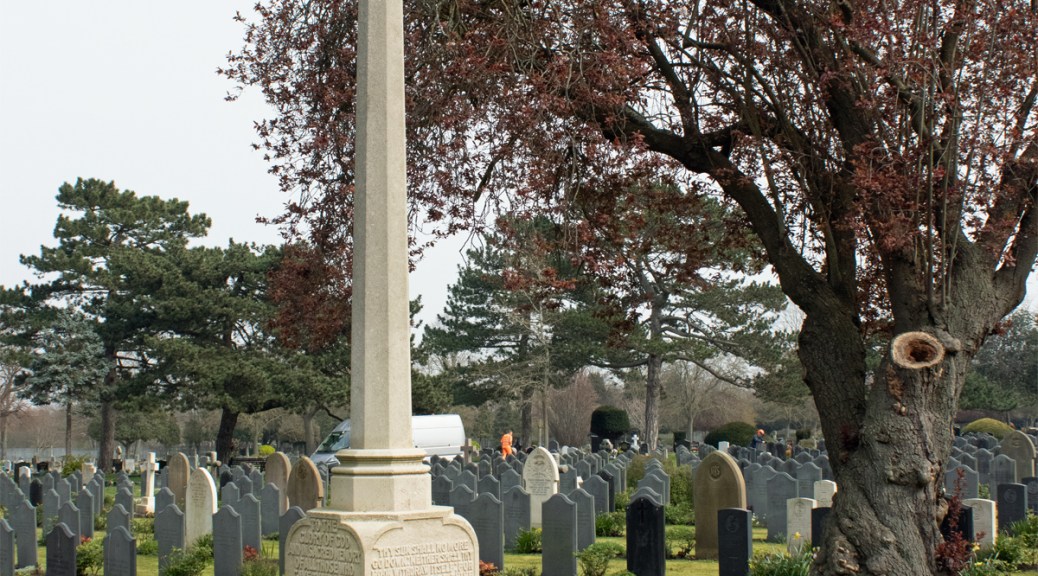
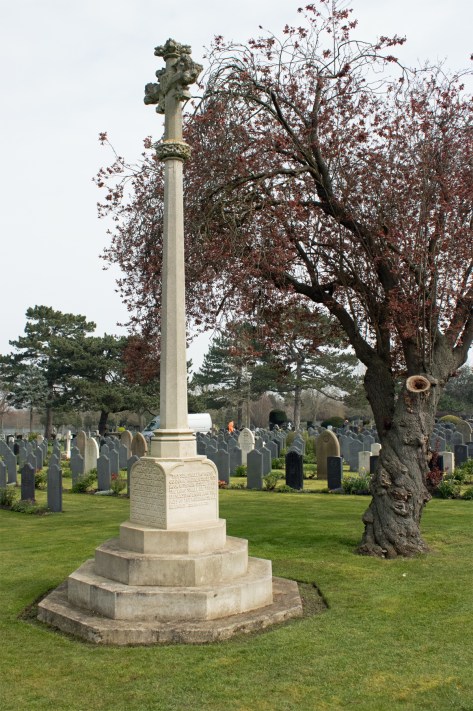
[Note: the photo above is of the memorial to the Chatham Air Raid victims, close to the mass grave for those whose bodies were not identified, in Woodlands Cemetery, Gillingham, Kent.]
 Death and Service