Category Archives: war

Private Herbert Andrews

Private Herbert Andrews

Herbert Arthur John Andrews was born in July 1896, the eldest of seven children of Hugh (known as Henry) and Jane Andrews from Evercreech, Somerset.

By the time war broke out, Herbert was helping out on his grandfather’s farm in nearby Thornford. He enlisted into the army on 15th November 1915, joining the Gloucestershire Regiment.

Private Andrews – whose military records show he was just 5ft 2ins (1.57m) tall – had three separate stints in France from March 1916, eventually spending a total of eighteen months on the front line. On 27th August 1917, while fighting at Passchendaele, he was wound in the face. His injuries seem not to have been too severe: he was treated in France, and was soon back on active duty.

Herbert seems to be the only member of his family to have seen active service. His brother Norman was the only one of his siblings to have been old enough to enlist and, while he did so in 1917, he was assigned to the Experimental Company of the Royal Engineers, testing munitions and gases in Porton.

It appears that while Herbert was on leave in February 1918 he fell ill. Ultimately, he was discharged as medically unfit for service on 7th September. Just three days later, he passed away three days later, succumbing to a combination of chronic Bright’s disease and haemoptysis. He was just 22 years old.

Private Herbert Andrews lies at rest in the graveyard of St Peter’s Church in his home village of Evercreech.
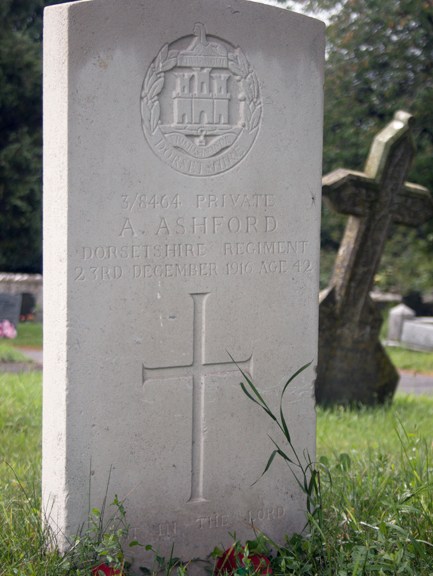

Private Arthur Ashford

Private Ashford

James Arthur Ashford was born in around 1871, in the Dorset village of Lidlynch. The son of John and Tryphina Ashford, his father died when James was only seven years old, leaving Tryphina to raise him and his three siblings.

James, who seems to have gone by his middle name, Arthur, found work as a farm labourer when he completed his schooling. The 1891 census found him living alone in a cottage at The Common, in Okeford Fitzpaine.

This life seems not to have suited Arthur, however, and, on 23rd November 1891, he enlisted in the army. Joining the Dorsetshire Regiment as a Private, his service records show that he was a little over 5ft 7ins (1.71m) tall, and weighed in at 133lbs (60.3kg). He was noted as being a Wesleyan, with brown hair, grey eyes and a fresh complexion.

Private Ashford enlisted to a total of seven years, with a further five years on reserve status. During his active duty, he travelled the world. He spent a total of eight-and-a-half years overseas, in Egypt, India and South Africa. By 1903, his contract came to an end, and he elected not to re-enlist.

Arthur’s choice may have been directed by love. In July 1899, he married Amy Upshall in Evercreech Parish Church. By this point he was on reserve status with the army, and employed as a labourer in the Somerset village. The couple had six children, though sadly, two of them – Arthur George and Elsie May – died in childhood.

By the time of the 1911 census, the Ashford family had set up home at Rose Cottage in Evercreech, Arthur employed as an agricultural labourer. By the time war broke out, however, he stepped up to serve his country once more.

Private Ashford enlisted within months of the First World War beginning, returning to the Dorsetshire Regiment he had previously served on 30th September 1914. Rather than being sent overseas, however, this time he served on the Home Front, in Dorchester and Portland.

On the evening of 22nd December 1916, Arthur fell down a gulley “near the Rector’s House at Portland” [Western Gazette: Friday 29th December 1916] . He was taken to the Verne Military Hospital in the town, but died of his injuries – a fractured skull – in the early hours of the following day. He was 45 years of age.

An inquest on the body was held by Mr GP Symes on Saturday afternoon… Opening the enquiry, the Coroner commented on the fact that a similar fatality had occurred in the gulley about 12 months previously. There was no evidence to show how Ashford got there, but it was probable that his hat blew off and he went down to get it. They could not imagine that anything else occurred – that anyone pushed him into the gulley.

[Western Gazette: Friday 29th December 1916]

The body of Arthur James Ashford was taken back to Somerset for burial. He was laid to rest in Evercreech Cemetery, not far from where his grieving family still lived.


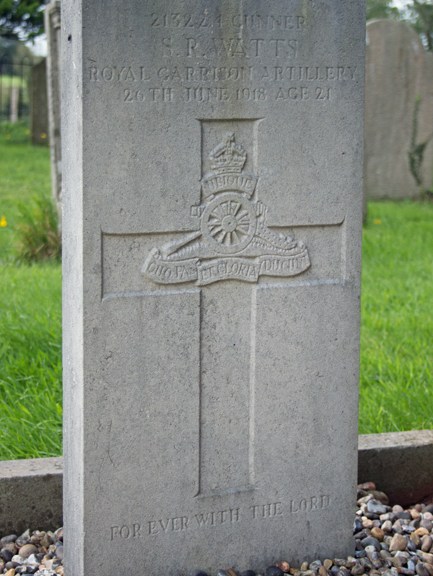
Gunner Samuel Watts

Gunner Samuel Watts

Samuel Reginald Watts was born in 1897, the seventh of eight children of Samuel and Augusta Watts.

He followed his father and brothers into the main industry in the area – coal mining – and was certainly working down the pits by the time of the 1911 census.

Samuel enlisted on 21st April 1918, and joined the Royal Garrison Artillery, which focused on heavy, large-calibre guns and howitzers that were positioned some way behind the front line. He was 5’5″ (1.65m) tall and weighed 144lbs (65kg). According to his war records, he had brown hair, hazel eyes and a fresh complexion.

His service started the very next day, when he was transferred to the Citadel in Plymouth for training.

After feeling unwell, complaining of headaches and a sensitivity to light, Gunner Watts was admitted to the Netley Hospital in Southampton on 18th June 1918. He was diagnosed with cerebrospinal fever, more commonly known as meningitis, and was treated over the next week.

Sadly, the treatment did not work, and Gunner Samuel Watts passed away on the evening of 26th June 1918. He had been in the army for a little over two months and had not seen active service.

Samuel Watts lies at peace in the graveyard of St John’s Church, Farrington Gurney.


Guardsman Harold Dummett

Guardsman Harold Joseph James Dummett

Harold Joseph James Dummett was born in early 1900, one of ten children – and the eldest son – of Harry and Elizabeth of Kingsdon, Somerset.

Harold joined the Coldstream Guards, although there are no records to confirm the date of his enlistment. His battalion – the 5th – remained stationed in Windsor throughout the war; it is likely, therefore, that Guardsman Dummett never saw front line service.

His pension records give his mother as his next of kin, while the Register of Soldier’s Effects also name his father.

Guardsman Dummett passed away from pleurisy and pneumonia at the Military Hospital in Purfleet on 15th February 1919. He was 19 years of age.

Harold Joseph James Dummett lies at peace in the quiet All Saints’ Churchyard in his home village of Kingsdon.


While Harold does not appear in the newspaper records, his parents do. In April 1937, the Taunton Courier reports that

Mr and Mrs Harry Dummett celebrated their golden wedding… There was a happy family gathering of all their children and two grandsons.

Taunton Courier and Weston Advertiser – 24th April 1937

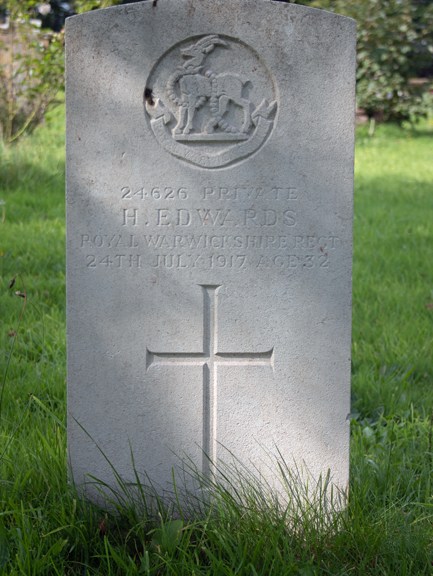
Private Harry Edwards

Private Harry Edwards

Henry Charles Edwards was born in 1883, the eldest of four children for Joseph and Elizabeth.

Joseph was an agricultural labourer, and Henry (or Harry) followed his father in the farming life, continuing in the role after Joseph died, and up until at least the 1911 census.

I was unable to find much regarding Harry’s military service. He signed up the Royal Warwickshire Regiment, and subsequently transferred to the Somerset Light Infantry.

He died from tetanus on 24th July 1917, aged 34. His pension records give his mother, Elizabeth, as his beneficiary.

Private Henry Edwards lies at rest in the churchyard of Lydeard St Lawrence, Somerset.

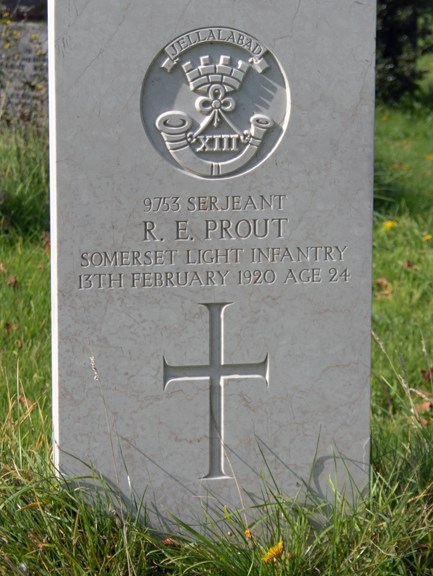
Serjeant Richard Prout

Sergeant Richard Edwin Prout

Richard Edwin Prout was born in 1896, the second son of Frederick and Anna (Hannah) Prout. When his father died in 1908, his mother remarried and by the 1911 census, Richard and his family had moved to Lydeard St Lawrence, where he was a baker’s boy.

He enlisted in June 1914, joining the Somerset Light Infantry and served throughout the war, receiving the Mons Star, Victory Medal and General Service Medals.

After the war, he continued in the army, and was assigned to Taunton Barracks.

His passing was unusual enough for it to be reported on in the local newspaper.

Sergt. Prout, it was stated at the Barracks yesterday, had been on leave for some days prior to his departure for Ireland, and had been spending his furlough at Crowcombe, where his parents live. On the evening of his death, he left home, after taking a hearty meal, to catch the 7.25 train to Taunton. He had to walk a mile to Crowcombe station, most of the way uphill. Early the following morning his dead body was discovered lying face downwards by the roadside, about 50 yards from the station. The body was removed to his home, and Dr. Frossard, of Bishop’s Lydeard, was called in to make a post-mortem examination. The doctor has reported that death was due to asphyxia brought on by over exertion on a full stomach, and syncope, following pressure on the neck by the tightness of the collar of his outside jacket, the doctor adding that he had great difficulty in unfastening the collar.

Western Daily Press – Friday 20th February 1920

A genuine case of someone going before their time. Having visited Lydeard St Lawrence, I recognise the hill he would have had to have climbed to reach the station, and it’s steep enough in a car, let alone walking up it.

Sergeant Prout, the newspaper reported, was generally esteemed by his fellow company, and at his funeral he received full military honours.

Richard Edwin Prout lies peacefully in the churchyard of Lydeard St Lawrence.

Private Stephen Rawle

Private Stephen John Rawle

Stephen John Rawle was born in 1894, the second of four sons of George Rawle, a sailor, and Louisa, his wife.

By the time war broke out, Stephen was working as a groom in Wheddon Cross, just south of Minehead.

As the Great War loomed, he enlisted and Private Rawle serving on the home front. His record show that he stood at 5ft 9.5ins (1.76m) and was of good enough health to be enrolled for the Territorial Force. He was assigned to the West Somerset Yeomanry.

He was medically discharged from service on 29th March 1915, having served for one year and 31 days.

The records show no signs of injury or wounds, and newspapers of the period do not link him with any misadventure. I can only assume, therefore, that he died of natural causes, possibly linked to the Spanish Flu Pandemic. Stephen died on 5th September 1918. He was 25 years old.

Private Stephen John Rawle lies at rest in the churchyard of Lydeard St Lawrence, alongside two of his brothers, Ernest and William.


George and Louisa’s other son – Edward – also served, enlisting in the Somerset Light Infantry and fighting in the Balkans. Private Edward Rawle survived the war, returning home in March 1919.

It should be noted that, by June 1921, George and Louisa had lost three of her four sons to the Great War. Their daughter, Norah, had also passed away in 1918.

The 1921 census found Louisa living in East Town, in the parish of Tolland, not far from Lydeard St Lawrence. Edward was living with her, as were her three-year-old granddaughter, Lorna, and her eighteen-month-old grandson Beatty. It is unclear whose children they were. George, at this point, was helping his younger brother out on the family farm in Williton.


Private Ernest Rawle

Private Ernest Charles Rawle

Ernest Charles Rawle was born in 1899, the fourth son of George Rawle, a sailor, and Louisa, his wife.

Ernest was still at school at the time of the 1911 census, and enlisted in the West Somerset Yeomanry, but enlisted in the army in April 1915. His served on the Home Front, but was discharged as being unfit for war service on 22nd July 1916.

Private Rawle’s discharge records confirm that he had pulmonary tuberculosis, which he had contracted a couple of months before. They go on to suggest that it was not a permanent condition, but was likely to render him unfit for service for a number of months.

Eager to do his bit, Ernest’s record show that he re-enlisted in August 1916, and that he was considered fit for military service by the November of that year.

His medical records continue further – he was admitted to a field hospital again in March 1917, again suffering from tuberculosis. He was moved back to base as he was “a danger to his comrades”.

His records after March 1917 are not available, but he passed way from TB in November 1919. He was just 21 years old.

Private Ernest Rawle lies at peace in the churchyard of Lydeard St Lawrence, alongside his two brothers, Stephen and William.


George and Louisa’s other son – Edward – also served, enlisting in the Somerset Light Infantry and fighting in the Balkans. Private Edward Rawle survived the war, returning home in March 1919.

It should be noted that, by June 1921, George and Louisa had lost three of her four sons to the Great War. Their daughter, Norah, had also passed away in 1918.

The 1921 census found Louisa living in East Town, in the parish of Tolland, not far from Lydeard St Lawrence. Edward was living with her, as were her three-year-old granddaughter, Lorna, and her eighteen-month-old grandson Beatty. It is unclear whose children they were. George, at this point, was helping his younger brother out on the family farm in Williton.


Private William Rawle

Private William Henry Rawle

William Henry Rawle was born in 1890, the eldest child of George Rawle, a sailor, and Louisa, his wife.

At the time of the 1911 census, William was working as a carter on a farm not far from Porlock in Somerset.

He enlisted in August 1914, joining the Somerset Light Infantry and serving as part of the Expeditionary Force. After a couple of postings, Private Rawle was transferred to the Pioneer Depot in March 1916.

Six months later William was medically discharged as unfit for continued service. His notes highlight his distinguishing marks as 3 marks on his left arm, birth mark under his right nipple and gunshot wound to the left eye (which I am guessing is what led to his discharge).

William died on 11th June 1921, aged 27 years old. I have been unable to find anything specific relating to his death and it is likely, therefore, that no misadventure was involved.

Private William Henry Rawle lies at peace in the churchyard of Lydeard St Lawrence, alongside his brothers Stephen and Ernest.


George and Louisa’s other son – Edward – also served, enlisting in the Somerset Light Infantry and fighting in the Balkans. Private Edward Rawle survived the war, returning home in March 1919.

It should be noted that, by June 1921, George and Louisa had lost three of her four sons to the Great War. Their daughter, Norah, had also passed away in 1918.

The 1921 census found Louisa living in East Town, in the parish of Tolland, not far from Lydeard St Lawrence. Edward was living with her, as were her three-year-old granddaughter, Lorna, and her eighteen-month-old grandson Beatty. It is unclear whose children they were. George, at this point, was helping his younger brother out on the family farm in Williton.


Private George Symons

Private George Symons

George Symons was born in 1895 to Charles and Rosa Symons. He was the third of five sons.

Charles worked as a carter on a farm, and his son became a cowman as soon as he could leave school.

Military records for George Symons are pretty sparse. From his gravestone we know he had joined the Somerset Light Infantry by the end of 1917. Assigned to the 4th Battalion, Private Symons’ unit served in India and the Middle East throughout the war, and it was while he was overseas that he was caught up on the fighting.

In the confusion of battle, George was initially recorded as ‘presumed dead’. Subsequently identified as badly injured, he was medically repatriated to Britain for treatment. Admitted to hospital, his wounds were to prove too severe: Private Symons passed away on 23rd June 1918: he was 23 years old.

George Symons’ body was taken back to Somerset for burial. He lies at rest in the churchyard of St Michael and All Angels in Milverton.