Category Archives: suicide

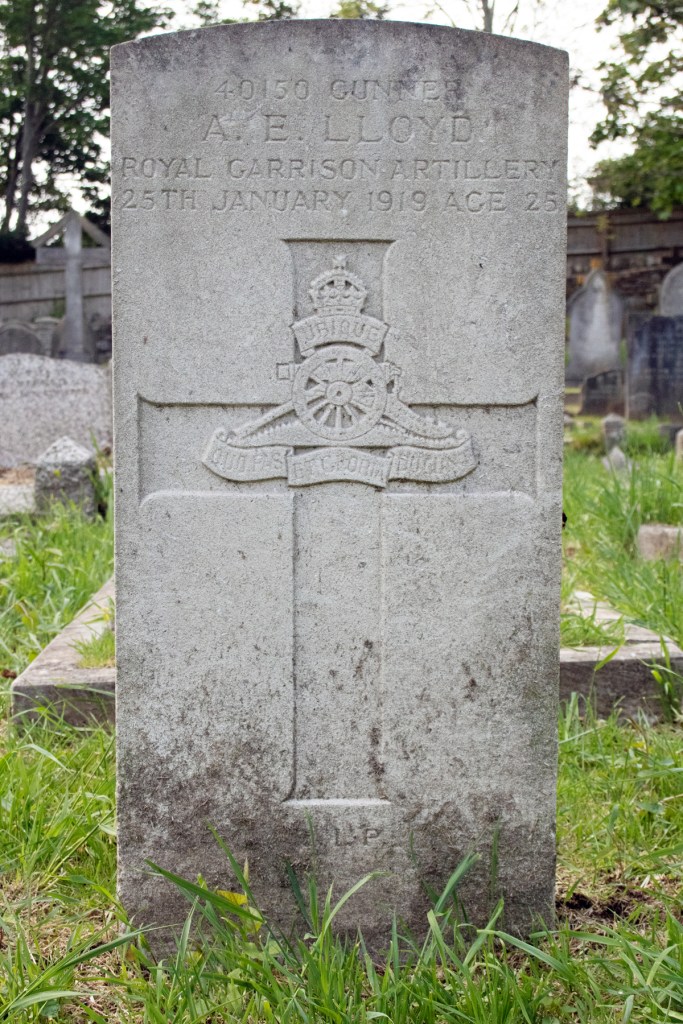
Gunner Albert Lloyd

Gunner Albert Lloyd

Albert Edward Prankard Lloyd was born in Somerset on 25th September 1893, in the Somerset village of Kewstoke (now a suburb of Weston-super-Mare). He was one of eight children to Jabez and Charity Lloyd. Jabez was initially a mason, but later went on to find work as a miner in South Wales. Charity worked as a laundress to help bring in extra money.

When Albert left school, he found employment as a labourer, remaining at home with Charity, with Jabez working away, and three of his sisters working as housemaids or laundresses. By 1911, however, he had moved to Wales with his father to work as a miner; steady employment that brought in a little more money because of the risks involved.

War, however, was on the horizon, and Albert enlisted before hostilities broke out. Joining up on 12th January 1914, his military records show him as standing 5ft 7ins (1.7m) tall and weighing in at 166lbs (75.3kg). He joined the Royal Garrison Artillery and, over the next five years, served three tours of duty in France, totalling just over three years on the Western Front.

Gunner Lloyd’s military service was not without incident, however. In November 1914 he was admitted to hospital for a week, suffering from shock. In April 1917, a shell exploded close to him and he was again found to be suffering from shock. His records note that, following the injury, he had had suicidal thoughts, and wished he was dead.

Just a month later, back on the battlefield, Albert received a gunshot wound to his right thigh. Nine months later, he was admitted to the Hermitage General Hospital in Higham, Kent for three weeks. (The ailment is a mystery, with just the term SCT Toe to identify it.)

When the Armistice came, Gunner Lloyd remained in France, finally returning home on 13th January 1919 ready to be demobbed. While not clear in his records, it seems that the initial ‘shock’ he had suffered from in 1914 had continued throughout the war.

One of the last comments on Albert’s service records is stark. “Found dead on Great Western Railway near Weston-super-Mare. 25.01.19“. Frustratingly, there is no other documentary evidence to expand on this curt phrase, no contemporary newspapers seem to have reported on the event, and nothing more than a scribbled police report was provided for the inquest (again, of which nothing remains).

It seems that the effects of five years of conflict proved too much for Gunner Lloyd; he committed suicide at the age of just 25 years old.

Albert Edward Prankard Lloyd lies at peace at last in the Milton Cemetery in his home town of Weston-super-Mare.


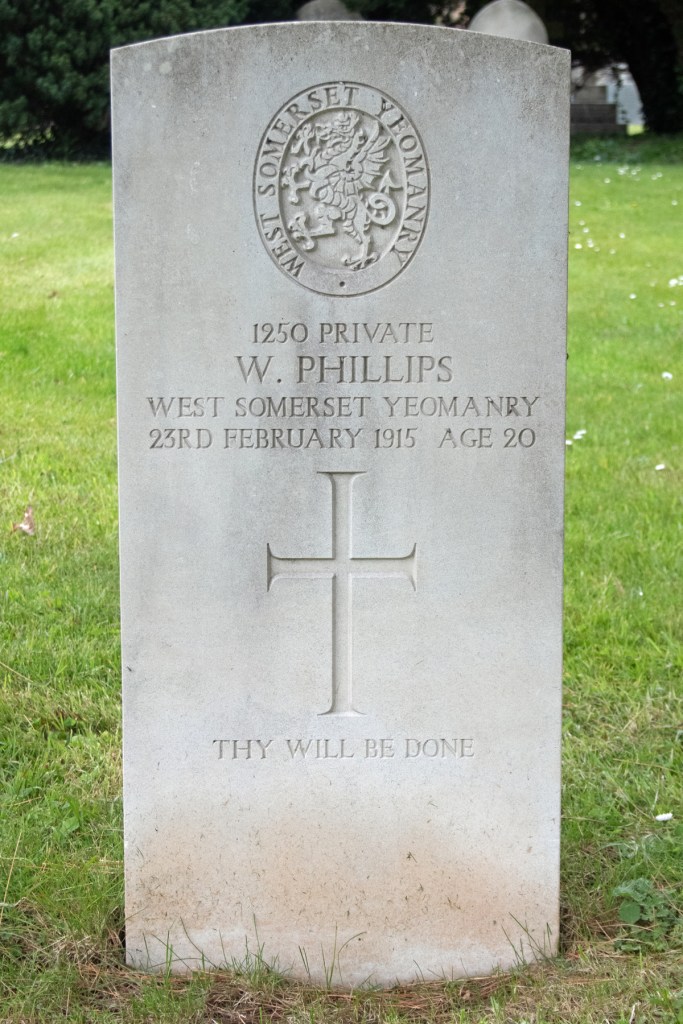
Private William Phillips

Private William Phillips

William Phillips was born in 1895, the youngest of seven children to Frank and Emily Phillips. Frank was a joiner and carpenter and, while his young family initially grew up in his home village of Thurloxton, Somerset, he and Emily soon moved them to nearby Taunton, where there would be more work and more opportunities.

By the time of the 1911 census, the young family were all tied up with different jobs. While William had become an office boy for an accountant when he left school, his siblings all had varying different roles: one was a boiler cleaner, another a mason, a third a cellarman and the fourth a shop assistant. With Frank’s own work, this meant that there were five wages coming into the home, albeit on a much smaller scale that we are used to these days.

War was coming, however, and, at the beginning of 1915, William enlisted in the West Somerset Yeomanry. Little information remains of his military service, but it is known that Private Phillips’ experience as a clerk was made use of, and he worked in admin at the reserve depot in Minehead.

William had, by this time, got himself a lady friend, who worked at the hospital in Taunton, and, while they did not see each other a lot, they corresponded regularly.

His new-found freedom from the family home seemed to have led to William being a bit freer with his money than his parents would like, and it appears that he may have run up a few debts He reassured his mother that he did not want to worry them with any business that he had. However, financial matters may well have played on his mind more than he would have liked to admit.

On Saturday 20th February 1915, Private Phillips travelled to Taunton to see his girlfriend; she was working, but he caught up with his sister instead, before returning to the base in Minehead that evening.

The following Tuesday morning, he received a letter from his girl and was last seen heading to breakfast in the hotel digs where he was billeted.

That afternoon, a local engineer was walking along the seafront, when he saw a body lying on the foreshore, about four feet (1.21m) from the high-water mark. The body – which was later identified as William – was wearing some clothing, but other bits were scattered around him. The police were called and Private Phillips’ body was taken to nearby Dunster.

The coroner confirmed William had drowned; the letter he had received was amongst his clothing, but there was nothing in it to suggest that anything was amiss. At the inquest, he suggested that “he could hardly suppose at this time of year that the deceased had taken off his clothing in order to bathe. [His conclusion was that William] got into the water with intent to drown himself.” [Taunton Courier and Western Advertiser: Wednesday 3rd March 1915]

The jury at the inquest returned the verdict of ‘found drowned’. Private Phillips was just 20 years old.

William’s body was brought back to Taunton for burial. He lies at rest in the St James Cemetery there.


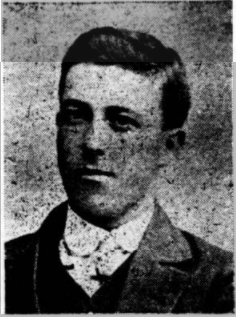
William Phillips
(from britishnewspaperarchives.com)

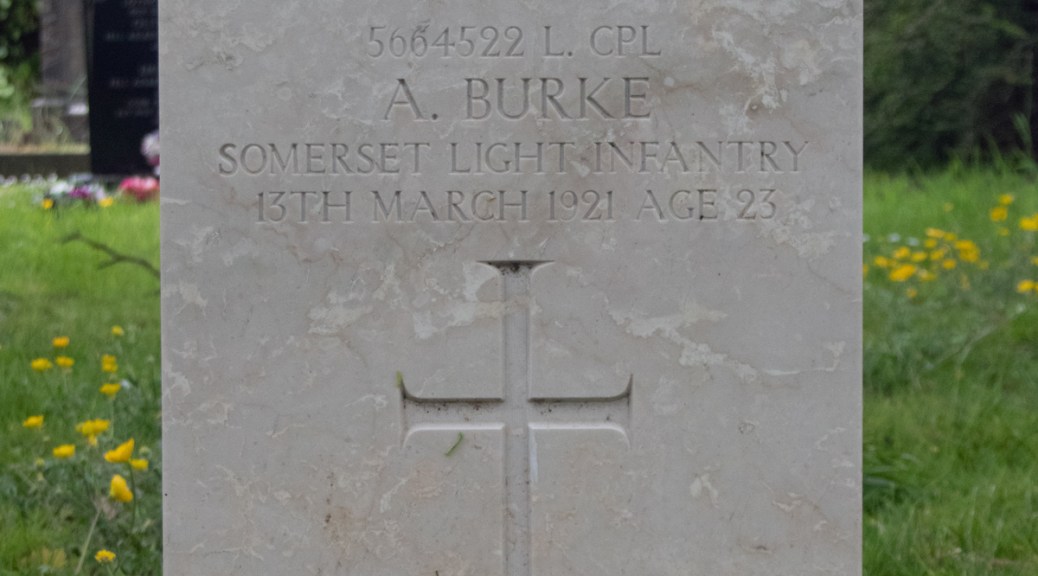
Lance Corporal Albert Burke

Lance Corporal Albert Burke

Sometimes, researching war graves can throw a bit of a curve ball, and the things you uncover can make you stop in your tracks. Such is the story surrounding Lance Corporal Albert Burke, and a media report surrounding his death in March 1921.


SCHEME OF VENGEANCE

Taunton Suicide’s Amazing Last Letter

Toll On Young Women

A sensational affair has occurred at Taunton Barracks. On Sunday morning, Albert (or Alfred James) Burke, aged 23, a Lance Corporal in the Somerset Light Infantry, was found to have taken his life by inhaling chloroform, his dead body being found on a bed at the military hospital, where he was employed as an orderly.

On Saturday night, according to the evidence, deceased appeared to be in his usual health and spirits. The next morning, a comrade found his dead body with a chloroform bottle by its side and near his face a large piece of cotton wool which he had evidently used for the purpose of inhaling the poison.

Some light was thrown on the tragedy by a letter addressed to a Taunton young woman, found on his clothing, and which was read at the inquest yesterday.

It was of an extraordinary character, and began “You wish to know what my intentions are in regard to you. Well, in the first place let me tell you I am not, as the coroner who holds the inquest will adjudge me, insane. In fact I don’t think I was ever so rational or level-minded as at the present moment, although I have had a glass or two.

“Well, Beatrice, mine is a rather long and interesting story. I married Louisa Wills some time in 1917, and I think the least said about her the better, but I wish to say this, that I have never knocked across a beast to equal her for violence. I am afraid the people around Brentford, Middlesex, could give you a far better account of her than I can.”

The writer went on to make certain allegations against the woman, and then referred to other towns where, he said, he had ruined girls before coming to Taunton and joining the Somerset Light Infantry. He added that he spent Friday night, when he was supposed to go out with Beatrice, with another girl in the barracks.

He said his father committed suicide owing to a “thing” who called herself a woman, and he (deceased) got a feeling with him that he would like to pay it back on a few girls. In conclusion, Burke expressed his satisfaction at knowing the condition Beatrice was in, and that he had been able to add another to the list of those on whom he wished to have his revenge.

Evidence was given by Alec Treeby, civilian orderly at the Barracks, who found deceased. In reply to the coroner, witness said that he knew the man was keeping company with a girl, but was not aware that there was any trouble about her.

PC Carter stated that the police had made enquiries, and a telephone message had been received that nothing was known of the man or of a wife and family of the name at Brentford…

[The] medical officer at Taunton Barracks said deceased was a steady, hard working man, and, so far as he knew, perfectly sane.

The jury returned a verdict of “suicide while of unsound mind”.

Western Times: Wednesday 16th March 1921

The newspaper report confirms the Lance Corporal’s name as either Albert or Alfred James Burke; the coroner also went on to say that he had also used the aliases of Povery and Pavey. Sadly, research around these names – and that of Louisa Wills – have either led to frustrating dead ends, or to results too vague to concretely connect them to Lance Corporal Burke.

The life and loves of Lance Corporal Burke are destined to remain a mystery. All that can be confirmed is that he took his own life on 13th March 1921; he was 23 years old.

Albert Burke lies at peace in St Mary’s Cemetery in Taunton, Somerset. He was accepted for commemoration as war dead on 27th May 2016 and was afforded a gravestone by the Commonwealth War Graves Commission.


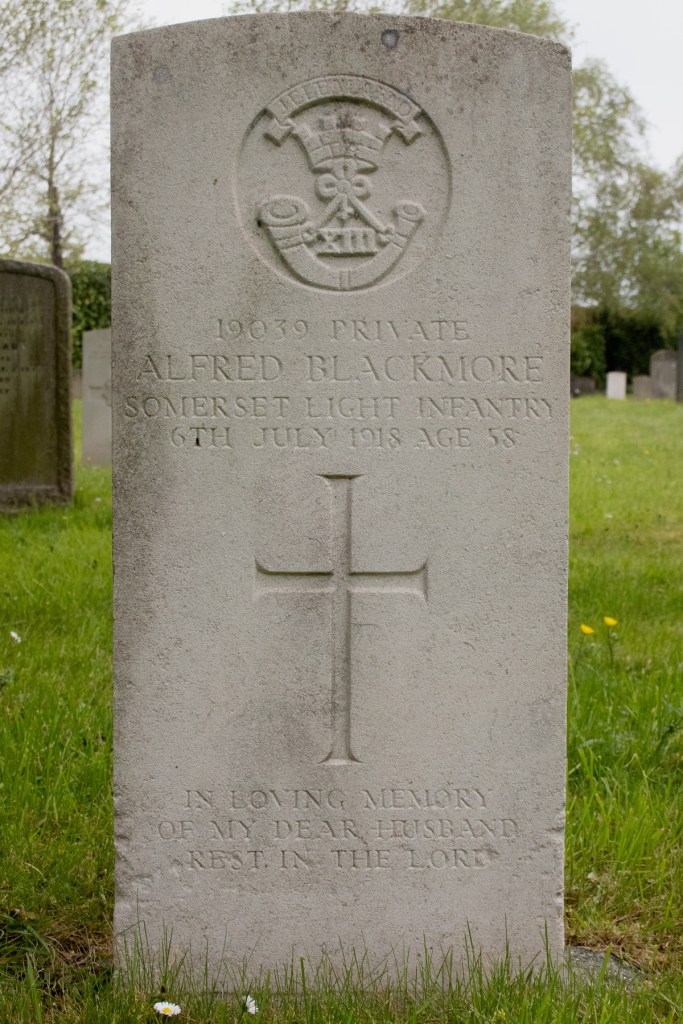
Private Alfred Blackmore

Private Alfred Blackmore

Alfred Blackmore was born on 25th October 1868 in the village of Thurlbear, near Taunton. Documentation varies and names cross over, but it appears that he was one numerous children to farm labourer William Blackmore and his wife, Mary Ann.

Details of Alfred’s early life are a bit hazy – again, in a rural location, names often cross over, so it is a challenge to totally confirm that they relate to the right person. His mother appears to have passed away by the time of the 1881 census, and Alfred was living with his father and three of his siblings and working as a farm hand.

Alfred again disappears off the radar for a while; in July 1894, he married Lucy Charlotte Yard, and the couple went on to have two daughters, Lucy and Beatrice. By 1901, the young family were living in the village of Frampton Cotterell, just to the north of Bristol, and Alfred had found employment as a marine fireman.

Ten years later, Lucy and the girls were still living in Frampton Cotterell, but Alfred was back in Taunton, lodging with a 75-year-old widow called Mary Croker and working as a labourer. This separation may have signalled the beginning of the end for the couple’s marriage.

War broke out, and it is evident that Alfred enlisted as a Private in the Somerset Light Infantry. Sadly, his service records are lost to time, but it appears that he served for at least three years.

The next time Alfred appears in documentation, it is a newspaper report on his passing, under the heading “Taunton Soldier’s Death”.

FOUND DROWNED AT BLACKBROOK

Mr F Foster Barham, coroner for West Somerset, held an inquest at the Blackbrook Inn, Ruishton, on Monday, relative to the death of Alfred Blackmore, aged 49, a private in the Labour Company at Taunton Barracks, whose body was found in the stream at Blackbrook on Saturday morning.

William Cozens, farmer… gave evidence of identification, and stated that on Friday he saw the deceased sitting by the hedge… about 400 yards from where the body was found.

William Richard Radnidge, butcher… stated that on Saturday morning he found the body in the stream dividing Ruishton from Taunton St Mary’s… His cap, belt and cape were on the bank. The deceased was lying face downward, his face and arms being in the mud below the surface.

PC Jenkins stated that at 10:45am on Saturday he received a communication from PC Wathen, in consequence of which he proceeded to Blackbrook, where he found the body lying under a hedge. He searched the body, and on it found a summons, returnable at Taunton on 29th June, for having failed to comply with a maintenance order obtained by his wife, Lucy Blackmore, on 25th September 1915, the sum of £2 13s [approx. £300 today] being due. On the back of the summons was written: “This is what my old cow has done for me.”

There was also the following letter: “When my body is found, don’t you give a farthing to my old cow. What I have got to come give to my brother, Edward Blackmore… Signed A Blackmore.” At the back of the letter was written: “Goodbye to all that I love.”

The deceased had left his lodging at nine a.m. on June 29th to attend the Taunton Police Court, but did not do so.

An officer stated that the deceased’s conduct during the three years he had been in the army had been satisfactory.

The Foreman of the jury said that according to the evidence they found that the deceased met with his death by drowning whilst temporarily insane.

Taunton Courier and Western Advertiser: Wednesday 10th July 1918

Alfred Blackmore took his own life on 6th July 1918. He was 49 years old [the war grave gives a different age].

Alfred lies at peace in St Mary’s Cemetery in Taunton, Somerset.