Clifford Charles Tucker was born in 1896, one of five children to John and Ellen Tucker. John was a shoemaker in the Somerset village of Othery, while Clifford became a farm labourer when he left school.
There is little documented of Clifford’s life, and what I have been able to identify about his military career has come from a newspaper article.
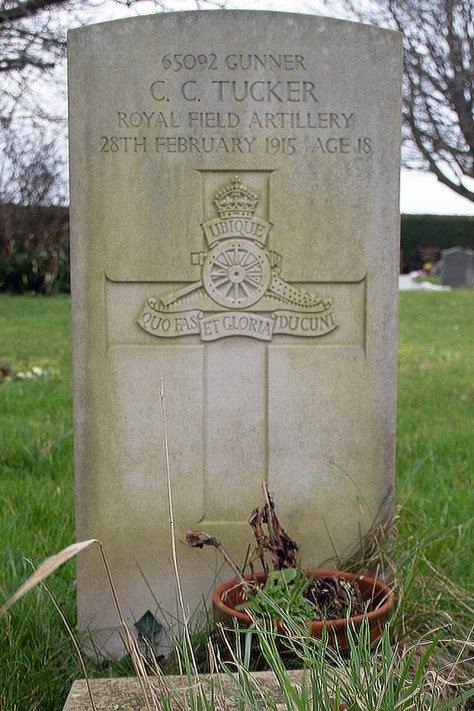
Much regret is felt in Othery at the new of the death of Clifford Tucker, one of the young fellows who volunteered for the service of their King and Country. Deceased, who was only 18 years of age… enlisted in the Royal Artillery about six weeks ago and was stationed at Brighton.
He was taken ill with pneumonia and died, his father arriving in time to see him before he breathed his last.
Taunton Courier and Western Advertiser: Wednesday 17th March 1915.
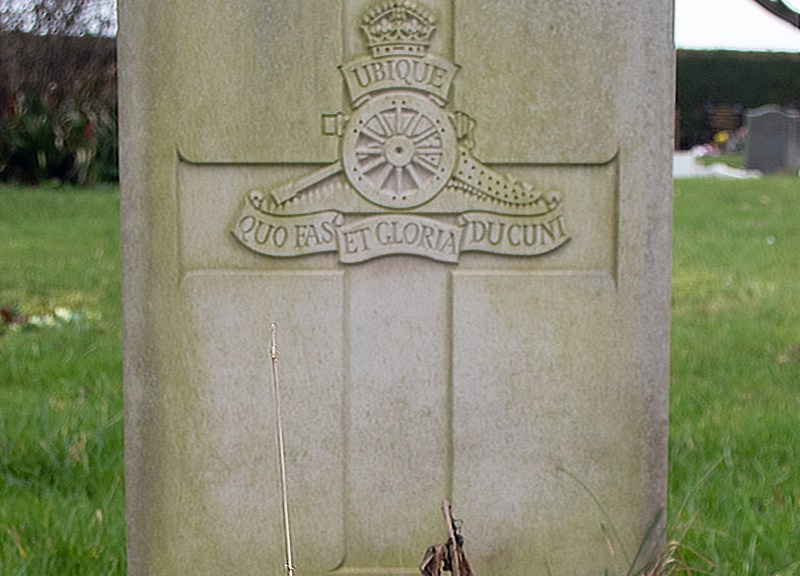
Gunner Tucker passed away on 28th February 1915, aged just 18 years old.
He lies at rest in the cemetery of his home village of Othery.
William James Waterhouse was born in 1875, the eldest of seven children to Richard and Elizabeth Waterhouse. The family lived in Cumberland, where Richard initially worked a grocer before becoming a music teacher.
William followed his father into food retail, working initially as a butcher’s boy in Barrow-in-Furness, before moving 400 miles to the south coast and settling in Eastbourne. Travel was definitely on William’s mind, however, as, by the 1911 census, he was a butcher’s manager at a hotel in Leicester.
William’s service records are limited; he was 39 when war broke out, and enlisted in the Eastern Mounted Brigade, before transferring Army Service Corps. During his time, he was promoted to Serjeant, and according to a newspaper report of his funeral “was most popular among the men.” [Wells Journal: Friday 9th July 1915]
It seems that, as part of his service, Serjeant Waterhouse had been assisting with haymaking in the Wells area, and it was after this that he fell ill. He developed pneumonia, and passed away on 30th June 1915. He 40 years old.
William James Waterhouse lies at rest in the cemetery of his adopted home town of Wells, in Somerset.
Edwin Herbert was born in 1864, the third of three children to Moses and Melina Herbert of Hove in East Sussex. Moses worked in the cement industry as a labourer, a job that had taken him from his home in Kent to Sussex, and which, by the 1871 census, would return him to his home county.
Edwin married Amelia Charlotte Titus in 1885 and the couple’s first child – a daughter, Nelly – was born a year later.
By the 1891 census, Edwin was also labouring in the North Kent cement industry, something he continued to do for at least the next twenty years, as confirmed in the following two censuses.
The Herberts’ second child, Amelia, was born in 1901, the year after Edwin’s mother passed away. The family were, by then, living in Cuxton, just to the south of Rochester. The cement industry was one of the large employers in the Medway valley, and it is not surprising that the family lived in and around that area for so long.
In 1910, Edwin’s father also died, at the age of 69. After the death of Melina, Moses had moved in with his daughter – Edwin’s older sister – in Rochester, and the family were also still labouring in the cement and brickmaking industry.
Edwin’s military records are sketchy. Piecing the evidence together, he enlisted in the Royal Army Service Corps.
It is likely that he did so on a voluntary basis. The cement industry was not protected by exemption. Kitchener’s initial conscription in March 1916 excluded married men. When this was extended in May 1916, there was still a maximum age limit of 41 (Edwin was 52 year old by this point).
By whichever means he had enlisted, Edwin served as a Corporal (there is nothing to confirm whether he was promoted from Private, or if he went straight into service at that rank). He was discharged on 30th July 1918, and it is likely that this was on a medical basis.
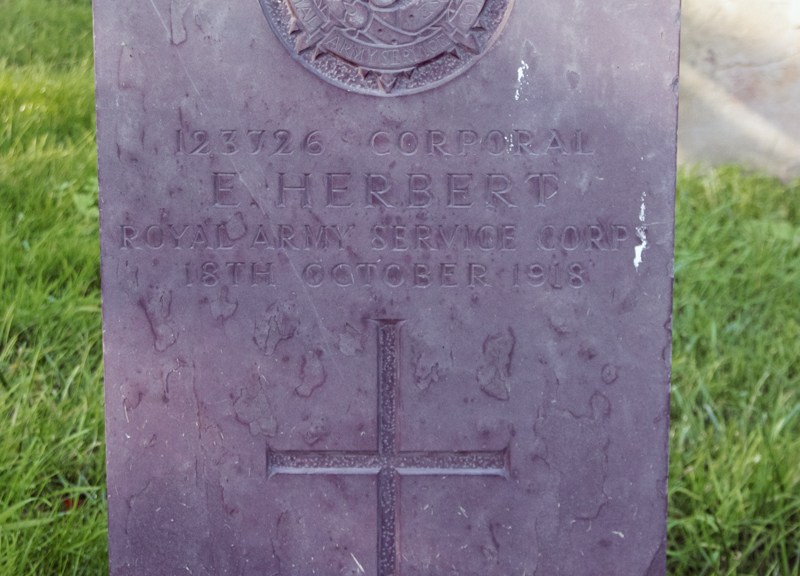
Corporal Herbert’s pension documents record that he passed away on 30th October 1918, as a result of carcinoma of the liver and exhaustion. He was 54 years old.
Edwin Herbert lies at peace in the quiet churchyard of St Helen’s in Cliffe, Kent.
The majority of the the Commonwealth War Graves Commission headstones in the UK are made from Portland stone, although, in face, over 50 different natural stones have been used.
Corporal Cornell’s headstone is one of two in St Helen’s Churchyard that have been fashioned from dark grey slate.
Walter George Colchin was born in 1884 in Borden, Kent. His parents, Herbert and Frances, moved the family – three sons, including Walter, and a daughter – to the village of Iwade, where they ran the Woolpack Inn.
There isn’t a great deal of information about Walter’s life. He married Bertha Sparks from the neighbouring village of Milton in 1916.
Walter joined the war effort at some point after that – I have been unable to find an exact date – and enlisted in the Royal Army Service Corps, before transferring to the Agricultural Company Labour Corps.
Private Colchin was on active service in Steyning, West Sussex, when the war came to a close. On 23rd December 1918, he suffered a cerebral haemorrhage and died. He was 34 years old.
Walter Colchin is buried in the graveyard of All Saints Church in his home village of Iwade.





 Death and Service