Category Archives: East Kent Regiment

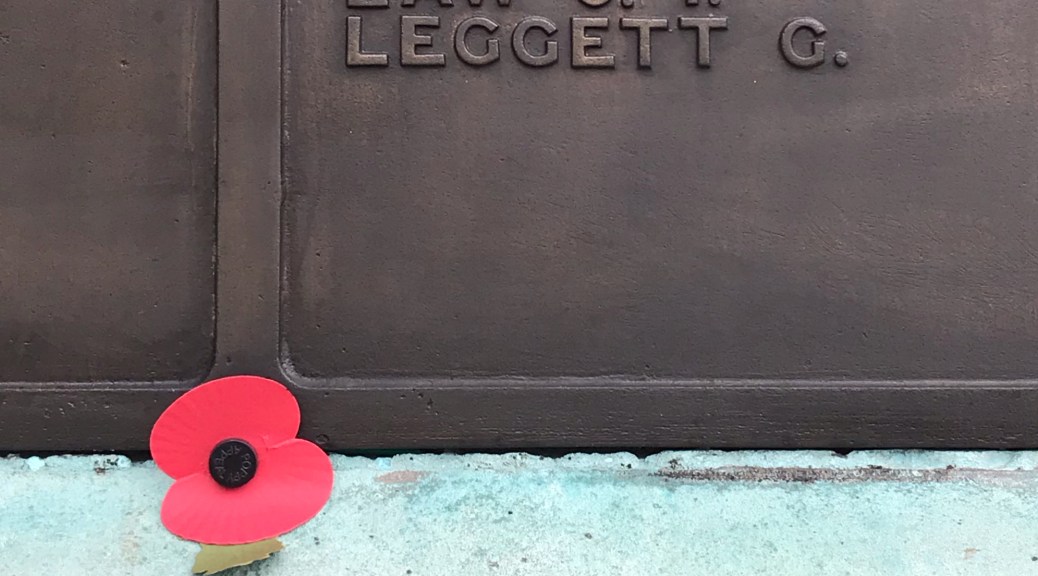
Lieutenant John Scrace

Lieutenant John Scrace

John Scrace was born on 31st July 1892 in Chatham, Kent, the oldest of five children to John and Adelaide Scrace. John Sr was a relieving officer for the Medway Board of Guardians, a role which involved “taking charge of poor or insane persons not otherwise cared for” [census1891.com]. Adelaide worked in a similar role, as an infant protection visitor.

It is fair to say, therefore, that John Jr had a very supportive childhood. He attended King’s School in Rochester, where he obtained a scholarship to Peterhouse College, Cambridge.

When war broke out, John was keen to do his part. Initially joining The Buffs (the East Kent Regiment), he transferred across to the newly-formed Royal Air Force in June 1918. By this point he had risen to the rank of Lieutenant, and, as part of his new RAF role, was based at Driffield in Yorkshire.

On 24th August 1918, the aircraft John was flying at the base, spun into the ground, and John was killed instantly. A subsequent inquest identified that “the cause of the accident was due to the fact that, for reasons unknown, part of the top of the left-hand plane of the machine crumpled up in the air and thereby [caused] the pilot to lose control of his machine.” [rafmuseumstoryvault.org.uk] Lieutenant Scrace was just 26 years of age.

John Scrace was buried in Christ Church Churchyard in Luton, Kent; he is commemorated in Woodlands Cemetery in nearby Gillingham.

Private Holdsworth Elphick

Private Holdsworth Elphick

Holdsworth Elphick was born on 7th June 1891, one of five children to Herbert and Mary Elphick. Herbert was a billiard marker and professional player, who had been born in Brighton. Mary was from Ireland, but the couple raised their family in London, presumably as this is where the best opportunities for work were.

When he left school, Holdsworth found work at the George Hotel in Balham, South London, where he was employed as a barman. The 1911 census shows another barman there called Geoffrey Elphick, who, while not one of Holdsworth’s brothers, may well have been a cousin.

When war broke out, Holdsworth was quick to sign up. He enlisted as a Private in the Buffs (the East Kent Regiment) on 9th September 1914 and, after a year on the Home Front, he was sent out to France as part of the British Expeditionary Force in August 1915.

There is little further information available about Private Elphick’s time in the army. He returned to England on 25th February 1916; this appears to have been a medical evacuation as, two months later, he was discharged from the army as he was no longer physically fit to continue.

Life continued for Holdsworth. In September 1917, he married Lydia Ann Armstrong, a dock labourer’s daughter from Southampton, although this is where his trail seems to end.

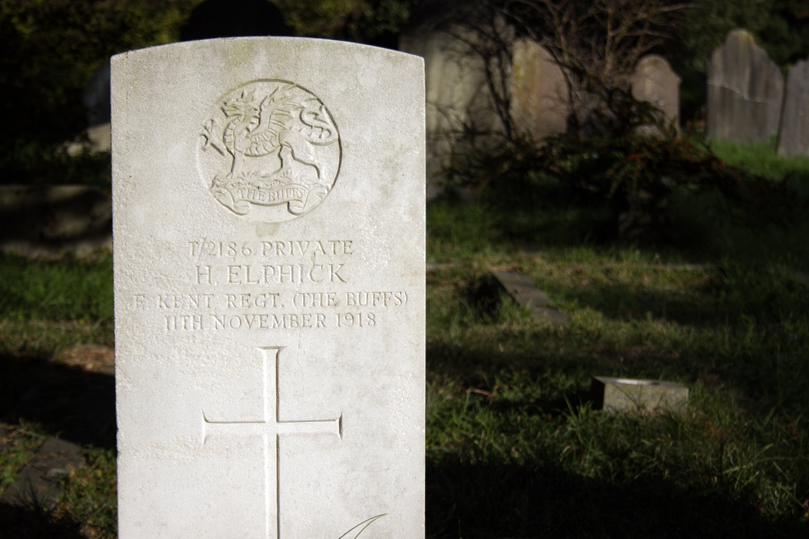
The next available evidence for Private Elphick is his gravestone. This confirms that he passed away on 11th November 1918 – Armistice Day – but no further information is available. He was just 27 years of age.

Holdsworth Elphick lies at rest in the Broadwater Cemetery in Worthing, West Sussex (presumably this is where he and Lydia moved after their marriage, although there is nothing to confirm this).


Private Aubert Smith

Private Aubert Smith

Aubert Charles Smith was born in 1893, the eldest of eight children to Charles and Mary Ann Smith. Charles worked at the Naval Dockyard in Chatham, and the family lived not far away in Gillingham, Kent.

When he left school, Aubert found work as a labourer in a ‘provision warehouse’, which may have been connected to the dockyard at which his father worked.

In July 1915, aged 22, he married Lucy Cox, who was the daughter of a mess cook at the naval base. The young couple went on to have a son, also called Aubert, in 1917.

At this point, the First World War was raging, but little documentation remains of Private Smith’s service. He enlisted in the East Kent Regiment (also known as The Buffs), but there is nothing to confirm when he enrolled or where his duty took him.

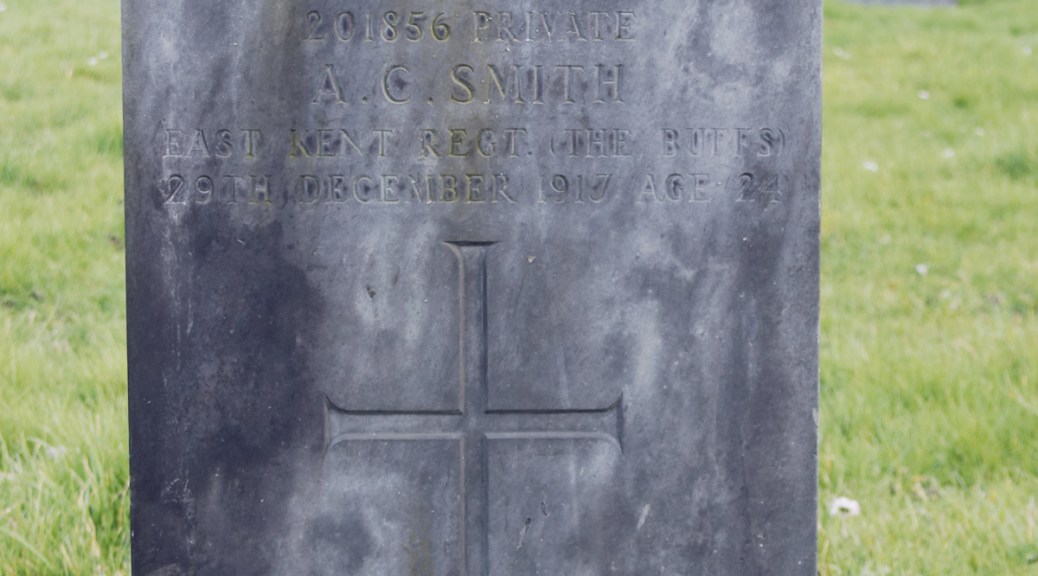
The next record for Private Smith shows that he was admitted to Fulham Military Hospital, suffering from testicular cancer. Sadly, he succumbed to the condition, and he passed away on 29th December 1917. He was just 24 years old.

Aubert Charles Smith lies at rest in the Woodlands Cemetery in his home town of Gillingham, Kent.


Corporal Sidney Hornby

This image has an empty alt attribute; its file name is photo-01-11-2020-12-01-50-e1605266325697.jpg

Sidney Horace Hornby was born to John and Emily in March 1880. John was a tailor’s assistant from Paddington, and the family – Sidney was the eldest of six siblings – initially lived in the Greenwich.

Sidney enlisted in the army in 1898. He joined the East Kent Regiment for a short service of seven years and was sent to South Africa. In March 1900 he was wounded at the Battle of Driefontein. His service, though, saw him promoted through the ranks from Private to Sergeant.

Something must have happened during his enlistment, however, as on 2nd September 1901 Sergeant Hornby’s military record marks him as having deserted.

Sidney’s records pick him up again on 24th April 1908, when he is put on court martial. Found guilty of desertion, he is reduced to the ranks and sentenced to three years’ penal servitude (later reduced to two years’ hard labour).

His attitude seems to continue, however, as within a matter of months he was discharged due to misconduct and denied any pension for his previous service.

Sidney’s family had moved from Greenwich to Kent at some point before the 1901 census, and his father died three years later. By the 1911 census, he had moved back in with his mother, and worked as a labourer to help look after them.

The Great War called, however, and it seems that Sidney’s previous misdemeanours did not excluding him from fighting again. He joined the Royal West Kent Regiment although his full service for the 1914-18 campaign are not accessible. Again, his service seems to have been good, as he was elevated to the rank of Sergeant for a second time.

Hints of Sergeant Hornby’s rebellious nature remain, however, as he was court marshalled again in February 1916. He was convicted of drunkenness, and reduced to the rank of Corporal.

That was the summer of the Battle of the Somme, and by the autumn Hornby was one of the many who fell during that time. He died on 4th October 1916 and was 36 years old.

Corporal Sidney Hornby is commemorated on the Thiepval Memorial.


Sidney Horace Hornby was my 1st cousin, four times removed.

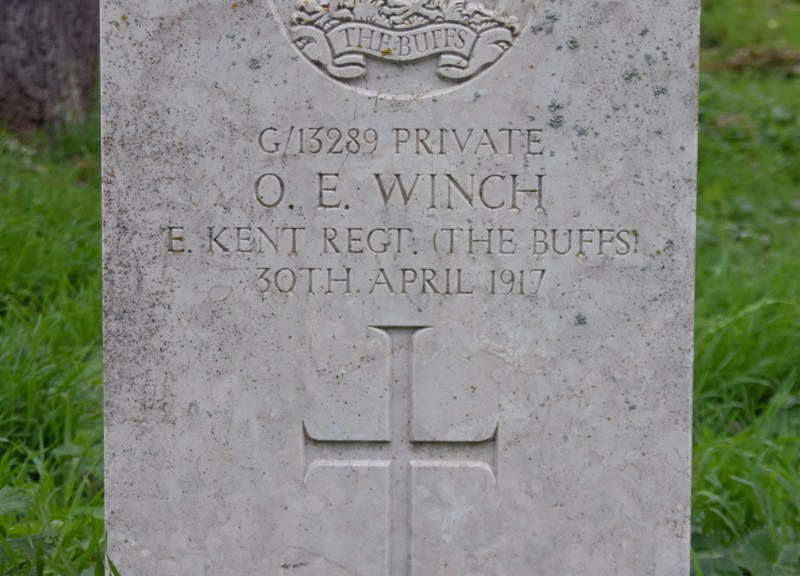
Private Osbourne Winch

Private Osbourne Winch

Osbourne Ethelbert Winch was born in Kent in 1888, one of three sons to Ernest and Ann Winch. Being the eldest, he inherited his unusual combination of names from his grandfathers – Osbourne on his mother’s side and Ethelbert on his father’s.

Osbourne had moved out of the family home by the time of the 1911 census, and, when war broke out, was quick to enlist. His records show that he was a tall man – standing at 5ft 10ins (1.78m) and he was declared fit for territorial service.

Private Winch joined the 45th Provisional Battalion, before moving to the Royal East Kent Mounted Rifles (also known as the Buffs) in 1916. Soon to be posted to the Front Line, Osbourne married Elsie Taylor in March that year, and he was posted in April.

Along with the move to the Buffs, Private Winch received promotions, first to Lance Corporal and then to Corporal. He again transferred to the Base Depot at Etaples in December 1916 and, for some reason, he reverted to being Private. His records confirm this was “under Para 12.VV.W.L.9/Geb No 5080 (AGI)”, although I have not been able to established what this means. There is no mention of disciplinary behaviour in his records, so whether this was because of the transfer to the depot, I cannot say.

Either way, he was transferred to the Front again on 13th December 1916, and remained on the Cavalry rate of pay.

Private Winch remained at the Front for a number of months. On 19th April 1917, possibly while involved in the Nivelle Offensive, he received gunshot wounds to the head and right hip. He was moved to a hospital in Béthune in northern France, where his hip was operated on.

Osbourne was transferred back to the UK on the Hospital Ship Cambria for medical treatment. His medical report from the UK hospital makes for grim reading:

Private states that he lay out for 2 days before being brought in. Gun shot wound head and right hip 19.4.17. Op on hip at Béthune – bad cough on admissions and moist sound in chest. Large septic wound over right hip exposing iliac crest and much comminution of ilium [breakage of the hip bone]. Acute pneumonia developed and patient grew steadily worse.

Medical Report: E Hamilton-Browne, Military Hospital, Endell Street, London WC

Private Osbourne Winch died at 4pm on 30th April 1917. He was 28 years old. He lies at peace in the graveyard of St Bartholomew’s Church in his home village of Bobbing in Kent.

Private Henry Thurley

Private Henry Thurley

Henry Edward Thurley was born in 1895, the tenth of twelve children to George and Charlotte Thurley. George was a brickmaker from Enfield, Middlesex, and the family moved around to follow his work.

Born in Sheerness, Kent, by the 1901 census, Henry was living with his family in Shoeburyness, Essex. Ten years later, the family had relocated back in Kent, and Henry had joined his father in the brickmaking business, while also working as a waterman – working on boats in the nearby Medway estuary.

When the Great War came, Henry was quick to enlist. He joined the East Kent Regiment – also known as “The Buffs” – in August 1915. After his initial training, Private Thurley was sent to France as part of the British Expeditionary Force.

Private Thurley was wounded on 6th March 1916, receiving gunshot wounds to his right foot, head and eyes. He was sent home to recover, but within a couple of months, he was back on the front line, serving for King and country again.

Henry was wounded again on 16th January 1917; this time is was his right eye that was affected, and he was shipped back to the UK and admitted to Merryflats War Hospital in Glasgow. His wounds appeared more serious this time, and he succumbed to them at 3:50pm on 1st February 1917. He was just 21 years old.

Private Henry Thurley was buried in the churchyard of St Mary the Virgin in his home village of Upchurch in Kent.