Category Archives: London Regiment

Private Herbert Spiller

Private Herbert Spiller

Herbert George Spiller was born in 1881, the second of four children to George and Emily Spiller. George was a timber merchant and ironmonger, born in Taunton, Somerset, who raised his family in his home town.

When Herbert left school, he found work as a clerk in a solicitor’s office, and this was the trade he followed, eventually becoming a solicitor in his own right.

In March 1907, he married Winifred Lewis, an outfitter’s daughter, and the couple soon emigrated, arriving in Perth, Australia, later that year. They had two children in Australia; a son, who sadly passed as a babe in arms, and a daughter. Within three years, however, the Spillers were back living in England again and went on to have four further children, three of whom survived infancy.

War had arrived, and Herbert enlisted on 11th December 1915, but was initially placed as a reserve. He was finally called to do his duty for King and country on 6th September 1917 and joined the 28th Battalion of the London Regiment. After initial training, Private Spiller was sent out to the Front, arriving in France in April 1918.

Herbert was back on home soil after three months, suffering from albuminaria (a disease of the kidneys) and served in territorial depots until he was demobbed in December 1918.

At this point, Herbert disappears from the records. It seems likely that his illness was the cause of his passing, but this cannot be confirmed. Either way, Herbert George Spiller died on 7th May 1920, at the age of 39 years old. He lies at rest in the St James Cemetery in his home town of Taunton, Somerset.


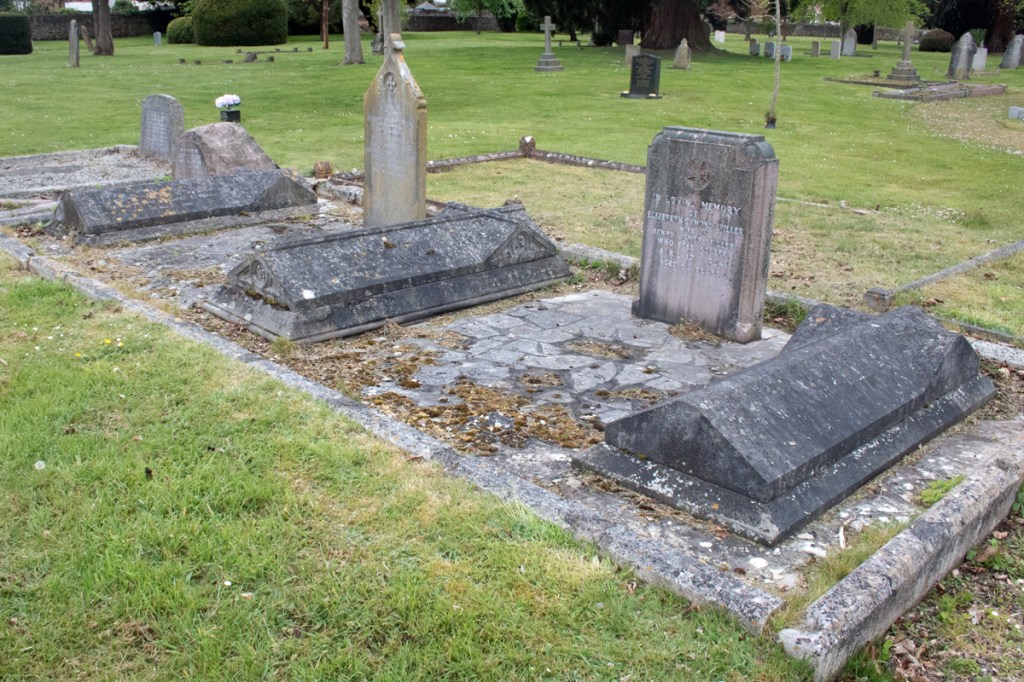
Please note: While Private Spiller was afforded a Commonwealth War Grave, his exact burial location is not identifiable. The image at the top of this post, therefore, is of the other family graves in the cemetery.


Herbert Spiller (from findagrave.com)

Private William Baber

Private William Baber

William Herbert Baber was born in May 1895, the oldest of six children to Henry and Alma Baber. By the time of William’s birth, Henry was an insurance agent for the Prudential insurance company and brought his family up in the Somerset village of Yatton. William’s father had been widowed early on, and so, in addition to his five younger siblings, he also had an older half-brother, also called Henry.

By the time of the 1911 census, William was working as a clerk in a coal office, and the family were living in a five room house not far from the village centre.

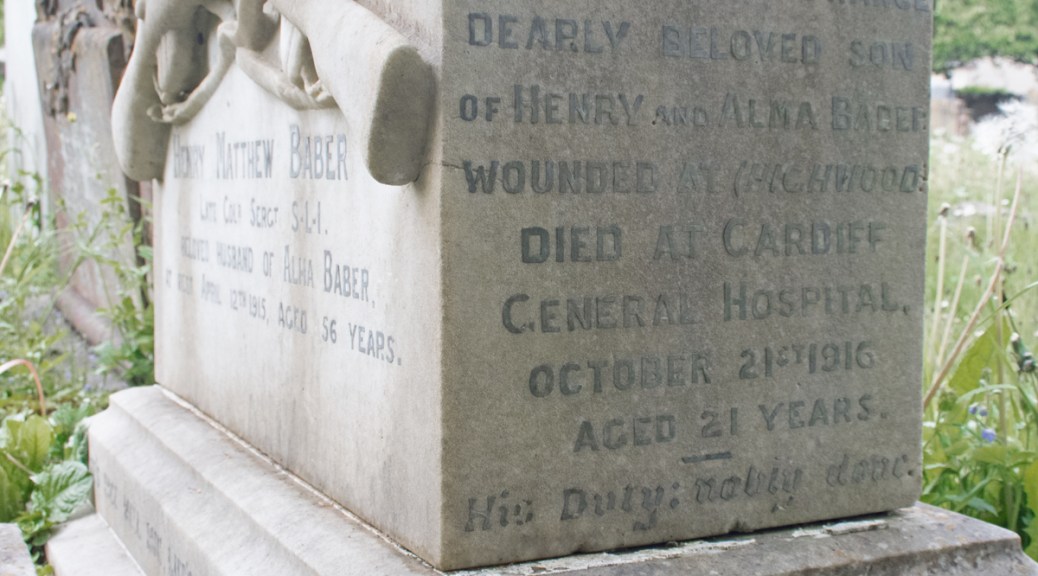
Little remains documented about William’s military service. He enlisted in the Somerset Light Infantry, but transferred to the 24th Battalion of the London Regiment. He was involved in the Battle of High Wood – part of the Somme offensive – and was wounded during the skirmish.

Evacuated back to home soil, Private Baber was treated in one of the military hospitals in Cardiff. Sadly, he was to succumb to his wounds, and passed away on 16th October 1916. He was just 21 years old.

William Herbert Baber lies at rest in the family grave in the churchyard of St Mary’s in Yatton.


William’s father Henry was also called up for war duty. You can read more about his story here.


Rifleman Walter Bromley

Rifleman Walter Bromley

Walter Vaine Bromley was born in March 1877, one of seven children to Frederick and Jane Bromley. Frederick was a gardener, and the family lived in Maidstone, Kent. Sadly Jane died when Walter was only two years old; while the cause of her death is not noted, she passed away in the Barming Lunatic Asylum in Kent.

Things must have been tough for Frederick; his maternal aunt, Sarah, came to live with the family to help raise his children, but further support seems to have been needed and, by the time of the 1891 census, Walter was a student at the Kent County Industrial School, which was, in effect, a boys home, near Ashford.

By the end of that year, having left school, he enlisted in the army, joining the Royal West Kent Regiment. He served most of his twelve years’ enrolment in India, although he suffered numerous hospital admissions for dysentery, ague and orchitis (a swelling of the testicles, often brought about by a sexually transmitted bacterial infection), amongst other ailments.

On being demobbed, Walter became a postman; he moved to Gillingham, and was given a round serving the Eastcourt area of the town. A year later, he married Rose Brenchley, and the couple went on to have four children; Ada, Violet, Frederick and Hilda.

Hostilities began, and, in July 1915, Walter enlisted in the 8th (City of London) Battalion, The London Regiment (Post Office Rifles). Rifleman Bromley served as part of the Territorial Force for his first year, before being sent to France in August 1916.

His time there was cut short, however, as he received a gunshot wound in the left ankle. William was repatriated to England for treatment, and was eventually medically discharged from the army on 22nd August 1917.

Surprisingly, it seems not to have been the ankle wound that led to Rifleman Bromley’s passing, however. His pension records, instead, give his cause of death as a goitre contracted whilst on active service. Either way, he passed on 9th July 1918, at the age of 41 years old.

Walter Vaine Bromley lies at rest in the Woodlands Cemetery in his adopted home town of Gillingham in Kent.


Walter Bromley (from ancestry.co.uk)

Flight Lieutenant Ronald Knight

Flight Lieutenant Ronald Knight

Ronald Victor Knight was born in March 1894, the youngest of two children – both sons – to John Knight, an Ironmonger from London, and his Swiss wife, Marie.

Ronald was well educated – being taught at Wells and Bedford Grammar Schools in the UK and Neuchatel in Switzerland, not far from where his mother was born. After studying at Bristol University, he went to work at Guys Hospital in London, training as a dental student.

When war broke out, he volunteered at once, being enlisted in the 8th Battalion London Regiment. Lieutenant Knight went with his regiment to France, and was involved in the Battle of Festubert and the fighting at Loos.

Returning home towards the end of 1915, Ronald married Gwendoline Dawkes, in a ceremony overseen by the Bishop of Bath & Wells.

Rather than returning to the front line, Lieutenant Knight accepted a commission to lead a section of the London Cyclist Corps, a position he held for a year or do. While in this service, Ronald and Gwendoline had their one and only child, a little girl they called Beryl.

In 1916, Ronald accepted a further move to the Royal Naval Air Service, becoming involved in flying as a Flight Lieutenant. It was while he was based at RNAS Cranwell that he was involved in the accident that led to his death.

An inquest was held into the incident, and evidence was taken.

Air Mechanic Charles Deboo [said] that the machine had been recently inspected, and that it was alright. He did not see the deceased flying, but saw the machine come down, nose first, in corkscrew fashion. He saw it at a height of 400ft. He went to the machine after it had fallen and found the officer was dead. The machine struck the ground and smashed up, but he could not say how the accident happened.

Charles Barrett, air mechanic, said he saw the accident. The deceased seemed as if he was going to turn towards the wind to land, and, as he turned, he banked, but he never righted himself. He nose-dived and spun round to the earth. He thought he lost control as he was turning, or the wind might have caught him. The machine was smashed, except for the tail.

The jury returned a verdict that deceased accidentally met his death while flying.

Retford and Workshop Herald and North Notts Advertiser: Tuesday 20th March 1917.

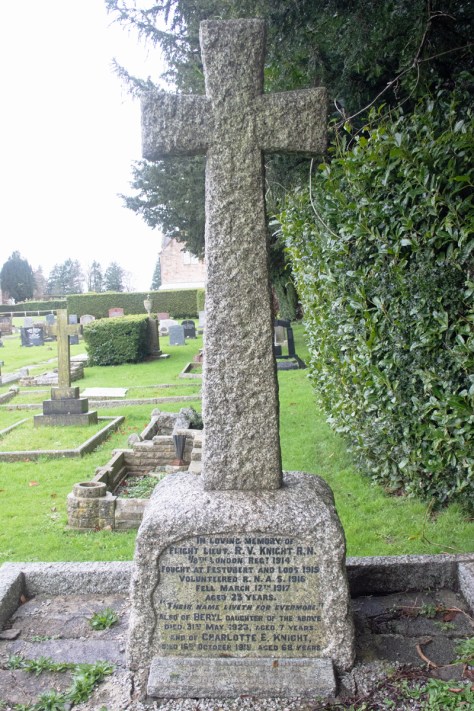
Flight Lieutenant Knight died in an aeroplane crash on 12th March 1917. He was 22 years old.

Ronald Victor Knight lies at rest in Wells Cemetery, Somerset.


Sadly, Ronald’s daughter, Beryl, died in the spring of 1923, when she was only 7 years old. She is buried with her father.

Gwendoline went on to marry Henri Booth in months after the death of her daughter. The couple went on to have two children, Elizabeth and William. She requested that her late husband’s war medals be given to his father, John.