Category Archives: Royal Air Force

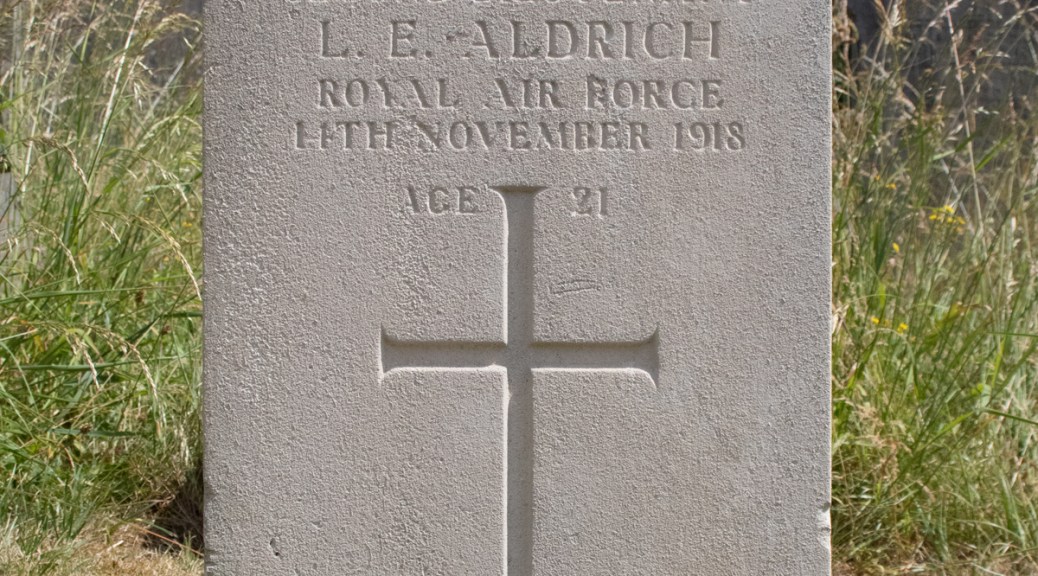
Second Lieutenant Leo Aldrich

Second Lieutenant Leo Aldrich

Leo Edwin Aldrich was born on 14th July 1897 in the Ohio city of Elyria, and was the only child to Hiram and Agnes Aldrich. Hiram was a machinist from New York and, by the time of the 1910 census, he had found work as a toolmaker for a motor company, and the family has moved to Detroit, Michigan, 150 miles (240km) along Lake Erie’s coastline.

When war came to Europe, Leo seemed keen to get involved. Full details of his military service are lost to time, but it seems that he enlisted in the Canadian Royal Engineers. By the summer of 1918, Leo was in Britain, and had transferred to the Royal Air Force. He had reached the rank of Second Lieutenant and was based at Yatesbury Airfield in Wiltshire.

On 14th November 1918, just three days after the Armistice was signed, he was flying in a Bristol F2b fighter aircraft, when it nosedived into the ground. Both Second Lieutant Aldrich and his passenger Second Lieutenant McDougall were seriously injured, and were taken to Bath War Hospital for treatment.

Sadly, Leo’s injuries were to prove to be too severe. He passed away the same day: he was just 21 years of age.

Leo Edwin Aldrich was laid to rest in Locksbrook Cemetery, not far from the hospital in which he passed.


Leo’s service records suggest that his next of kin was his wife, Mrs Leo Aldrich of 480 East 112th Street, Cleveland, Ohio. There are no identifiable marriage records for him although, intriguingly another one does exist.

This confirms the wedding of a George L Aldrich to a Helen J Seymour on 6th August 1918 in Cuyahoga, Ohio. As the names do not match, the record would normally be dismissed, but the parents’ names – Hiram and Agnes – match Leo’s, as does the place of birth – Elyria – and his occupation – Second Lieutenant.

Further details for Helen Seymour, and why Leo may have given the name George, are lost to time.


Boy Mechanic William Mackay

Boy Mechanic William Mackay

William James Mackay was born in Bath, Somerset, on 2nd January 1900. The son of a woman called Matilda, the following year’s census found him living as a nurse child in the home of John and Elizabeth Logie. The household was made up of the Logies, their five children, a boarder, and another nurse child, Harold Fellows.

The next census, taken in the spring of 1911, shows a change in circumstances for the family. Matilda and William were living in the Walcot area of the city, with Matilda’s husband, William Smith. The document suggests that the couple had been married for twelve years, but this would not account for the younger William’s original surname. The census return states that he had taken the name of Smith as well, and there was a fourth resident in the household, widow Elizabeth Clarke.

War came to Europe in the summer of 1914, and William Jr was keen to step up and play his part. Because of his age he was unable to enlist immediately, and it was not until the start of 1917, that he was able to enlist.

William – who had returned to the name Mackay by this point – was working as a clerk when he joined the Royal Naval Air Service (RNAS) on 23rd January 1917. His service records show that he enlisted as a Boy Mechanic, and that he was 5ft 8.5ins (1.74m) tall. He had brown hair, brown eyes and a fresh complexion.

Boy Mechanic Mackey was assigned to HMS Daedelus, one of the RNAS shore-based facilities: it was here that he was to receive his training over the spring and summer. Military barracks were notoriously cramped and hotbeds for illness and disease, and William was not to be immune to health issues. He contracted cerebrospinal meningitis within months of arriving at the base, and passed away on 5th August 1917. He was just 17 years of age.

William James Mackay was brought back to Somerset for burial. He was laid to rest in the sweeping grounds of Bath’s Locksbrook Cemetery.


Second Lieutenant Henry Fleming

Second Lieutenant Henry Fleming

On Tuesday morning another member of the Royal Flying Corps, Second Lieutenant Henry Roland Fleming, lost his life at Upavon. Lieutenant Fleming, who was 28 years of age, and married, having his home at Ripley, Surrey, was attached to the Central Flying School early last month, having volunteered for service on the outbreak of war, joining the Special Reserve Air Service. Nearly four years ago he gained the Aero Club’s certificate at Brooklands, but for nearly two years prior to the outbreak of war had not practiced aviation. On Tuesday morning the conditions were very favourable for flying, and the deceased’s flight was watched by Major Webb-Bowen, assistant commandant at the school, and Captain Stopford, who was flying at the same time. Lieutenant Fleming was about 1200ft [365m] up when the attitude of his machine first attracted the attention of the officers. They noticed it dive in an almost vertical position, after which it turned over on its back and glided for some distance upside down. Then it turned its nose to ground again, and from a height of some 450 feet [137m] dived straight into the earth. Death was instantaneous. The officers found Mr Fleming dead in the remains of the machine, with the strap broke in the fall still about his waist. Medical examination showed that he had dislocated his neck and fractured his skull. Lieutenant Fleming, who comes from a well-known family, was one of the first in the country to take up aviation. His father went through the Crimean Campaign in the 4th Irish Dragoon Guards, and a brother was killed in the South African War.

Salisbury and Winchester Journal: Saturday 28th November 1914

Henry Roland Fleming was born in the summer of 1884 in Farnham, Surrey. There is scant information about his early life, but the 1911 census recorded him as boarding at the New Inn in Amesbury, Wiltshire, where he was employed as an aviator.

Henry gained his wings on the 25th April 1911 – shortly after the census – flying a Bristol biplane. He married Ivy Wyness-Stuart, a widow six years his senior, in the spring of 1913, but after this, the couple’s trail goes cold.

When war broke out, Henry stepped up to play his part. He gained a commission to the Royal Flying Corps and, once again found himself based on Salisbury Plain. Tragically it was only a matter of months because the fatal accident.

While his widow was living in Surrey, her Henry Roland Fleming was laid to rest in Amesbury Cemetery, not far from airfield where he had developed his flying skills.


Second Lieutenant Henry Fleming
(from findagrave.com)

Second Lieutenant Forrest Evans

Second Lieutenant Forrest Evans

The life of Forrest Dinnett Evans is a challenge to uncover, although his service records shed tantalising glimpses into his history.

Forrest enlisted in the Canadian Royal Flying Corps on 8th August 1917. He joined up in Toronto, Canada, but gave his address as 26 Leicester Drive, Boston, Massachusetts.The same document gives his middle names as Dennett, and that his father was called George William Evans. It also suggests that both men were British subjects. While it’s not clear when the Evans family moved to North America, there are no UK census or birth records for either man.

Forrest was 19 years 9 months old when he enlisted and stood 5ft 10ins (1.77m) tall. He gave his trade as an student aviation cadet. He was mobilised straight away, and sent to Britain. His time in the Canadian Royal Flying Corps came to an end on 18th December 1917, when he received a commission in the Royal Flying Corps.

Second Lieutenant Evans, as he was now known, was based at Boscombe Down, Wiltshire. It was here, on 27th March 1918, that he was in charge of an Armstrong Whitworth FK8 two-seater biplane. Shortly after take off, the aircraft span into the ground: Forrest was killed instantly. He was 20 years of age.

With his family overseas, Forrest Dinnett Evans was laid to rest in Amesbury Cemetery, just a few miles from Boscombe Down.


Lieutenant Keith Beddy

Lieutenant Keith Beddy

Keith Charles Beddy was born in Port Elizabeth, South Africa. His parents were Walter and Isabella Beddy, and he was the sixth of eight children.

Little additional information is available about Keith’s early life. When war broke out, he enlisted in the army, eventually becoming assigned to the 5th Battalion of the Hampshire Regiment. Rising through the ranks to the rank of Lieutenant, he eventually transferred to the Royal Flying Corps.

Lieutenant Beddy was based on Boscombe Down, near Amesbury, Wiltshire. On 6th February 1918, he was flying his RAF BE 2e aircraft when he attempted a turn at a low altitude. The plane nose-dived and crashed into the ground, and Keith was killed instantly. He was just 21 years of age.

With his family on the other side of the world, Keith Charles Beddy was laid to rest in Amesbury Cemetery, not far from the airfield where he had been based.


Cadet Hubert Morley

Cadet Hubert Morley

Hubert Arthur Morley was born on 28th July 1900, the second of two children to Arthur and Annie Morley. The family were raised in Coventry, Warwickshire, but Arthur had been born in Manchester. The 1901 census recorded him as working as a cycle works timekeeper, but by 1911 he had found other employment as a dealer in hosiery and hats.

By the summer of 1918, the war was showing hints of coming to an end, and Hubert was keen not to miss out on the action. On 9th July, a few weeks before his eighteenth birthday, he enlisted in the Royal Air Force. His service record show that he was 5ft 7.5ins (1.71m) tall, with brown hair, greenish brown eyes and a fair complexion.

Cadet Morley had previously been employed as an engineer, and was sent to the No. 7 Observers School of Aeronautics in Bath, Somerset. His time here, however, was to be tragically short. Hubert contracted pneumonia, and was admitted to the Bath War Hospital. The condition was to prove his undoing: he passed away on 27th October 1918, at just eighteen years of age.

Finances may have limited Arthur and Annie’s ability to bring their son home. Hubert Arthur Morley was laid to rest in the military section of Bath’s sweeping Locksbrook Cemetery.


Member Ivy Hibberd

Member Ivy Hibberd

Ivy Pretoria May Hibberd was born in the spring of 1900 in the Wiltshire village of Wylye. One of nine children, she was the daughter of bricklayer Edwin Hibberd and his wife, Elizabeth.

There is little information available about young Ivy’s life. She enlisted in the Women’s Royal Air Force on 14th October 1918, and was sent off to Handsworth College in Birmingham for training.

Member Hibberd’s time in service was to be tragically brief. Having contracted a combination of influenza and pneumonia, she died on 6th November 1918. She was just 18 years of age and passed away just over three weeks after signing up.

Ivy Pretoria May Hibberd’s body was taken back to Wiltshire for burial. She was laid to rest in the peaceful graveyard of St Mary’s Church in her home village, Wylye.


Private William Higgins

Private William Higgins

William George Newton was born in Culmstock, Devon, early in 1889. His mother, Ada, was unmarried at the time, and there is no indication as to who his father was. The 1891 census found mother and son living with Ada’s parents, John and Hannah, in South Street, Wellington, Somerset.

In the summer of 1892, Ada married Frederick Higgins, a police constable from Baltonsborough. The couple set up home in the village of Mark, and went on to have ten children. It was at this point that William took on Frederick’s name, though whether that was because he was actually his birth father is unclear.

When he finished his schooling, William found labouring work. On 9th March 1910, he married Annie Achilles, a painter’s daughter from Glastonbury. The couple set up home in a small cottage in Bank Street, Highbridge, and went on to have three children.

The next year’s census recorded that William was employed as a stoker for Highbridge Bacon Co Ltd, a large factory to the south of the town. His and Annie’s oldest child, son William Jr, who was just two months old at this point, and William’s grandfather, the now widowed John, completed the household.

When war broke out, William stepped up to play his part. He enlisted on 28th October 1915, joining the 3rd Battalion of the Gloucestershire Regiment as a Private. His service records show that he was 26 years and 10 months old, and stood 5ft 2ins (1.57m) tall.

Private Higgins’ service documents confirm that he served for nine months before being medically discharged from the army. He had contracted haemoptysis and had an enlarged heart. His medical records confirmed that, at the time of his dismissal, he was totally incapacitated and unable to work.

William returned to Somerset, but is would seem that his health continued to dog him over the next couple of years. He passed away on 29th October 1918, at the age of 29 years of age.

William George Higgins was laid to rest in the cemetery of his adopted home town, Highbridge.


Annie was now a widow, with three young children to support. She married again in the spring of 1922, to bus conductor William Davey. Annie was to outlive not only her husband, but all three of her children.

William and Annie’s youngest, Cyril, passed away when he was just a couple of months old.

Albert, their middle son, “had been for a great while a cripple from trouble in his leg, but was able to get about on crutches.” [Central Somerset Gazette: Friday 22nd July 1932] He passed away on 16th July 1932, aged just 18 years old.

William Jr had tried out in the Royal Navy when he was sixteen years of age. Beginning with the rank of Boy 2nd Class, he was dismissed in March 1928, as he was deemed unsuitable for the rank of Boy 1st Class.

In the autumn of 1934, he married Nettie King, the daughter of a factory worker from Street, Somerset. The couple went on to have three children, although in an echo of his parents’ tragedy, their middle child, Phyllis, passed away when just eighteen months old.

When war came to Europe for a second time, William sought to serve his country for a second time. He enlisted in the Royal Air Force, and rose to the rank of Leading Aircraftman. On 18th June 1940, he was on board a Blenheim aircraft flying from the UK to Malta, when the plane came down in bad weather near Marseille. William and his two companions, Pilot Officer Johnston and Sergeant Micklethwaite were all killed.

Leading Aircraftman Higgins was laid to rest in the Mazargues War Cemetery near Marseille.


Lieutenant David Slocombe

Lieutenant David Slocombe

David William Slocombe was born on 9th November 1893, the oldest of seven children to William and Kate. William was a tin worker from Huntspill, Somerset, and it was in nearby Highbridge that the family were born and raised.

David appears to have been a bright lad, receiving a sponsorship from the King James Foundation to attend Dr Morgan’s School in Bridgwater. He spent six years there, from September 1906 to July 1912, and went on to become a customs and excise clerk when he left.

When war arrived in Europe, David was called upon to play his part. He initially enlisted on 1st December 1915, but was placed on reserve for nearly a year. His service records show that he was 22 years of age and 5ft 8.5ins (1.74m) tall. When he was finally mobilised, he was given a commission in the Royal Flying Corps.

At this point, David’s trail goes cold. Later documents confirm that he transferred across to the Royal Air Force when it was founded in April 1918, and that he rose to the rank of Lieutenant. He served in France and Italy and, by the end of the war, was attached to the 44th Training Depot Station in Oxfordshire.

By the autumn of 1918, Lieutenant Slocombe had come down with pneumonia. He was admitted to the 3rd Southern General Hospital in Bicester, and this is where he was to breathe his last. David died on 24th October 1918, aged just 24 years old.

David William Slocombe was brought back to Somerset for burial. He was laid to rest in Highbridge Cemetery.


Lieutenant Harold Redler

Lieutenant Harold Redler

News has been received at Bathpool, Taunton, that Lieutenant HB Redler, MC (RAF), was killed while flying at Turnberry, near Ayr. Lieutenant Redler, who was 21 years of age, was the eldest son of Mr and Mrs DB Redler, of Moorreesbury [sic], South Africa, and formerly of Bathpool, Taunton, and he sailed from South Africa with a schoolfellow at the end of 1915, at the age of 18, in order to join the Royal Flying Corps. On arrival in England they found no vacancies, and entered the Artists’ Rifles OTC, from which they joined the RFC. After obtaining his commission, Lieut. Redler spent a few months in France last year, and was then sent to Ayr as a fighting instructor. In March of this year he was sent to France for a six weeks’ course, during which he won the Military Cross, and it is believed that his record will show a total of nearly twenty enemy machines brought down.

Taunton Courier and Western Advertiser: Wednesday 3rd July 1918

Harold Bolton Redler was born in Worcester, Worcestershire, on 27th January 1897. The oldest of five children, his parents were Daniel and Annie. Daniel was a flour miller from Devon, and the family had moved to Worcester the year before Harold was born.

In 1903, the Redlers emigrated to South Africa. Initially settling in King William’s Town (now Qonce), they moved to Moorreesburg after the birth of Harold’s youngest sibling, Norman, in 1906.

Harold was educated at the Bishops Diocesan College in Rondebosch, Cape Town, and it was from here that he and his friend decided to step up and serve their King and Empire. Sadly, his service records have been consigned to history, and only the newspaper report remains to piece together his time in service.

Lieutenant Redler’s awarding of the Military Cross, however, is documented:

For conspicuous gallantry and devotion to duty. He encountered four enemy two-seater machines and attacking the lowest drove it to the ground with its engine damaged. Later he attacked one of five enemy two-seater machines and drove it down out of control. He has destroyed in all three enemy machines and driven three others down out of control. He continually attacked enemy troops and transport from a low altitude during operations and showed splendid qualities of courage and determination throughout.

London Gazette: 22nd June 1918

On the morning of 21st June 1918, Lieutenant Redler was flying a de Havilland DH9 aircraft, accompanied by Captain Ian Henderson. The plane was fitted with a Lewis gun, which the pair were testing. At 10am, the aircraft crashed, and both were killed. No immediate cause was identified, and their RAF cards record an open verdict. Harold was just 21 years of age.

With his parents and siblings in South Africa, Harold Bolton Redler’s body was taken to Somerset for burial. He was laid to rest with his paternal grandparents in the peaceful St Augustine’s Churchyard in West Monkton.


Lieutenant Harold Redler