
Category Archives: Cook

Trimmer Cook Douglas Ferguson

Trimmer Cook Douglas Ferguson

At Dartmouth on Saturday, Mr AM Dawson held an inquest on Douglass [sic] Davidson Mitchell Ferguson, cook, aged 30, of a Government trawler, whose body was recovered from the boat float the previous afternoon.

TG Elliott, of the Britannia Inn, said deceased had one drop of whiskey at his house on Thursday.

W Bursey, seaman, said he saw deceased at the King’s Arms Hotel, the same evening. He was very quiet and chatted with others.

Frank Lavers, coal lumper, said he thought he saw Ferguson at 9.50 on his way to the Embankment. Deceased asked the time and spoke quite rationally.

After evidence as to the recovery of the body, and Dr GM Soper’s evidence that the death was due to drowning, an open verdict was returned.

Lieut. PN Taylor [Royal Naval Reserve], commander of the vessel to which deceased had belonged, said Dartmouth was the most dangerous place for the embarkation at night that he had visited, owing to the restricted lighting. He thought rails should eb placed not only around the Boat Float, but along the whole of the Embankment.

Members of the jury agreed that lights in the vicinity of the Boat Float were inadequate, and the jury added a rider to their verdict urging the authorities to provide adequate lighting as advised by the Town Council, for the benefit of persons embarking in the vicinity of the Boat Float, and with a view to preventing further tragedies.

[Western Times: Tuesday 29th February 1916]

Douglas Davidson Ferguson was born in Stirling, Scotland, on 28th August 1896. One of four children, his parents were Andrew and Mary Ferguson. There is little information available about his early life, unfortunately, but it is clear that he enlisted in the Royal Naval Reserve on the 6th September 1915.

Assigned the role of Trimmer Cook, Douglas’s records show that he was 5ft 3ins (1.6m) tall, with brown eyes and a pale complexion. He was also noted as having a tattoo of a dancing girl on his left arm.

Douglas was initially assigned to the cruiser HMS Pactolus, and travelled from Scotland to Devon, where the Royal Naval Dockyard in Devonport would become his base. He remained stationed there for the next few months, working on ships’ galleys as they patrolled out the Channel coastline. It was during one of these voyages that he fell into the River Dart and drowned.

It would seem that Douglas Davidson Ferguson’s family were unable to cover the cost of taking his body back to Scotland for burial. Instead, he was laid to rest in the graveyard of Dartmouth’s St Clement’s Church.
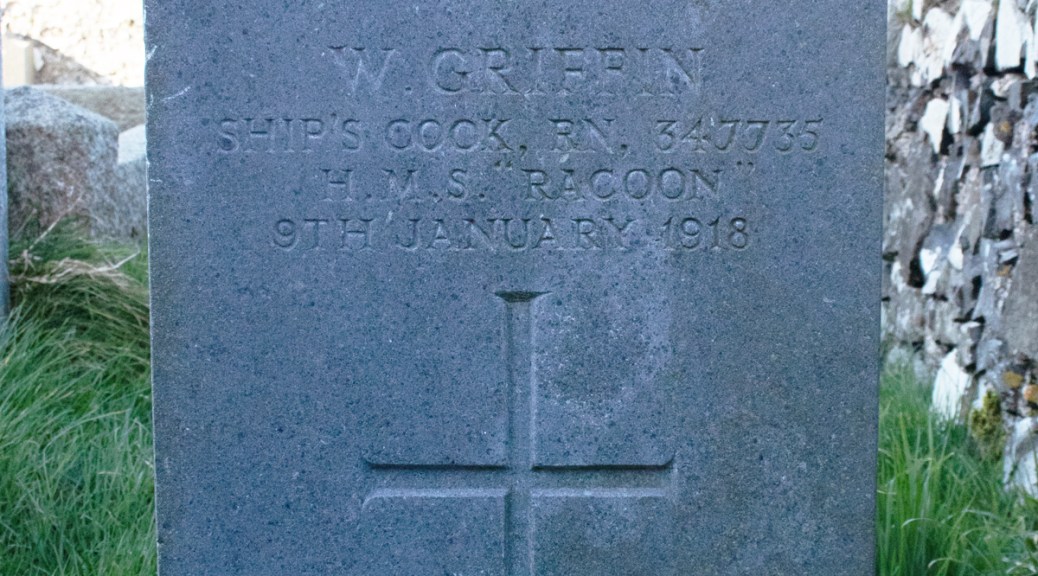

Ship’s Cook Walter Griffin

Ship’s Cook Walter Griffin

Walter Griffin was born on 15th December 1886 in Woolwich, Kent. Details of his early life are lost to time, but, by the time of the 1901 census, he was working as a cooper’s mate at a cement factory in Higham, Kent.

Walter sought bigger and better things for himself, and, on 19th June 1907, he enlisted in the Royal Navy as Cook’s Mate 2nd Class. His service records confirm that he was 5ft 4ins (1.62m) tall, with brown hair, grey eyes and a fresh complexion.

Walter was initially sent just down the coast to the Royal Naval Dockyard in Chatham, Kent, for his training. He remained there for nine months, and was promoted to Cook’s Mate 1st Class for his service.

In January 1908, he was given his first posting, on board HMS Wildfire, and, over the next nine years, he served on a further four ships, returning to Chatham in between postings. Walter was obviously dedicated to the work he was doing: in January 1910 he was promoted to Leading Cook’s Mate, and by 1917, he was promoted again, to the ran of Ship’s Cook.

This promotion coincided with a transfer to what would be his last assignment, on board HMS Racoon. This Beagle-class destroyer patrolled the waters between Scotland and Northern Ireland, and he spent the winter of 1917/18 on board.

On 9th January 1918, there were storm conditions off the Irish coast: high seas and blizzard limited limited vision. At 2am, the Racoon struck rocks, and foundered: in the treacherous conditions, all hands were lost. Shio’s Cook Griffin was 31 years of age.

Walter Griffin’s body washed ashore near the village of Ballintoy, Country Antrim, the following day. He was laid to rest in the parish church, next to two other crew members, Ordinary Seaman Frank Green and Stoker 2nd Class Frederick Sarell.

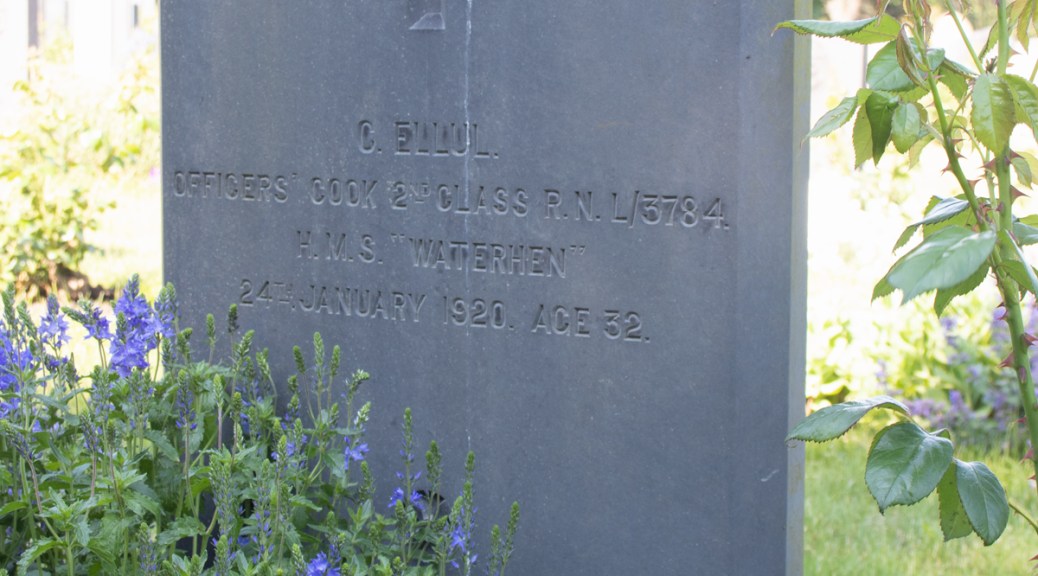
Officers’ Cook Carmelo Ellul

Officer’s Cook Carmelo Ellul

Carmelo Ellul was born in Valetta, Malta, on 26th May 1889. There is little information about his early life, other than the fact that he worked as a baker.

He came to England at some point in the early 1900s, and was living in Portsmouth. It was here that he met Selina Southcott, who had been born on the Isle of Wight, and the couple married in 1904. The couple would go on to have three children, all boys: Maurice, who was born in 1911; Alva, who was born in 1912, but who died as a toddler; and Edwin, who was born in 1916.

Carmelo seemed to want a life of adventure: in the summer of 1912, he enlisted in the Royal Navy. Over the next eight years, Officer’s Cook Ellul served on a number of naval vessels, including HMS Bacchante, which toured the North Sea, and was involved in the Battle of Heligoland in August 1914.

Carmelo’s naval life continued after the war ended, although he seems to have been more shore-based than before. He was serving on HMS Waterhen on 24th January 1920, when he collapsed with an epileptic fit, and died of heart failure. He was just 32 years old.

Carmelo Ellul was laid to rest in the Woodlands Cemetery in Gillingham, Kent, presumably as his ship was moored in the nearby Naval Dockyard in Chatham.