Tag Archives: Cook’s Mate

Cook’s Mate 2nd Class Stephen Hare

Cook’s Mate 2nd Class Stephen Hare

Skegness Lad Killed In Air Raid

Among the Naval ratings killed in the recent air raid by the Germans on Chatham we regret to record that a Skegness lad was among the victims. This was Percy Hare, the only son of Mr and Mrs Henry Hare, of Algitha Road. The deceased lad joined the Navy some months ago, and was stationed at Chatham undergoing training. Prior to entering the Service he assisted his father in the baking business. The family are well-known in Skegness and neighbourhood, and Mr Hare has for several years been prominently identified with the Wesleyan cause locally, while his dead son was secretary of and a teacher in the Skegness Wesleyan Sunday School, and was also qualifying as a local preacher in the circuit.

[Lincolnshire Standard and Boston Guardian: Saturday 15th September 1917]

Stephen Percy Hare was born on 31st March 1897 in Skegness, Lincolnshire. He was the only child to Henry and Annie Hare. Henry was a baker, and the family lived on the main shopping thoroughfare, leading to the seafront.

The 1901 census recorded the family residing at 29 Lumley Road, where the ground floor presumably served as the bakery, with the upstairs as their living accommodation.

The following census records take some unpicking. Annie Hare was recorded as being a boarding house keeper, and was living with Stephen at 25-27 Lumley Road. They had two residents – bakers Robert England and George Gay. Henry is absent from the record, but at No. 23 were John and Eliza Hare, aged 73 and 67 respectively and possibly Henry’s parents, were running another boarding house with their three adult daughters.

When war broke out, Stephen was just 17 years of age. He was too young to formally enlist, but he had his chance when, on 1st December 1916, he joined the Royal Navy. Send to HMS Pembroke, the Royal Naval Dockyard in Chatham, Kent, his baking background stood him in good stead, and he was given the rank of Cook’s Mate 2nd Class. His service papers show that he was just under 5ft 8ins (1.7m) tall, with fair hair, blue eyes and a fresh complexion.

Cook’s Mate Hare spent the next nine months learning his trade. By the summer of 1917, Pembroke was a busy and cramped place. The battleship HMS Vanguard had been sunk, leaving its replacement crew, waiting in Chatham, with nowhere to go. There had been an outbreak of spotted fever, and the decision was taken to turn the dockyard’s Drill Hall into temporary accommodation. Stephen was one of those to be billeted there.

On the evening of the 3rd September 1917, five German Gotha bombers undertook the first night time raid on Britain. Chatham was in their line of fire, and two bombs landed direct hits on the Drill Hall. Cook’s Mate Hare was among the dozens of sleeping men who lost their lives when the glass roof shattered and crashed down on them. He was just 20 years of age.

The body of Stephen Percy Hare was taken back to Lincolnshire for burial. He was laid to rest in the town’s St Clement’s Churchyard.


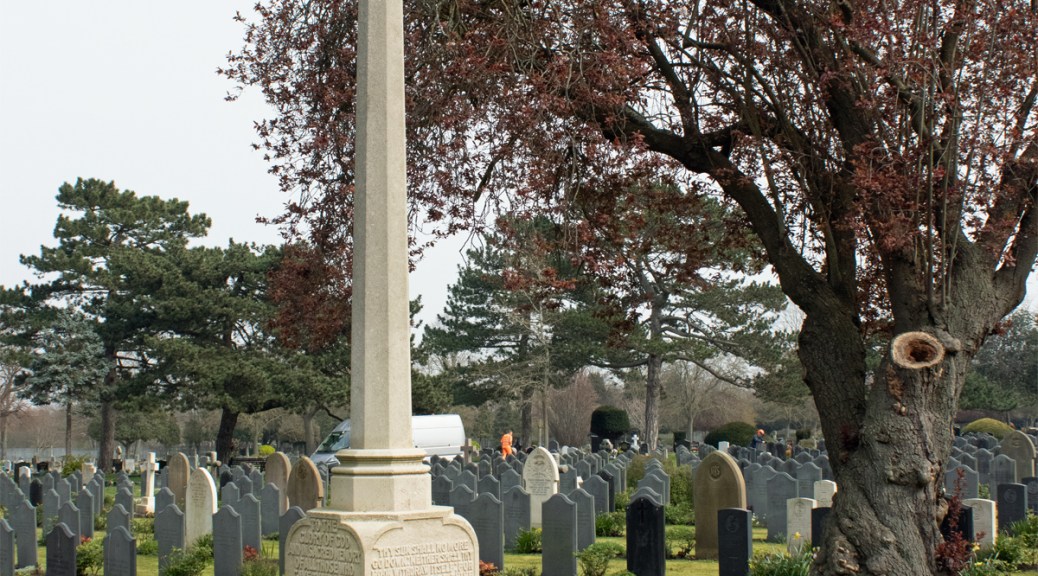
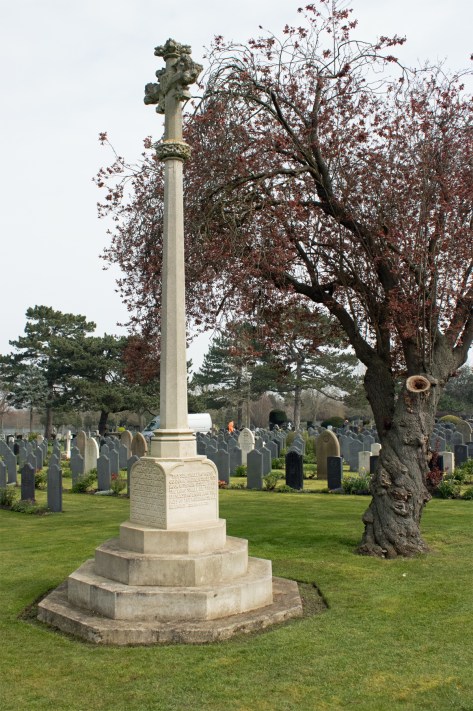
[Note: the photo above is of the memorial to the Chatham Air Raid victims, close to the mass grave for those whose bodies were not identified, in Woodlands Cemetery, Gillingham, Kent.]
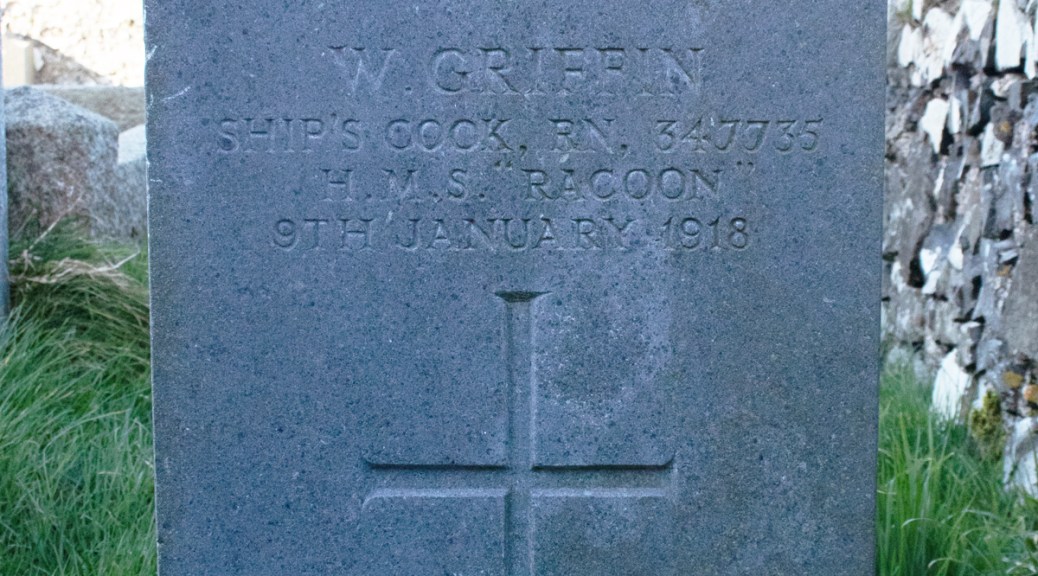

Ship’s Cook Walter Griffin

Ship’s Cook Walter Griffin

Walter Griffin was born on 15th December 1886 in Woolwich, Kent. Details of his early life are lost to time, but, by the time of the 1901 census, he was working as a cooper’s mate at a cement factory in Higham, Kent.

Walter sought bigger and better things for himself, and, on 19th June 1907, he enlisted in the Royal Navy as Cook’s Mate 2nd Class. His service records confirm that he was 5ft 4ins (1.62m) tall, with brown hair, grey eyes and a fresh complexion.

Walter was initially sent just down the coast to the Royal Naval Dockyard in Chatham, Kent, for his training. He remained there for nine months, and was promoted to Cook’s Mate 1st Class for his service.

In January 1908, he was given his first posting, on board HMS Wildfire, and, over the next nine years, he served on a further four ships, returning to Chatham in between postings. Walter was obviously dedicated to the work he was doing: in January 1910 he was promoted to Leading Cook’s Mate, and by 1917, he was promoted again, to the ran of Ship’s Cook.

This promotion coincided with a transfer to what would be his last assignment, on board HMS Racoon. This Beagle-class destroyer patrolled the waters between Scotland and Northern Ireland, and he spent the winter of 1917/18 on board.

On 9th January 1918, there were storm conditions off the Irish coast: high seas and blizzard limited limited vision. At 2am, the Racoon struck rocks, and foundered: in the treacherous conditions, all hands were lost. Shio’s Cook Griffin was 31 years of age.

Walter Griffin’s body washed ashore near the village of Ballintoy, Country Antrim, the following day. He was laid to rest in the parish church, next to two other crew members, Ordinary Seaman Frank Green and Stoker 2nd Class Frederick Sarell.

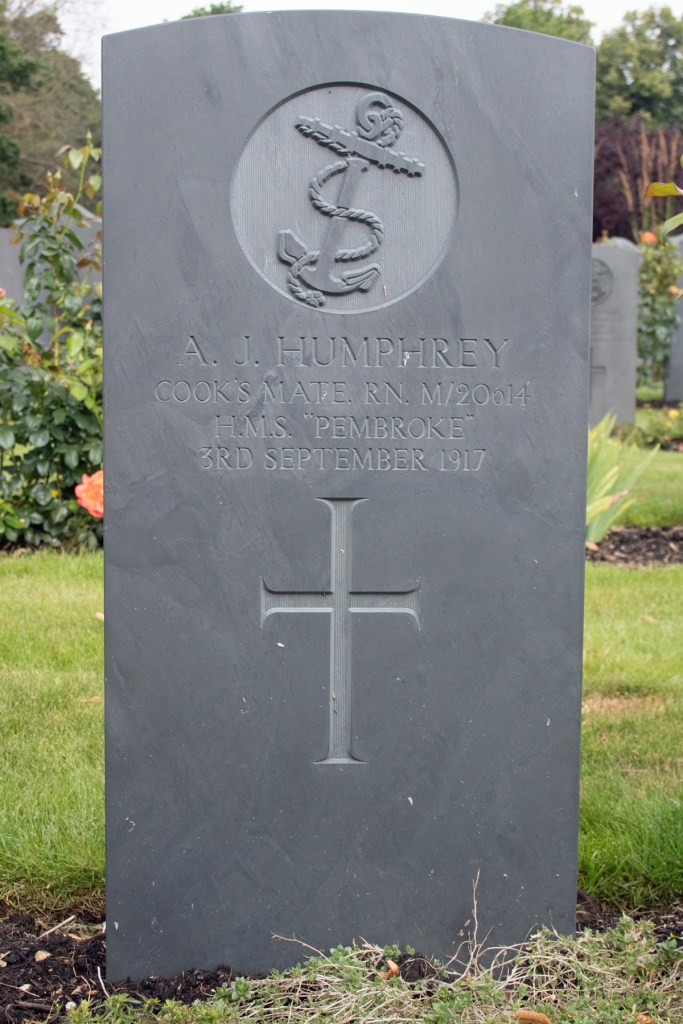
Cook’s Mate Arthur Humphrey

Cook’s Mate Arthur Humphrey

Arthur John Humphrey was born on 22nd December 1880 in the Surrey village of Horne. One of seven children, his parents were agricultural labourer Thomas Humphrey and his wife Eliza.

When he left school, Arthur also found labouring work. By 1899 he had moved to the town of Redhill, where he met tailor’s daughter Kate Wilson. The couple married in St Matthew’s Church that year, and went on to have six children.

With a family to look after, Arthur found additional work to help bring money in, and he became a carter for a local bakery. This seems to have spurred him on, and by the time war broke out, he had become more hands on with the baking side of things.

The hostilities brought new opportunities, and the chance of more permanent, better played employment became available. On 25th May 1916, Arthur enlisted in the Royal Navy as a Cook’s Mate. His service records show that he stood at 5ft 5ins (1.65m) tall, had brown hair, grey eyes and a fresh complexion.

Cook’s Mate Humphrey’s service was wholly at HMS Pembroke, the Royal Naval Dockyard in Chatham, Kent. While he would have been billeted in the barracks themselves, by the summer of 1917, the dockyard was becoming a very crowded place. The Drill Hall was brought in as additional accommodation and, that summer, this is where Arthur was moved to temporarily.

The German Air Force was suffering significant losses during the daylight raids it was carrying out. In an attempt to stem the flow of casualties, they decided to trial night time raids and, on 3rd September 1917, Chatham found itself in the midst of a bombing raid. The Drill Hall that Cook’s Mate Humphrey was sleeping in received a direct hit, and he was killed. He was just 36 years old.

The 98 servicemen who perished during the Chatham Air Raid that night were buried in a mass funeral at the Woodlands Cemetery in nearby Gillingham. This, too, is where Arthur Humphrey was laid to rest.