
Category Archives: Flight Cadet

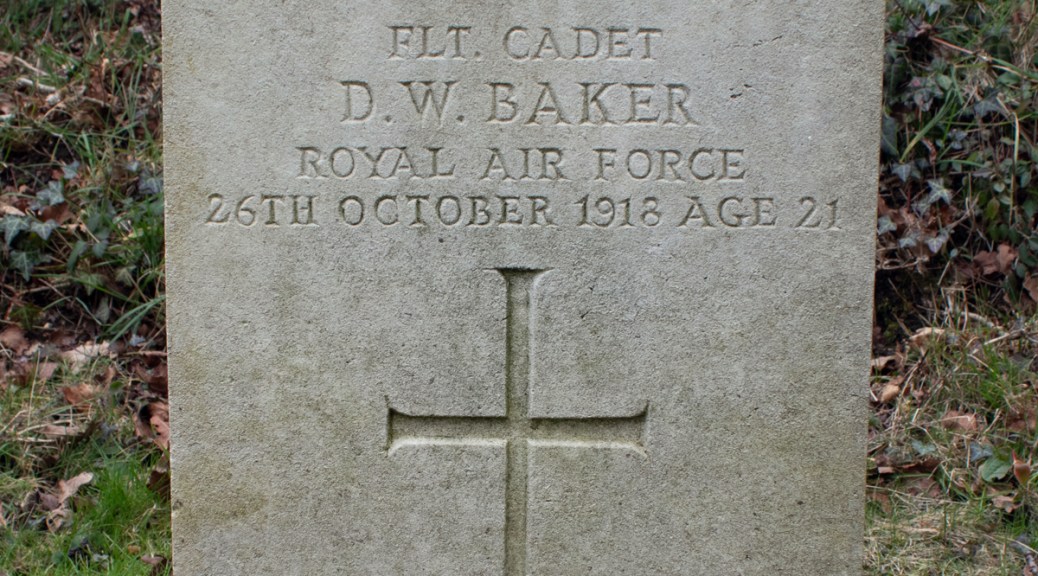
Flight Cadet Douglas Baker

Flight Cadet Douglas Baker

Douglas Walter Baker was born in Newbury, Berkshire, in 1898. One of seven children, his parents were Henry and Rosa Baker. Henry was a commercial traveller for a cornmeal, cake and flour merchants, and the family lived at 91 Crescent Road, Reading at the time of the 1901 census, then at 196 King’s Road, Reading, ten years later.

There is little concrete information about Douglas’ early life. When war broke out, he enlisted in the 4th Battalion of the Royal Berkshire Regiment, later documents seeming to suggest that he had added three years to his age to enable him to do so. His unit served in France from April 1915, but, as his army service records have been lost, it’s unclear when or if Private Baker went with them.

Douglas seemed to want more, though, and, on 18th December 1915, he transferred to the Royal Flying Corps. Given the rank of Air Mechanic 2nd Class, he was attached to No. 1 Aircraft Repair Depot. By March 1917, he had been promoted to Air Mechanic 1st Class. Again, however, he sought more and, just a few months after the Royal Air Force was formed, he started flying lessons.

The now Flight Cadet Baker had transferred to 29 Training Depot Station in Hampshire. Based at an aerodrome near Beaulieu, Douglas was taught in a Sopwith Camel. Two months into his instruction, he was undertaking a routine flight, when his aircraft got into a spin he was unable to get out of. The machine fell to the ground, and Douglas was killed instantly.

A report of the incident noted that: “the cause of the accident was in our opinion due to the machine spinning to the ground from about 500ft. The reason the pilot could not regain control of the machine is unknown.” [Royal Air Force Casualty Card]

Douglas Walter Baker was just 20 years of age when he died on 26th October 1918. His body was taken to the graveyard of St Paul’s Church, East Boldre, not far from the air base at which he had been billeted.
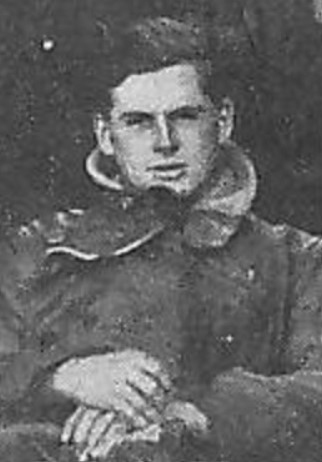

Flight Cadet Douglas Baker
(from findagrave.com)

The life of a WW1 pilot was notoriously dangerous. On the same day of Douglas’ death, and at the same airfield, fellow pilot Second Lieutenant Malcolm Vande Water lost his life in a separate incident.
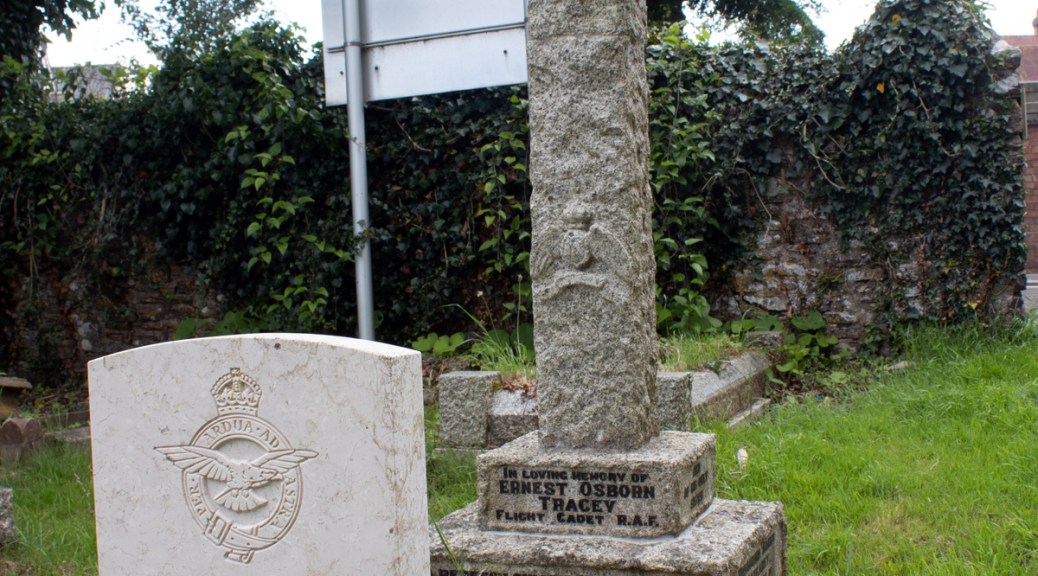
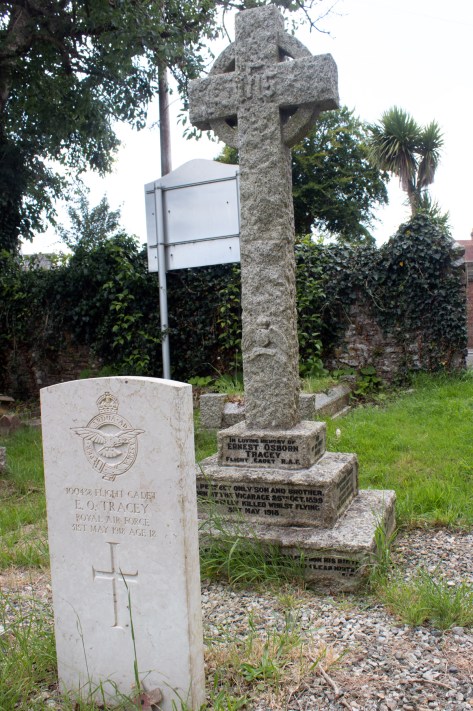
Flight Cadet Ernest Tracey

Flight Cadet Ernest Tracey

Flt-Cadet Ernest Osborn Tracey, RAF, who died on Friday, the result of injuries sustained through a collision in the air when undergoing his final training, was the only son of Rev. HF and Mrs Tracey, of Dartmouth. He was born in Oct. 1899, at St Saviour’s Vicarage, of which church his father was vicar for 23 years, retiring from the living in 1913 in order to take up clerical duties in New Zealand. Mr Tracey was educated at Blundell’s, where he held a house master’s scholarship. When he left in the middle of last year he was the winner of the Coles’ prize for science; was one of the shooting VIII, of which he had his cap and colours; a member of the Upper Sixth, the OTC, and he had also won the first prize for drawing. On leaving Blundell’s he obtained a cadetship at Woolwich, and was transferred to the RAF.

[Western Morning News: Tuesday 4th June 1918]

Ernest Osborn Tracey was born in Dartmouth, Devon, on 25th October 1899, and was baptised in his father’s church six weeks later. The younger of two children to Reverend Henry and Alice Tracey, he gave up his schooling to enlist in the Royal Flying Corps on 12th November 1917.

When the Royal Air Force was formed the following April, Flight Cadet Tracey automatically transferred across. Training to be a reconnaissance pilot, Ernest would have cut a dashing figure, standing 6ft 1in (1.85m) tall. He was based at Yatesbury Airfield in Wiltshire, and was learning to fly a BE2, twin seater biplane.

At 8:30pm on 31st May, his aircraft collided with another, sending Ernest’s machine spinning into a nosedive. He crashed into the ground and was killed instantly.

The body of Ernest Osborn Tracey was taken back to Devon for burial. He was laid to rest in the graveyard of St Clement’s Church, Dartmouth.


Ernest’s will gave his mother, Alice, as his beneficiary. The newspaper report suggests that Henry had travelled to New Zealand to tend a new flock there, and the Commonwealth War Graves Commission records him as being “Chaplain to the Forces” and Vicar of Dartmouth.

It certainly seems that any time spent in New Zealand was limited. By the time of the 1921 census, Reverend Tracey had found a new posting, in the Staffordshire village of Gentleshaw. The same census return found Alice staying with their daughter, Rosamond, and her family, in Totnes, Devon.


Flight Cadet Claude Rawlings

Flight Cadet Claude Rawlings

Claude John Howard Rawlings was born on 5th November 1896 in the Monmouthshire village of Aberbeeg. One of three children, his parents were Sidney and Alice Rawlings. Sidney was a brewer from Bath, Somerset, while Alice was born in the Welsh village and this is where the couple raised their family.

By the time of the 1911 census, Claude had been sent to Weston-super-Mare, Somerset, and was a boarding student at the Brynmalyn Private School to the north of the town centre. His heritage would not have been out of place, though, as nine of the 25 live-in students were from Wales. Claude’s parents seemed to have taken the opportunity to visit Sidney’s mother in Bath, a possible prequel to them moving back to Somerset permanently.

Claude completed his schooling at Brynmalyn the following year, and took up a place as an agricultural student in Broadstone, Dorset. When war broke out, however, he was called upon to play his part.

Details of Claude’s military service are sketchy, but he initially enlisted in the Gloucestershire Regiment and was assigned to the 4th (City of Bristol) Battalion. The regiment service in France and Italy from 1915 onwards, but there is no evidence of Private Rawlings serving anywhere other than on home soil.

Claude wanted greater things, and was drawn to a life in the sky. In the spring of 1918, he transferred to the Royal Air Force, and was attached to 125 Squadron. Sent to Fowlmere Airfield near Royston, Hertfordshire, Flight Cadet Rawlings began his training. Over the next couple of months, he learnt to fly a Royal Aircraft Factory R.E.8 biplane.

Flight Cadet Rawlings was dong a routine practice flight on 12th August 1918, when, during a left hand turn, the aircraft’s side slipped and nose dived. The plane crashed to the ground, and Claude was killed instantly. He was just 21 years of age.

The body of Claude John Howard Rawlings was brought back to Somerset for burial. He was laid to rest in Bath Abbey Cemetery.


Flight Cadet Claude Rawlings
(from britishnewspaperarchive.co.uk)

Claude’s grave was a family plot, and he was reunited with his parents when Alice and Sidney died in 1933 and 1945 respectively.


The inscription on the family headstone gives Claude’s date of death as October 1918. All other records confirm the crash took place on 12th August, and that he died at the scene.


Lieutenant Alan Lloyd

Lieutenant Alan Lloyd

Alan Edward Lloyd was born in around 1899, the second of five children – all boys – to William and Edith Lloyd. Both of his parents were Welsh, and his older brother was born in Cardiff. Railway clerk William moved around the country with work, however, and Alan was born in Lydney, Gloucestershire, his younger brother in Paddington, London, and his two youngest siblings were born in Windsor, Berkshire.

There is little information about Alan’s early life; what is clear is that, by the autumn of 1918, he had been in the army, reaching the rank of Lieutenant. He transferred across to the newly formed Royal Air Force and, in December that year was training as a Flight Cadet at Shotwick Airfield near Chester.

On the 4th December, Alan was flying his Sopwith Camel, when he got into a flat spin; the aircraft crashed and Alan was killed. He was just 19 years old.

Alan Edward Lloyd was brought to Devon – where his family were now living – for burial. He was laid to rest in the graveyard of All Saints Church in Highweek, near Newton Abbot.


Lieutenant Alan Lloyd
(from ancestry.co.uk)