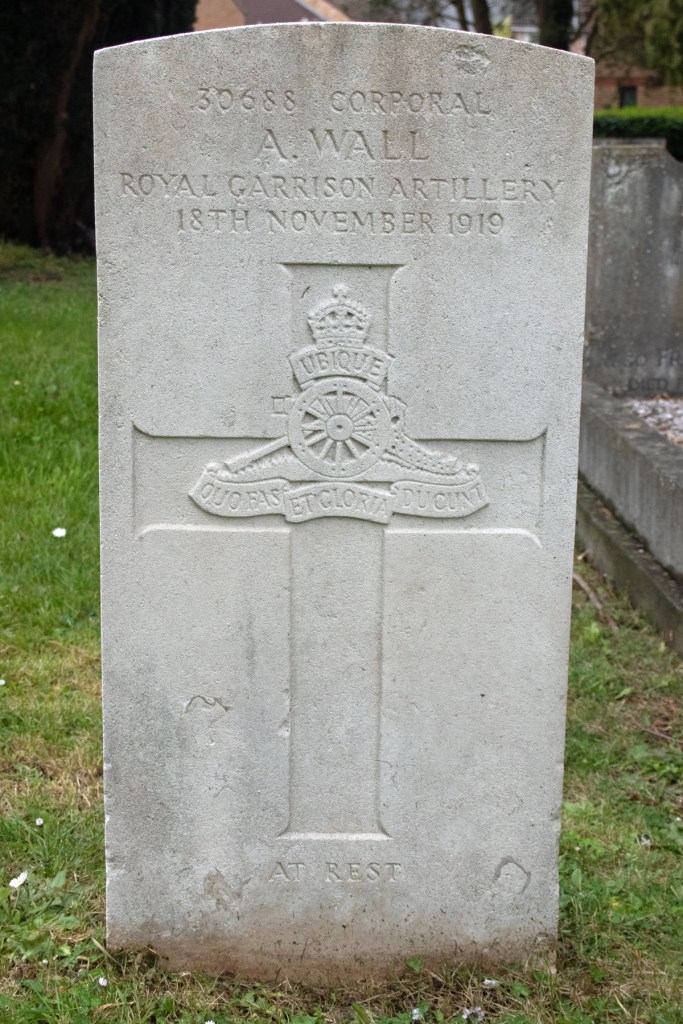
Albert Wall was born in the spring of 1890, one of eight children to James Wall and his wife Louise. James was a mason’s labourer from Taunton, Somerset, and brought his family up in his home town.
Details of Albert’s life are tantalisingly absent. It appears that he had a sense of adventure, and joined the Royal Garrison Artillery when his age allowed. By 1911, he was stationed at Port Royal in Jamaica, and was listed as a Gunner.
Gunner Wall’s involvement with the Royal Garrison Artillery extended into the Great War. He was sent to Egypt in April 1915, and, as part of his service, gained the Victory and British Medals and the 1915 Star. Albert seems to have been luck in that he saw out the war fairly unscathed, and was promoted to the rank of Corporal.
In the winter of 1918, Albert married Beatrice Salter. The war over, he was subsequently discharged from active service in April 1919.
Life on civvy street was not destined to be a long one, however, as, on 18th November 1919, he passed away from kidney disease. He was just 29 years of age.
Albert Wall was laid to rest in the St James Cemetery in his home town of Taunton.
As a sad footnote to this story, on 5th March 1920, Beatrice gave birth to a little boy, who she called Gordon. Albert was never to see his son.
Sidney Gilbert Watts was born in 1892, one of five children to railway inspector Arthur Watts and his wife Laura. Initially brought up in the village of Congresbury, near Bristol, Arthur soon moved the family to nearby Taunton.
A likeable man, Arthur continued working for Great Western Railways. He also became involved in the Taunton Co-operative and Industrial Society and, for a number of years was the Chairman. Suddenly, and unexpectedly, however, on 20th January 1907, he collapsed and died from a heart attack.
Now widowed, Laura’s children rallied around her. Most of them had left school; her eldest, Reginald, was a school master, her older daughters Florrie and Mabel worked for a milliner and draper, and two lodgers moved in to help financially support her and her youngest daughter Evelyn.
By this time Sidney had followed in his father’s footsteps, and found work as a porter for GWR. He had moved to Hayle in Cornwall, where, according to the 1911 census, he was boarding with 33-year-old widow, Lizzie Richards, and sharing the house with another railway worker, Richard Crago.
Sidney seemed to be looking for something more. In February 1912, he enlisted as a Private in the Royal Army Medical Corps. He trained as a cook and, when war broke out, was sent out to France as part of the British Expeditionary Force.
In July 1915, Private Watts contracted pleurisy and was treated in a hospital in Boulogne. He was discharged for duty and assigned to a hospital ship, where he stayed for six months. While there, he contracted pneumonia and was bedridden for six weeks, his lung having collapsed.
Sidney was evacuated to England to recuperate. His health did not improve, however, and he was medically discharged from the army on 31st July 1916. A few months later, he was admitted to Cranham Lodge Sanatorium near Gloucester, but passed away on 24th September 1916. He was just 24 years old.
The body of Sidney Gilbert Watts was brought back to Taunton, and he was laid to rest in the St James Cemetery in the town.
David Percy was born in 1896, one of ten children to Elizabeth Percy. By the time of the 1901 census – the first one on which David appeared – Elizabeth was widowed, so there is no record of who his or his siblings’ father was.
Elizabeth, working to make ends meet, found employment as a cook at Taunton Boys’ School, in her home town. The 1911 census shows her two youngest sons – David and his older brother Douglas – were living with her, as was a lodger, Owen Howe. David, by this time, had left school and found work as a labourer, while Douglas was employed as a carter.
David soon found a new job as a printer for Hammett & Co. in the town, but war was beckoning across the Channel. In October 1914 he enlisted, joining the West Somerset Yeomanry as a Private and was sent to Minehead for training.
The local newspaper picked up his story:
He there caught a chill and was in hospital for some time. At Easter [1915] he was removed to the Taunton Hospital, and subsequently sent home.
Taunton Courier and Western Advertiser: 26th May 1915
Sadly, after Private Percy’s discharge home, he passed away from his ‘chill’, breathing his last on 15th May 1915. He was just 19 years old.
David Percy was buried in St James’ Cemetery in his home town of Taunton.
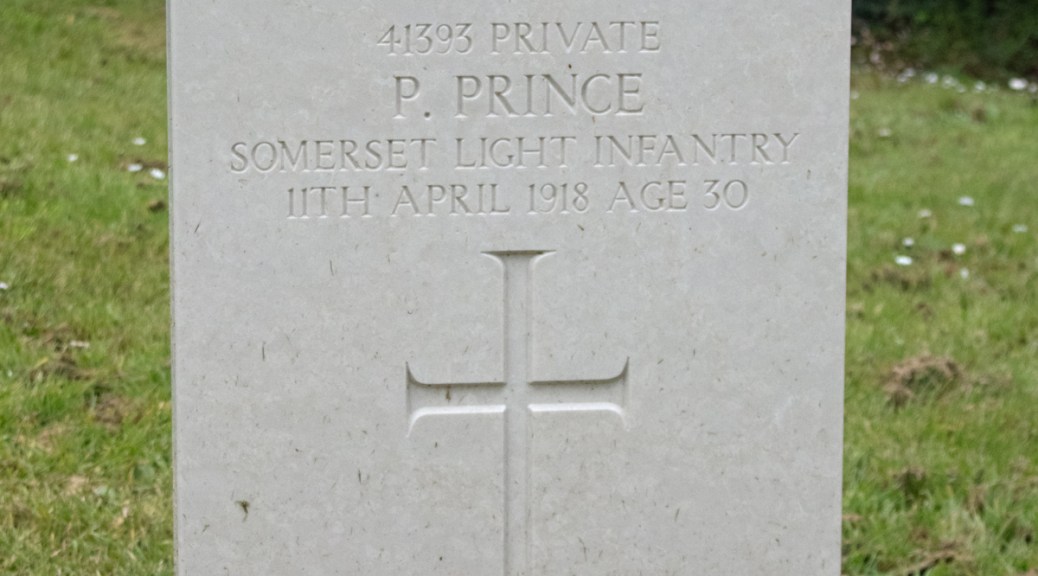
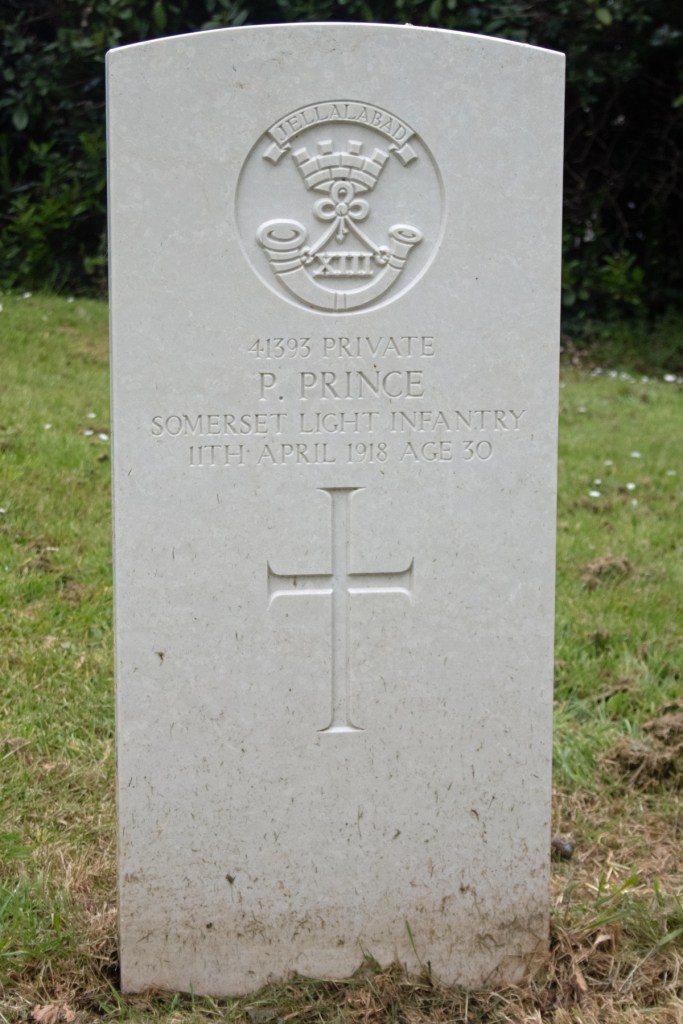
Percy Prince was born in 1890, one of seven children to John and Eliza Prince. John was an agricultural labourer and coal merchant, and brought his family up on the Somerset/Wiltshire border, near Bruton.
Percy followed in his father’s line of work when he left school, eventually moving to Frome. He met and married a woman called Florence Stickler in July 1909, setting up home in Water Lane, to the south of the town centre.
War was soon beckoning, and Percy enlisted in the Somerset Light Infantry as a Private. Sadly, his service records are lost to time, and so details of him time in the army are not available. What we do know is that he was assigned to one of the depots, although which one is not clear.
Sadly, that is about the limit of information available about Private Prince. He died on 11th April 1918, at the Military Hospital in Taunton. There is nothing to confirm a cause of death, but he just was 28 years old.
Percy Prince was buried in St James’ Cemetery in Taunton.
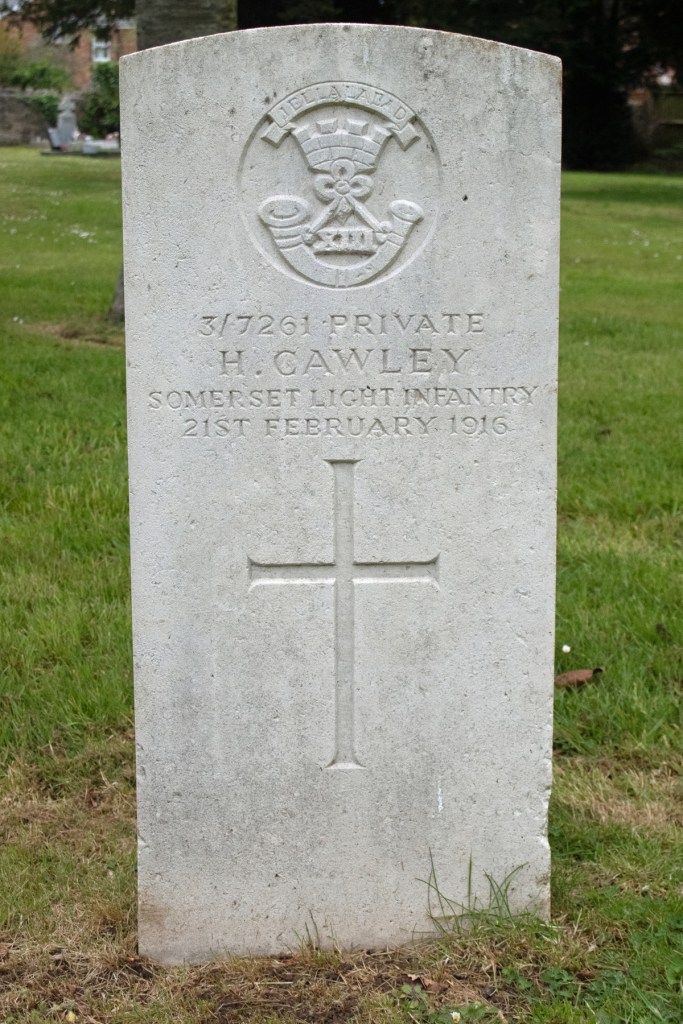
Henry Cawley was born in September 1871, one of eight children to John and Ann Cawley. John worked as a blacksmith in the village of Corfe, near Taunton, Somerset, but when Henry left school, he found work as a butcher’s assistant in Bristol.
Henry disappears from the radar for a while. John died in 1884, but the next information available for his son comes in the form of his war medals. This confirms that he enlisted in the Somerset Light Infantry in the summer of 1915, and that he was assigned to the depots as a Private. He was awarded the Victory and British Medals, as well as the 1915 Star, but then fell ill early in 1916.
Private Cawley was medically evacuated back to England, and was admitted to a sanatorium in Taunton. Sadly, whatever illness he contracted, he succumbed to, and he passed away on 21st February 1916, at the age of 45 years old.
Henry Cawley was laid to rest in St James’ Cemetery in Taunton.
Henry’s war pension was given to his mother, Ann. After her husband’s death, she continued to live in Corfe and, based on the available information, lived into her 80s.
Ernest John Sedgbeer was born in Taunton in the summer of 1891, the second of seven children to Henry and Alice Sedgbeer. Henry worked in a foundry, and his son joined him as a labourer.
By the time of the 1911 census, most of the nine members of the family disappear from the records – it is likely that these were lost – but both father and son are to be found living in South Wales – Henry working as a furnace stoker in the Rhondda, Ernest as a labourer below ground in Llanwonno, near Pontypridd.
Ernest seems to have had an opportunity to find other employment, and started work for Great Western Railways in February 1914. War was imminent, however, and a little over a year later, he had enlisted.
Ernest first joined the Duke of Cornwall’s Light Infantry as a Private, but transferred over to the Dorsetshire Regiment. He was certainly involved in fighting on the Western Front, although full details of his military service are not documented.
His records show that he was awarded the Victory and British Medals and the 1915 Star. Private Sedgbeer was wounded in July 1916 and medically evacuated back to England, where he was admitted to King’s Hospital in Lambeth. Sadly, he was to die of his injuries on 7th July 1916, aged just 25 years old.
Ernest John Sedgbeer lies at rest in the St James’ Cemetery in his home town of Taunton, Somerset.
The local newspaper reported on Private Sedgbeer’s funeral, although it seems to have attributed it to the wrong brother.
The death took place… on Friday last, of Private Charles Sedgebeer of the Dorset Regiment, who was severely wounded in the recent heavy fighting on the Western Front. Deceased was the second son of Mr and Mrs Henry Sedgebeer… and was employed on the railway before the war. His father and three brothers are on active service in France, and one brother in the Navy. The eldest brother has won the DCM.
Taunton Courier and Western Advertiser: Wednesday 19th July 1916
Ernest was indeed the second son of the family, but Charles was the oldest, and survived the war.
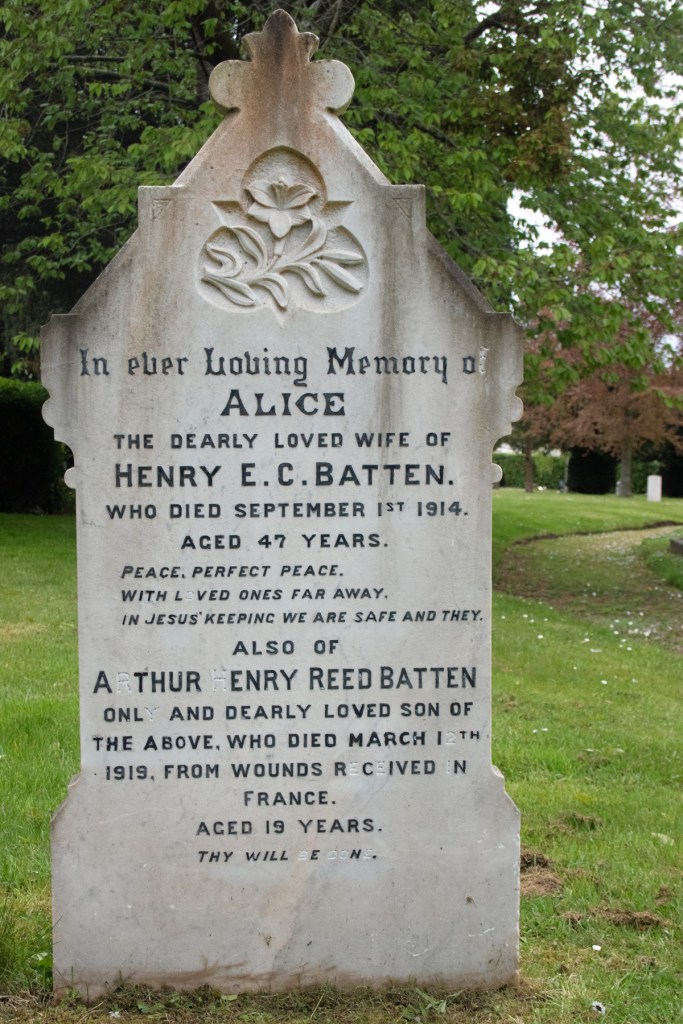
Arthur Henry Reed Batten was born in the spring of 1900, the only child to Henry and Alice. Henry was a gardener, and the young family lived in the Somerset town of Taunton.
There is little documentation about Arthur’s short life. When war broke out, he enlisted in the 1st Battalion of the Devonshire Regiment. While there is nothing to confirm the date he joined up, it may well have been a reaction to the passing of his mother, who died on 1st September 1914, at the age of 47 years old.
Private Batten’s battalion initially fought on the Western Front during the war, before moving to Italy in November 1917, then back to France the following April. It seems likely that it was during this second stint in France at some point late in 1918 that Arthur was caught up in the fighting.
He received a gunshot wound, and was shipped back to England for treatment. Admitted to the Military Hospital in Stockport, Greater Manchester, he seems to have suffered for a long time, passing away from his injuries on 12th March 1919, three months after the Armistice was signed. He was just 19 years of age.
Arthur Henry Reed Batten was brought back to Taunton burial, and lies in the family grave in St James’ Cemetery, alongside his mother.
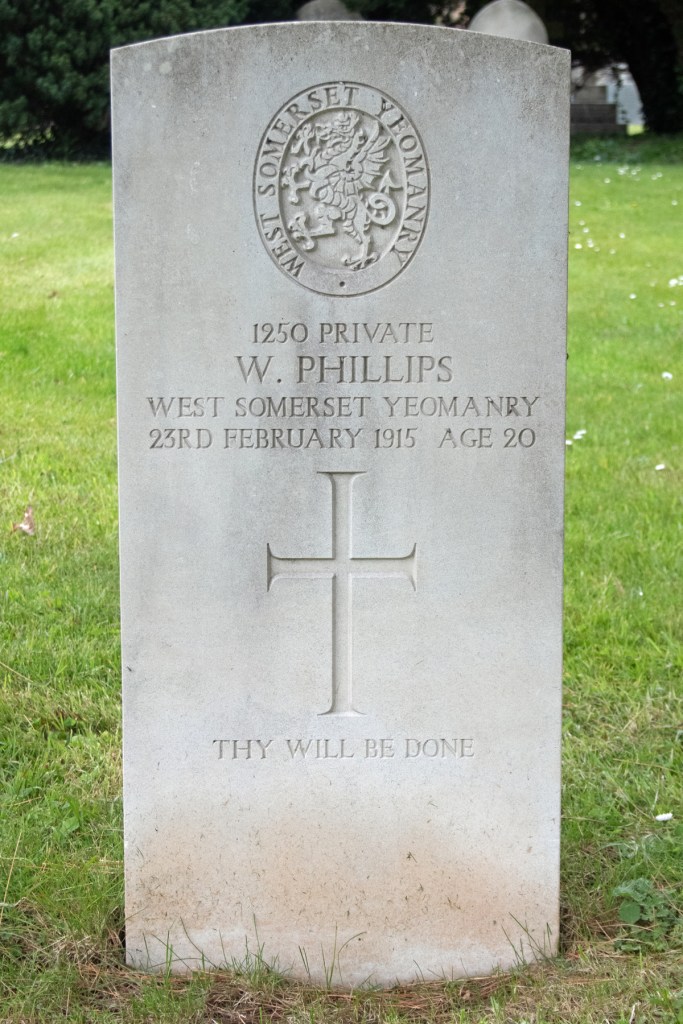
William Phillips was born in 1895, the youngest of seven children to Frank and Emily Phillips. Frank was a joiner and carpenter and, while his young family initially grew up in his home village of Thurloxton, Somerset, he and Emily soon moved them to nearby Taunton, where there would be more work and more opportunities.
By the time of the 1911 census, the young family were all tied up with different jobs. While William had become an office boy for an accountant when he left school, his siblings all had varying different roles: one was a boiler cleaner, another a mason, a third a cellarman and the fourth a shop assistant. With Frank’s own work, this meant that there were five wages coming into the home, albeit on a much smaller scale that we are used to these days.
War was coming, however, and, at the beginning of 1915, William enlisted in the West Somerset Yeomanry. Little information remains of his military service, but it is known that Private Phillips’ experience as a clerk was made use of, and he worked in admin at the reserve depot in Minehead.
William had, by this time, got himself a lady friend, who worked at the hospital in Taunton, and, while they did not see each other a lot, they corresponded regularly.
His new-found freedom from the family home seemed to have led to William being a bit freer with his money than his parents would like, and it appears that he may have run up a few debts He reassured his mother that he did not want to worry them with any business that he had. However, financial matters may well have played on his mind more than he would have liked to admit.
On Saturday 20th February 1915, Private Phillips travelled to Taunton to see his girlfriend; she was working, but he caught up with his sister instead, before returning to the base in Minehead that evening.
The following Tuesday morning, he received a letter from his girl and was last seen heading to breakfast in the hotel digs where he was billeted.
That afternoon, a local engineer was walking along the seafront, when he saw a body lying on the foreshore, about four feet (1.21m) from the high-water mark. The body – which was later identified as William – was wearing some clothing, but other bits were scattered around him. The police were called and Private Phillips’ body was taken to nearby Dunster.
The coroner confirmed William had drowned; the letter he had received was amongst his clothing, but there was nothing in it to suggest that anything was amiss. At the inquest, he suggested that “he could hardly suppose at this time of year that the deceased had taken off his clothing in order to bathe. [His conclusion was that William] got into the water with intent to drown himself.” [Taunton Courier and Western Advertiser: Wednesday 3rd March 1915]
The jury at the inquest returned the verdict of ‘found drowned’. Private Phillips was just 20 years old.
William’s body was brought back to Taunton for burial. He lies at rest in the St James Cemetery there.
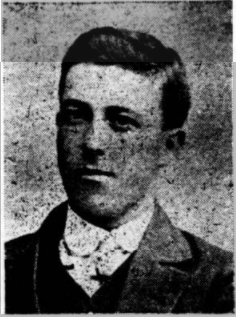
William Phillips (from britishnewspaperarchives.com)
Percy George Westcott was born at the end of 1877, the eldest of six children to George and Elizabeth Wescott. George was a police constable, and brought the family up in the Somerset town of Frome.
After leaving school, Percy sought a trade and, by 1901, was living in the East End of London, working as a wheelwright, work he continued with until the start of the war.
In November 1911, Percy married Annie Maria Meineke, a widow with a young son. The couple set up home in Clapton, East London.
War was on the horizon, however, and Percy was keen to enlist. He volunteered for the Army Service Corps at the beginning of June 1915. His application was turned down, however, and the reason for his discharge given was “Not being likely to become an efficient soldier”.
Percy appears to have been undeterred, however, and by September 1915 had enlisted successfully. He joined the London Regiment as a Private, but this is as much as is documented about his military service.
Private Westcott’s next appearance in records is on the Army Register of Soldiers’ Effects. This confirms that he had served in the 3rd/10th Battalion, which was a territorial force. The document also identifies that he passed away on 20th March 1916, at the age of 38.
While a cause of death is not noted, the location given – the London Asylum, Colney Hatch – is perhaps more significant. As the name suggests, this was a mental health facility; which gives an indication as to the Private Westcott’s state at the time of his passing.
While Percy’s widow was still living in London, his body was taken back to Somerset to be laid to rest. Percy George Westcott is buried in St James’ Cemetery in Taunton, where his parents lived.
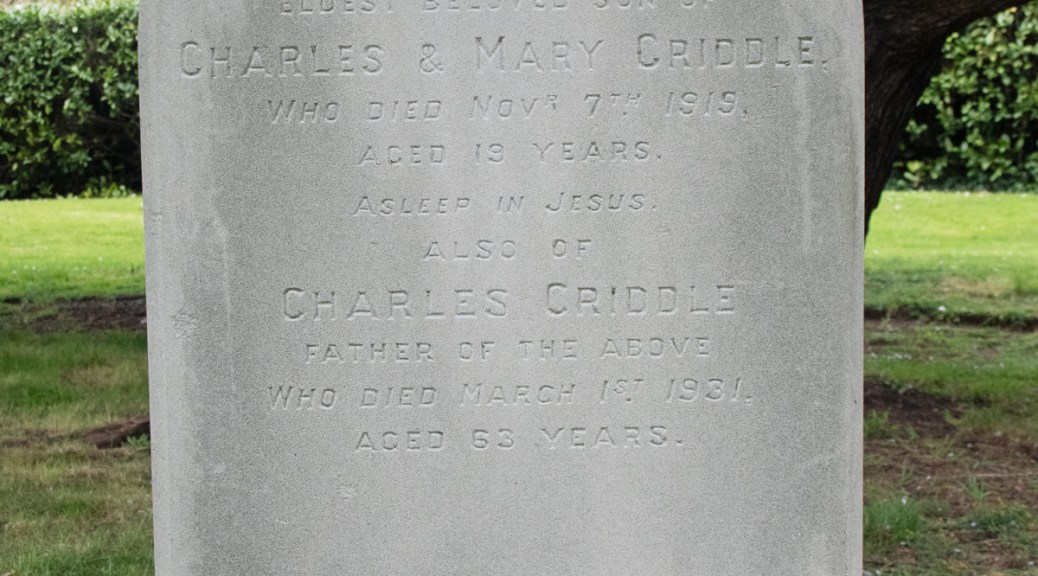
Charles Pretoria Criddle was born on 18th June 1900, the second of five children to Charles and Mary Criddle. Charles Sr was an army reservist, who worked as a labourer for the local council, and the family lived in Taunton, Somerset.
Sadly, little detail of Charles Jr’s life is documented. The Great War broke out when he was only 14, so was too young to enlist at the beginning of the conflict. However, he did volunteer, albeit later on, and joined the 15th Battalion of the Hampshire Regiment at some point in 1918.
Private Criddle’s was one of those lives to be cut tragically short, not by conflict, but by illness. He survived the war, but was subsequently admitted to a military hospital in Brighton, Sussex, where he passed away ‘from disease’ on 7th November 1919. He was just 19 years of age.
Charles Pretoria Criddle lies at rest in the St James Cemetery in his home town of Taunton, Somerset.
Tragedy was to strike again for Charles Criddle Sr. Less than a week after his son had passed, he was called upon to identify the body of his sister, Emma Cable. She had taken her own life after suffering an increasing number of fits over the previous few years.
Emma was a widow, and, since the previous winter, had become increasingly depressed and less physically able, having suffered a debilitating bout of influenza. Early on the morning of Sunday 16th November 1919, she took herself out, dressed in only her nightgown and a pair of boots, and had drowned herself in the River Tone.
At the inquest into her passing, her doctor noted that he had seen her on the previous Thursday “but her condition was not such that he could certify her as insane, but she had been violently hysterical.” [Taunton Courier and Western Advertiser: Wednesday 19th November 1919]
The Coroner recorded a verdict that the deceased drowned herself while of unsound mind.











 Death and Service