Herbert George Spiller was born in 1881, the second of four children to George and Emily Spiller. George was a timber merchant and ironmonger, born in Taunton, Somerset, who raised his family in his home town.
When Herbert left school, he found work as a clerk in a solicitor’s office, and this was the trade he followed, eventually becoming a solicitor in his own right.
In March 1907, he married Winifred Lewis, an outfitter’s daughter, and the couple soon emigrated, arriving in Perth, Australia, later that year. They had two children in Australia; a son, who sadly passed as a babe in arms, and a daughter. Within three years, however, the Spillers were back living in England again and went on to have four further children, three of whom survived infancy.
War had arrived, and Herbert enlisted on 11th December 1915, but was initially placed as a reserve. He was finally called to do his duty for King and country on 6th September 1917 and joined the 28th Battalion of the London Regiment. After initial training, Private Spiller was sent out to the Front, arriving in France in April 1918.
Herbert was back on home soil after three months, suffering from albuminaria (a disease of the kidneys) and served in territorial depots until he was demobbed in December 1918.
At this point, Herbert disappears from the records. It seems likely that his illness was the cause of his passing, but this cannot be confirmed. Either way, Herbert George Spiller died on 7th May 1920, at the age of 39 years old. He lies at rest in the St James Cemetery in his home town of Taunton, Somerset.
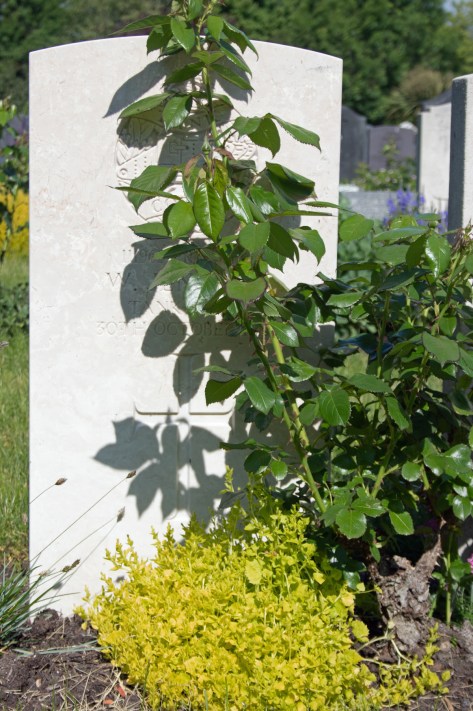
Please note: While Private Spiller was afforded a Commonwealth War Grave, his exact burial location is not identifiable. The image at the top of this post, therefore, is of the other family graves in the cemetery.
Charles Doble – also known as Charlie – was born 12th September 1884, the second of seven children to James and Mary Ann Doble from Dunkeswell in Devon. James was a carpenter, but on leaving school, Charles initially found work as an errand boy, before becoming employed as a porter at the Taunton and Somerset Hospital.
The 1911 census found Charles in the village of Cotford St Luke, working as an attendant at the Somerset and Bath Asylum. Housing more than 800 patients at the time, it is reasonable to assume that his duties would have been wide and varied.
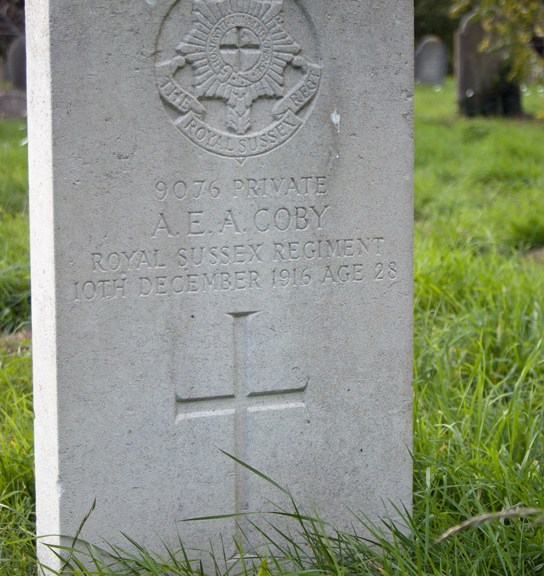
Details of Charles’ military service are scarce. He enlisted in the Hertfordshire Regiment as a Private in April 1916, but soon transferred over to the 13th Battalion of the Royal Sussex Regiment.
In the spring of that year, Charles married Ethel Willmott; presumably this was before he was sent abroad, because he soon found himself on the Western Front.
His battalion was caught up in the Battle of the Boar’s Head, during with the Royal Sussex Regiment succeeded in capturing a section of the German front line trench and second line trench, before being pushed back because of mounting casualties and a lack of ammunition.
It seems likely that Private Doble was one of those injured on what became known as The Day Sussex Died, as he was evacuated back to England for treatment. Admitted to a military hospital in Stourbridge, sadly his wounds proved too much for Charles to bear; he passed away on 13th December 1916, at the age of 32 years old.
Charles Doble’s body was brought back to Taunton, and he was buried in the St James’ Cemetery in the town.
William Herbert Baber was born in May 1895, the oldest of six children to Henry and Alma Baber. By the time of William’s birth, Henry was an insurance agent for the Prudential insurance company and brought his family up in the Somerset village of Yatton. William’s father had been widowed early on, and so, in addition to his five younger siblings, he also had an older half-brother, also called Henry.
By the time of the 1911 census, William was working as a clerk in a coal office, and the family were living in a five room house not far from the village centre.
Little remains documented about William’s military service. He enlisted in the Somerset Light Infantry, but transferred to the 24th Battalion of the London Regiment. He was involved in the Battle of High Wood – part of the Somme offensive – and was wounded during the skirmish.
Evacuated back to home soil, Private Baber was treated in one of the military hospitals in Cardiff. Sadly, he was to succumb to his wounds, and passed away on 16th October 1916. He was just 21 years old.
William Herbert Baber lies at rest in the family grave in the churchyard of St Mary’s in Yatton.
William’s father Henry was also called up for war duty. You can read more about his story here.
Hubert Stanley Parsons was born towards the end of 1892, the eldest of eight children to Frank and Emily Parsons. Frank was a burner, working in the lime kilns in his home village of Yatton, in Somerset. When he left school, Hubert followed in his father’s footsteps, while his younger siblings found work in the local paper makers and bakers.
Sadly, a lot of Hubert’s military records are lost to time. What is clear is that he enlisted on 22nd September 1915, joining the 10th Battalion of the Devonshire Regiment as a Private. He served on the Western Front, gaining the Victory and British Medals and the 1915 Star in the process.
In November 1915, Private Parsons’ battalion was moved to Salonika, Greece, to help fight on the Serbian front. Whether Hubert ever fought in the Balkans is not known; the next – and last – time he appears in documentation is in the Register of Soldiers’ Effects. This confirms simply that he died in hospital on 27th March 1917. The cause and location are not known, but he was just 24 years of age.
Hubert Stanley Parsons lies at rest in the graveyard of St Mary’s Church in Yatton, Somerset.
Percy Payne was born in the village of Kingston Seymour, between Weston-super-Mare and Yatton, Somerset. His parents were agricultural labourer Harry Payne and his wife, Elizabeth, and he had three brothers.
It seems that Percy’s parents may well have separated by 1911; Elizabeth is listed as a widow in the 1911 census, but Harry appears to be alive and well and living in South Wales.
According to the census records, Elizabeth was working as a charwoman, while three of her children were working to help support the family. Percy’s two older brothers were employed as a carter and a domestic servant, while Percy himself was working as an errand boy.
By the time war broke out, Percy has stepped up the ladder. His service records listed his trade as a groom, working in Congresbury, near Bristol. He enlisted in March 1916, at the age of 19 years and 8 months, and was assigned as a Private in the Northumberland Fusiliers. He spent most of that year training on home soil, before being shipped out to France at the end of December.
Illness seems to have dogged Private Payne; he returned to England after a couple of months, and was transferred to the Labour Corps fairly soon afterwards. By September 1917 a further transfer was made, this time to the Royal Army Medical Corps, before he was finally discharged from military service on 21st January 1918, suffering from tuberculosis.
Sadly, the lung condition was to prove fatal, and Percy passed away on 26th June 1918. He was just 21 years old.
Percy Payne lies at rest in the graveyard of St Mary’s Church in the village of Yatton, Somerset.
Herbert Jenkins was born in 1891, the youngest of five children to George and Amelia Jenkins. George was a domestic gardener, and the family lived in the Somerset village of Yatton next to the Prince of Orange public house. Amelia helped make ends meet, by working as a seamstress and upholsterer.
Amelia passed away in 1909, and it was around his time that Herbert felt the calling of military service. He enlisted as a Private in the Royal Marines Light Infantry on 17th September 1909.
Sadly, little documentation remains about Private Jenkins’ naval service, although the 1911 census gives his location as the Stonehouse Barracks in Devon.
Herbert’s family life held a series of highs and lows. His father George died in 1915, and he went on to marry Blanche Elvins, a bootmaker’s daughter from Bristol, the following year. Sadly, however, she passed away in December 1918, and Herbert was alone again.
By this time, the Great War was over, although Private Jenkins was still serving. He was assigned to HMS Warspite, which had fought, and been damaged, in the Battle of Jutland. While there is no evidence that Herbert had been on board during the skirmish, this is the last vessel on which he served.
As with his military career, details of Herbert’s passing are lost to time. All that is known is that he died in Bristol on 24th August 1919 and that the cause was ‘disease’. He was just 27 years of age.
Herbert’s next of kin was his sister Jennie; she brought him back to his home town of Yatton to be buried in the graveyard of St Mary’s Church.
Ernest Frederick Hawkins was born in Street, Somerset, in 1884. He was the youngest of six children to Charles Hawkins and his wife Elizabeth. Both of Ernest’s parents were shoemakers in the Clark’s Factory in the town, and this was the trade Elizabeth continued in after her husband’s death in 1887.
Ernest’s life has some mysteries about it and there is a sense that he spent time trying to escape from something. In August 1904, he enlisted in the army, joining the Scottish Rifles (also known as the Cameronians). He did this under an assumed name, preferring to be called James Fisher.
“James” gave his next of kin as his parents, listing them as George and Annie in South Acton (even though these were not his actual parents’ names, and that his father had passed away 17 years previously).
His enlistment papers give an interesting insight into the young man. He was listed as 22 years old, 5ft 4ins (1.62m) tall, with brown eyes, black hair and a sallow complexion. His arms were adorned with a number of tattoos, including Buffalo Bill on his upper right arm and a ship surrounded by flags on his upper left.
Private Fisher served for a year on home soil, before being shipped out to India. He returned to the UK in October 1907, and transferred to the Army Reserve.
Ernest returned to Somerset, and it was here that he met Sarah Jane Manning. The couple married in a registry office in Bristol, and went on to have two children, Hubert and Iris.
War broke out, and Private Fisher was remobilised. By August 1914 he was promoted to Lance Corporal, and sent to France as part of the British Expeditionary Force. Here he became caught up in a number of the key battles of the conflict.
On 24th July 1916, during the British attacks on High Wood at the Somme, he was wounded in the right arm, and invalided back to England for treatment. Admitted to the War Hospital in Guildford, Surrey, it was confirmed that he had received a gun-shot wound to his right arm, which had resulted in a compound fracture of the humerus, radius and ulna. Sadly for Ernest, the only option was a full amputation of his right arm.
After some time to recover, Ernest was transferred to the Pavilion Military Hospital in Brighton where he was fitted for an artificial limb. He spent three months in the Brighton facility, before being moved to the Queen Mary’s Convalescent Home in Roehampton to recuperate. He was eventually discharged – from the hospital and the army – on 10th March 1917, and returned to his wife and family in Somerset.
There is little further documented information about Ernest. He and Sarah went on to have a further child – Leslie – in 1917. Sadly, where Ernest had been a toddler when his father had died, Leslie was consigned to be a babe-in-arms when Ernest passed away.
Ernest Frederick Hawkins – also known as James Fisher – died in Swindon on 2nd July 1918, at the age of 34. He lies at rest in St Mary’s Cemetery in his adopted home town of Taunton, Somerset.
Ernest’s gravestone also commemorates his brother Frank Hawkins. Frank was nine years older than Ernest, and, like his younger brother, had decided that the military life was for him.
Frank enlisted in the Royal Navy in November 1894 and was assigned a Boy 2nd Class on HMS Impregnable – the training ship based in Chatham, Kent. Over the period of his twelve years’ service, Frank rose through the ranks to Able Seaman. When his term was up, he joined the Royal Fleet Reserve for a further five years.
When war came, Able Seaman Hawkins was immediately called back into action. He was assigned to HMS Goliath, serving off German East Africa and the Dardanelles. On the night of the 12th May 1915, the ship was guarding the water off Gallipoli, when it was struck by three Ottoman torpedoes. The resulting explosions caused the ship to sink quickly, and 570 souls – out of a total complement of 750 crew – were lost.
Able Seaman Hawkins was one of those lost, and was subsequently commemorated on his brother’s gravestone.
John Valentine Thick was born in 1883, the youngest of two children to John Thick and his wife Anna. John Sr was a plumber, and evidently moved around with his work. He was born in Surrey, Anna came from Berkshire; their older child, Grace was born in Hampshire, while John Jr was also born in Berkshire.
By the time of the 1891 census, John Sr had moved the family down to Blandford Forum in Dorset. Little more is known about his son’s early life, but by 1907, he was back in Berkshire, and married Henrietta Entwistle, who had grown up in Chelsea.
The young couple went on to have three children – John, Muriel and Margaret – and settled down in Reading, Berkshire. John, by this time, was working as a domestic gardener.
Little documentation exists relating to John’s military service. He enlisted in the Hampshire Regiment, and was assigned to the 1st Labour Company. Private Thick would have been part of the regiment’s territorial force, presumably using his gardening skills to help with the war effort.
While it is difficult to confirm the dates of his service, it seems that John had enlisted towards the end of 1916. It was early the following year that he fell ill, and was soon admitted to hospital with bronchitis. Sadly, this condition was to get the better of him, and Private Thick passed away on 8th March 1917. He was just 34 years old.
John Valentine Thick lies at rest in St Mary’s Cemetery in Taunton, Somerset.
Geoffrey William Lake was born in London in 1900, the oldest of two children to George and Emma Lake. George was a bank clerk who soon got promotion to bank manager and, as a result, moved the family to the Somerset town of Taunton at some point between 1904 and 1911.
When he left school, Geoffrey found work at his father’s bank and, with the war still being played out on the other side of the English Channel, he joined the Inns of Court Officers Training Corps in August 1918.
Sadly, this was to be the decision that saw Private Lake’s undoing. Whilst training in Hertfordshire, he caught influenza, which then led to pneumonia. Admitted to the Military War Hospital in Napsbury, the illnesses got the better of him, and tragically he passed away on 10th November 1918. He was just 18 years of age.
Geoffrey William Lake was brought back to Taunton, and lies at rest in St Mary’s Cemetery in the town.
Francis Moreton Hawkins was born in Cottingham, Northamptonshire on 15th July 1895. He was the eldest of eight children to Francis and Louisa Hawkins. Francis Sr was a butcher and, by 1905, he had moved the family to Taunton, where he set up a ship on the main shopping street in the town.
When Francis left school, he became a clerk for the business; he went on to take civil service exams, gaining employment in the General Post Office and then Customs & Excise. War was looming, however, taking him in a different direction.
Sadly, a lot of Francis’ military records no longer exist. What the records do tell us, though, is that he initially enrolled with the Somerset Territorials in October 1914, transferring first to the Civil Service Rifles and then the Rifle Brigade. He served his term in the army, rising to the rank of Lance Corporal.
When the war came to a close, Lance Corporal Hawkins was placed on furlough while he waited to be demobbed, and returned home on 19th November 1918. Feeling unwell, he took straight to his bed, and, three days later, was admitted to the Military Hospital in Taunton with influenza and pneumonia.
Tragically, these were to get the better of him; Francis passed away at the hospital on 23rd November 1918. He was just 23 years old.
Francis Moreton Hawkins lies at rest in St Mary’s Cemetery in his home town of Taunton.