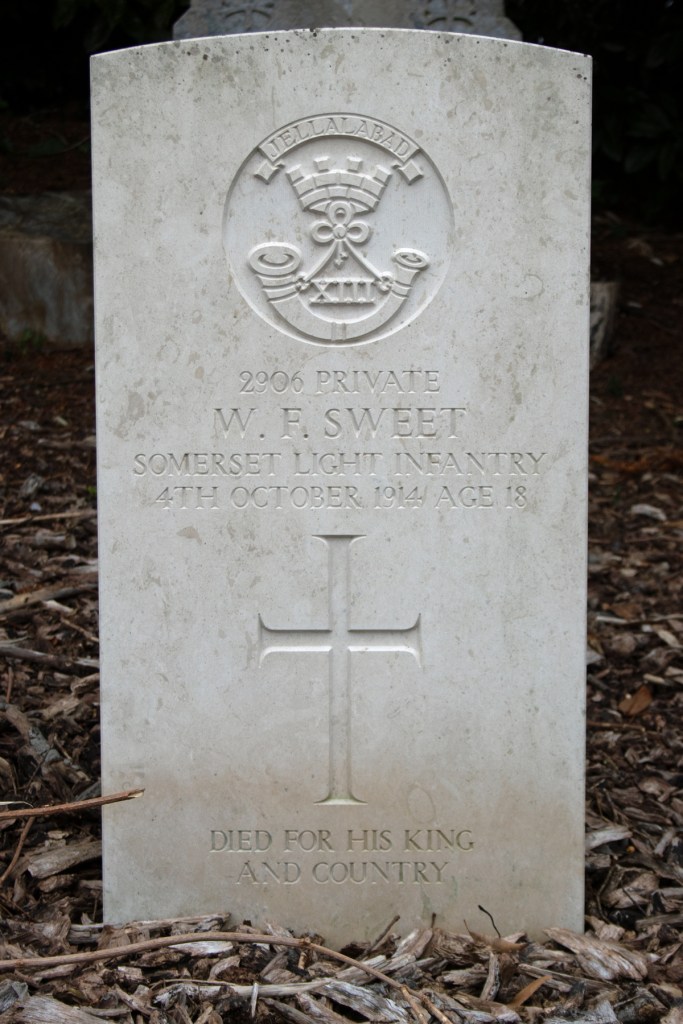
William Frank Sweet was born towards the end of 1897 and was the youngest of seven children. His father, Richard, was a groom and, together with his wife, Mary, he raised the family in the Somerset town of Yeovil.
When William left school, he found work as an errand boy for a tailor; by the time of the 1911 census, Richard was working as a coachman for a hotel, and the family were living in a house on the north side of the town.
There is very little other documentation on young William’s life. When war broke out, he enlisted in the Somerset Light Infantry, and was assigned to the 5th Battalion, who were based in Taunton.
Further information on Private Sweet is scarce; given when he died, it is likely that he enlisted as part of the first wave of voluntary recruiting. It is also likely that, when he was training at the Tidworth Barracks on Salisbury Plain, he came down with some illness, and it was this to which he succumbed.
William Frank Sweet died on 4th October 1914, at the age of just 17 years old. His body was brought back to Yeovil, and he was buried in the town’s cemetery on 10th October, the day after his Battalion set sail across the English Channel to join the onslaught.
Albert Rudolph Percy was born in April 1889 in Taunton, Somerset. His parents were William Percy, a draper, and his wife, Elise, who had been born in Baden Baden, Germany. Elise’s background certainly influenced the naming of the couple’s five children, all sons with middle names ranging from Rudolph and Frederick, to Leopold and Felix.
All but the eldest of William and Elise’s children followed their father into the drapery business; after initially doing so when he left school, Albert’s older brother Frederick took holy orders, a following he continued for the rest of his days.
On the outbreak of war 1914, Albert volunteered for military service, leaving his father’s business behind him. Enlisting in the West Somerset Yeomanry, he was shipped off to to Colchester in Essex for training.
While taking two days’ leave in September that year, Private Percy returned home, and, on the first evening complained of feeling unwell. A doctor was summoned and diagnosed spinal meningitis. Albert was swift to succumb to the illness, passing away on 4th October 1914. He was just 25 years old and likely one of the first from Taunton to die whilst on active service.
Albert Rudolph Percy lies at rest in St Mary’s Cemetery in his home town of Taunton, Somerset.
Arthur Henry Lee was born in April 1895, and was one of five children. His parents were Arthur and Hannah (or Annie) Lee, and the family lived in the Chard area of Somerset. Arthur Sr worked as a ‘twist hand’, operating the machines in a lace factory and, when his son left school, he too found work in the same factory.
There is little documented about Arthur’s early life. When war broke out, however, he was quick to enlist, and joined the Somerset Light Infantry as a Private. He was assigned to the 5th (1st Reserve) Battalion, and was stationed at Mansfield House.
Sadly, Private Lee’s military service was not to be a long one. As happened with lots of young men from different parts of the country coming together in large numbers, illness and disease spread quickly in the military encampments,
Arthur was not immune to this and was admitted to the Military Hospital in Taunton with meningitis. He passed away on 7th December 1914, aged just 19 years old.
Arthur Henry Lee lies in St Mary’s Cemetery in Taunton, Somerset.
Henry Thomas Underhill is one of those people whose lives are lost to time. Details of his early life were difficult to track down, but snippets helped unlock some of the mystery.
In late October 1914, a number of Somerset newspapers gave the following report:
Soldier’s Sudden Death
The West Somerset Coroner held an enquiry at Taunton Barracks on Saturday afternoon relative to the death of Private Henry Thomas Underhill, aged 44, of Street, which took place on Wednesday [14th October 1914].
Deceased was talking to Private TF Davis on a landing in the barracks, when he reeled and, throwing up his arms, fell heavily to the ground, his head striking the floor.
Major Stalkartt, RAMC, was at once summoned, but he found that life was extinct. He afterwards made a post mortem examination, which revealed fatty degeneration of the heart, with a fracture of the bae of the skull. The doctor considered that death was due to heart failure, and that the skull was fractured in falling to the ground.
The deceased was accorded a military funeral at St Mary’s Cemetery the same afternoon. He was an old member of the Somerset Light Infantry, which he recently re-joined on account of the war.
Wells Journal: Friday 23rd October 1914
Private Underhill’s pension record confirms that he was married to a woman called Mary Ann and that the couple had had a daughter, Beatrice Kate Lavinia Underhill, who had been born in December 1906. While searching for Henry directly drew too many variables to provide any certainty, his daughter proved the key to unlock his story.
Henry Thomas Underhill was born in the summer of 1860. One of nine children, his parents were William Underhill and his wife Elizabeth, who was also known as Betsy. William worked as a clerk for a button maker, and the family lived in Birmingham, which, at the time, was in Warwickshire.
When he left school, Henry found work as a ‘brass tube drawer’, making the metal tubes, using a die. He found love too, and, on 13th March 1881, aged just 20, he married Emma Howner. The couple went on to have a son, Ernest, in 1889 although, from the documentation about him, it seems likely that he passed away when only a toddler. Further tragedy was to strike Henry, when Emma also died in 1890, aged just 30 years old.
It may have been around this time that Henry found a focus in military service; he does not appear in the 1891 census and the next set of documentation for him dates from 1900.
It’s at this point that Henry married for a second time. Mary Ann Kelly was seventeen years younger than her new husband, and was the daughter of a carpenter from Solihull. Her father, Michael, had died when she was only a teenager, and she lived with her mother, Lavinia, helping to support her.
Henry’s previous experience with metalwork – and probably his time in the military – found him employment making gun components. The 1901 census finds him and Mary living in Yardley, to the east of Birmingham, with Lavinia and Mary’s younger brother William.
This was obviously a suitable and convenient arrangement; the next census, in 1911, shows the family still living together. By this time, Lavinia was still the head of the household, and shared her home with daughter Mary, Henry and four-year-old Beatrice; son William, his wife Ada and their new-born son, William. Making up the household on Census Day was a visitor, Amy.
War was on the horizon, and this is where we return to the initial news report about Private Underhill. It is likely that Henry had re-enlisted – or at least been called back up – as soon as hostilities broke out. Sadly, his service was not to be a long one, as he suffered the fatal heart attack within a couple of months of the start of the war. Private Underhill was 54 years old at the time of his death.
Henry Thomas Underhill’s body was buried in St Mary’s Cemetery in Taunton, Somerset.
Samuel Roberts was born in April 1875, one of seven children to William and Harriet Roberts from Bridgwater in Somerset. William worked as a labourer in a timber yard, though sadly he died young, when Samuel was only a child.
In the spring of 1899, Samuel married Rosina (or Rose) James, and the couple went on to have six children. Samuel was supporting his family working as a wicker chair maker, a roaring trade in a part of the county where reed beds were in plentiful supply.
Samuel’s war grave suggests that he enlisted in the Somerset Light Infantry, and that this must have been early in the First World War, given that he passed away in October 1914. His pension records paint a slightly muddier picture, however. They give the cause of Private Roberts’ death as Hodgkin’s disease and mania, but suggest that:
As is has not been possible to establish that Private S Roberts actually joined for service or was paid as a soldier during the war, Mrs Roberts’ claim to [a] pension cannot be admitted.
WW1 Pension Ledger: Private Samuel Roberts
Whether Samuel ever enlisted, or whether he only told Rose that he had, or whether, through his mania, he believed that he had, will likely never be uncovered. Either way, what can be established is that he passed away on 19th October 1914, at the age of 39 years old.
He lies at rest in the St John’s Cemetery in his home town of Bridgwater.
William Crossan was born in 1892 in Ballinamore, Ireland. He was the fourth of five children to Patrick and Catherine Crossan.
William disappears from the 1911 Census of Ireland, but has joined the Irish Guards by the time war broke out.
Guardsman Crossan’s battalion was involved in the Battle of Mons, but it was during the fighting at Ypres that he was injured.
Shipped back to the UK for treatment, William passed away on 2nd November 1914. While details are scarce, presumably he died at one of the Red Cross Hospitals in the Sherborne area, as this is where he was buried.
Guardsman William Crossan lies at rest in Sherborne Cemetery.