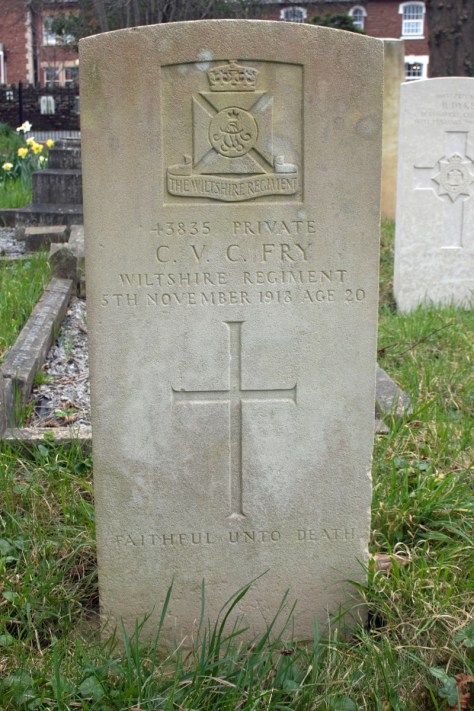
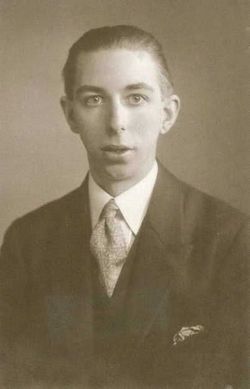
Clarence Vivian Clements Fry was born in November 1898 to William and Rosa Fry. William was a ‘provisions merchant clerk’, who went on to become a ‘cheese and provision dealer’, or grocer. Sadly, Rosa passed away in 1904, at the tender age of 31, leaving Clarence without a mother at just six years old.
William remarried in 1908, and he and new wife Amy had a daughter, also called Amy, a year later. By the 1911 census, the family of four were living in a three storey Victorian Terraced house to the south of Bridgwater town centre.
Sadly, little of Clarence’s military career remains documented. Initially joining the Royal Army Service Corps, Private Fry soon transferred over to the Duke of Edinburgh’s Wiltshire Regiment.
The 1st Battalion found in some of the key battles on the Western Front, including Mons, Ypres, Messines and Vimy Ridge. As his enlistment date isn’t known, it’s impossible to say whether Private Fry was involved in these conflicts or not.
What is likely is that Private Fry was involved in the Battle of the Selle, which took place near the towns of Cambrai and Valenciennes in northern France in October 1918. Clarence was certainly injured at this point, and was evacuated to England for treatment.
Admitted to the Cambridge Military Hospital in Aldershot, it seems that his injuries were too severe and he succumbed to them on 5th November 1918, just a week before the Armistice was signed. Private Fry was just 19 years old.
Clarence Vivian Clements Fry lies at rest in the Wembdon Road Cemetery in his home town of Bridgwater in Somerset.
Walter Ricks Treliving was born in Bridgwater, Somerset, in 1876, the middle of three children to James and Elizabeth Treliving. James was a commercial traveller in the drapery trade, and this is something his son followed him into.
According to the 1891 census, Walter was a pupil at the Commercial Traveller’s School in Pinner, Middlesex, which was, in effect, a boarding school-cum-children’s home for the children of commercial travellers and orphans.
Commerce was obviously engrained into Walter by this point and, after leaving school, he followed his father into the trade of trading. He travelled with his work, frequently boarding with others; in 1901, the census recorded him as living lodging with his maternal aunt Annie Ricks.
Love beckoned, however, and in 1904, Walter married Mabel Broadrick, the daughter of a Unitarian Minister from Worcestershire. The couple set up home in Weston-super-Mare and had a daughter, Beryl, two years later.
Things were not to go smoothly, however, as an article in the Western Daily Press were to show:
In the Divorce Court yesterday, a case was heard in which Mr Walter Treliving, a commercial traveller of Weston-super-Mare, petitioned for a divorce from Mabel Annie Treliving, on the ground of her misconduct with Mr Charles E Rust, an engineer. The case was undefended.
Mr Treliving said he was married on the 13th August 1904 at Bridgwater, and afterwards lived at Weston-super-Mare. There was one child of the marriage. The married life was happy until May 1913, when his wife told him that she cared for someone else.
In July 1913, his wife went away to Manchester on a visit, and when she came back she told him she had stayed with Mr Rust at the Grand Hotel… He forgave her for that, and took her away for a holiday to Lynton. He then discovered that she was still corresponding with the co-respondent, and afterwards that she was meeting him again.
On the 13th September his wife left him, and he heard that she had gone to Khartoum with the co-respondent. He received a letter from her, in which she said:
“Dear Walter. The divorce papers have come. Of course I cannot defend the case, nor he. So you have it all in your power. I hope you will be happy now you are free. If eve I came back to England, may I see Betty [sic]? I cannot marry Mr R. She will not divorce him. I do not know what I shall do now. I hope you will be happy if you marry again, as I hear you will. Oh! if you had only held out one hand to save me, how different it might have been. I am a broken woman. Yesterday, when the petition came, I realised it. You are fully paid back for all your sufferings. Enjoy your victory. Your wife.”
Petitioner said it was not his intention to marry again, as his wife suggested. He had done everything in his power to induce her to remain with him.
Western Daily Press: Thursday 1st April 1915
A decree nisi was granted to Walter and he was awarded costs.
Sadly, it has not been possible to track Walter’s military history. That he enlisted is evident; he joined the Royal Army Service Corps, and rose through the ranks to become Second Lieutenant Treliving. The divorce proceedings did not identify him as serving in the army, so it seems likely that he joined up at some point after April 1915 – his age and his status as a single father seem further proof of this assumption.
Walter returned to Bridgwater in October 1918 to attend his mother’s funeral. Elizabeth had contracted influenza and, sadly, after returning home Walter also caught and succumbed to it. He died on 11th October 1918, at the age of 42.
His probate confirms two beneficiaries; his sister Hilda Treliving, and another woman, Kate Symons, presumably as guardians and trustees for Beryl.
Walter Ricks Treliving lies at rest in the Wembdon Road Cemetery in his home town of Bridgwater, Somerset. He had been buried on the same day as Elizabeth, the mother whose funeral he had returned to attend.
Thomas Cox was born in September 1900, the oldest of four children to William and Ellen Cox from Bridgwater, Somerset. On Thomas’ baptism records, William listed himself as a manufacturer, but there is nothing to confirm what he made.
Sadly, William died in 1905, leaving Ellen to raise four children under five years old – including a babe-in-arms. Determined to look after her young family, however, by the time of the 1911 census, she gave her occupation as a grocer.
War was on the horizon and, while his full records are not evident, it is clear that Thomas must have looked to enlist as soon as his age would allow. He was assigned to the 53rd (Young Soldier) Battalion of the Hampshire Regiment, a training unit based not far from Warminster.
Sadly, Private Cox’s service was not to be a long one. While training, he contracted pneumonia, and passed away on 31st October 1918. He had just turned 18 years old.
Thomas Cox lies at rest in the Wembdon Road Cemetery in his home town of Bridgwater, Somerset.
Stephen Reed was born in August 1887, one of seven children to Stephen and Eliza Reed from Bridgwater, Somerset. Stephen Sr was a labourer, eventually working as a carter for the local council.
Stephen Jr sought bigger and better things, however. After initially working as a butcher, he enlisted in the army in January 1907. He served a term of three years in the Coldstream Guards, before being stood down to reserve status in 1910.
Stephen had by then, found his calling in life and joined the police force. Standing at 6ft 1in (1.84m) tall, he would have cut an imposing figure. By the time of the 1911 census, he was boarding at the barracks in Dorchester, where he was listed as a police constable.
In May 1913, Stephen, by now aged 25, married Emily Maud Bower, in their home town. By March of the following year, the young couple had settled back in Swanage, Dorset, and had had a child, Stephen George.
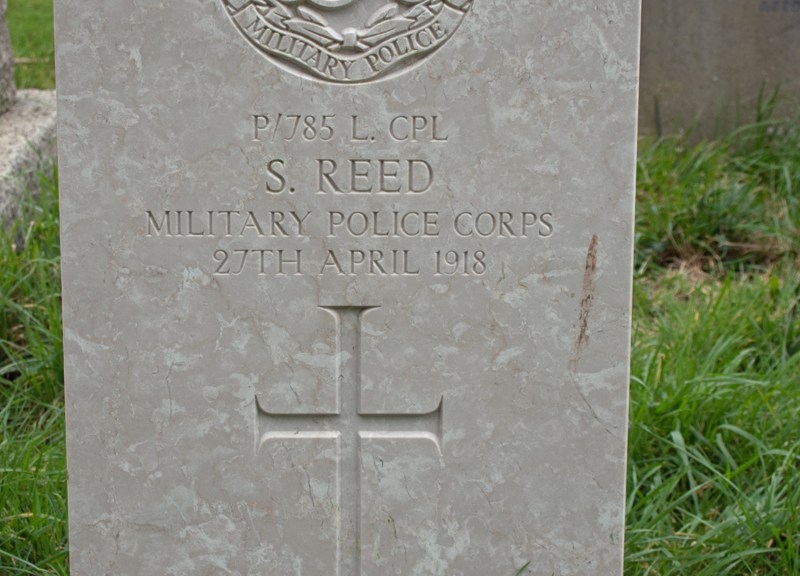
War was on the horizon, however, and Private Reed was re-mobilised in August 1914, finding himself overseas within weeks. He was quickly promoted to Lance Corporal, and, after a couple of years – including fighting at Mons and receiving a subsequent gunshot wound to his hand – was transferred to the Military Police Force.
In April 1918, Lance Corporal Reed contracted tuberculosis, and was ill enough to be evacuated back to England for treatment. He was admitted to the Royal Victoria Hospital in Netley, Hampshire, but passed away within a day of arriving. Sadly, his records show that a telegram was sent to Emily summoning her to the hospital, but, as this was dated the same day he passed away, it seems unlikely that she would have arrived in time.
Lance Corporal Reed died on 27th April 1918. He was 31 years old.
Stephen Reed lies at rest in the Wembdon Road Cemetery in his home town of Bridgwater.
A sad addition to Stephen’s military records is a latter to his widow in September 1918, asking for acknowledgement of receipt of his belongings. The items in question boiled down to: pair of braces; button stick; shaving brush; 2 boot brushes; comb; pipe lighter; handkerchief; pocket knife; safety razor; towel; flannel vest; waistcoat; identity disc; wrist strap; pair of scissors; tie clip; mirror; pipe; cigarette holder; 4 cap badges; card case; wallet and photos; wallet and correspondence; cigarette care; cigarettes; tobacco.
We can assume that these items – especially the photographs and correspondence – gave some level of comfort to Emily, but seeing her late husband’s life summed up in a bagful of belongings must also have been heart-breaking.
Wilfrid Stanley Vagg was born in 1899 in the Somerset village of Doulting. One of six children, his father Albert was the local blacksmith and innkeeper and he lived with his wife Annie and their family in the Waggon & Horses in the village.
When he left school, Wilfrid was keen to follow in his father’s footsteps; the Oakhill Brewery Company was just up the road from the family pub, and it was here that he found employment as a clerk. When war broke out, however, he must have wanted to do his bet, enlisting in the Somerset Light Infantry when he turned 18.
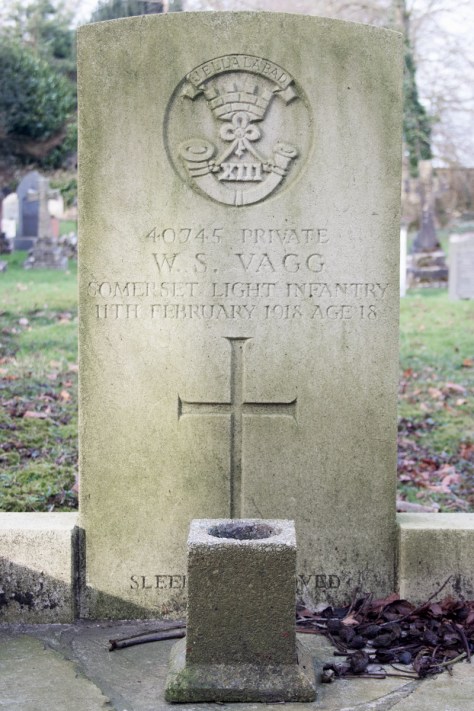
It may well have been while he was training on Salisbury Plain that Private Vagg became ill. He was treated at the Fargo Military Hospital, situated just to the north of Stonehenge, and was operated on for appendicitis. Sadly, he did not recover, and passed away on 11th February 1918. He was just 18 years of age.
Wilfrid Stanley Vagg lies at rest in the graveyard of St Aldhelm’s Church in his home village of Doulting in Somerset.
Edward Lionel Gane was born in 1899 and was one of eight children. Known as Lionel, he was the son of Edwin and Joanna Gane, and lived in the quiet Somerset village of Ditcheat. Edwin began life as a pig dealer, but by the time of the 1911 census, had changed direction and become an insurance agent.
Joanna passed away in 1915, and this may have been the impetus Lionel needed to find his way in the world. He enlisted in the Wiltshire Regiment, joining the 3rd (Reserve) Battalion of the Duke of Edinburgh’s brigade.
The battalion – a depot and training unit – were initially based in Devizes, before moving to Dorset and then Kent. While there is no confirmation of when Private Gane enlisted, it would have been by September 1917, which is when the battalion became part of the Thames & Medway Garrison.
The end of the war marked another ending for the Gane family. Edwin passed away on Armistice Day – 11th November – and further tragedy was to follow, as Private Gane contracted influenza and died less than two weeks later.
Edward Lionel Gane died in a military hospital in Malling, Kent, on 24th November 1918. He was just 19 years old. He lies at rest in the graveyard of St Mary’s Church in his home village of Ditcheat.
Percy William Strong was born in April 1897, the youngest of five children to Albert Strong and his wife Elizabeth. The family lived in Shepton Mallet, Somerset, where Albert worked as a mason’s labourer.
Percy was keen to make his own way in the world. By the 1911 census, and having left school, he was working as a farm boy on Kingsdown Farm in Shepton, alongside a couple of other paid, and boarding, employees.
He seemed to have been after adventure in his life too; in January 1913, he enlisted in the Royal Navy, getting his training on a number of vessels, even before the start of the Great War. In his six years of service, he was promoted from Boy to Able Seaman, and served on nine ships.
Able Seaman Strong’s final assignment was at HMS Idaho, the naval base in Milford Haven, Pembrokeshire, which he joined in May 1918. It was while he was stationed at HMS Idaho that tragedy would strike.
A boat belonging to a Government Patrol-boat capsized in Milford Haven, when three members of the crew lost their lives. They were Sub-Lieutenant Lever (20), Birkenhead; Leading Seaman Thomas Palmer (30) Shepton Mallet; and AB Percy Strong (21), Shepton Mallet.
The boat, containing six men, had come ashore in a rough sea. It left Milford Haven Naval stage on return to the ship at eleven am. A sharp squall caught the men when well out on their return journey, and this the craft failed to weather, and was capsized. The six occupants were cast into the sea, and despite the efforts of men in boats from other vessels, the three named were drowned, and the others had a narrow escape.
Western Mail: Friday 11th October 1918
Able Seaman Strong has lost his life on 9th October 1918. He was just 21 years old.
Percy William Strong’s body was returned to Shepton Mallet, the town of his birth, and lies at rest in the cemetery there.
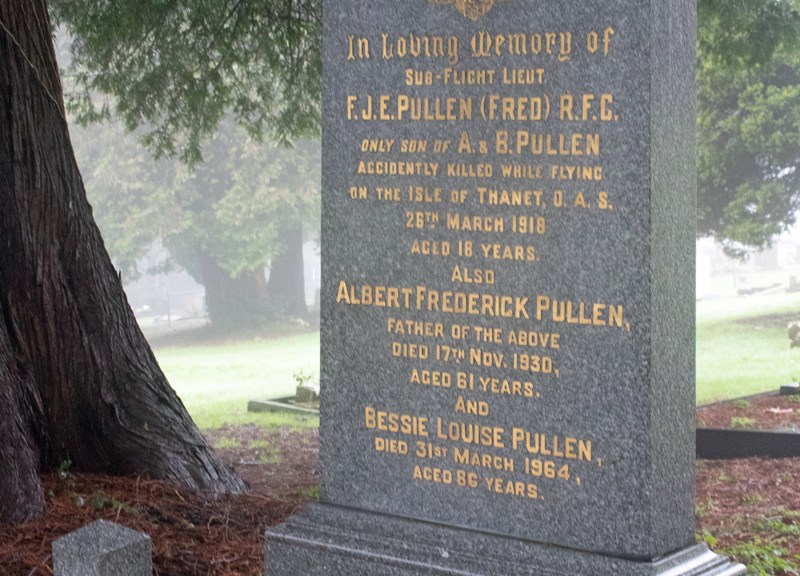
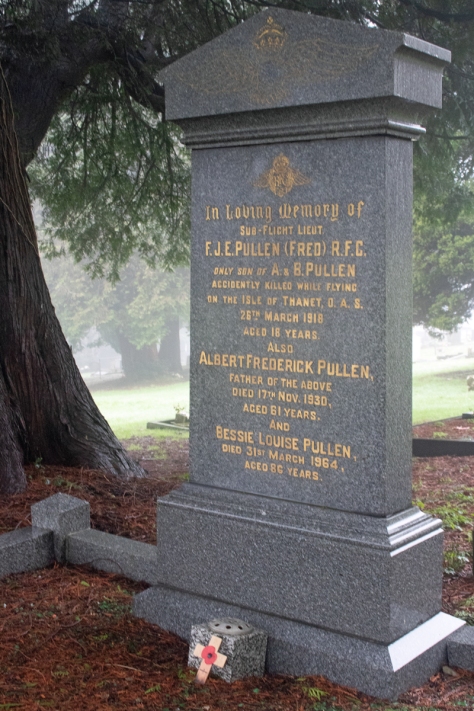
Frederick John Edward Pullen was born in May 1899, the only son to Albert and Bessie Pullen from Shepton Mallet in Somerset. Albert worked at the local prison, acting as clerk, warden and school master to the inmates.
Little else survives to expand on Fred’s military life; his gravestone confirms that he had enlisted in the Royal Flying Corps and, although no date can be attributed to this, it is likely to have been almost as soon as he turned 17.
A report of the young man’s funeral does give a little insight into the young man.
…before entering the service of his country, Lieutenant Pullen was in the Civil Service, and a letter from his late surveyor at Oxford, speaks in high terms of his character and abilities.
He graduated to the rank of Service Pilot in February last, and was gazetted in March. By the Naval authorities he was considered a very good pilot, and was graded as Class A (exemplary).
Shepton Mallet Journal: Friday 5th April 1918
Alongside the Edwardian trait of listing the chief mourners and floral tributes, the newspaper also gives an in-depth report of the cause of Second Lieutenant Pullen’s demise.
The brave young office, who was at a war school [Manston Airfield, Kent], was engaged in ‘stunting’ or trick flying, absolutely necessary in warfare, when from some unknown cause, he fell into a field, and was instantly killed.
A farmer who was ploughing near the spot said he was not conscious of the presence of an aeroplane in the vicinity till this one seemed to drop from the clouds. It nose-dived, but righted on coming near the earth, and seemed to swoop up again, but before going far turned turtle and fell, upside down.
The poor lad was found crushed beneath his gun, and had met instantaneous death. Letters received from witnesses of the accident stated that people living in the neighbourhood hurried to the spot with remedies of all sorts, and were much saddened to find that nothing that they could do was of any avail.
Shepton Mallet Journal: Friday 5th April 1918
Second Lieutenant Pullen met his death in a flying accident on 26th March 1918. He was just 18 years old.
Frederick John Edward Pullen lies at rest in the cemetery of his home town of Shepton Mallet.
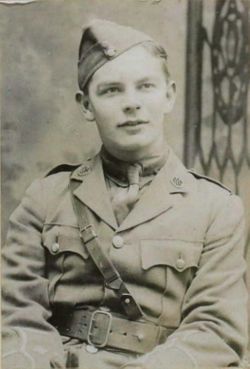
Second Lieutenant Fred Pullen (courtesy of findagrave.com)
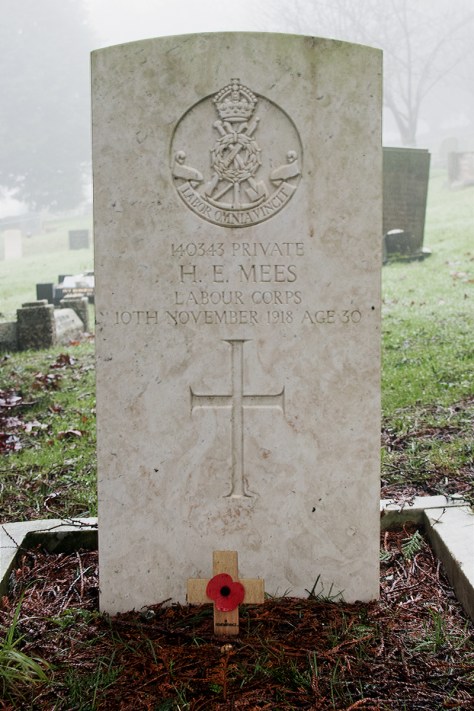
Henry Edward Mees was born in Shepton Mallet, in June 1888. Henry was one of six children, and lived in Somerset with his father – Frederick and his mother Emma. Frederick was a gardener who worked as a groundsman for the local cemetery.
After leaving school, Henry found work as a clerk for a local auctioneer. Of his two brothers, the elder has found a trade in carpentry, while his younger sibling helped his father.
Henry’s service records are scant; he enlisted in the Labour Corps, although there is no confirmation of when this happened. Private Mees joined the 615th Home Service Employment Company and was based in England.
The HSE Companies categorised the employment of the men serving with them, whether they were cooks, caretakers, clerks, policemen, butchers or telephone operators, and used the men to the best of their skills. It is likely, therefore, that Private Mees continued in his clerk role, albeit in a different line of work from auctioneering.
Sadly, few further details of Henry’s life remain documented. He is listed as having been admitted to the War Hospital in Bath, and he died from influenza on 10th November 1918. He was 30 years old.
Henry Edward Mees lies at rest in the cemetery of his home town, Shepton Mallet, sadly tended by his father as part of his day-to-day job.
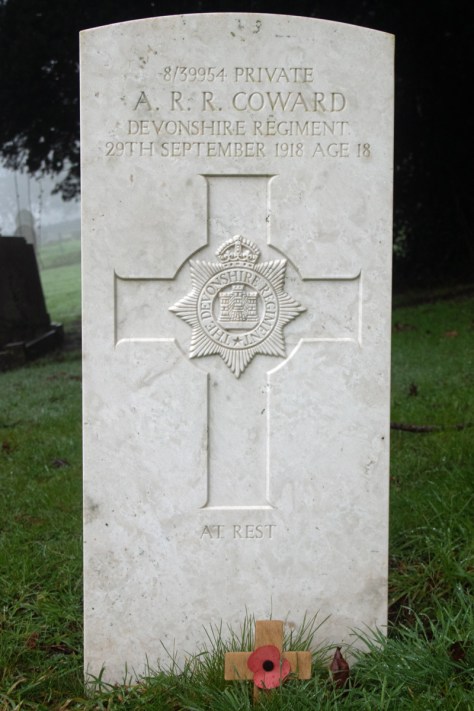
Albert Reginald Robert Coward was born on 26th August 1900, the middle of three children – all boys – for James and Florence Coward. James was a labourer and drayman for the railways, and the family lived in Shepton Mallet, Somerset.
Little remains of Albert’s military service records. His older brother Arthur was a Corporal in the Somerset Light Infantry. He died in France in April 1918, which may have been a contributing factor to his sibling’s decision to do his duty.
Albert enlisted in the 53rd Battalion of the Devonshire Regiment and, given his age, I would presume that this was as soon as he was able to – sometime in 1918.
Whether Private Albert Coward saw any military action is not known. He is listed as having passed away at a military hospital on 29th September 1918, although, as I have been unable to find a cause of death, it is likely to have been an illness, rather than an injury. Albert was aged just 18 years old.
Albert Reginald Robert Coward lies at rest in the cemetery of his home town.
Albert Reginald Robert Coward (courtesy of findagrave.com)
Corporal Arthur William James Coward is commemorated on the Arras memorial in France. He was 23 years old when he died.