Tag Archives: brothers

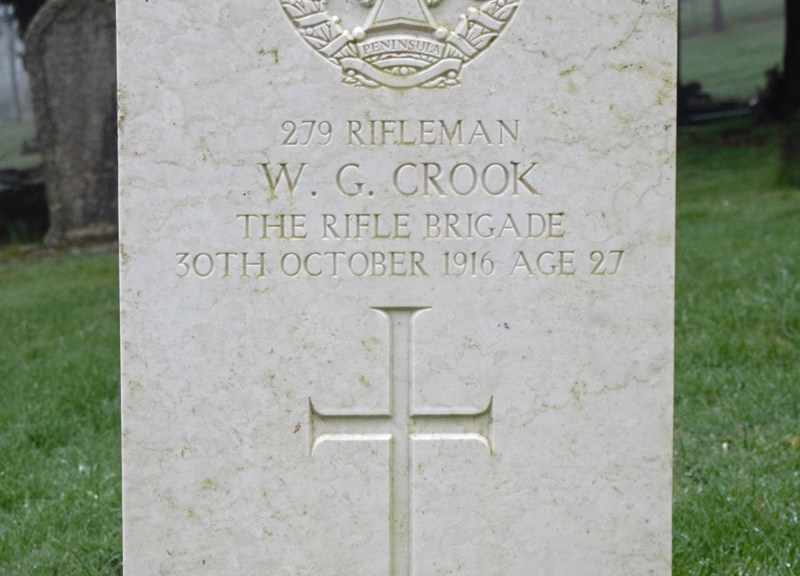
Rifleman Walter Crook

Rifleman Walter Crook

Walter George Crook was born in 1900, one of thirteen children to William – a gardener – and Elizabeth Crook from Shepton Mallet in Somerset.

When he left school, Walter worked as a printer for the town’s newspaper and, by the time of the 1911 census, he was living with his family in a six-roomed house in the middle of the town.

Walter moved on from the Shepton Mallet Journal, and found employment at the Hare and Hounds Hotel in the town. War was coming, however, and he enlisted in the 22nd (Wessex and Welsh) Battalion of the Rifle Brigade.

Rifleman Crook was stationed with his battalion in Salonica, Greece, and it was while he was here that he suffered a cerebral tumour. He was invalided home, and treated in the Royal Victoria Hospital in Netley, Hampshire. Sadly, he lost his fight, passing away on 30th October 1916, aged just 27 years old.

Walter George Crook lies at rest in the cemetery of his home town of Shepton Mallet.


Walter’s brother Gordon is also buried in Shepton Mallet Cemetery – read his story here.


A third brother, Bertie, was also gave his life in the Great War. The local newspaper had given a touching report on his death in April 1916.

Bertie Crook left school at the age of 13, and went into service with Mrs Dickinson at Whitstone, as a stable lad. He was there a year and then, on account of Mrs Dickinson giving up horses and leaving the town, they recommended him to Lord Derby’s stables at Newmarket, under the Hon. G Lambton. Small as he was, Bertie Crook undertook the railway journey alone, with a label in his buttonhole. He served five years apprenticeship, which expired at the beginning of October [1915]. He then tried to join the Royal Field Artillery, but not being tall enough he joined a West country regiment on the 20th October, and left Tidworth Barracks for France in the early part of January. He was in his 21st year, having been born on the 29th July. 1895.

The Hon. George Lambton writes “I was terribly shocked and grieved to hear of the death of your boy… Mrs Lambton and I send our deepest sympathy… I always liked your boy so much when he was in my stable; and I felt sure that with his quiet and courageous character he would make a good soldier. I shall have a plate put up in the stable in memento of his glorious death.”

Shepton Mallet Journal: Friday 21st April 1916

Lance Corporal Bertram Stanley Crook is buried at the 13th London Graveyard in Lavantie, France.


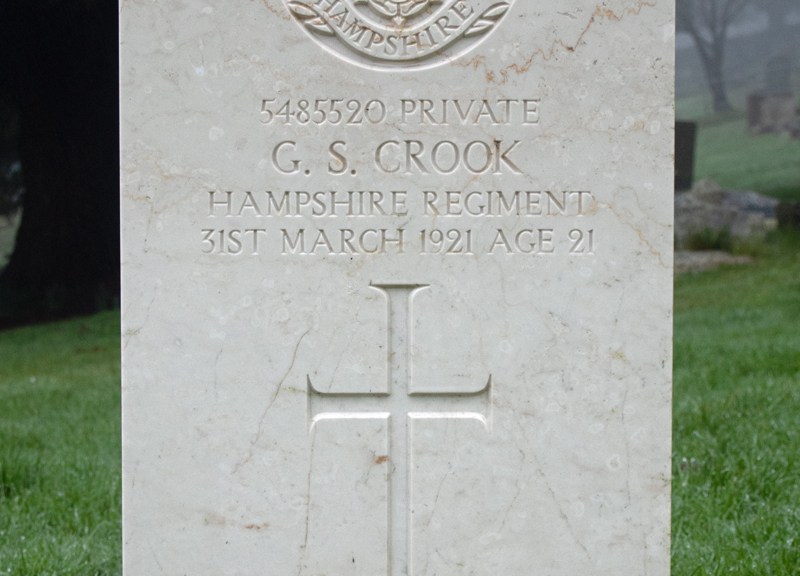
Private Gordon Crook

Private Gordon Crook

Gordon Spencer Crook was born in 1900, one of thirteen children to William and Elizabeth Crook from Somerset. William, like his father, was a gardener, and the family lived in Lower Lane, a small lane sandwiched between the railway and a stream in the centre of Shepton Mallet.

The military records for Gordon, who seems also to have gone by the name of George, are a challenge to piece together. His older brothers Walter and Bertram both died as a result of the fighting, both in 1916, and it seems likely that Gordon was keen to do his bit as soon as he could, to honour their memories.

He enlisted in the Hampshire Regiment, whose battalions served both in France and on the home front. There is conflicting information about his service, but Private Crook appears to have fought at the front, gaining the Victory and British Medals.

Again, with his passing, there is little information surrounding Gordon, or George. A brief notification in the Shepton Mallet Journal stated that “On March 31, at Royal Victoria Hospital Netley, Gordon Spencer, the dearly loved son of W and E Crook, aged 21 years.”

Gordon Spencer Crook lies at rest in the cemetery of his home town, Shepton Mallet.


Gordon’s brother Walter is also buried in Shepton Mallet Cemetery – read his story here.


A third brother, Bertie, was also gave his life in the Great War. The local newspaper had given a touching report on his death in April 1916.

Bertie Crook left school at the age of 13, and went into service with Mrs Dickinson at Whitstone, as a stable lad. He was there a year and then, on account of Mrs Dickinson giving up horses and leaving the town, they recommended him to Lord Derby’s stables at Newmarket, under the Hon. G Lambton. Small as he was, Bertie Crook undertook the railway journey alone, with a label in his buttonhole. He served five years apprenticeship, which expired at the beginning of October [1915]. He then tried to join the Royal Field Artillery, but not being tall enough he joined a West country regiment on the 20th October, and left Tidworth Barracks for France in the early part of January. He was in his 21st year, having been born on the 29th July. 1895.

The Hon. George Lambton writes “I was terribly shocked and grieved to hear of the death of your boy… Mrs Lambton and I send our deepest sympathy… I always liked your boy so much when he was in my stable; and I felt sure that with his quiet and courageous character he would make a good soldier. I shall have a plate put up in the stable in memento of his glorious death.”

Shepton Mallet Journal: Friday 21st April 1916

Lance Corporal Bertram Stanley Crook is buried at the 13th London Graveyard in Lavantie, France.


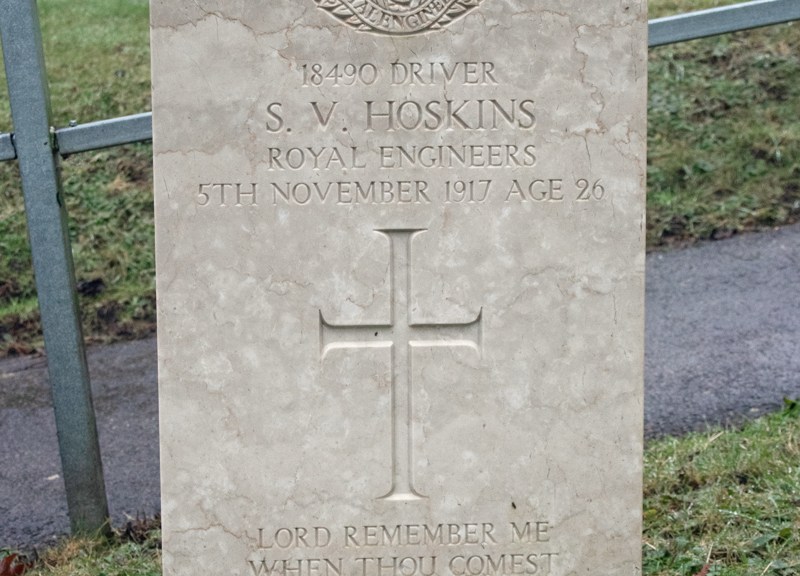
Driver Sidney Hoskins

Driver Sidney Hoskins

Sidney Victor Hoskins was born in February 1892, one of eleven children to Sidney and Elizabeth Hoskins from Shepton Mallet in Somerset. Sidney Sr worked as a quarryman and labourer in local factories.

Sidney was keen to make a life for himself, enlisting in the army in 1909. He served two years as a driver for the Royal Engineers, before being put on the reserve list. By the time of the 1911 census, he was listed as a packer on the railway. In November of that year, Sidney married Ada Lambert, also of Shepton Mallet.

While working on the line in April 1913, Sidney had an accident, suffering a fractured skull. He wasn’t able to carry out any hard labour form that point.

War broke out and Sidney was remobilised; just a month after Ada gave birth to their one and only child, a daughter they named Ada.

New baby notwithstanding, Driver Hoskins was shipped to France as part of the British Expeditionary Force. After two months he was sent down the line after suffering a fit, and was subsequently treated for pleurisy in Nantes. In November 1914, he returned to England and was ultimately discharged on medical grounds in February 1915.

During his time in France, he had also developed tuberculosis, and eventually spent three months in a sanitorium in Taunton, Somerset, to recover.

The condition continued to haunt Sidney, however, and he succumbed to the illness on 5th November 1917. He was 25 years of age.

Sidney Victor Hoskins lies at rest in the cemetery of his home town of Shepton Mallet.


Sidney’s younger brother, William Napier Hoskins, was also involved in the Great War. He had enlisted in the Somerset Light Infantry, and was based in India. Injured in fighting in the Persian Gulf, he was invalided back to India to recover. He was well enough to return to the fray, and was shipped to Mesopotamia, where he was injured again. He died of his wounds in Kut-al Amarah, Iraq, in 1915, aged just 20 years old.

The boys’ older brother Charles had also died in 1895, aged just six years old. While Sidney Sr and Elizabeth had had a family of eight girls, they were to outlive all three of their sons.


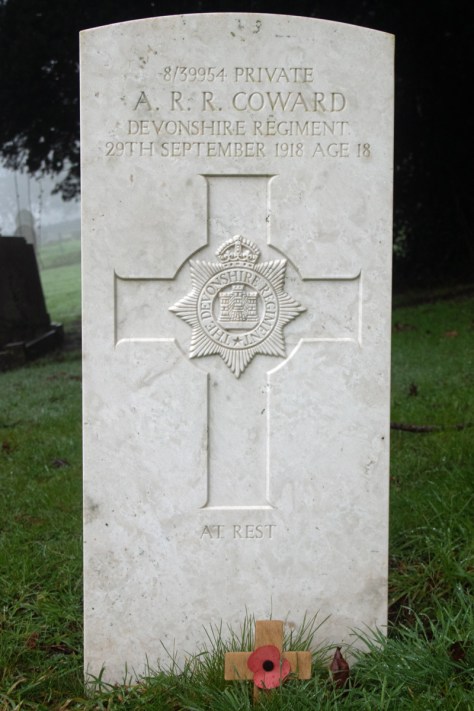
Private Albert Coward

Private Albert Coward

Albert Reginald Robert Coward was born on 26th August 1900, the middle of three children – all boys – for James and Florence Coward. James was a labourer and drayman for the railways, and the family lived in Shepton Mallet, Somerset.

Little remains of Albert’s military service records. His older brother Arthur was a Corporal in the Somerset Light Infantry. He died in France in April 1918, which may have been a contributing factor to his sibling’s decision to do his duty.

Albert enlisted in the 53rd Battalion of the Devonshire Regiment and, given his age, I would presume that this was as soon as he was able to – sometime in 1918.

Whether Private Albert Coward saw any military action is not known. He is listed as having passed away at a military hospital on 29th September 1918, although, as I have been unable to find a cause of death, it is likely to have been an illness, rather than an injury. Albert was aged just 18 years old.

Albert Reginald Robert Coward lies at rest in the cemetery of his home town.


Albert Reginald Robert Coward
(courtesy of findagrave.com)

Corporal Arthur William James Coward is commemorated on the Arras memorial in France. He was 23 years old when he died.


Private Charles Curtis

Private Charles Curtis

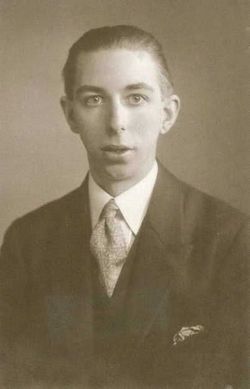
Charles Curtis was born in Wells, Somerset, in January 1894, one of fifteen children to Charles and Mary Jane Curtis. Charles Sr worked as a gardener in the Wells area, and, after leaving school, Charles Jr started work as a mill hand for the local paper mill (this would have been either St Cuthbert’s Mill in Wells, or the Wookey Hole Mill in the nearby village).

Charles enlisted in October 1915, joining the Royal Army Medical Corps. He was posted to France a month later and, while specifics of his military service are not readily apparent, Private Curtis was awarded the Victory Medal, the British Medal and the 1915 Star.

Charles was admitted to hospital on 1st November 1917 with an inflamed cervical gland (reported as Trench Fever), for which he underwent an operation. He remained hospitalised at Whalley Range for more than two months, and was passed for active service, having apparently recovered.

Private Curtis was suddenly taken ill again on 1st July, and his family telegrammed. His mother and one of his sisters boarded a train for the hospital – again in Whalley – but they had not gone far when word came that he succumbed to rheumatic fever. He was 24 years old.

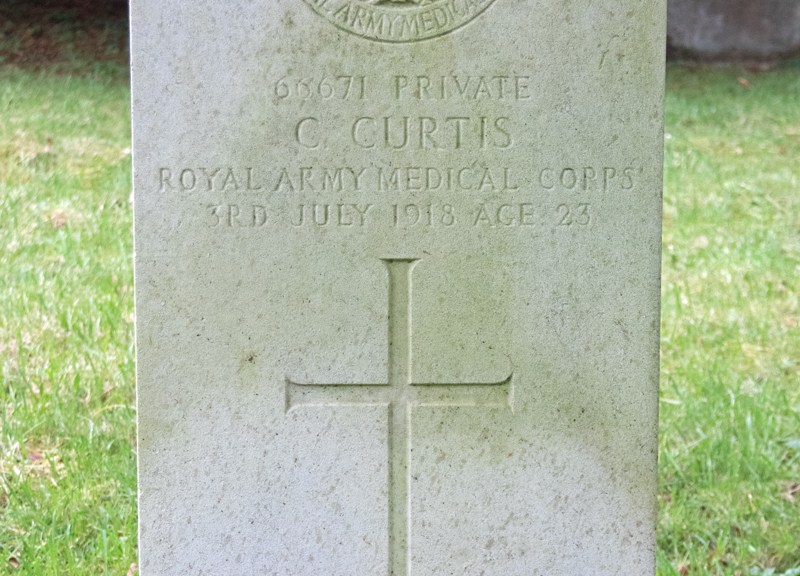
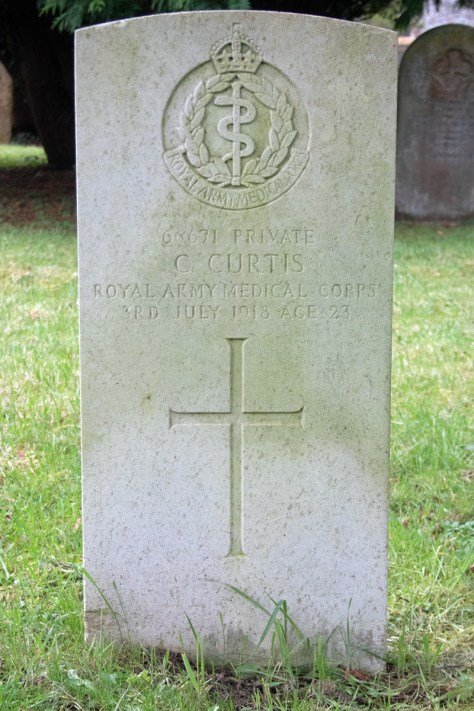
Charles Curtis Jr lies at rest in the graveyard of St Matthew’s Church in the village of Wookey, Somerset.


A newspaper report of his funeral confirms that Charles was one of five brothers who had entered military service during the Great War. Amazingly, given that seven of the brothers ended up serving, Charles was the only one to die as a result of the war.


Driver William Hagger

Driver William Hagger

William Joseph Hagger was born in the spring of 1885, one of thirteen children to William Henry Hagger and his wife Emily Ann. The family lived on the Isle of Grain in Kent, where William Sr worked as a labourer in the local cement works.

William Jr was evidently keen to travel. On the 1901 census he is listed as a navyman on HMS Lion, a training vessel in Devonport, Plymouth.

His First World War records state that he officially joined the Royal Navy in 1906, travelling to West Africa as an Able Seaman. While there, he contracted a fever, and was invalided out of the service the following year.

William married Esther Elizabeth Reed in May 1909; by the 1911 census, she was living in Northfleet, Kent, working as a cartridge maker for the local arsenal. William himself is not recorded at the same property, and I have been unable to locate him at this point.

He next appears on the enlistment papers for the Royal Engineers. He joined up very early in the war – December 1914 – and after his training, Driver Hagger embarked for the Western Front in August 1915.

While serving, it seems that his previous affliction resurfaced, and William was dogged by colds and coughs. In the autumn of 1916, he was admitted to a field hospital with haemoptysis (coughing up blood), eventually returning to his unit three months later.

Driver Hagger’s health was fair until, in October 1917, his unit was gassed; he was sent back to England and hospitalised in Aldershot, and this time was discharged from the army six months later.

It seems that William did not recover from his illness and passed away on 22nd November 1918. He was 33 years old.

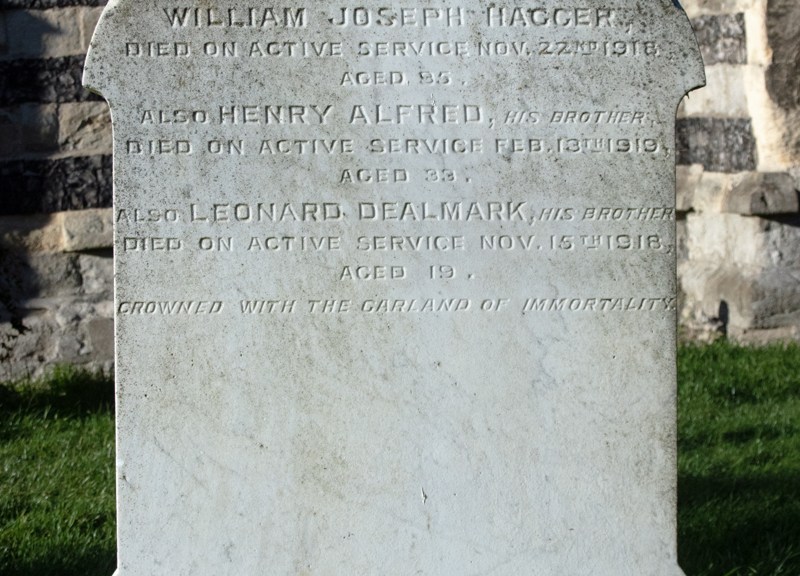
William Joseph Hagger lies at peace in a quiet corner of St Helen’s Churchyard, in Cliffe, North Kent.


William’s gravestone also acts as memorial to two of his brothers, Henry and Leonard.


Henry Alfred Hagger was born two years after William. He was also keen to make a name for himself, emigrating to California, and working as a streetcar conductor in Oakland. Initially declaring himself exempt from draft as he had a wife to support, he subsequently joined the British Columbia Regiment on 31st July 1917.

Henry was attached to the Forestry Depot of the Canadian Expeditionary Force, who were to be shipped to Europe to harvest trees for use on the Western Front. However, at the point of his medical – in September 1917 – he was discharged as unfit for active service due to his asthma.

Henry Hagger died on 13th February 1919, presumably of his lung condition. He is buried in Ross Bay Cemetery in British Columbia.


Leonard Dealimark Hagger was born in 1899. He enlisted as soon as he was able to, just short of his 18th birthday. Joining the York & Lancaster Regiment, he was posted in 1918.

His battalion saw some of the fiercest of the battles in the closing months of the war – Estaires, Messines, Bailleul, Kemmel Ridge, Scherpenberg, Selle, Valenciennes – and it is likely that Leonard was involved in some of these engagements.

Private Hagger was wounded in the closing weeks of the war, and passed away in a hospital in Liege, Belgium on 15th November 1918. He had just turned 19 years of age.

Private Leonard Hagger lies at peace in the Robermont Cemetery in Belgium.


Private Roberts Hallett

Private Roberts Hallett

Private Roberts Pretoria Hallett was born in the summer of 1900, to Frank – a shepherd from Charlton Adam in Somerset – and Emily, who came from the neighbouring village of Charlton Mackrell. Roberts (the correct spelling) was the youngest of eleven children.

Roberts was just twelve when his father died, and, when war came, he enlisted in Taunton, along with his brothers, Francis and William.

Private Hallett was assigned to the 5th Battalion Royal Warwickshire Regiment. While his records don’t identify exactly when he saw battle, by the last year of the war the battalion would have been involved in the fighting in northern Italy.

What we can say for certain is that he was shipped home at some point towards the end of the war. He was admitted to the No. 1 Northern General Hospital in Newcastle-upon-Tyne in October 1918. Private Hallett’s records show that he died “of disease” on 16th October.

Roberts Pretoria Hallett lies at rest in the churchyard of St Mary’s in his home village of Charlton Mackrell, Somerset.


The Great War was not kind to Emily Hallett: having lost her husband in 1912, her son William died while fighting in India in 1916 and that is where he was buried. Her other son Francis died in the Third Battle of Ypres in June 1917 and lies at rest in Belgium.

Roberts Hallett, therefore, is the only one of the three brothers to be buried local to her.

Private Stephen Rawle

Private Stephen John Rawle

Stephen John Rawle was born in 1894, the second of four sons of George Rawle, a sailor, and Louisa, his wife.

By the time war broke out, Stephen was working as a groom in Wheddon Cross, just south of Minehead.

As the Great War loomed, he enlisted and Private Rawle serving on the home front. His record show that he stood at 5ft 9.5ins (1.76m) and was of good enough health to be enrolled for the Territorial Force. He was assigned to the West Somerset Yeomanry.

He was medically discharged from service on 29th March 1915, having served for one year and 31 days.

The records show no signs of injury or wounds, and newspapers of the period do not link him with any misadventure. I can only assume, therefore, that he died of natural causes, possibly linked to the Spanish Flu Pandemic. Stephen died on 5th September 1918. He was 25 years old.

Private Stephen John Rawle lies at rest in the churchyard of Lydeard St Lawrence, alongside two of his brothers, Ernest and William.


George and Louisa’s other son – Edward – also served, enlisting in the Somerset Light Infantry and fighting in the Balkans. Private Edward Rawle survived the war, returning home in March 1919.

It should be noted that, by June 1921, George and Louisa had lost three of her four sons to the Great War. Their daughter, Norah, had also passed away in 1918.

The 1921 census found Louisa living in East Town, in the parish of Tolland, not far from Lydeard St Lawrence. Edward was living with her, as were her three-year-old granddaughter, Lorna, and her eighteen-month-old grandson Beatty. It is unclear whose children they were. George, at this point, was helping his younger brother out on the family farm in Williton.


Private William Rawle

Private William Henry Rawle

William Henry Rawle was born in 1890, the eldest child of George Rawle, a sailor, and Louisa, his wife.

At the time of the 1911 census, William was working as a carter on a farm not far from Porlock in Somerset.

He enlisted in August 1914, joining the Somerset Light Infantry and serving as part of the Expeditionary Force. After a couple of postings, Private Rawle was transferred to the Pioneer Depot in March 1916.

Six months later William was medically discharged as unfit for continued service. His notes highlight his distinguishing marks as 3 marks on his left arm, birth mark under his right nipple and gunshot wound to the left eye (which I am guessing is what led to his discharge).

William died on 11th June 1921, aged 27 years old. I have been unable to find anything specific relating to his death and it is likely, therefore, that no misadventure was involved.

Private William Henry Rawle lies at peace in the churchyard of Lydeard St Lawrence, alongside his brothers Stephen and Ernest.


George and Louisa’s other son – Edward – also served, enlisting in the Somerset Light Infantry and fighting in the Balkans. Private Edward Rawle survived the war, returning home in March 1919.

It should be noted that, by June 1921, George and Louisa had lost three of her four sons to the Great War. Their daughter, Norah, had also passed away in 1918.

The 1921 census found Louisa living in East Town, in the parish of Tolland, not far from Lydeard St Lawrence. Edward was living with her, as were her three-year-old granddaughter, Lorna, and her eighteen-month-old grandson Beatty. It is unclear whose children they were. George, at this point, was helping his younger brother out on the family farm in Williton.