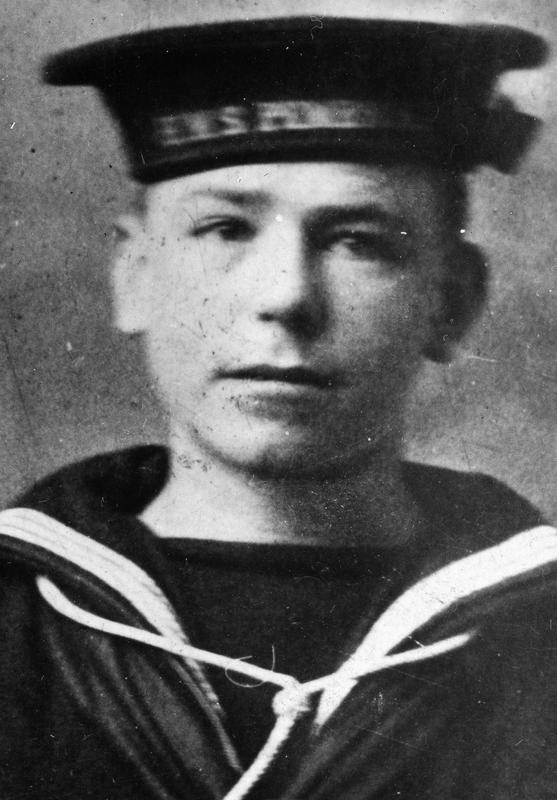
Arthur Wellman was born in the spring of 1891 and was one of nine children. His parents – road builder Thomas and collar machinist Eliza – were both born in Somerset, and it was in Chard that they married and raised their family.
Arthur and his siblings found work in the local lace industry – the 1911 census recorded him living with his family in Chard, working as a lace hand, minding the machinery in the mill.
In the summer of 1915, Arthur married Daisy Jane Slade, the daughter of an agricultural labourer from North Curry, Somerset. They went on to have a daughter, Beryl, who was born in May 1916.
By May 1916, Arthur had seen two of his brothers serve and die in the war: Private Bert Wellman had been killed serving with the Somerset Light Infantry in Mesopotamia, while Gunner William Wellman died from tuberculosis having served with the Royal Field Artillery. Whether through a sense of duty or a sense of guilt, he put his name forward to play his part. Full details are not available, but he enlisted in the Somerset Light Infantry that autumn.
Private Wellman was assigned to the 4th (Reserve) Battalion, and was sent for training. Sadly, while in barracks, he contracted cerebrospinal meningitis; he died in hospital on 20th March 1917, at the age of just 25 years old.
Arthur Wellman’s body was brought back to Somerset for burial. He was laid to rest in Chard Cemetery, not far from his brother, William.
William Wellman was born in March 1890 and was one of nine children. His parents, road builder Thomas and collar machinist Eliza were both born in Somerset, and it was in Chard that they married and raised their family.
William and his siblings found work in the local lace industry – the 1911 census recorded most of the family in Chard, but William was boarding in Stapleford, Derbyshire, with his older brother Fred; both were working as lace hands.
War was coming to Europe, and, as a previous member of the territorial force of the Somerset Light Infantry, William was keen to play his part. In February 1915, he enlisted in the Royal Field Artillery: his records show that he was 5ft 7ins (1.69m) tall, had light brown hair, grey eyes and a slender build, weighing 129lbs (58.5kgs).
Gunner Wellman was sent to Wiltshire for training but, while in barracks, he fell ill. Having contracted tuberculosis of the kidney, he was admitted to a hospital in Sutton Veny. After two months’ treatment, his health did not improve sufficiently enough, and he was discharged from the army on medical grounds in February 1916.
William returned to Chard, but was not to get any better. He passed away at home on 1st April 1916; he was just 26 years old.
William Wellman was laid to rest in the cemetery of his home town, not far from his brother, Private Arthur Wellman.
William and Arthur were not the only two of the siblings to fight in the Great War.
Their youngest brother, Private Bert Wellman fought with the Somerset Light Infantry, and died in fighting in Mesopotamia on 22nd November 1915. He was just 20 years of age.
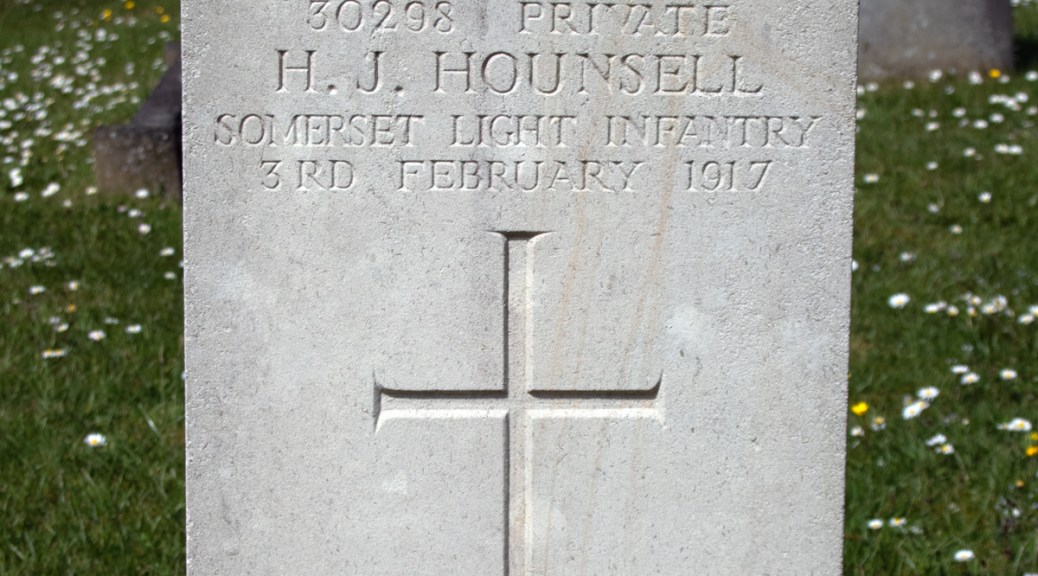
Henry James Hounsell was born in the spring of 1891, one of ten children to George and Emma Hounsell. George was a farm labourer and carter, and the family were raised in Tatworth, on the outskirts of Chard, Somerset.
Henry may have followed his father in farm work, but he wanted bigger and better things from life. The 1911 census recorded him as boarding with the Burt family in Corscombe, Dorset, where he was working as a baker’s van man.
Henry’s two older brothers, George and Alfred, died in 1913 and 1914 respectively; this left him as the oldest male of the siblings. In the summer of 1915, he married Lydia Lentell, the daughter of a shirt starcher and collar maker from East Coker, Somerset.
By this point, however, war was raging across Europe, and Henry was called upon to play his part. Full details of his service are lost to time, but it is clear that he enlisted in the Somerset Light Infantry as a Private in the 4th (Reserve) Battalion. By the time he joined up – at some point after August 1916 – his troop had already been sent out to Mesopotamia; it is unclear whether Henry also went overseas, but it appears unlikely.
The only other documents relating to Private Hounsell are those concerning his passing. His pension record confirms that he died on 3rd February 1917, having been suffering from a tumour in the back of his head, which had been aggravated by his military service. He was just 25 years old.
Henry James Hounsell was brought back to Somerset for burial. He was laid to rest in Tatworth Cemetery in Chard.
Lydia and Henry had had no children; she remained a widow for a number of years, before marrying for a second time in the autumn of 1939. Tragically, this was also destined to be a short-lived marriage – her new husband, Frederic Hodge, died just three years later.
Arthur William Young was born on 11th July 1900, in the Gloucestershire village of Charfield. His parents, James and Eliza, were both born in the area, and this is where they raised their nine children.
James worked as a bone turner and sawyer, working the material for things like buttons. This was a family trade, and something that Arthur followed his father and older siblings into when he finished school.
By this point, storm clouds were brewing over Europe. Arthur was too young to enlist when war first broke out, but when his older brother Francis died in Northern France in December 1917, this seemed to have driven him to play his part as well.
Arthur enlisted in the Royal Marine Artillery on 1st July 1918, a couple of weeks before his eighteenth birthday. Assigned the rank of Private, his records show that he was 5ft 9ins (1.65m) tall, had blue eyes, brown hair and a fresh complexion. It was also noted that he had a scar on his right wrist and another on his forehead.
After nine months’ service, Arthur was promoted to Gunner and, by the autumn of 1919, he was assigned to the dreadnought HMS Queen Elizabeth.
On 1st December 1920, while moored in Portland Harbour, Dorset, a concert was held on HMS Warspite. Gunner Young attended, but on the trip back to his own ship, the boat he was on collided with another, and he and three others were knocked overboard and drowned. He was just 20 years of age.
Arthur William Young was brought back to Gloucestershire for burial. He was laid to rest in the family plot in the Congregational Chapelyard in his home village of Charfield.
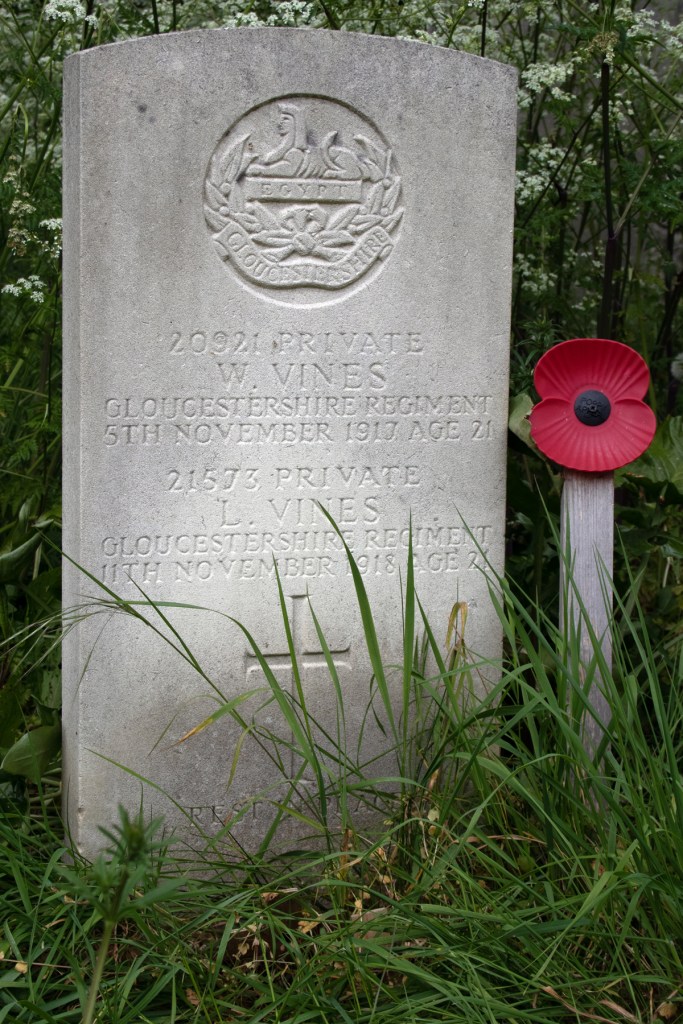
Leslie Vines was born on 16th September 1898, and was one of seventeen children to John and Emma. John was an elastic web maker or braider from Stroud, Gloucestershire, and it was in nearby Wotton-under-Edge that he and Emma raised their growing family.
Braiding and weaving ran in the family: the 1911 census recorded six of the Vines’ children who were over school age were employed in the local mill. When he finished school, Leslie also found work there.
When war came to Europe, Leslie was eager to play his part. He enlisted in the Gloucestershire Regiment on 18th June 1915, just a month after his older brother, Wilfred, had joined up. His service records confirm that he was 5ft 2ins (1.57m) tall: Keen as he was to follow his older brothers into glory, he gave his age as 19 (two years older than he actually was) in order to be accepted for duty.
Private Vines’ eagerness, however, was to be thwarted. On 29th June, less than two weeks after joining up, he was discharged from service. Details are scant, but this seems to have been on the basis that, following his medical examination, he was considered to be unfit for duty.
At this point, Leslie’s trail goes cold and the next available record is that for his death on Armistice Day, 11th November 1918. He was just 20 years of age. While the cause of his passing is not readily available, it was not reported on in any of the contemporary newspapers, so is likely to have been of natural causes.
Leslie Vines was laid to rest alongside his brother, Private Wilfred Vines, in the graveyard of St Mary the Virgin Church in his home town, Wotton-under-Edge.
Wilfred Vines was born on 19th March 1897 and was one of seventeen children to John and Emma Vines. John was an elastic web maker or braider from Stroud, Gloucestershire, and it was in nearby Wotton-under-Edge that he and Emma raised their growing family.
Braiding and weaving ran in the family: the 1911 census recorded six of the Vines’ children who were over school age were employed in the local mill. This included Wilfred, who was working as a bobbin collector.
War came to Europe, and Wilfred was keen to play his part. He enlisted on 25th May 1915, joining the 15th Battalion of the Gloucestershire Regiment as a Private. His records show that he stood just 5ft 2ins (1.57m) tall.
Private Vines was sent for training to the camp at Chiseldon, Wiltshire. It seems that, while he was there, he was injured and, although full details are not available, his wounds were serious enough for him to be discharged from the army because of them. He was formally released on 30th May 1916, and returned home to recover and recuperate.
At this point, Wilfred’s trail goes cold. All that is recorded is that, on 5th November 1917, he passed away at home from his injuries. He was just 20 years of age.
Wilfred was laid to rest in the graveyard of St Mary the Virgin Church in his home town. He shares his grave with his younger brother, Leslie, who died the following year.
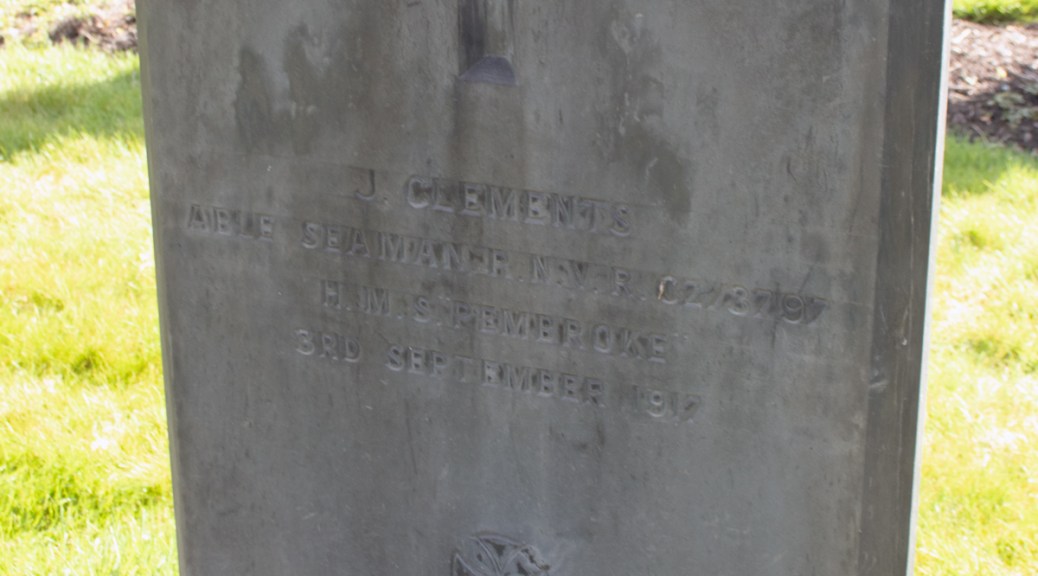
John Clements was born on 22nd March 1891 in the Lanarkshire town of Airdrie. He was one of seven children to John and Catherine Clements.
There is little concrete information about John Jr’s life. When he left school, he followed his father and two brothers, David and George into the mining industry, working at the New Orbiston Colliery, walking distance from home.
When war broke out, however, John Jr wanted to play a bigger part and – probably to Catherine’s horror – he enlisted in the Royal Naval Volunteer Reserve at the same time as two of his three brothers also joined up.
Information about Able Seaman Clements’ service is scarce. All that can be confirmed is that, in the autumn of 1917, he was based at HMS Pembroke, the Royal Naval Dockyard in Chatham, Kent.
The base was particularly busy at that point in the war, and John found himself billeted in overflow accommodation in the barracks’ Drill Hall.
On the night of 3rd September 1917, Chatham was bombarded by a German air raid, and the Drill Hall received a direct hit. Able Seamen Clements was among those killed. He was just 26 years old.
John Clements’s body, along the other victims of the Chatham Air Raid, was laid to rest in the Woodlands Cemetery in nearby Gillingham.
Able Seaman John Clements (from britishnewspaperarchive.co.uk)
John and Catherine’s second son had been killed, but, as the local newspaper reported, there seemed to be more trauma ahead:
Private George Clements, Cameron Highlanders, aged 23… is officially posted missing in recent operations in France. He has seen a long period of active service, and previous to enlisting, was employed in the… Hattonrigg Colliery.
Private David Clements, Royal Irish, the eldest son [of John and Catherine] is in hospital in Yorkshire suffering from ‘gassing injuries’. This is the third occasion upon which he has been wounded; fortunately, he is making a satisfactory recovery. He is 28 years of age and was employed in the… New Orbiston Colliery.
Bellshill Speaker: Friday 14th September 1917
Thankfully, George was found and David recovered and John was to be the only casualty of the conflict for the Clements family.
Albert Cairns was born on 22nd October 1894, one of ten children to Wilson and Maria Cairns. Both of his parents were born in Northern Ireland, and flax dresser Wilson raised his family in the capital, Belfast.
When he left school, Albert began shop work, but he wanted bigger and better things. On 2nd March 1912, having already been a volunteer in the Royal Inniskilling Fusiliers, he enlisted in the regiment full time. His service records show that he was 5ft 4.5ins (1.64m) tall, weighed 125lbs (56.7kg) and had blue eyes, brown hair and a fresh complexion.
Private Cairns’ army service was brief, however, as, on 23rd March he was discharged for “having made a mis-statement as to [his] age on enlistment.”
Undeterred, six months later, Albert tried again, this time enlisting in the Royal Navy as a Stoker 2nd Class. His determination was clear, as he lied about his age again, giving his year of birth as 1893. This was overlooked (or at the very least not checked), and he was sent to HMS Pembroke, the Royal Naval Dockyard in Chatham, Kent, for his training.
In February 1913, Stoker Cairns was assigned to the cruiser HMS Blonde. He spent the next two years on board, and was promoted to Stoker 1st Class.
For all his desire to serve, Albert’s military career was a chequered one. Over the period of five years, he served on four ships, returning to Chatham after each voyage. His character began as Very Good, but as time went on this slipped to Good and then to Indifferent. On four separate occasions he was detained for going AWOL, and he spent a total of 159 days in the brig.
In May 1917 he returned to HMS Pembroke; that summer was a busy time for the base, and Stoker 1st Class Cairns found himself billeted in overflow accommodation set up in the barracks’ Drill Hall.
On the night of 3rd September, Chatham came under attack from a German air raid, and the Drill Hall received a direct hit. Stoker Cairns was among those to be killed that night. He was 22 years of age.
Albert Cairns was laid to rest in the Woodlands Cemetery in Gillingham, Kent, alongside the other victims of the Chatham Air Raid.
Tragically, Albert was not the first boy of that name to be born to the family. Albert Wilson Cairns was born in 1888, but died when only a toddler.
Wilson and Maria also had three sons called Wilson: the first, born in 1889, died at the age of two. The second was born in 1892, but passed away at the age of seven months.
The third Wilson Cairns was born in 1896. He went on to become a mill labourer, before joining the Royal Inniskilling Fusiliers in February 1913. Just like his older brother had done before him, however, he had lied about his age, and was soon discharged. Two years later he tried again, and this time succeeded in joining up.
Private Cairns was assigned to the 2nd Battalion, and soon found himself in France and in the thick of it. Fighting in the Battle of Ancre, he was killed on 23rd November 1916. He was just 20 years of age, and was laid to rest in the Waggon Road Cemetery near Beaumont-Hamel.
Private Wilson Cairns (from findagrave.com)
The Belfast Telegraph reported on Albert’s death, and noted Wilson’s death ten months previously. It also confirmed that Wilson and Maria’s oldest son, George, had also been wounded, and was recovering in a convalescent camp.
The same newspaper ran a number of messages of condolence for Albert, including one from his loving sweetheart, Katie Rollins.
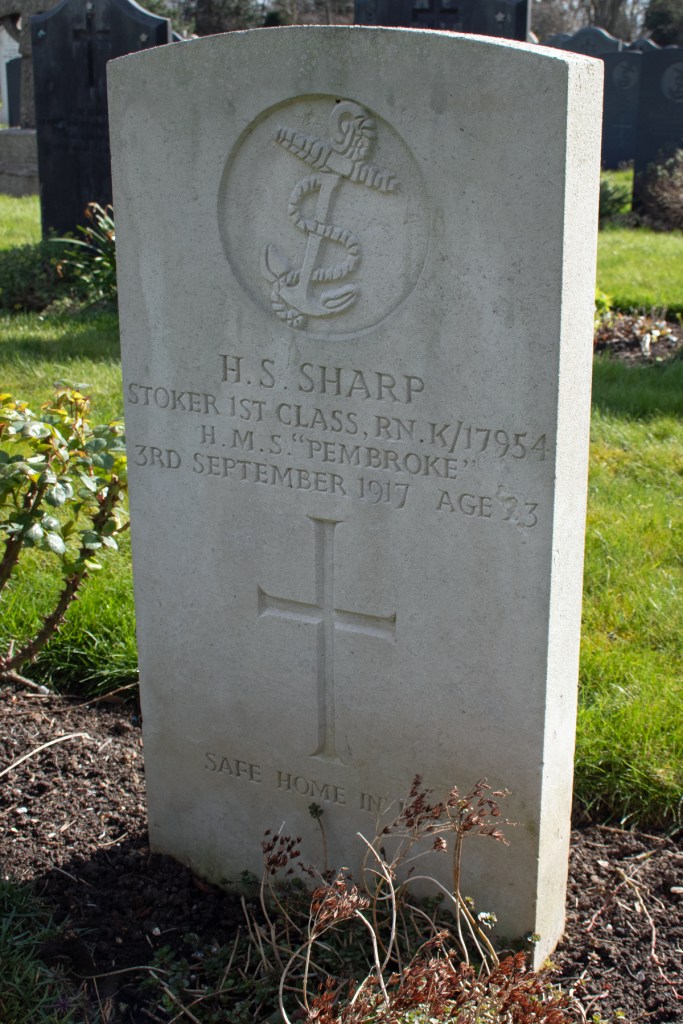
Horace Stanley Sharp was born on 13th April 1894, the oldest of eight children to Harry and Edith. Harry was a labourer from Luton in Bedfordshire, and this is where he and Edith raised their family.
When he left school, Horace found work at a local iron foundry, but he wanted more of a career and, on 25th February 1913, he enlisted in the Royal Navy as a Stoker 2nd Class. His service records confirm that he was 5ft 4ins (1.62m) tall, had brown hair, grey eyes and that he had a fair complexion.
Stoker Sharp was first posted to HMS Pembroke, the Royal Naval Dockyard in Chatham, Kent. Here he would have received his training, but, during this time, he went absent without authorisation, and, as a result, spent 24 days in the cells. It seems that his training was extended as a result of this, as he was not given his first posting – on board the cruiser HMS Sirius – until January 1914.
Over the next couple of years, Horace served on two further vessels – HMS Alert, where he gained a promotion to Stoker 1st Class, and HMS Swiftsure, where he was detained for a further five days. The reason for this second time in the brig is not recorded, but, as it coincided with the death of Horace’s mother, the cause seems likely to have been connected.
In 1916 he returned to HMS Pembroke, before being assigned to the brand new battlecruiser HMS Repulse, where he served for a year, taking part in operations in the Persian Gulf and the Dardanelles.
At the end of July 1917, Stoker 1st Class Sharp returned to Chatham once more. The base was particularly busy that summer, and the large number of extra servicemen meant that Horace was billeted in temporary accommodation in Chatham Drill Hall.
On the 3rd September 1917, the first night air raid carried out by the German Air Force bombarded the town, and scored a direct hit on the Drill Hall; Stoker 1st Class Sharp was among those killed that night. He was just 23 years of age.
Horace Stanley Sharp was laid to rest, along with the other victims of the Chatham Air Raid, in the Woodlands Cemetery, Gillingham.
Stoker 1st Class Horace Sharp (from findagrave.com)
Horace’s younger brother Harry also fought in the First World War, serving a a Private in the 1st Battalion of the London Regiment. He was assigned to the 13th Battalion of the Royal Fusiliers, and fought at the 3rd Battle of Ypres in 1917.
He was wounded on 5th September 1917, receiving a gun shot wound in the back. Private Sharp was admitted to hospital, and died from his injuries later that day. He was just 20 years of age and passed away just two days after his older brother. He was laid to rest in the Reninghelst Military Cemetery in Belgium.
Edmund George Durnford was born in the spring of 1881 in the Somerset village of Pitcombe. The second oldest of twelve children, he was the oldest son to Edmund and Eliza Durnford. Edmund Sr was an agricultural labourer who travelled with the work – the 1891 census recorded the family living in Mells, near Frome.
When Edmund Jr left school, he found work at an ironmonger’s. He moved to Midsomer Norton and, in 1907, he married local carter’s daughter Bessie Welch. The young couple set up home in a terraced house on the road to nearby Radstock, and went on to have two children: Ian, who was born in 1908, and Ronald, born the following year.
War came to Europe, and Edmund was keen to play his part. He enlisted in the Royal Army Service Corps as a Driver, and was assigned to the 827th Company. Full details of his service are not available, but he remained a part of the territorial force and was promoted to Lance Corporal.
The local newspaper of the time reported on what became of Edmund:
Lance Corporal Edward [sic] G Durnford, Army Service Corps… son of Mr and Mrs EG Durnford… died suddenly on April 18 at Duston Hospital, Northampton, from shell shock and hemorrhage [sic] of the brain, was 38 years of age. The body was brought back from Northampton, and the deceased accorded a military funeral at Midsomer Norton last week.
Somerset Guardian and Radstock Observer: Friday 3rd May 1918
There are a couple of inconsistencies with the report. The newspaper has Edmund’s name wrong, while his pension record does not mention shell shock as the cause of death (it confirms the cerebral haemorrhage, but also cites a granular kidney). Given that Lance Corporal Durnford did not serve abroad, it seems unlikely that shell shock was a contributing factor.
The same article also places three of Edmund’s brothers in the war, and gives an insight into what had become of them before the conflict. Gunner Percy Durnford was with the Canadian Field Artillery, training in the South of England; Sergeant Major Arthur Durnford, of the Australian Light Horse, was based in Sydney; Bombardier Horace Durnford, of the Royal Garrison Artillery, had served in France, where he had been gassed, but was, at the time of his oldest brother’s death, based in Egypt.
Edmund George Durnford died in Northampton on 18th April 1918. He was 38 years of age. His body was brought back to Somerset, and he was laid to rest in the graveyard of St John the Baptist Church in Midsomer Norton.
Edmund’s younger son, Ronald, served in the Second World War. He joined the Royal Artillery, reaching the rank of Lance Bombardier. Ronald was serving in the Far East early in 1942, and for the next year, no news was heard of him.
However, contact was made in March 1943, confirming that Ronald had been captured by the Japanese, and was a prisoner of war in Borneo. Three months later, his wife, Kathleen, received a postcard from him, confirming he was a prisoner of war, well and unwounded.
Tragic news was quick to follow, however:
In last week’s issue it was stated that Mrs [Bessie] Durnford… had received through her daughter-in-law news that her son, Lance Bombardier Ronald Durnford, was a prisoner of war in Jap hands and was unwounded.
On Saturday she received the sorrowful news that he was dead in the following messages, which her daughter-in-law had sent on:
“I deeply regret to inform you a report has been received from the War Office, that [Ronald], who was reported a prisoner of war in Borneo Camp, had died from dysentery. The date of his death is not yet known, but you may rest assured as soon as any further information is received, I will immediately let you know.”
Somerset Guardian and Radstock Observer: Friday 30th July 1943
Lance Bombardier Durnford was laid to rest in the Labuan War Cemetery in Malaysia.
Further family tragedy, albeit with a life well-lived, was to follow as, on 6th September 1943, Bessie too died at the age of 86. She was laid to rest alongside Edmund in the family plot. Her obituary confirmed that “She leave a husband, seven daughters, and four sons to mourn her loss. One son and one daughter are in Canada, and one son in Australia, and one daughter and son in London.” [Somerset Guardian and Radstock Observer, Friday 17th September 1943]
Bessie had not, in fact, remarried: the husband was, in fact, the one who had died some 25 years before.