
Tag Archives: Chief Writer

Writer 1st Class Harry Goodger

Writer 1st Class Harry Goodger

Harry Goodger was born on 15th April 1885, the fourth of five children – and the only boy – to George and Emma Goodger. George was a canal labourer from Aylesbury in Buckinghamshire, but by the time of his son’s birth, the family had settled in Tipton, Staffordshire.

Harry was initially committed to education and, by the time of the 1901 census, he was working as a school teacher. His heart seemed set on a career with more prospects, however, and so, on 2nd November 1904, he enlisted in the Royal Navy.

Harry’s service records show that he was 5ft 2ins (1.57m) tall and that he had bark brown hair, dark brown eyes and a fresh complexion. He was also noted as having a mole on his wight upper arm and another on his left breast.

Harry’s rank was Writer 3rd Class, which was the naval equivalent of a clerk. After an initial training period, he was assigned to the cruiser HMS Terrible. Over the next decade, he served on ten further ships, and was based at HMS Victory, the Royal Naval Dockyard in Portsmouth, in between voyages.

Writer Goodger slowly progressed through the ranks during his naval service. On 1st November 1908 he was promoted to Writer 2nd Class, and on 31st October 1912 was raised to Writer 1st Class. Harry seems to have needed extra support, however, and he was knocked back to Writer 2nd Class on 25th April 1913, and sent back to Portsmouth for further training. By 23rd October 1914, however, while serving on HMS Bulwark, he again received a promotion to Writer 1st Class.

By the spring of 1915, Harry had been assigned to HMS Princess Irene. She an ocean liner that has been converted to a minelayer at the start of the war.

On 27th May 1915, while Irene was moored off Sheerness, Kent, a series of explosions ripped through the ship, killing more than 350 crew. Writer Goodger was among those who perished: he was 30 years of age.

The body of Harry Goodger was buried in Woodlands Cemetery, Gillingham, Kent alongside the other victims of the disaster.


Writer 1st Class Harry Goodger
(from findagrave.com)

Harry’s surname is variously spelt Goodger and Goodyer across the documents that trace his life. While his headstone has the latter spelling, I have used Goodger, as this is what is recorded on his naval service records.
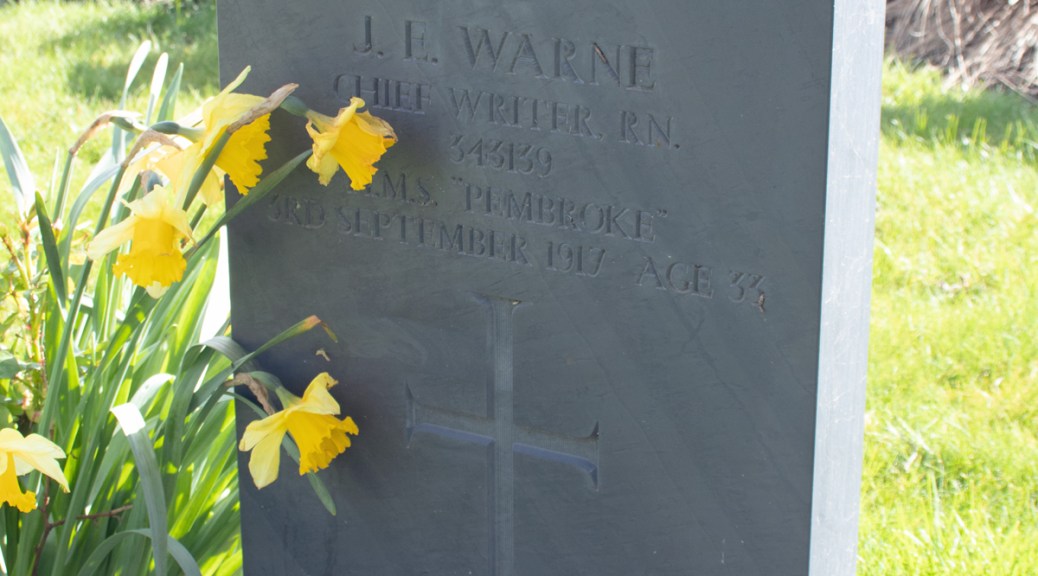
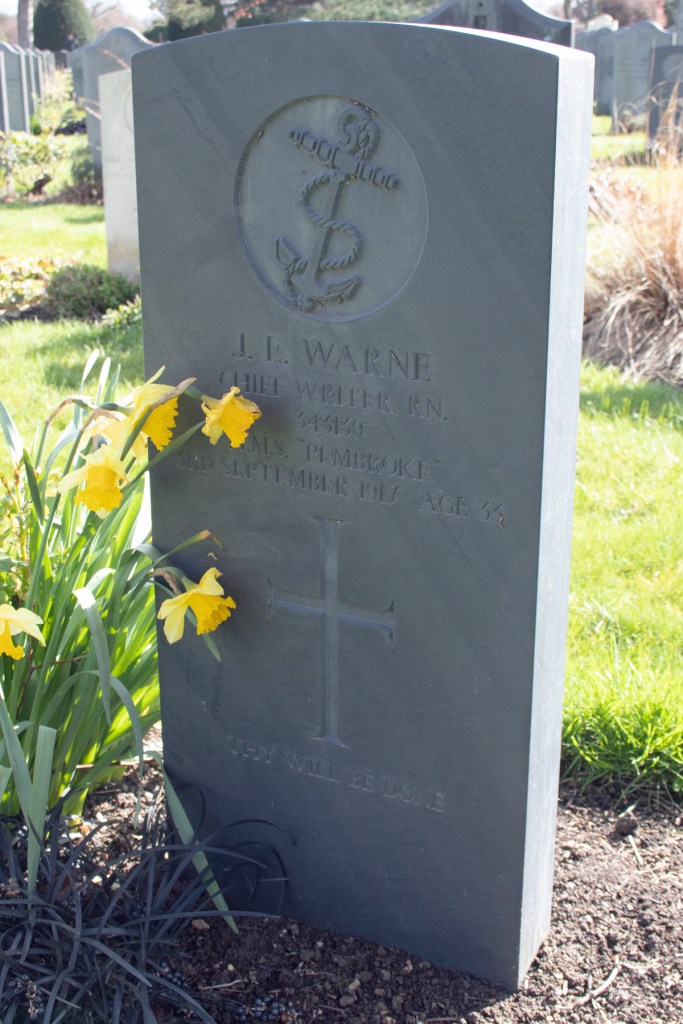
Chief Writer James Warne

Chief Writer James Warne

James Edwin Warne was born on 4th August 1884, in Portsmouth, Hampshire. He was one of four children to shipwright Edwin Warne and his wife Elizabeth.

The naval life was all around him and, straight out of school, James sought out a career in the service and, on 28th December 1899, aged just 15 years old, he enlisted. His service records show that he was just 5ft 2.5ins (1.59m) tall, had dark brown hair, brown eyes and a dark complexion. Initially taken on in the role of Boy Writer, he was sent to HMS Pembroke, the Royal Naval Dockyard in Chatham, Kent, for training.

Over the next couple of years he learned his trade, serving on a couple of ships, but also at HMS Pembroke and the nearby base in Sheerness, HMS Wildfire. When he came of age in 1902, he was formally inducted into the Royal Navy. His records show that his time in the navy were standing him in good stead – he had grown 5ins (13cm) in the previous couple of years.

James was afforded the rank of 3rd Class Writer. This was a mainly clerical role, James would have been involved in the day-to-day welfare concerns for the crew. Over the next twelve years, he honed his trade, serving on a handful of vessels, but being mainly based in Chatham and Sheerness.

By the time James’ initial period of service came to an end in August 1914, he had risen through the ranks to 2nd Class Writer (in 1906) and 1st Class Writer (four years later).

It was while James was based in Sheerness that he met Emily Jane Hayes. She was the daughter of a naval boilermaker; the couple married in 1906, and went on to have four children: Leonard, Jenny, Edwin and Phyllis.

When war broke out, James’ contract with the Royal Navy was renewed, and he was promoted to Chief Writer. He became permanently based at HMS Pembroke, and the family set up home in Nelson Road, Gillingham, not far from the Dockyard.

In the summer of 1917, HMS Pembroke was an overcrowded place. This was compounded by two events: men who had been earmarked to join the HMS Vanguard had been forced to remain at the barracks after the ship had been sunk at Scapa Flow, while an outbreak of ‘spotted fever’ in the barracks meant that the sleeping accommodation had to be increased in an effort to avoid further infection.

This would have increased Chief Writer Warne’s workload and hours, and he slept on site, in temporary accommodation set up in the barracks’ Drill Hall.

On the night of the 3rd September, the German Air Force conducted the first night time raid on England. Chatham came in the firing line, and the Drill Hall received a direct hit.

Given the proximity of the dockyard to the family home, Emily must have known something was wrong, and could only have hoped that her husband was not involved. Sadly, Chief Writer Warne was among those to be killed. He was 33 years of age.

James Edwin Warne was laid to rest in Gillingham’s Woodlands Cemetery – again, walking distance from the family home – along with the other victims of the Chatham Air Raid.