


Charles James Welling was born on 23rd October 1860, and was the oldest of three children to Charles and Ann Welling. The Wellings were a military family, Charles Sr employed as a Serjeant Instructor of Musquetry in the Parkhurst Barracks on the Isle of Wight when his son was born.
Ann had been born in South Africa while her Irish parents were based out there. She and Charles Sr married in Farnham, Surrey, presumably where the families were based by that point.
Charles Jr’s mother died in 1863, just a month after giving birth to his youngest sibling. His father married again, to Sarah Ash, and by 1871, the Wellings were living in barracks at the School of Musketry in Hythe, Kent.
Being his father’s son, Charles Jr was set to make his own mark on the world and, on 21st January 1876, he joined the Royal Navy. Too young to formally enlist, he was given the rank of Boy 2nd Class, and sent off to HMS Impregnable, the shore base in Devonport, Devon, for his training.
Over the next eighteen months, Boy Welling learnt his trade, spending time at HMS Ganges – another shore base near Ipswich, Suffolk – and the sloop HMS Penguin. It was here that Charles came of age in 1878, and he officially joined the Royal Navy with the rank of Ordinary Seaman. His service papers show that he was just 4ft 10.5ins (1.49m) tall, with light brown hair, blue eyes and a fair complexion.
Ordinary Seaman Welling career was to take a turn in 1880, when he began training as a signaller. His initial contract with the navy was for ten years, and, by the time that came to an end in May 1889, he had served on eight ships in all, rising through the ranks from Signalman 3rd Class, to Signalman 2nd Class in August 1881 and Qualified Signalman seven years later.
When Charles’ term of service came to an end, he immediately renewed it, and with the new contract came a promotion to Leading Signalman. The next decade saw him travel the world, returning to HMS Pembroke, the Royal Naval Dockyard in Chatham, Kent, in between voyages. His commitment to the role paid off: in March 1894 he was promoted to 2nd Class Yeoman of Signals. Just eight months later he took the rank of Yeoman of Signals.
It was around this time that Charles married the love of his life, Harriet Carlaw. Born in London, the couple exchanged vows in St Pancras, Middlesex, on 13th January 1894 and had a son, also called Charles, the following year.
Charles’ naval career continued its upward trajectory, and on 1st March 1898, he was awarded the rank of Chief Yeoman of Signals. By this point HMS Pembroke had become his permanent base and, at the end of his contract in 1899, he was stood down to reserve status.
The 1901 census shows what may have been a downward step for the Wellings: it recorded the family living in rooms at 136 Bayham Street, Camden, Middlesex, where Charles was working as a messenger.
Opportunities come in the most unexpected of places, however, and the following census found them living at Pier House, Sunderland, Tyne and Wear, where Charles was employed as a lighthouse keeper.
By this point, Charles had been invalided out of the navy for medical reasons. The writing on his service papers is unclear, and his dismissal seems to have been as a result of disease of gestes, possibly the neurological disorder dystonia.
When war broke out in 1914, however, anyone with experience was called upon to play their part. Given his age at the time, it seems likely that Charles volunteered for service, reporting to HMS Pembroke on 2nd August 1914. He was given his old rank of Chief Yeoman of Signals, and remained at the naval base for the next two years.
Charles’ health was definitely suffering by this point, and he was admitted to the Royal Naval Hospital in Chatham, in September 1916. Suffering from the heart condition endocarditis, this would take his life. He passed away on 16th September, at the age of 55 years old.
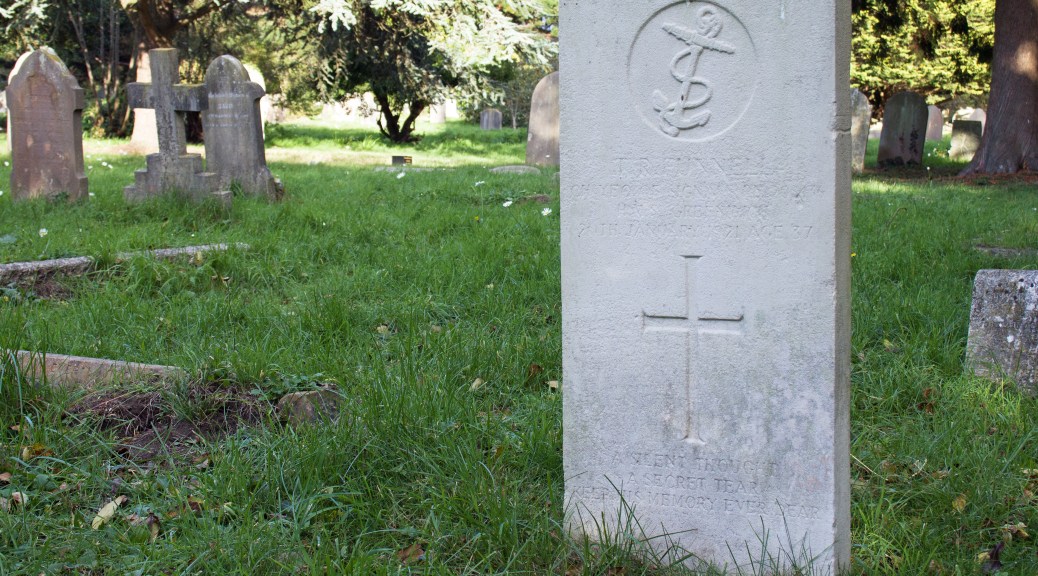
With Harriet still living in Sunderland, Charles’ body was laid to rest in Woodlands Cemetery, Gillingham, Kent, not far from the base he had called home for so long.
Charles and Harriet’s son had also stepped up to play his part when war broke out. Enlisting in the Royal Engineers, Pioneer Welling soon found himself in the Middle East. While serving in Palestine, he contracted malaria, and passed away from the condition on 16th October 1918. Charles was just 23 years of age, and was laid to rest in Haifa War Cemetery.
It is tragic to note that Harriet had lost her husband and her son within two years.

 Death and Service