George William Sandell was born on 13th August 1902, the oldest of five children to William and Mary Sandell. While George was born in Chichester, William raised the family in Worthing; he was a carpenter and joiner by trade, and came from a local building family.
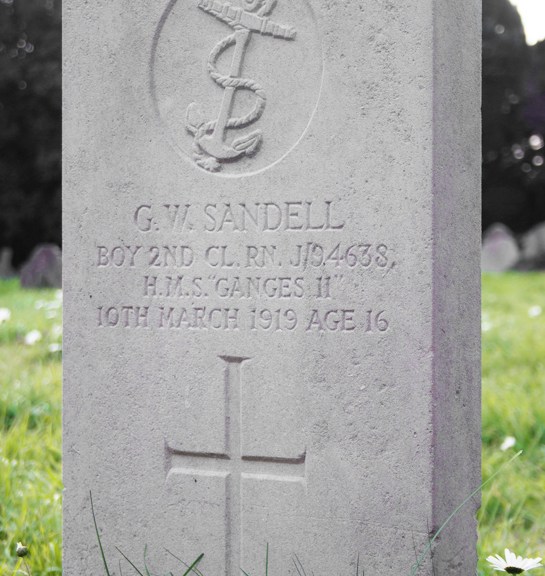
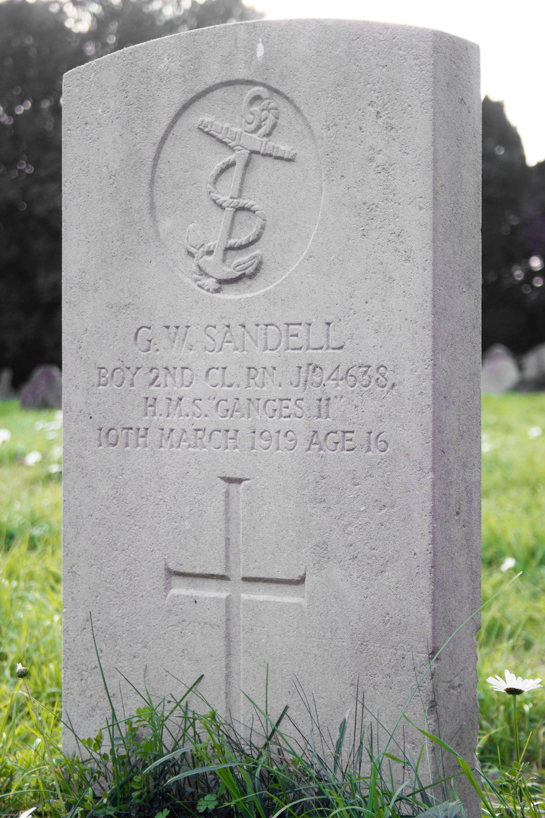
When George left school, he found work as a porter on the railways. Too young to be directly involved in the 1914-1918 conflict, he was definitely for adventure, and, on 5th February 1919, he enlisted in the Royal Navy.
Assigned the rank of Boy – because of his age – he was sent to HMS Ganges II, a training establishment in Suffolk. His decision to enlist was set to be young George’s undoing; within weeks he had contracted pneumonia, and he passed away on 10th March 1919. Tragically, he was just 16 years old.
William and Mary brought their boy back to Worthing; he was buried in the Broadwater Cemetery there, within walking distance of their home.
For me, a huge coincidence to this story is that I lived in the house George was brought up in. He was raised at 27 Southfield Road, in Worthing, up until he was sent for training in 1919. I lived at the same address for a number of years in the early 2000s.
Edgar Godden was born in the summer of 1892, one of eight children to John and Alice Godden. John came from Littlehampton, and Alice from Worthing, and this is where they raised their family.
John was a bricklayer, and it was this trade that Edgar went into when he left school. War was coming to Europe, however, and, within weeks of the conflict breaking out, he had volunteered his services.
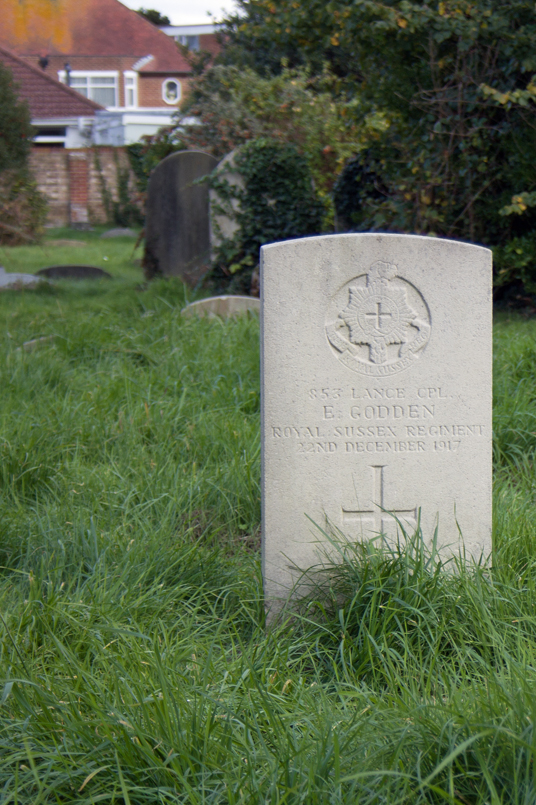
Edgar joined the Royal Sussex Regiment, and was assigned to the 7th (Service) Battalion. Details of his military service are a little sketchy, but a newspaper article, written after his death, gives a hint about what happened to him.
Mr Edgar Godden… who was twenty-five years of age and leave a widow and a little child, enlisted on the 1st September 1914, and was wounded in the arm in September of the following year. In October 1916 he was blown up and buried by an enemy mine. Last February he was taken out of the trenches and sent to a hospital in France, and last April he came home to England and had an arm amputated. Since his discharge from the Seventh Royal Sussex Regiment, he had been a member of the staff of the Post Office, and was known as “The One-armed Postman”.
Worthing Gazette: Wednesday 10th January 1918.
In the autumn of 1916, and recovering from his injuries Lance Corporal Godden married Emily Owers. They lived with John and Alice, but I have been unable to find details of the child mentioned in the newspaper report.
It seems that his injuries had left Edgar in a weakened state, and, after a ‘short and painful illness’ [Worthing Gazette: 2nd January 1918], he passed away on 22nd December 1917. He was just 25 years of age.
Edgar Godden was laid to rest, finally at peace, in the Broadwater Cemetery in his home town of Worthing, West Sussex.
The newspaper report above gave a little more information about a couple of Edgar’s siblings.
Mr & Mrs [John] Godden had one son killed in action in November 1916; and still another – the eldest – is now in France, as a member of the Royal Engineers.
Worthing Gazette: Wednesday 10th January 1918
Edgar’s oldest brother – also called John – survived the war, but it was his younger brother, Charles, who was killed in action.
A Corporal in the 11th Battalion of the Royal Sussex Regiment, Charles was caught up in the Battle of the Somme. It was while fighting in the Battle of the Ancre on 13th November 1916, that he was killed. He is remembered at the Thiepval Memorial in Northern France, and is also commemorated on Edgar’s own headstone.
One last aside to Edgar’s story is his address in the last few years of his life. John and Alice were living in Worthing, specifically at a house called “Chiswick” in Tarring Road, to the west of the town.
Coincidentally, when researching another soldier, Private Ernest Parsons, this turns out to be the address where he also died, just ten months later on 4th October 1918. There is no apparent other link between the two men.


 Death and Service