Tag Archives: Dorset Yeomanry

Private William Biddlecombe

Private William Biddlecombe

William Charles Biddlecombe was born in the spring of 1896, and was the third of nine children to Robert and Eliza. Both of his parents came from Hampshire, but their older children – William included – were born and raised in Poole, Dorset. Robert was a police constable there, but moved to the village of Longburton, near Sherborne, in around 1910.

According to the 1911 census, William was two of the household of eight to be employed, having found work as a gardener when he finished his schooling. Storm clouds were brewing across Europe, however, and he would be called upon to play his part.

Full service details have been lost to time, but it is clear that William had joined the Dorset Yeomanry (Queen’s Own) by the summer of 1915. He was attached to the 3rd/1st Battalion. The unit was based on home soil and there is no evidence that Private Biddlecombe saw any action overseas.

At this point, William’s trail goes cold and, in fact, the next record for him is that of his passing: “The funeral took place on Wednesday amid every token of respect and esteem of Trooper W Biddlecombe, of B Squadron (3/1st Dorset QO Yeomanry, son of PC and Mrs Biddlecombe of Westhill Police-station.” [Western Gazette – Friday 18 February 1916]

William Charles Biddlecombe died on 15th February 1916: he was 20 years of age. He was laid to rest in the peaceful graveyard of St James the Great Church in Longburton, close to where his grieving family lived.


William’s was not the only passing that his grieving mother would have to attend to. On 18th December, Robert was on duty, which had taken him into Sherborne. He was suddenly taken ill, and rushed to the town’s Yeatman Hospital, but died the same day. He was laid to rest close to his son in Longburton.


William’s younger brother, Robert, also served during the First World War. As a Private, he was attached to the 8th Battalion of the Somerset Light Infantry, and spent time fighting in Northern France. He was caught up and was killed in the Second Battle of Cambrai. He died on 9th October 1918, and was laid to rest in Naves Communal Cemetery Extension.


Gunner William Merritt

Gunner William Merritt

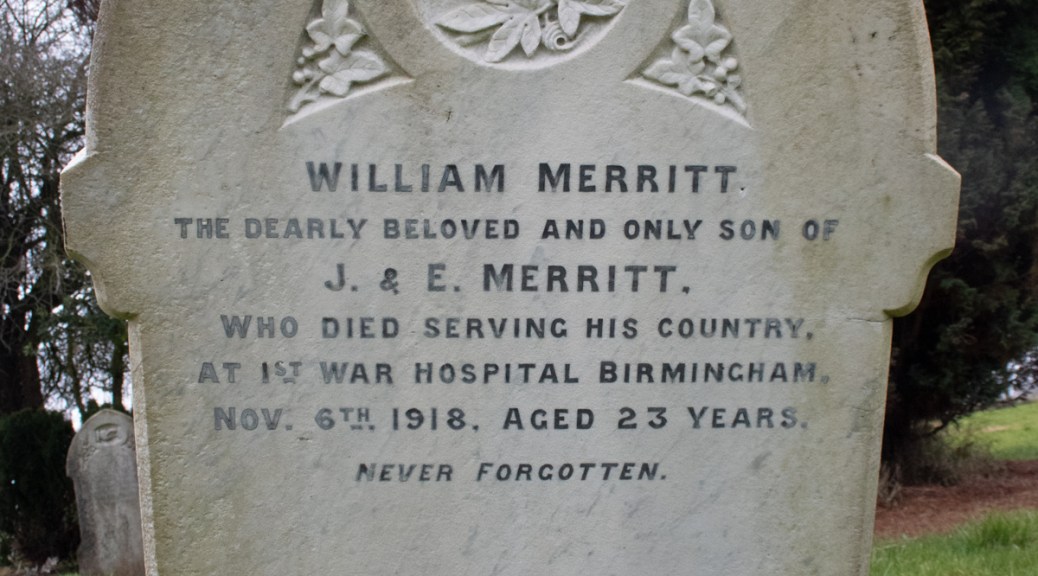
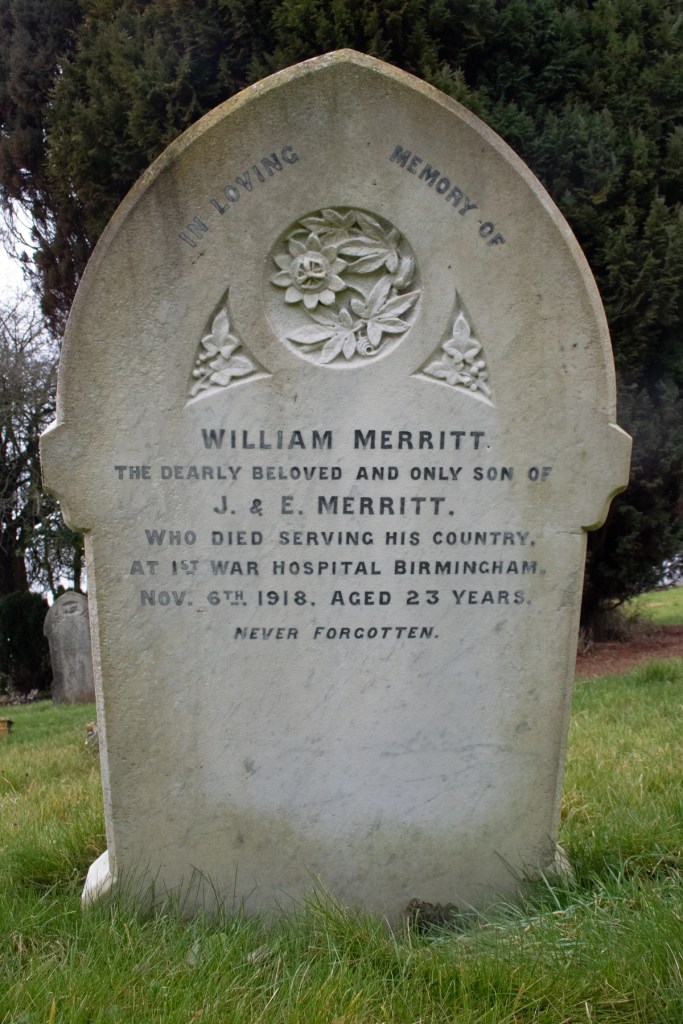
William Merritt was born in the summer of 1895 in Chippenham, Wiltshire. He was the youngest of three children to John and Elizabeth Merritt. John was a blacksmith, and he moved the family to Milborne Port, Somerset, when William was just a boy.

William found work as a shoesmith when he left school, but was one of the first to enlist when war broke out in 1914. He had his medical examination on 17th November, which confirmed that he was 5ft 5ins (1.65m) tall, had good vision and was of good physical development.

Initially assigned to the Dorset Yeomanry, Private Merritt’s trade soon found him taking on the role of Shoeing Smith for the battalion. He was obviously good at what he did, because by May 1915, he had been promoted to the rank of Corporal Shoeing Smith.

William had not enlisted in the army to make and mend shoes, however, and, in March 1916, he transferred to the Royal Garrison Artillery, back with the rank of Gunner. Rather than being sent to the Western Front, however, he found himself billeted at a camp in the West Midlands.

Little further information about Gunner Merritt’s service is available for the next couple of years. The next record for him comes on 5th November 1918, confirming his admission to the Birmingham War Hospital, as he was suffering from influenza and pneumonia. Sadly, his admittance to hospital was to prove too late: he passed away from heart failure the following day. Gunner Merritt was just 23 years of age.

William Merritt’s body was brought back to Somerset for burial. He was laid to rest in the cemetery of the town in which he had plied his trade before the war, Milborne Port.


William’s sparse personal effects were also returned to his parents. The records note that these included: “pair [of] boots, 6 postcards, razor, comb, toothbrush, shaving soap and brush, letter, pair of socks, bell.”

Another bureaucratic error is highlighted in a letter sent from the hospital in which William passed to his regiment’s records office notes that “I have to inform you that the body was forwarded to his Wife for burial…” William was unmarried, and his body was actually returned to his mother, Elizabeth.


Lance Corporal William Warne

Lance Corporal William Warne

William Henry Warne was born in Walworth, South London, in March 1892. His father is not named, but his mother was Ellen Warne (or Gould), who was “living on her own means”. He had two older siblings, Fred – whose surname is listed as Gould – and Gertie Warne.

By the time of the 1911 census, William was a law clerk in West Coker, near Yeovil in Somerset. The record shows him living with his mother and sharing her surname – which was now listed as Gould. Again, Ellen’s occupation was “private means”.

William’s full military service records are not available, but various sources produce a little information.

Private William Warne had enlisted in the Dorset (Queen’s Own) Yeomanry by April 1915, as this is when he was dispatched to Egypt. August 1915 saw his battalion shipped to Gallipoli; William survived this horrendous battle and returned to Egypt by the end of that year. As a result, he earned the 1915 Star medal.

When the Dorset Yeomanry was retitled, Private Warne became part of the Corps of Hussars. After Egypt, the battalion moved to Palestine, where they saw out the war. He was appointed Lance Corporal at some point during this time.

The exact details of his passing are lost to time; he passed away on 9th October 1918 at the British Red Cross Hospital in Netley, and his records suggest that he died of wounds. He was 26 years old.

Lance Corporal Warne’s life was an intriguing one from start to finish.

The Army Register of Soldiers’ Effects is a document that shows how much was paid out to the relatives of soldiers who have passed away in service; in the research I have carried out over the last few months, this amount has generally ranged between £2 and £8, rarely reaching double figures.

William’s mother and sister, however, received a significant amount. The initial payment was £31 13s 8d, and this was followed by a second figure of £19 10s. There may be various reasons for this – the campaigns William fought in, the prestigious regiment, the appointment to Lance Corporal – but again this is another mystery that will remain such.

Lance Corporal William Warne lies at rest in Sherborne Cemetery.