Tag Archives: Hussars

Private Reginald Payne

Private Reginald Payne

Reginald Payne was born on 27th January 1898 in Milverton, Somerset. He was the third of five children – and the oldest son – to Thomas and Mary Payne. Thomas was a dairyman, and both he and Mary were from Devon: the family moved back to the county after Reginald was born, and, by the time of the 1911 census, they had settled in the village of Halberton.

Reginald, at this point, was still in school, and there is little information about his life. When war broke out, he volunteered to serve his country, but, with no military records remaining, the only point of reference for him is a newspaper report of his funeral.

Quite a gloom was cast over Halberton when it became known that Pte. Reginald Payne, eldest son of Mr & Mrs T Payne, of Brimery Dairy, had passed away at the Military Hospital, Devonport. Deceased, who enlisted in 1916 in the Hussars, and was attached to the 1st City of London Yeomanry, proceeded to Egypt, and whilst there he underwent two operations for appendicitis. He returned to England after recovering, and was sent to Ireland, where he had a return of the old trouble, and was again operated on four times, and then sent to Devonport, where he passed away.

[Western Times: Friday 6th February 1920]

Reginald Payne was a day over 22 years of age when he passed away. He was taken back to Halberton for burial, and was laid to rest in the peaceful St Andrew’s Churchyard.


Serjeant-Trumpeter Alexander de Vere

Serjeant-Trumpeter Alexander de Vere

Alexander Johnstone de Vere was born on 10th August 1889 in Murree, India (now Pakistan). He was one of five children to Norfolk-born Alexander Johnstone (also known as John Ralph de Vere), and his wife Dorothea who had been born in Sangor, India. Alexander Sr was a Sergeant Major in the 12th Lancers, and the family returned to England not long after his son was born, settling first in Aldershot, then in Sandhurst.

Alexander’s youngest sibling, George, was born in Cairo, Egypt, so the family was on the move again. Sadly, Alexander Sr died in a nursing home in the city just two years later and, after returning to England, Dorothea passed away in a Holborn infirmary just two years later.

Documents for the de Vere children – Ellen, Alexander, Dorothea, William and George – are few and far between. The 1911 census places Dorothea boarding with a family in Kingston-upon-Thames, where she was employed as a dress maker. The same document records William as a Bandsman in the 1st Battalion of the Seaforth Highlanders, based at Chanpatia, in Northern India. George, meanwhile, was a schoolboy at the Duke of York’s Royal Military School on the outskirts of Dover. Of the two eldest siblings, however, there is no record.

In the autumn of 1912, Alexander married Emily Louise Collins. Born in Norfolk in 1884, she was working as a servant in a house in Surrey when she and Alexander met. The couple married in Faversham, Kent, and settle down there, their daughter, Dora, being born in the town in January 1915.

Given his family’s military background, it is not unsurprising that Alexander enlisted in the army almost as soon as war was declared. He may have already seen military service, as he enlisted in the 11th Hussars as a Lance Corporal. By 15th August 1914, Alexander was in France.

Lance Corporal de Vere was quickly caught up in the fighting. He saw action at Mons and Nery in 1914, and at Ypres the following year. By this point, he had been promoted to the rank of Sergeant Trumpeter, reflecting the musical connection he shared with his younger brother, William.

Alexander remained in France until January 1916, when he was invalided home. He was admitted to Dorchester County Hospital in Dorset, suffering from a cerebral abscess. Despite treatment, he succumbed to the condition, passing away on 17th March 1916, at the age of just 26 years old.

Alexander Johnstone de Vere was brought back to Kent for burial. He was laid to rest in Faversham Borough Cemetery.


Private George Dove

Private George Dove

George Dove was born in Wincanton, Somerset, on 4th December 1883. One of five children, his parents were farm labourer George Dove and his wife, Jane.

George Jr did not follow his father into farm work: the 1901 census found him boarding with a family in Radstock, working in one of the coal mines in the area. Ten years later, he was living back with his family, employed as a groom.

His work with horses stood him in good stead when war was declared. George enlisted early on, and was assigned to the 19th (Queen Alexandra’s Own Royal) Hussars as a Private. By October 1914, he was in France, returning to England with his squadron the following spring.

At some point during the conflict, Private Dove transferred to the Reserve Regiment of Cavalry. He was posted to the 5th Regiment, which trained men for the Northumberland Hussars and Yorkshire Dragoons, amongst others.

Further details of George’s life are scarce; at some point, he married a woman called Emily, although records of the couple’s wedding no longer exist. The only thing that can be confirmed is that George was admitted to the Bermondsey Military Hospital in Surrey, where he passed away on 24th October 1918. He was 34 years old.

The body of George Dove was brought back to Somerset for burial. He lies at rest in the cemetery in his home town, Wincanton.


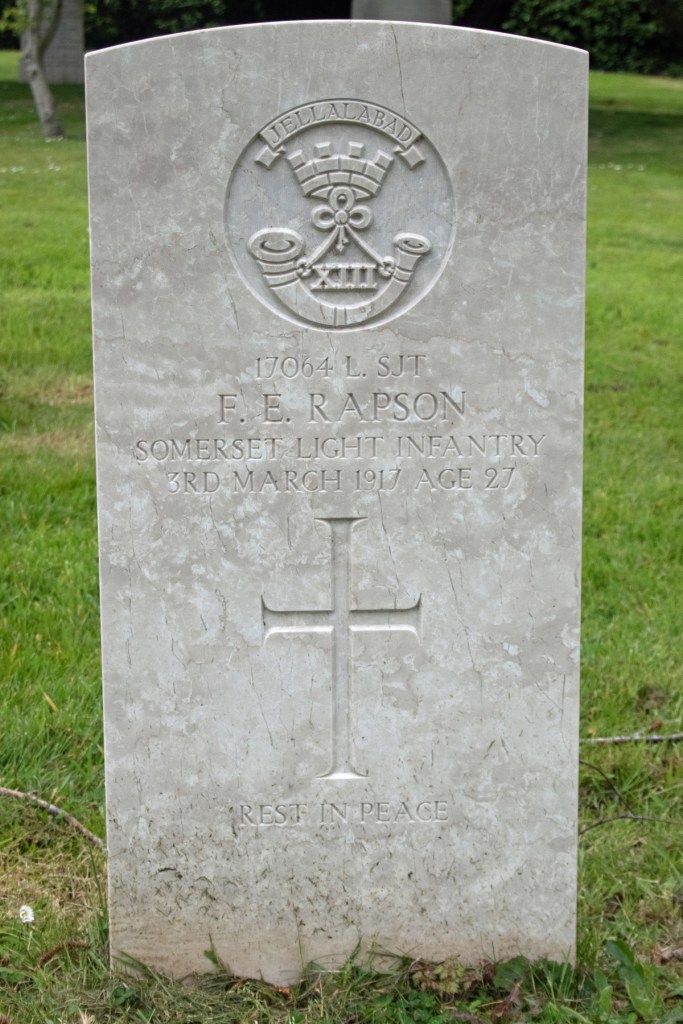
Lance Serjeant Frederick Rapson

Lance Serjeant Frederick Rapson

Frederick Ernest Rapson was born in the spring of 1888, one of nine children to Francis and Susan Rapson. Francis was a Serjeant in the 18th Hussars, and the family lived in Dulverton, a village on the edge of Exmoor.

Francis had served in the armed forces for 26 years, but passed away after a short illness in February 1891. According to a local friend and supporter, he had been in charge of the local yeomanry in Dulverton for a number of years and had been ‘in the prime and flower of life’. [West Somerset Free Press: Saturday 28th February 1891]

Susan was left widowed with nine children, the eldest of whom was only 13 years old. Frederick was only three at the time, and had lost his father at a very early age.

In 1895, Susan married a Frederick Howard, who was a painter and carpenter. The family moved to Taunton in Somerset, and Frederick and Susan went on to have three children of their own.

On 6th February 1910, Frederick Rapson married Lucy Knight; by this time, he was working as a compositor for the local newspaper. The couple set up home in the middle of Taunton, and went on to have three children, Francis, Frederick and Ronald.

War was coming, and, while Frederick did not actively seek military service in the same way as his father had done, it was not something he was able to avoid. While his full military records are not available, it’s clear that he enlisted in the Somerset Light Infantry at some point early on in the conflict.

Private Rapson was assigned to the 1st Battalion, who were based on the Western Front for the duration of the conflict. During his time there, he was awarded the Victory and British Medals, but not the 1915 Star, so that would narrow down his enlisting to some point in 1916.

While he was promoted to the role of Lance Serjeant, his service was to be a short one. At the start of 1917, he contracted pneumonia and was admitted to hospital. Sadly, the condition was to get the better of him, and he passed away on 3rd March 1917. He was just 27 years of age.

Frederick Ernest Rapson was buried in a quiet corner of St James’ Cemetery in Taunton, Somerset.