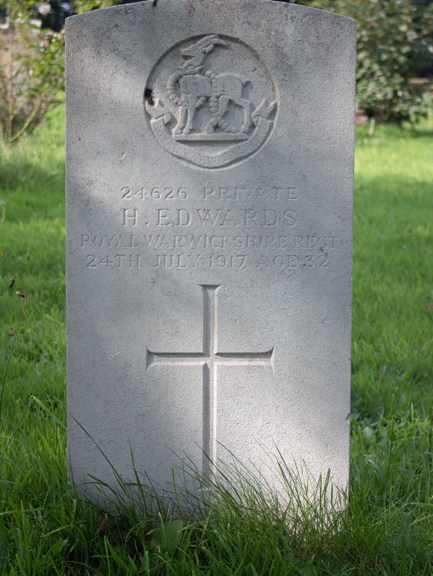
Henry Charles Edwards was born in 1883, the eldest of four children for Joseph and Elizabeth.
Joseph was an agricultural labourer, and Henry (or Harry) followed his father in the farming life, continuing in the role after Joseph died, and up until at least the 1911 census.
I was unable to find much regarding Harry’s military service. He signed up the Royal Warwickshire Regiment, and subsequently transferred to the Somerset Light Infantry.
He died from tetanus on 24th July 1917, aged 34. His pension records give his mother, Elizabeth, as his beneficiary.
Private Henry Edwards lies at rest in the churchyard of Lydeard St Lawrence, Somerset.
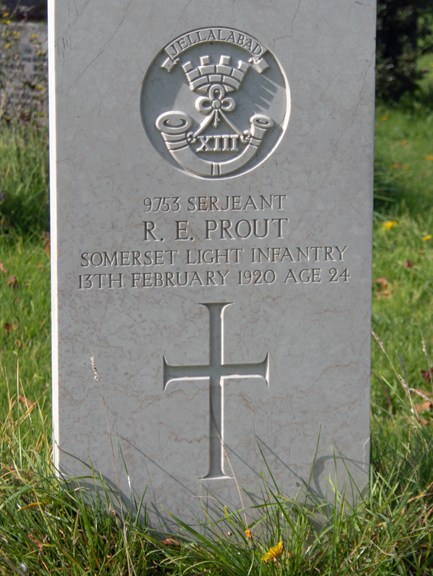
Richard Edwin Prout was born in 1896, the second son of Frederick and Anna (Hannah) Prout. When his father died in 1908, his mother remarried and by the 1911 census, Richard and his family had moved to Lydeard St Lawrence, where he was a baker’s boy.
He enlisted in June 1914, joining the Somerset Light Infantry and served throughout the war, receiving the Mons Star, Victory Medal and General Service Medals.
After the war, he continued in the army, and was assigned to Taunton Barracks.
His passing was unusual enough for it to be reported on in the local newspaper.
Sergt. Prout, it was stated at the Barracks yesterday, had been on leave for some days prior to his departure for Ireland, and had been spending his furlough at Crowcombe, where his parents live. On the evening of his death, he left home, after taking a hearty meal, to catch the 7.25 train to Taunton. He had to walk a mile to Crowcombe station, most of the way uphill. Early the following morning his dead body was discovered lying face downwards by the roadside, about 50 yards from the station. The body was removed to his home, and Dr. Frossard, of Bishop’s Lydeard, was called in to make a post-mortem examination. The doctor has reported that death was due to asphyxia brought on by over exertion on a full stomach, and syncope, following pressure on the neck by the tightness of the collar of his outside jacket, the doctor adding that he had great difficulty in unfastening the collar.
Western Daily Press – Friday 20th February 1920
A genuine case of someone going before their time. Having visited Lydeard St Lawrence, I recognise the hill he would have had to have climbed to reach the station, and it’s steep enough in a car, let alone walking up it.
Sergeant Prout, the newspaper reported, was generally esteemed by his fellow company, and at his funeral he received full military honours.
Richard Edwin Prout lies peacefully in the churchyard of Lydeard St Lawrence.
George Symons was born in 1895 to Charles and Rosa Symons. He was the third of five sons.
Charles worked as a carter on a farm, and his son became a cowman as soon as he could leave school.
Military records for George Symons are pretty sparse. From his gravestone we know he had joined the Somerset Light Infantry by the end of 1917. Assigned to the 4th Battalion, Private Symons’ unit served in India and the Middle East throughout the war, and it was while he was overseas that he was caught up on the fighting.
In the confusion of battle, George was initially recorded as ‘presumed dead’. Subsequently identified as badly injured, he was medically repatriated to Britain for treatment. Admitted to hospital, his wounds were to prove too severe: Private Symons passed away on 23rd June 1918: he was 23 years old.
George Symons’ body was taken back to Somerset for burial. He lies at rest in the churchyard of St Michael and All Angels in Milverton.
William Henry Warne was born in Walworth, South London, in March 1892. His father is not named, but his mother was Ellen Warne (or Gould), who was “living on her own means”. He had two older siblings, Fred – whose surname is listed as Gould – and Gertie Warne.
By the time of the 1911 census, William was a law clerk in West Coker, near Yeovil in Somerset. The record shows him living with his mother and sharing her surname – which was now listed as Gould. Again, Ellen’s occupation was “private means”.
William’s full military service records are not available, but various sources produce a little information.
Private William Warne had enlisted in the Dorset (Queen’s Own) Yeomanry by April 1915, as this is when he was dispatched to Egypt. August 1915 saw his battalion shipped to Gallipoli; William survived this horrendous battle and returned to Egypt by the end of that year. As a result, he earned the 1915 Star medal.
When the Dorset Yeomanry was retitled, Private Warne became part of the Corps of Hussars. After Egypt, the battalion moved to Palestine, where they saw out the war. He was appointed Lance Corporal at some point during this time.
The exact details of his passing are lost to time; he passed away on 9th October 1918 at the British Red Cross Hospital in Netley, and his records suggest that he died of wounds. He was 26 years old.
Lance Corporal Warne’s life was an intriguing one from start to finish.
The Army Register of Soldiers’ Effects is a document that shows how much was paid out to the relatives of soldiers who have passed away in service; in the research I have carried out over the last few months, this amount has generally ranged between £2 and £8, rarely reaching double figures.
William’s mother and sister, however, received a significant amount. The initial payment was £31 13s 8d, and this was followed by a second figure of £19 10s. There may be various reasons for this – the campaigns William fought in, the prestigious regiment, the appointment to Lance Corporal – but again this is another mystery that will remain such.
Lance Corporal William Warne lies at rest in Sherborne Cemetery.
William Larkin was born in 1863, the eldest son of Alfred and Frances Larkin from Cranbrook in Kent.
He disappears off the radar for a few censuses – there are too many variations on his surname to identify exactly where he was on the 1881 and 1891 documents.
From later documents, however, we can identify that he married Eliza in around 1886; the couple had no children. By the 1901 censes the couple were living to the north of Maidstone; ten years later, they were running the Fox & Goose pub in Weavering, Kent.
Private Larkin’s military service is also lacking in documentation, but some information can be pieced together.
Originally enlisting in the Royal West Kent Regiment, he (was) transferred over to the Royal Defence Corps, and served on home soil.
On Sunday 2nd April 1916, Lance Corporal Larkin was on guard at a gunpowder factory in Faversham, Kent. As the Ministry of Munitions reported at the time:
During the weekend a serious fire broke out in a powder factory in Kent, which led to a series of explosions in the works.
The fire, which was purely accidental, was discovered at midday and the last of the explosions took place shortly after two in the afternoon.
The approximate number of casualties is 200.
Thanet Advertiser: Saturday 8th April 1916.
William was not killed during the Faversham Explosion, but Boxley Parish Council (who covered the Weavering area) carried out research on the names on the village war memorial. According to that research, William “developed cancer after the ‘Faversham Powder Works’ explosion”. He died two months later, on 8th July 1916. He was 53 years of age.
Lance Corporal William Larkin lies at rest in the graveyard of St Mary & All Saints Church in Boxley, Kent.
More details of the Faversham Explosion, along with the servicemen who died there, can be found here.
It is often a challenge to find details of the fallen soldiers whose graves pepper the churchyards of the UK.
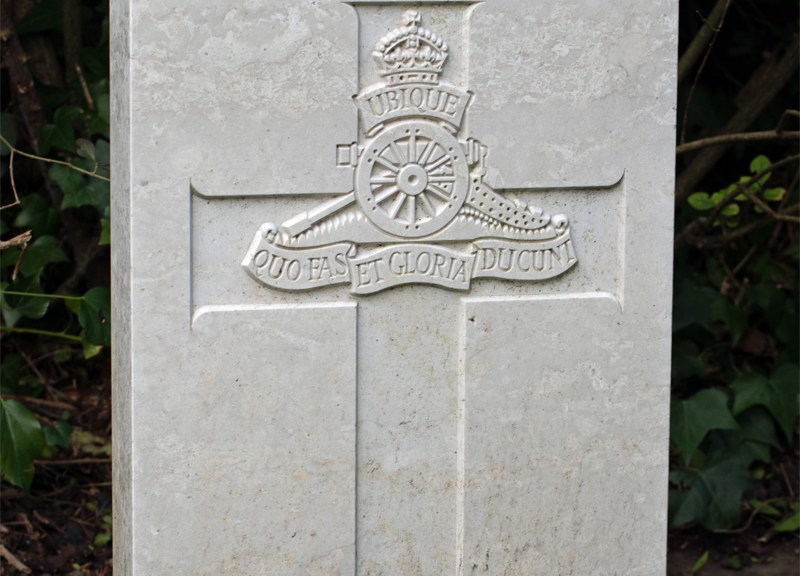
Sadly, Gunner Thomas Kelly is one of those names lost to time.
Born in 1893, he lived in Alsager, Cheshire and enlisted in the Royal Field Artillery. He served in the Balkans during the war and was wounded. Brought back home to the Yeatman Hospital in Sherborne, Dorset, he died of his wounds on 11th January 1918.
He was buried in the town’s cemetery on 16th January 1918; he was just 25.
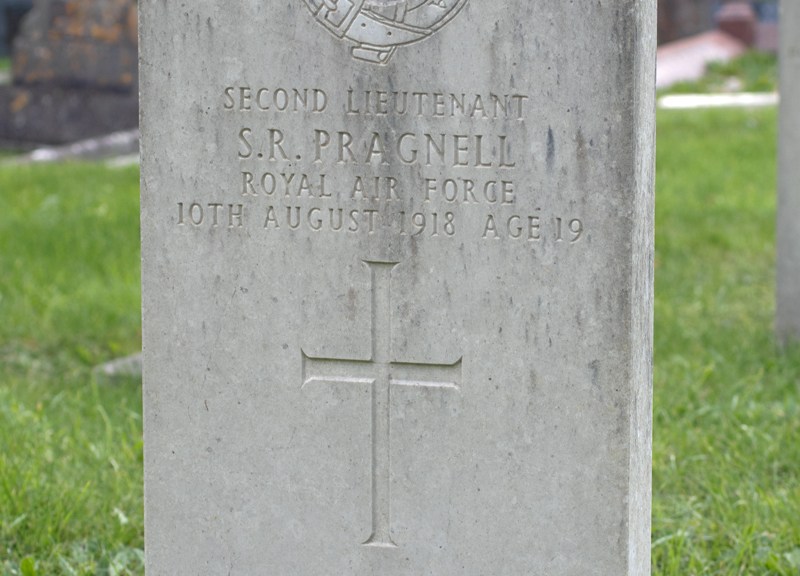
Sidney Ralph Pragnell was the eldest of two children of Edward and Ellen Pragnell. Edward grew up in Sherborne, before moving to London to work as a chef; he found employment as a cook in an officer’s mess, which took him and his wife first to Ireland – where Sidney was born – and then to the barracks at Aldershot.
By the time of the 1911 census, Edward had brought his family back to Dorset, and was running the Half Moon Hotel, opposite the Abbey in Sherborne. Sidney, aged 12, was still at school.
When war broke out, Sidney was eager to play his part, even though he was underage. An article in the local newspaper highlights his keenness and how he progressed.
…he was keen to serve his country and joined every local organisation his age would allow him to. He was an early member of the Sherborne VTC and Red Cross Detachment, and was actually the youngest member of the Volunteers to wear the uniform. Whilst still under age, he enlisted in the Royal Naval Division at the Crystal Palace and after a period of training was drafted as a qualified naval gunner to a merchant steamer carrying His Majesty’s mails and in this capacity went practically round the world. In February he joined the RNAS and after some air training in England went to France to an air station, where he passed all the tests with honours and gained the ‘wings’ of the qualified pilot. Lieutenant Pragnell then decided to go in for scouting and came back to England for advanced training in the special flying necessary for this qualification and it was whilst engaged in this that he met with the accident which resulted in his death.
Western Chronicle: Friday 16th August 1918.
The esteem in which Second Lieutenant Pragnell was held continues in the article, which quotes the condolence letter sent to his parents by his commander, Major Kelly.
It is with deep regret that I have to write you of the death of your son, Second-Lieutenant SR Pragnell. Your boy was one of the keenest young officers I have ever had under my command and was extremely popular with us all and his place will be extremely hard to fill.
The service can ill afford to lose officers of the type of which Lieutenant Pragnell was an excellent example and it seems such a pity this promising career was cut short when he had practically finished his training. May I convey the heartfelt sympathy of all officers and men in my command to you in this your hour of sorrow.
Western Chronical: Friday 16th August 1918.
What I find most interesting about this article is that the letter from Major Kelly detail how Edward and Ellen’s son died, and this this too is quoted by the newspaper.
Your son had been sent up to practice formation flying and was flying around the aerodrome at about 500 feet with his engine throttled down waiting for his instruction to ‘take off’. Whiles waiting your boy tried to turn when his machine had little forward speed. This caused him to ‘stall’ and spin and from this low altitude he had no chance to recover control and his machine fell to earth just on the edge of the aerodrome and was completely wrecked. A doctor was there within a minute, but your boy had been killed instantaneously.
Western Chronicle: Friday 16th August 1918.
Further research shows that the aerodrome Second Lieutenant Pragnell was training at was RAF Freiston in Lincolnshire, which had been designated Number 4 Fighting School with the specific task of training pilots for fighting scout squadrons. He had been flying a Sopwith Camel when he died.
Second Lieutenant Sidney Ralph Pragnell lies at rest in the cemetery of his Dorset home, Sherborne.
Edward (Teddy) Lewsley was born in 1894, the ninth of twelve children to James and Charlotte Lewsley from London.
James had worked with horses, and become a cab driver at the turn of the century; Edward started as a general labourer on finishing school.
Edward’s military history is a little vague. From his gravestone, we know that he joined the Duke of Cornwall’s Light Infantry and was in the 1st Battalion. The battalion fought at the Battles of Mons, Marne and Messines.
In the spring of 1915, Edward’s battalion fought in the Second Battle of Ypres and, given the timing, it seems likely that he was involved.
Whether he was on the Western Front or stationed in the UK, Private Lewsley was admitted to the Red Cross Hospital in Sherborne, where he passed away on 30th May 1915. He was buried in the town’s cemetery.
One of Edward’s brothers also enlisted in the Light Infantry.
Daniel Lewsley first joined the East Surrey Regiment in 1909 and continued through to 1928. This included a stint as part of the British Expeditionary Force in France.
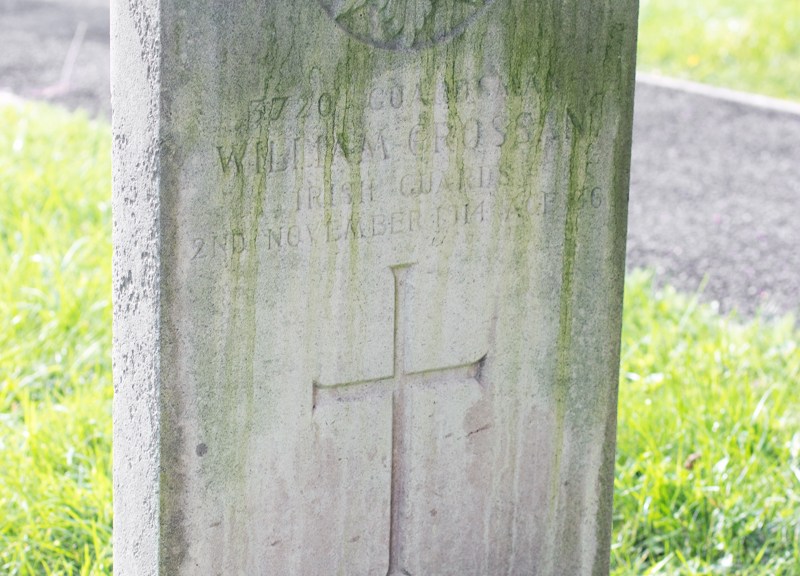
William Crossan was born in 1892 in Ballinamore, Ireland. He was the fourth of five children to Patrick and Catherine Crossan.
William disappears from the 1911 Census of Ireland, but has joined the Irish Guards by the time war broke out.
Guardsman Crossan’s battalion was involved in the Battle of Mons, but it was during the fighting at Ypres that he was injured.
Shipped back to the UK for treatment, William passed away on 2nd November 1914. While details are scarce, presumably he died at one of the Red Cross Hospitals in the Sherborne area, as this is where he was buried.
Guardsman William Crossan lies at rest in Sherborne Cemetery.
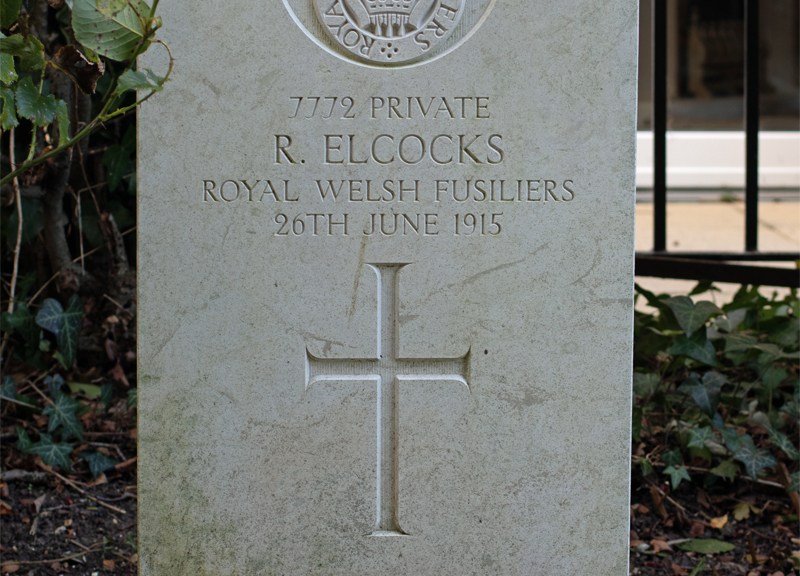
Richard William Elcocks was born in Wellington, Shropshire, the second son of foundryman Thomas Elcocks and his wife Emma. Born in June 1883, he was one of nine children.
After initially becoming a printer’s apprentice, he enlisted in the Royal Welsh Fusiliers in May 1903. After his initial training and service, Private Elcocks was transferred to the Army Reserve in 1911.
In January 1914, Richard married Charlotte Shenton. Charlotte was a widow ten years his senior, and had two children, Albert and Fred.
When war broke out, Private Elcocks was again called up and shipped to France as part of the British Expeditionary Force. His records confirm that he received a gunshot wound to the left arm on 31st October 1914; the injury was enough for him to be shipped back to the UK for treatment.
He was treated in the Yeatman Hospital in Sherborne, Dorset, and appears to have been there for some time. His records state that he died on 26th June 1915 from an ‘intestical [intestinal?] obstruction following gun shot wound of left humerous’. He was 32 years of age.
Private Richard Elcocks lies at rest in Sherborne cemetery.









 Death and Service