Tag Archives: Balkans

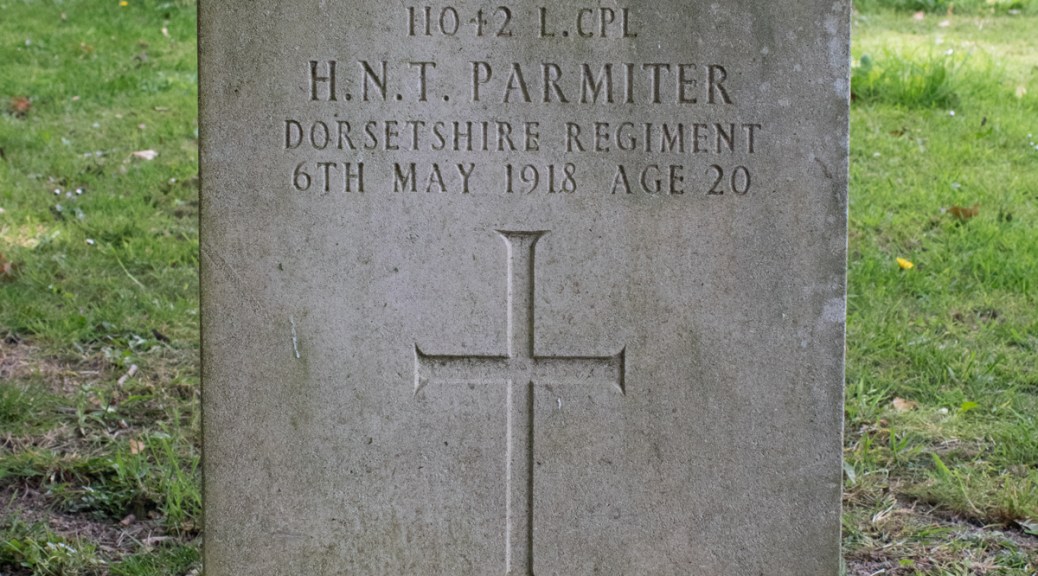
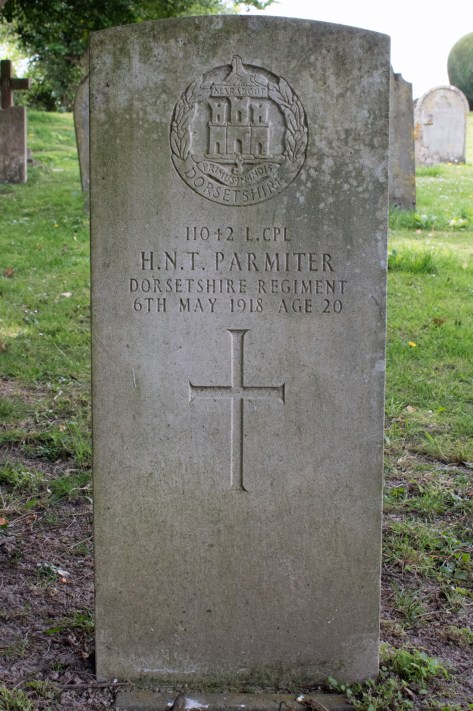
Lance Corporal Hugh Parmiter

Lance Corporal Hugh Parmiter

Hugh Norman Trivick Parmiter was born on 21st February 1898, and was the sixth of ten children. His father, James, was a Sergeant in the Dorsetshire Regiment, and the family travelled to where the army needed him. Hugh was the third of the children to be born in Bangalore, India, while his mother, Annie, gave birth to his oldest two siblings in Egypt.

By 1900 the Parmiters had returned to Britain, Annie and the children living in family barracks in Dorchester, while James was being trained in Hythe, Kent.

The 1911 census records the family living in the rural Dorset village of Gussage St Michael. Having been pensioned from the army, James was employed as a dairyman, and the family lived in a modest village cottage. At thirteen years of age, Hugh was still attending school, growing up in the peaceful surroundings of the Dorset countryside.

When war broke out, Hugh stepped up to play his part. Full details of his service have been lost to time, but from what remains it is clear that he enlisted in the Devonshire Regiment in the opening weeks of the war. By 11th July 1915, Private Parmiter’s unit was ensconced in the Balkans.

Hugh was caught up in the fierce fighting at Gallipoli, and rose to the rank of Lance Corporal. He would not come out unscathed, however, and was medically evacuated to Britain for treatment. While details of his injuries are unclear, they were severe enough for him to be medically discharged from the army: he was formally stood down on 17th January 1916, a week after the final evacuations from the Dardanelles Strait.

At this point, Hugh’s trail goes cold. James had passed away in 1914, and Annie had moved to Pimperne, a village on the outskirts of Blandford Fordham. Hugh’s health still dogged him however, and he passed away on 6th May 1918: he was 20 years of age.

The body of Hugh Norman Trivick Parmiter was laid to rest in St Peter’s Churchyard in Pimperne.

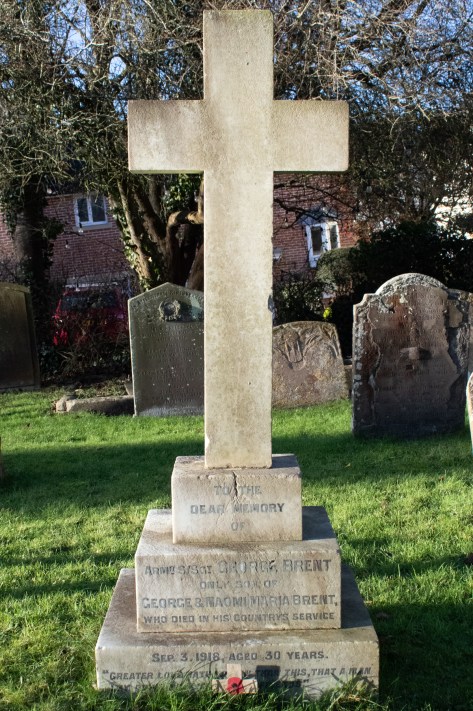
Staff Serjeant George Brent

Staff Serjeant George Brent

George Brent was born in the autumn of 1887 in Bratton, Wiltshire, and was the only child to George and Naomi Brent. Census records humbly record George Sr was a wool carder, although he actually ran Luccombe Mill, the family living in the substantial Luccombe House.

George had been widowed in the 1870s, and was thirty-four years older than his second wife, Naomi. When he died in 1900, she was left to raise her teenaged son. She was not on her own, however, the 1901 census recording her as living on her own means, and with servant Eliza Whately to support her.

Education was important to Naomi, and by the time of the 1911 census, George was working as a draughtsman and designer for an engineering company. War was on the horizon, however, and he would step up to serve his country.

George enlisted in the Army Ordnance Corps, and served in the Balkans from October 1915. Full details of his time in the army have been lost, but he rose through the ranks and, by the summer of 1918, he was a Staff Serjeant.

At some point love blossomed and, George married a woman called Edith. Sadly, her life is destined to remain a mystery: she is noted as being George’s widow on his probate record and his beneficiary in the Army Register of Soldiers’ Effects.

Staff Serjeant Brent’s health seems to have suffered after three years in the eastern Mediterranean. He was admitted to the military hospital in Mansfield, Nottinghamshire, although his condition is unclear. He passed away on 3rd September 1918, at the age of 30 years old.

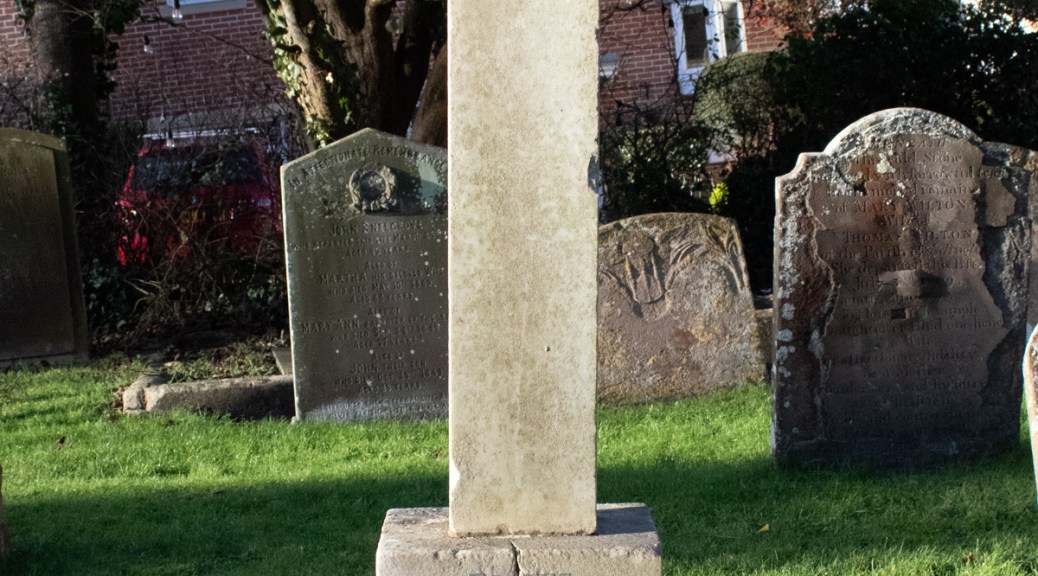
The body of George Brent was taken back to Wiltshire for burial. He was laid to rest in Bratton Baptist Chapelyard, not far from Luccombe House.


George left an estate of £978 16s 6d (approx. £58,000 in today’s money) to his widow. Naomi must have taken some comfort in Edith’s presence: the 1921 census found them living in Luccombe House.

The census sheds some light on Edith’s background, noting that she was born in Grangemouth, Stirlingshire. Interestingly, she and Naomi have two visitors: widow Helen Harrower (aged 65) and Helen Georgina Harrower (aged 32). The younger Helen was also born in Grangemouth, and it appears that the visitors were Edith’s mother and sister.


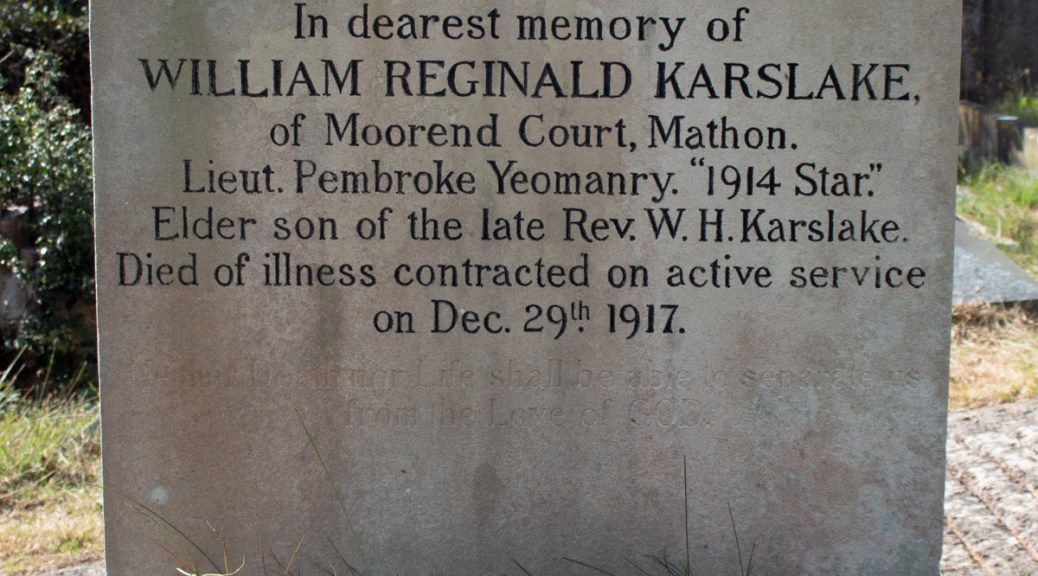
Lieutenant William Karslake

Lieutenant William Karslake

William Reginald Karslake was born in the spring of 1867 in the Surrey village of Westcott. The oldest of three children, his parents were William and Annie Karslake. William Sr was the vicar of the village’s Holy Trinity Church, and the family had a retinue of five servants to look after the household.

By the time of the 1891 census, the Karslakes had moved to Eastbourne in East Sussex. Their house, on the corner of Carlisle and Granville Roads, was a grand affair, and, while William Jr’s siblings, Henry and Mary, were 22 and 19 years old, there was still a live-in retinue of four staff to support them. William Jr is absent from this record, and he may well have been studying in Oxford at the time.

In the autumn of 1896, William Jr married Laura McKenzie. She was an admiral’s daughter who had been born in Glasgow, but their couple exchanged vows in Faringdon, Berkshire. The 1911 census found the family living in the 19-room Moorend Court in the Herefordshire village of Mathon. The couple had two children – Sam and Bridget – by this point and had a governess, parlourmaid, two housemaids, a kitchen maid and a cook to keep them in the right lifestyle.

The census recorded William’s employment as ‘formerly resident land agent’, which suggests he may have spent time overseas before marrying. His father had passed away by this point, and his brother Henry had taken up holy orders.

When war was declared, William was quick to volunteer his services. Initially acting as a driver for the British Red Cross, he found himself in France within weeks of the conflict starting. By January 1915, Lieutenant Karslake was moved to the Balkans, and at this point seems to have transferred to the Pembroke Yeomanry.

Little additional information is available to William. He passed away following an illness on 29th December 1917: he was 50 years of age.

It would seem that William Reginald Karslake was either hospitalised in Devon, or that there are additional family connections in the area. He was laid to rest in Paignton Cemetery, far from his substantial Herefordshire home.


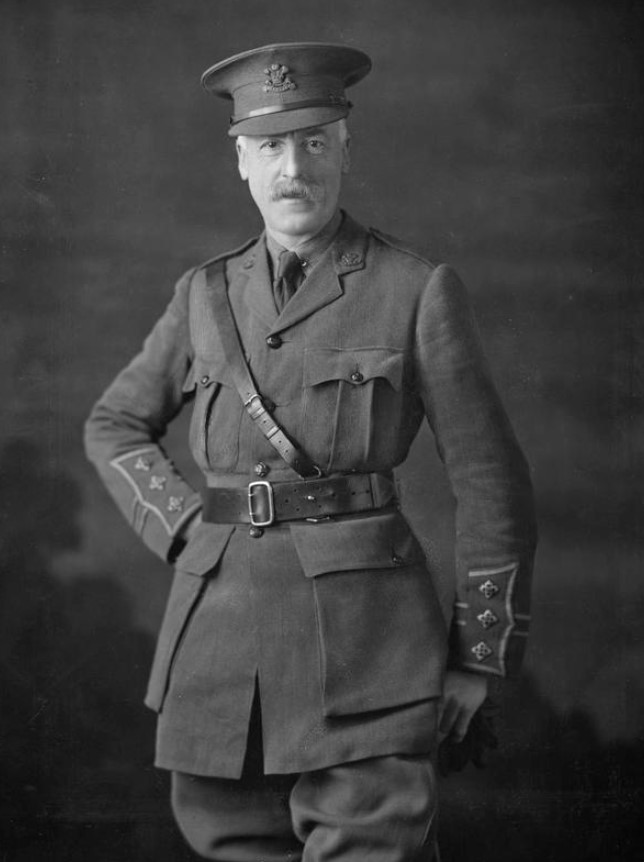
Lieutenant William Karslake
(from findagrave.com)

Corporal Charles Fernley

Corporal Charles Fernley

Charles Edward Fernley was born on 28th November 1874 in Stepney, East London. One of thirteen children, his parents were Richard and Eliza Fernley. Richard was a sluice keeper, who worked his way up to be an inspector of sewers and drains for London County Council. By 1888, he had been able to move his family out of the East End, to suburban Bromley, south of the river in Kent.

By the time of the 1891 census, Charles had finished his schooling, and had found work as a printer’s labourer. Ten years later, however, he was employed as a packer for a millinery warehouse. There seems to have been more need for this back in the East End, however, as he was living in Bow in the summer of 1901.

On 21st August 1901, Charles married Hannah Weston in St Faith’s Church, Stepney. She was three years younger than her husband, and was the daughter of a boatbuilder. The couple settled in a small terraced house in East Ham and had a son, Leonard, who was born in 1908.

When war came to Europe, Charles was keen to play his part. He enlisted in the Essex Regiment, and was assigned to the 1st/4th Battalion. Sent to the Balkans in August 1915, it is likely that he was caught up at Gallipoli and, in December 1915, evacuated with his battalion to Mudros on the Greek island of Lemnos.

By this point, the now Corporal Fernley had contracted dysentery, and was repatriated to Britain for treatment. He was admitted to the Newton Park VAD Hospital on the outskirts of Bath, but was to succumb to the condition on 31st December 1915. He was 41 years of age.

Charles Edward Fernley was laid to rest in the quiet Holy Trinity Churchyard in Newton St Loe, Somerset.


While Charles’ headstone is dedicated to Sergeant Fernley, all other documentation suggests that he held the rank of Corporal when he died.


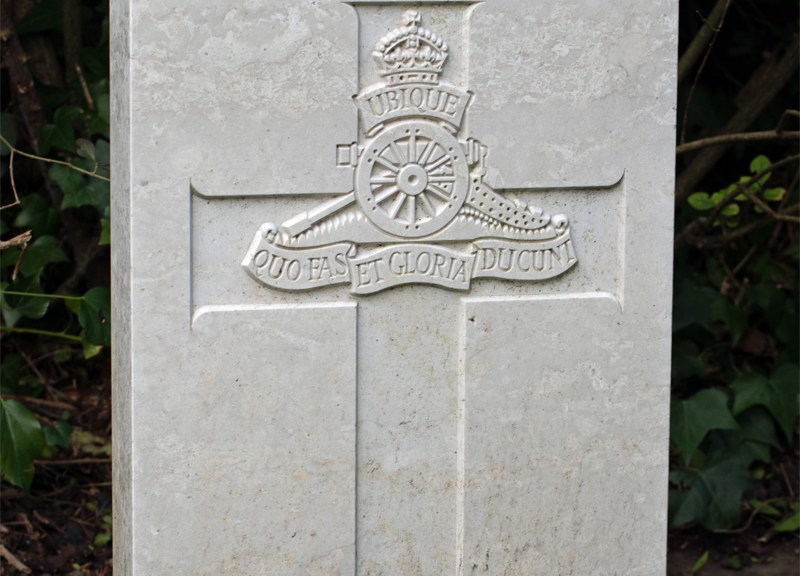
Gunner Thomas Kelly

Gunner Thomas Kelly

It is often a challenge to find details of the fallen soldiers whose graves pepper the churchyards of the UK.

Sadly, Gunner Thomas Kelly is one of those names lost to time.

Born in 1893, he lived in Alsager, Cheshire and enlisted in the Royal Field Artillery. He served in the Balkans during the war and was wounded. Brought back home to the Yeatman Hospital in Sherborne, Dorset, he died of his wounds on 11th January 1918.

He was buried in the town’s cemetery on 16th January 1918; he was just 25.