Walter John Mutter was born in the spring of 1899, the youngest of four children to William and Sarah. William was a lime burner from Pitminster in Somerset, but the family had settled in nearby Corfe by the time Walter was born.
The 1911 census recorded the Mutters as still living in Corfe; William and his two eldest sons – Harry and Francis – were working as farm labourers, while Walter was still at school.
When war came to Europe, Walter was keen to step up and play his part. Full details of his service are unclear, although he probably did not enlist early in the conflict, because of his young age. Private Mutter had joined the Worcestershire Regiment probably by the start of 1918, and soon found himself overseas.
An inquest was held at Bath… on Private Walter John Mutter, 8th [Battalion of the Worcestershire Regiment]. It was stated that deceased was only 19, and had been a prisoner in German hands three months behind enemy lines carrying munitions. He told his brother he had been served badly by the Germans, and was kicked and struck with the butt end of a rifle. A doctor said his legs below the knees were covered with the scars of very severe sores. He was practically starved, his food consisting of two meals daily, a bit of black bread and a kind of turnip wash. He was admitted to Bath War Hospital in a starved, emaciated, and debilitated condition, and although he improved in health, he died in the hospital after spending Christmas at his home near Taunton. A post mortem revealed that the wall of deceased’s stomach, which was as thin as blotting paper owing to starvation, was ruptured. His appetite was good while home, and he had probably given his debilitated stomach too much work. Death was due to hemorrhage [sic], but the state of starvation was dur to ill treatment by the Germans. A verdict in accordance with the evidence was returned, the Coroner commenting on the German brutality to their prisoners that the case revealed.
Wells Journal: Friday 10th January 1919
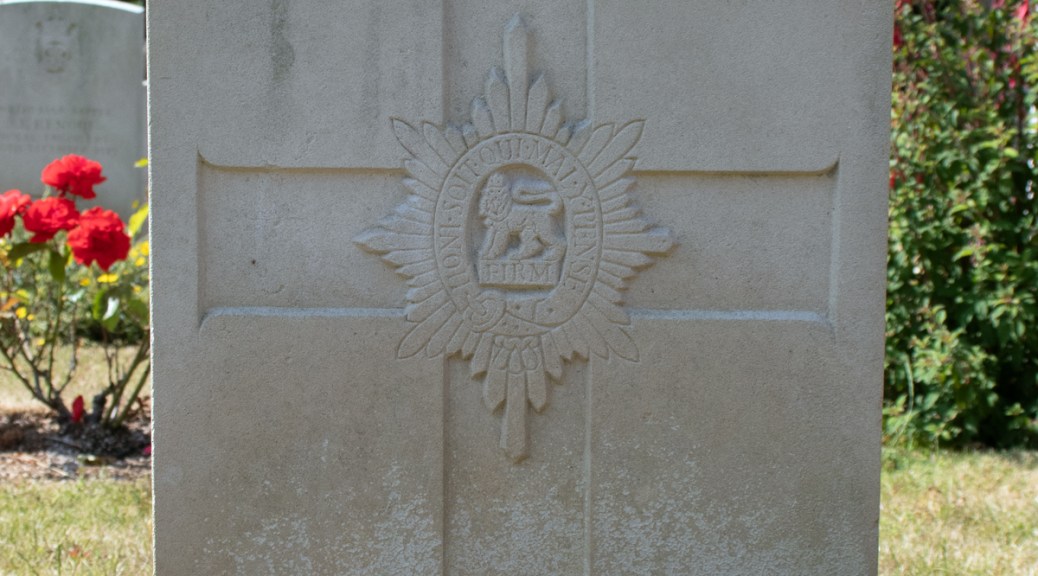
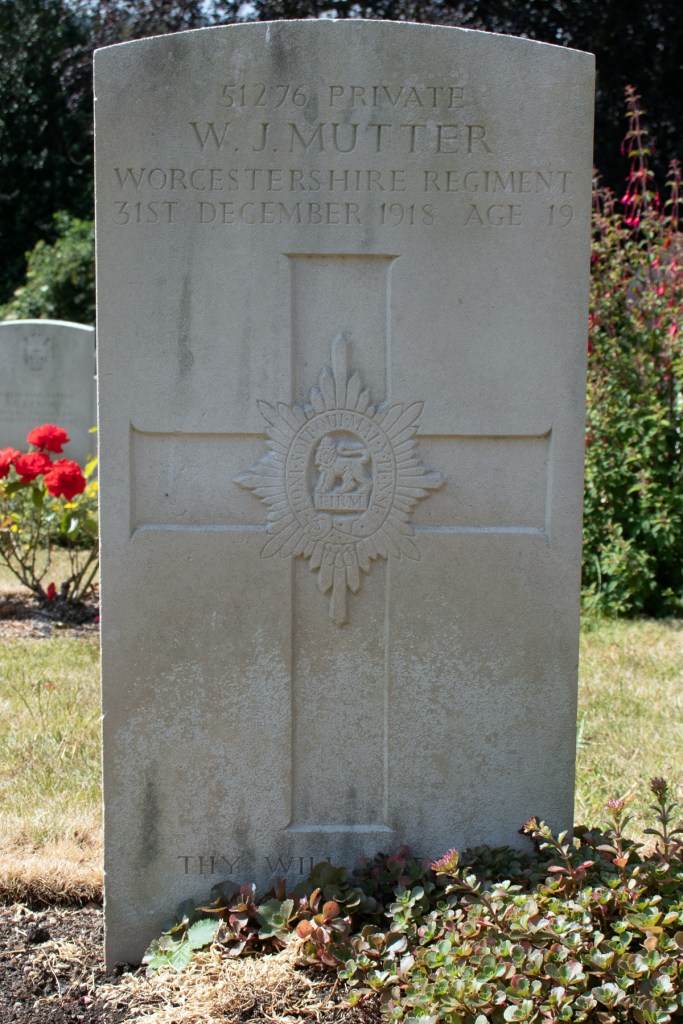
Walter John Mutter died on 31st December 1918, aged just 19 years old. He was laid to rest in the army section of Bath’s Locksbrook Cemetery, not far from the hospital where he had passed away.
William John Dunster was born in Uffculme, Devon, at the beginning of 1894. The older of two children, his parents were Robert and Mary Dunster. Robert was a carter and farm labourer, but when William left school, he found work on the railways. By the time of the 1911 census, the family had moved to Milverton in Somerset, and William was employed as an engine cleaner at the station in Taunton.
William had always had a keen interest in the army, and joined the Somerset Light Infantry early in 1914. His full service records are not available, but he was assigned to the 1st Battalion and, when hostilities were declared, he was dispatched to France.
On 26th August 1914, with the heroic men of his Regiment, he leaped over the trench amid a hail of bullets: a terrible gunshot wound laid him low, and he was taken prisoner by the Germans. For two years he remained in the hands of his captors, and endured all those sufferings and privations which our brave men have to bear in Germany.
[In 1916] he was removed to Switzerland Then all was done that could be done to save a young soldier’s life – the skill of the doctor, the comfort of the hospital, the care of the nurse – but unfortunately his constitution had been undermined.
In December 1916, by the kindness of [the secretary of the Prisoners of War Society] Mrs Walsh, he was enabled to see his mother, who paid him a visit, and this for a time revived him wonderfully.
Taunton Courier and Western Advertiser: Wednesday 26th June 1918
By the spring of 1918, Corporal Dunster had been medically evacuated to England, and was admitted to a military hospital in Southampton. This gave Robert and Mary the chance to see their son again, and Mary remained at her son’s side until he passed away on 19th June 1918. He was 23 years of age.
William John Dunster was brought back to Somerset for burial. He was laid to rest in the graveyard of St Bartholomew’s Church in the village of Oake, where his family were living.
Frank Harold Ely was born in November 1889, and was the oldest of four children. His parents were coal porter Frank Ely and his wife, Florence. They were both born in Kent, and raised their family in their home town of Faversham.
When Frank Jr left school, he found work as a bottler, but he had his eyes set on bigger adventures. In January 1908, at the age of 18, he enlisted in the 1st Battalion of the Rifle Brigade. His service records show that he was 5ft 5.5ins (1.66m) tall and weighed 109lbs (49.5kg). Rifleman Ely had brown hair, grey eyes and a fair complexion. He was also noted as having a scat on his right knee.
Rifleman Ely’s early service was wholly territorial, but not without incident: in 1909 he was treated for tonsillitis, two years later, he received treatment for syphilis.
He was also not one to toe the line. In August 1911, he was reprimanded for not appearing at the 6:30am parade. On 9th March 1912, he was severely reprimanded for ‘improper conduct in town, at about 11:35pm’. On 25th September 1913, he was reprimanded once again, this time for irregular conduct – using the officers’ latrines.
When war came to Europe, the Rifle Brigade were soon in the thick of it. On 26th August 1914, Frank was wounded in the hand during fighting at Ligny, France, and was then captured and held as a prisoner of war in Hamelin until the spring of 1918.
Moved to the Netherlands, Rifleman Ely was finally released after the Armistice was signed, and returned to England on 19th November 1918. He was demobbed the following March, but re-enlisted within weeks, was given the rank of Serjeant and was due to be shipped to India to continue his service.
However, while at an army camp in Aldershot, Frank contracted pneumonia. The struggles the previous few years had had on his health proved too much for him, and, on 26th August 1919 – five years to the day that he had been shot and captured – Serjeant Ely passed away. He was 40 years of age.
Frank Harold Ely was brought back to his home town for burial. He was laid to rest in Faversham Borough Cemetery.
Edmund George Durnford was born in the spring of 1881 in the Somerset village of Pitcombe. The second oldest of twelve children, he was the oldest son to Edmund and Eliza Durnford. Edmund Sr was an agricultural labourer who travelled with the work – the 1891 census recorded the family living in Mells, near Frome.
When Edmund Jr left school, he found work at an ironmonger’s. He moved to Midsomer Norton and, in 1907, he married local carter’s daughter Bessie Welch. The young couple set up home in a terraced house on the road to nearby Radstock, and went on to have two children: Ian, who was born in 1908, and Ronald, born the following year.
War came to Europe, and Edmund was keen to play his part. He enlisted in the Royal Army Service Corps as a Driver, and was assigned to the 827th Company. Full details of his service are not available, but he remained a part of the territorial force and was promoted to Lance Corporal.
The local newspaper of the time reported on what became of Edmund:
Lance Corporal Edward [sic] G Durnford, Army Service Corps… son of Mr and Mrs EG Durnford… died suddenly on April 18 at Duston Hospital, Northampton, from shell shock and hemorrhage [sic] of the brain, was 38 years of age. The body was brought back from Northampton, and the deceased accorded a military funeral at Midsomer Norton last week.
Somerset Guardian and Radstock Observer: Friday 3rd May 1918
There are a couple of inconsistencies with the report. The newspaper has Edmund’s name wrong, while his pension record does not mention shell shock as the cause of death (it confirms the cerebral haemorrhage, but also cites a granular kidney). Given that Lance Corporal Durnford did not serve abroad, it seems unlikely that shell shock was a contributing factor.
The same article also places three of Edmund’s brothers in the war, and gives an insight into what had become of them before the conflict. Gunner Percy Durnford was with the Canadian Field Artillery, training in the South of England; Sergeant Major Arthur Durnford, of the Australian Light Horse, was based in Sydney; Bombardier Horace Durnford, of the Royal Garrison Artillery, had served in France, where he had been gassed, but was, at the time of his oldest brother’s death, based in Egypt.
Edmund George Durnford died in Northampton on 18th April 1918. He was 38 years of age. His body was brought back to Somerset, and he was laid to rest in the graveyard of St John the Baptist Church in Midsomer Norton.
Edmund’s younger son, Ronald, served in the Second World War. He joined the Royal Artillery, reaching the rank of Lance Bombardier. Ronald was serving in the Far East early in 1942, and for the next year, no news was heard of him.
However, contact was made in March 1943, confirming that Ronald had been captured by the Japanese, and was a prisoner of war in Borneo. Three months later, his wife, Kathleen, received a postcard from him, confirming he was a prisoner of war, well and unwounded.
Tragic news was quick to follow, however:
In last week’s issue it was stated that Mrs [Bessie] Durnford… had received through her daughter-in-law news that her son, Lance Bombardier Ronald Durnford, was a prisoner of war in Jap hands and was unwounded.
On Saturday she received the sorrowful news that he was dead in the following messages, which her daughter-in-law had sent on:
“I deeply regret to inform you a report has been received from the War Office, that [Ronald], who was reported a prisoner of war in Borneo Camp, had died from dysentery. The date of his death is not yet known, but you may rest assured as soon as any further information is received, I will immediately let you know.”
Somerset Guardian and Radstock Observer: Friday 30th July 1943
Lance Bombardier Durnford was laid to rest in the Labuan War Cemetery in Malaysia.
Further family tragedy, albeit with a life well-lived, was to follow as, on 6th September 1943, Bessie too died at the age of 86. She was laid to rest alongside Edmund in the family plot. Her obituary confirmed that “She leave a husband, seven daughters, and four sons to mourn her loss. One son and one daughter are in Canada, and one son in Australia, and one daughter and son in London.” [Somerset Guardian and Radstock Observer, Friday 17th September 1943]
Bessie had not, in fact, remarried: the husband was, in fact, the one who had died some 25 years before.
Stanley James Southwood was born in 1896, the oldest of six children to John and Florence Southwood from Bridgwater, Somerset. John was a labourer and ship’s mate, while Stanley, who was the only boy in the family, started work loading barrows in a brickyard.
Military life was pulling Stanley, however. According to another researcher, he enlisted in the Special Reserves of the Somerset Light Infantry in October 1912. Six months later he joined the regular army, and was there when the war began.
While I have not been able to corroborate this information, it appears that Southwood was reported missing on 11th September 1915, after being wounded in the chest. He was taken prisoner of war, and, while being held, he developed tuberculosis in both lungs.
After his release (no documents confirm when this was) he was discharged from the army as medically fit to continue. He was in a military hospital at the time – the beginning of November 1918 – suffering from tuberculosis, which had been exacerbated by the chest wound he had received three years earlier. At the time he was discharged, he had the rank of Lance Corporal.
Sadly, it seems that Stanley never fully recovered from his wartime experience. He died on 8th September 1919 from consumption (tuberculosis), aged just 23 years old.
Stanley James Southwood lies at rest in the Wembdon Road Cemetery in his home town of Bridgwater in Somerset.



 Death and Service