Tag Archives: Somerset

Private Thomas Moody

Private Thomas Moody

Thomas Edward Moody was born in 1890, the second of five children for Thomas and Emily.

By the start of the war, “Little Tommy Moody” was working with his father in the quarries around Shepton Mallet and was the eldest son living at home.

He joined the North Somerset Yeomanry and was shipped out to France, where he was badly injured. An article in the Shepton Mallet Journal, included after his funeral, says as much about the life of this young man as it does about the Edwardian approach to military matters.


DEATH AND FUNERAL OF A SOLDIER – The death has taken place of Thomas Edward Moody, son of Thomas Moody, of Stoney Stratton, Evercreech, at the age of 18, and who as a 1914 man, joined the North Somerset Yeomanry and went out to France. He was badly wounded, resulting in the loss of an eye, and after some time in hospital and a short leave at home, he was sent back to rejoin his regiment, the 3rd Reserve Cavalry, in France. This was about two years ago. He spent his last leave home at Christmas. After a time in hospital at Devonport, he was removed to Bath early last month, discharged from the army as incurable, and there he died on May 5th, the cause of death being consumption of the brain. The funeral, on Saturday afternoon last, was of military character. The corpse, brought from Bath the day before, was borne from the deceased’s home at Stratton on a hand bier, attended by a bearer party of eight men from Taunton Military Barracks, to the Parish Church, where the first portion of the service was taken. The Union Jack enshrouded the coffin, on and around which a number of floral tributes rested. Sixty members of the Evercreech Branch of the Comrades of the Great War, and a couple of marines, joined the funeral cortege at the home, and on leaving the Church lines up on either side, as the body of their dead comrade was borne hence on the shoulders of four of their number to the cemetery. The vicar, Rev. RY Bonsey, officiated. The Last Post was sounded by Bugler Tucker, of Shepton Mallet, and another bugler from Tauton Barracks. “Little Tommy Moody”, as he was familiarly called amongst his chums, was a conspicuous member of the Evercreech Football Club previous to the War.

Shepton Mallet Journal – 9th May 1919.

(It is interesting to know that the date of death in the article does not match that on the gravestone. I would be inclined to believe the latter.)

Private Moody was obviously a fighter and a strong character – returning to the front after losing an eye, some time in hospital and a short leave – and you can guarantee he was missed in the village.

Thomas Edward Moody lies at rest in the cemetery of his home town, Evercreech.

Private Herbert Andrews

Private Herbert Andrews

Herbert Arthur John Andrews was born in July 1896, the eldest of seven children of Hugh (known as Henry) and Jane Andrews from Evercreech, Somerset.

By the time war broke out, Herbert was helping out on his grandfather’s farm in nearby Thornford. He enlisted into the army on 15th November 1915, joining the Gloucestershire Regiment.

Private Andrews served in France from March 1916, eventually spending eighteen months on the front line (not counting leave), and received a gun shot wound to the face on 27th August 1917. (He was treated in France, and remained there for a further five months.)

Herbert seems to be the only member of his family to have seen active service. His brother Norman was the only one of his siblings to have been old enough to enlist and, while he did so in 1917, he was assigned to the Experimental Company of the Royal Engineers, testing munitions and gases in Porton.

It appears that while Herbert was on leave in February 1918 he fell ill. Ultimately, he was discharged as medically unfit for service on 7th September. Just three days later, he passed away three days later, succumbing to a combination of chronic Bright’s disease and haemoptysis. He was just 22 years old.

Private Herbert Andrews lies at rest in the graveyard of St Peter’s Church in his home village of Evercreech.

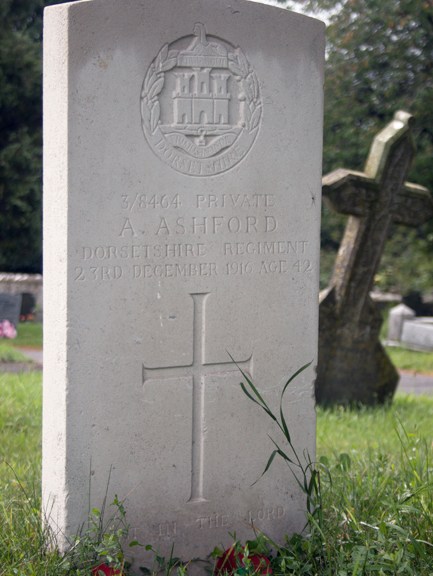
Private Arthur Ashford

Private Ashford

Arthur James Ashford was born in the Dorset village of Okeford Fitzpaine, to John and Tryphina Ashford. His father died when Arthur was only seven years old, leaving Tryphina to raise him and his three siblings.

Arthur had had a military career before the start of the Great War. He had enlisted into the Dorsetshire Regiment in 1891 and, while I have not been able to locate his records from that time, the regiment had been stationed in Ireland in the 1890s.

In 1899 he married Amy Upshall, at which point he was employed as a labourer. The couple had six children, though sadly, two of them – Arthur George and Elsie May – died in childhood.

He enlisted within months of the First World War beginning, returning to the Dorsetshire Regiment he had previously served on 30th September 1914. (It is interesting that on his enlistment papers he said that he had previously served for 12 years, although the dates don’t fully tally up.) This time, however, Private Ashford served on the Home Front, in Dorchester and Portland.

On the evening of 22nd December 1916, Arthur fell down a gulley in Portland. He was taken to the Verne Military Hospital in the town, but died of his injuries – a fractured skull – in the early hours of the following day.

Private Arthur Ashford was buried in his home village of Evercreech on Thursday 28th December 1916.

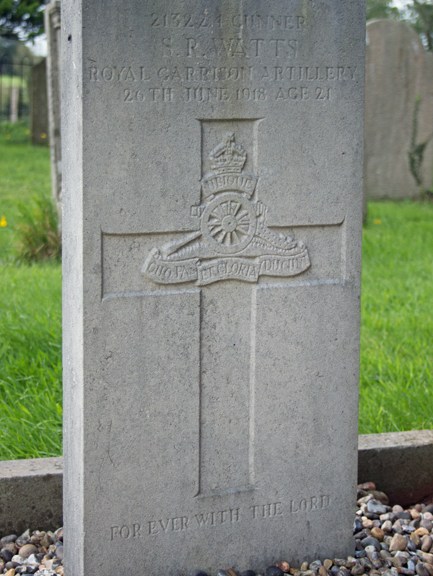
Gunner Samuel Watts

Gunner Samuel Watts

Samuel Reginald Watts was born in 1897, the seventh of eight children of Samuel and Augusta Watts.

He followed his father and brothers into the main industry in the area – coal mining – and was certainly working down the pits by the time of the 1911 census.

Samuel enlisted on 21st April 1918, and joined the Royal Garrison Artillery, which focused on heavy, large-calibre guns and howitzers that were positioned some way behind the front line. He was 5’5″ (1.65m) tall and weighed 144lbs (65kg). According to his war records, he had brown hair, hazel eyes and a fresh complexion.

His service started the very next day, when he was transferred to the Citadel in Plymouth for training.

After feeling unwell, complaining of headaches and a sensitivity to light, Gunner Watts was admitted to the Netley Hospital in Southampton on 18th June 1918. He was diagnosed with cerebrospinal fever, more commonly known as meningitis, and was treated over the next week.

Sadly, the treatment did not work, and Gunner Samuel Watts passed away on the evening of 26th June 1918. He had been in the army for a little over two months and had not seen active service.

Samuel Watts lies at peace in the graveyard of St John’s Church, Farrington Gurney.

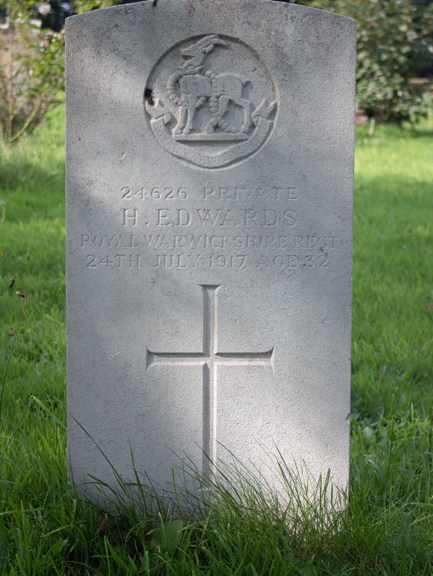
Private Harry Edwards

Private Harry Edwards

Henry Charles Edwards was born in 1883, the eldest of four children for Joseph and Elizabeth.

Joseph was an agricultural labourer, and Henry (or Harry) followed his father in the farming life, continuing in the role after Joseph died, and up until at least the 1911 census.

I was unable to find much regarding Harry’s military service. He signed up the Royal Warwickshire Regiment, and subsequently transferred to the Somerset Light Infantry.

He died from tetanus on 24th July 1917, aged 34. His pension records give his mother, Elizabeth, as his beneficiary.

Private Henry Edwards lies at rest in the churchyard of Lydeard St Lawrence, Somerset.

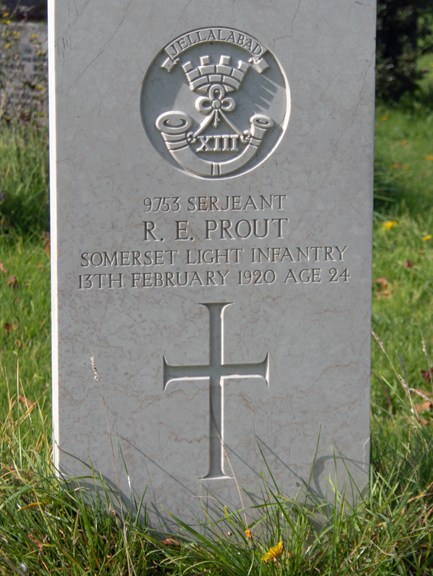
Serjeant Richard Prout

Sergeant Richard Edwin Prout

Richard Edwin Prout was born in 1896, the second son of Frederick and Anna (Hannah) Prout. When his father died in 1908, his mother remarried and by the 1911 census, Richard and his family had moved to Lydeard St Lawrence, where he was a baker’s boy.

He enlisted in June 1914, joining the Somerset Light Infantry and served throughout the war, receiving the Mons Star, Victory Medal and General Service Medals.

After the war, he continued in the army, and was assigned to Taunton Barracks.

His passing was unusual enough for it to be reported on in the local newspaper.

Sergt. Prout, it was stated at the Barracks yesterday, had been on leave for some days prior to his departure for Ireland, and had been spending his furlough at Crowcombe, where his parents live. On the evening of his death, he left home, after taking a hearty meal, to catch the 7.25 train to Taunton. He had to walk a mile to Crowcombe station, most of the way uphill. Early the following morning his dead body was discovered lying face downwards by the roadside, about 50 yards from the station. The body was removed to his home, and Dr. Frossard, of Bishop’s Lydeard, was called in to make a post-mortem examination. The doctor has reported that death was due to asphyxia brought on by over exertion on a full stomach, and syncope, following pressure on the neck by the tightness of the collar of his outside jacket, the doctor adding that he had great difficulty in unfastening the collar.

Western Daily Press – Friday 20th February 1920

A genuine case of someone going before their time. Having visited Lydeard St Lawrence, I recognise the hill he would have had to have climbed to reach the station, and it’s steep enough in a car, let alone walking up it.

Sergeant Prout, the newspaper reported, was generally esteemed by his fellow company, and at his funeral he received full military honours.

Richard Edwin Prout lies peacefully in the churchyard of Lydeard St Lawrence.

Private James Burnett

This image has an empty alt attribute; its file name is img_4008s.jpg
Private James Burnett

James Burnett was born in 1888, the second son of James and Sarah Ann Burnett. James Sr was a farm labourer, and his son quickly followed his line of work.

James enlisted in the Devonshire Regiment in February 1916. He was noted as being 5ft 2ins (1.58m) tall, and weighed in at 7.5st (47.6kg).

Private Burnett’s medical record notes that his sight was such that he should wear glasses constantly, and, in fact, he was signed off medically as Category B1 (“Free from serious organic diseases, able to stand service on Lines of Communication in France, or in garrisons in the tropics. Able to march 5 miles, see to shoot with glasses, and hear well.”)

After training, Private Burnett was mobilised in September 1916, but transferred to the Agricultural Company (of the Labour Corps) in the summer of 1917.

Sadly, however, I have been unable to locate any details of James’ passing. He died on 29th February 1920 and lies at rest in the local churchyard of his home village, Lydeard St Lawrence, Somerset.

Private Stephen Rawle

Private Stephen John Rawle

Stephen John Rawle was born in 1894, the second of four sons of George Rawle, a sailor, and Louisa, his wife.

By the time war broke out, Stephen was working as a groom in Wheddon Cross, just south of Minehead.

As the Great War loomed, he enlisted and Private Rawle serving on the home front. His record show that he stood at 5ft 9.5ins (1.76m) and was of good enough health to be enrolled for the Territorial Force. He was assigned to the West Somerset Yeomanry.

He was medically discharged from service on 29th March 1915, having served for one year and 31 days.

The records show no signs of injury or wounds, and newspapers of the period do not link him with any misadventure. I can only assume, therefore, that he died of natural causes, possibly linked to the Spanish Flu Pandemic. Stephen died on 5th September 1918. He was 25 years old.

Private Stephen John Rawle lies at rest in the churchyard of Lydeard St Lawrence, alongside two of his brothers, Ernest and William.


George and Louisa’s other son – Edward – also served, enlisting in the Somerset Light Infantry and fighting in the Balkans. Private Edward Rawle survived the war, returning home in March 1919.

It should be noted that, by June 1921, George and Louisa had lost three of her four sons to the Great War. Their daughter, Norah, had also passed away in 1918.

The 1921 census found Louisa living in East Town, in the parish of Tolland, not far from Lydeard St Lawrence. Edward was living with her, as were her three-year-old granddaughter, Lorna, and her eighteen-month-old grandson Beatty. It is unclear whose children they were. George, at this point, was helping his younger brother out on the family farm in Williton.


Private Ernest Rawle

Private Ernest Charles Rawle

Ernest Charles Rawle was born in 1899, the fourth son of George Rawle, a sailor, and Louisa, his wife.

Ernest was still at school at the time of the 1911 census, and enlisted in the West Somerset Yeomanry, but enlisted in the army in April 1915. His served on the Home Front, but was discharged as being unfit for war service on 22nd July 1916.

Private Rawle’s discharge records confirm that he had pulmonary tuberculosis, which he had contracted a couple of months before. They go on to suggest that it was not a permanent condition, but was likely to render him unfit for service for a number of months.

Eager to do his bit, Ernest’s record show that he re-enlisted in August 1916, and that he was considered fit for military service by the November of that year.

His medical records continue further – he was admitted to a field hospital again in March 1917, again suffering from tuberculosis. He was moved back to base as he was “a danger to his comrades”.

His records after March 1917 are not available, but he passed way from TB in November 1919. He was just 21 years old.

Private Ernest Rawle lies at peace in the churchyard of Lydeard St Lawrence, alongside his two brothers, Stephen and William.


George and Louisa’s other son – Edward – also served, enlisting in the Somerset Light Infantry and fighting in the Balkans. Private Edward Rawle survived the war, returning home in March 1919.

It should be noted that, by June 1921, George and Louisa had lost three of her four sons to the Great War. Their daughter, Norah, had also passed away in 1918.

The 1921 census found Louisa living in East Town, in the parish of Tolland, not far from Lydeard St Lawrence. Edward was living with her, as were her three-year-old granddaughter, Lorna, and her eighteen-month-old grandson Beatty. It is unclear whose children they were. George, at this point, was helping his younger brother out on the family farm in Williton.


Private William Rawle

Private William Henry Rawle

William Henry Rawle was born in 1890, the eldest child of George Rawle, a sailor, and Louisa, his wife.

At the time of the 1911 census, William was working as a carter on a farm not far from Porlock in Somerset.

He enlisted in August 1914, joining the Somerset Light Infantry and serving as part of the Expeditionary Force. After a couple of postings, Private Rawle was transferred to the Pioneer Depot in March 1916.

Six months later William was medically discharged as unfit for continued service. His notes highlight his distinguishing marks as 3 marks on his left arm, birth mark under his right nipple and gunshot wound to the left eye (which I am guessing is what led to his discharge).

William died on 11th June 1921, aged 27 years old. I have been unable to find anything specific relating to his death and it is likely, therefore, that no misadventure was involved.

Private William Henry Rawle lies at peace in the churchyard of Lydeard St Lawrence, alongside his brothers Stephen and Ernest.


George and Louisa’s other son – Edward – also served, enlisting in the Somerset Light Infantry and fighting in the Balkans. Private Edward Rawle survived the war, returning home in March 1919.

It should be noted that, by June 1921, George and Louisa had lost three of her four sons to the Great War. Their daughter, Norah, had also passed away in 1918.

The 1921 census found Louisa living in East Town, in the parish of Tolland, not far from Lydeard St Lawrence. Edward was living with her, as were her three-year-old granddaughter, Lorna, and her eighteen-month-old grandson Beatty. It is unclear whose children they were. George, at this point, was helping his younger brother out on the family farm in Williton.